Have you ever typed “brite” when you meant “bright” and then stopped to wonder whether both spellings are correct? You are not alone. The confusion between brite vs bright is common because the two words sound exactly the same in ordinary English pronunciation.
However, sounding alike does not mean they have the same spelling, meaning, or grammatical use. In standard American English, bright is the normal and correct spelling when you want to describe something full of light, strong in color, intelligent, or hopeful.
Brite, on the other hand, is generally not the standard spelling of the adjective. It may appear in brand names, product names, or stylized names, which can make the spelling seem legitimate in everyday life.
This guide explains brite vs bright in simple terms, shows when each form can appear, and gives practical examples so you can choose the right spelling confidently. ✨
|Imbed vs Embed: What’s the Difference and Which One Should You Use?
Quick Answer: Brite vs Bright
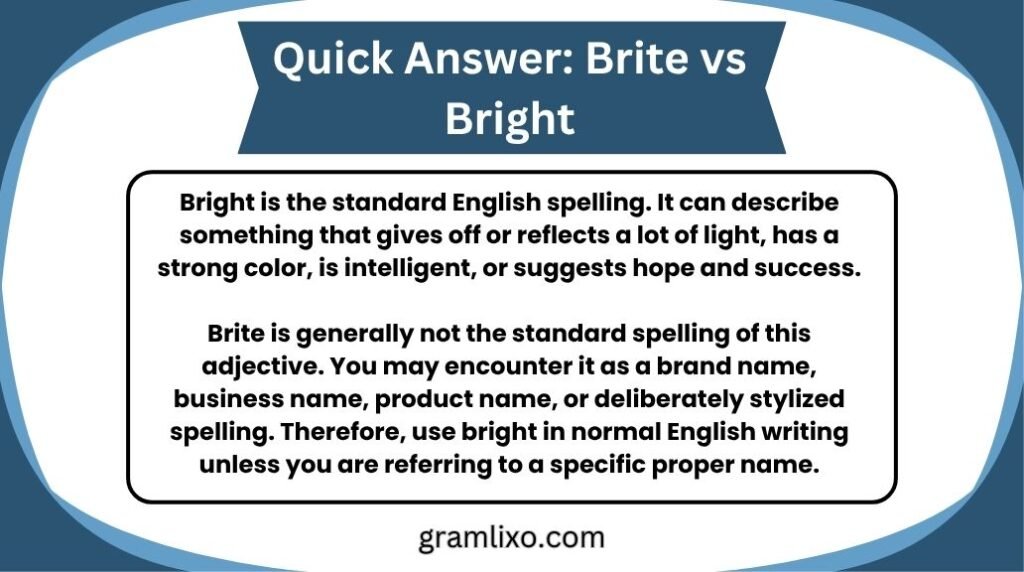
Bright is the standard English spelling. It can describe something that gives off or reflects a lot of light, has a strong color, is intelligent, or suggests hope and success.
Brite is generally not the standard spelling of this adjective. You may encounter it as a brand name, business name, product name, or deliberately stylized spelling. Therefore, use bright in normal English writing unless you are referring to a specific proper name.
Simple rule:
👉 Standard English word = bright
👉 Brand/stylized name = brite may be correct
Understanding the Basics of Brite vs Bright
The easiest way to understand this spelling difference is to separate standard vocabulary from specialized or stylized names.
Comparison Table
| Form | Type | Meaning | Example | Correct/Incorrect |
|---|---|---|---|---|
| bright | Standard English adjective | Full of light or strong in color | The room is bright. | ✅ Correct |
| bright | Standard English adjective | Intelligent | She is a bright student. | ✅ Correct |
| bright | Standard English adjective | Hopeful or promising | He has a bright future. | ✅ Correct |
| brite | Nonstandard spelling in ordinary English | Usually intended to represent “bright” | The room is brite. | ❌ Generally incorrect |
| brite | Proper/stylized name | May be part of a brand or product name | Brite is the company name. | ✅ If officially styled that way |
The standard dictionary form is bright. Cambridge Dictionary lists bright as an adjective meaning full of light, strong in color, intelligent, and full of hope or happiness.
So, if you are writing an essay, email, article, school assignment, business document, or ordinary sentence, bright is almost always the spelling you want.
What Does “Bright” Mean?
Bright is a versatile English adjective with several common meanings.
1. Bright Means Full of Light
The most familiar meaning relates to light.
For example:
The kitchen is bright and airy.
Here, bright means that the kitchen has plenty of light.
Other examples include:
- The sun is bright today.
- She turned on the bright lamp.
- The stars looked bright in the night sky.
- This screen is too bright.
- We walked into a bright room.
Cambridge Dictionary defines bright in this sense as something that is full of light or shining.
Sentence Breakdown
The room is bright.
- The room = subject
- is = linking verb
- bright = adjective describing the room
Because bright describes a noun, it functions as an adjective.
2. Bright Means Strong in Color
Bright can also describe colors that are vivid, intense, or easy to notice.
Examples:
- She wore a bright yellow dress.
- The walls are bright blue.
- I love bright colors.
- He bought a bright red car.
- The children used bright crayons.
Cambridge specifically identifies this meaning as a strong color.
Compare:
Dull blue → less vivid
Bright blue → vivid and noticeable
3. Bright Means Intelligent
English speakers also use bright to describe someone who learns quickly or is intelligent.
For example:
Maya is a bright student.
This does not mean Maya is glowing or covered in light. It means she is intelligent and quick to learn.
Other examples:
- He is a bright young man.
- She is one of the brightest students in her class.
- That was a bright idea.
- The child is very bright.
This is another established dictionary meaning of bright.
4. Bright Means Hopeful or Promising
The word can also describe something positive about the future.
For example:
She has a bright future ahead of her.
Here, bright means promising or hopeful.
You may also hear:
- The future looks bright.
- The company has a bright outlook.
- Things are looking brighter.
- He has a bright career ahead of him.
This figurative meaning is widely established in English.
What Does “Brite” Mean?
This is where brite vs bright becomes interesting.
Brite is not normally the standard spelling you should use when writing the ordinary English adjective bright.
For example:
❌ The room is brite.
✅ The room is bright.
❌ She wore a brite yellow dress.
✅ She wore a bright yellow dress.
❌ He is a brite student.
✅ He is a bright student.
The spelling brite can nevertheless appear in the real world because companies, products, services, organizations, and other names sometimes use alternative spellings for branding.
A stylized spelling does not automatically become the standard spelling of the English word.
Why Does “Brite” Look Correct?
There is a simple reason.
English contains many words whose pronunciation does not perfectly reveal their spelling. Bright is pronounced approximately /braɪt/ in American English, while the spelling contains gh.
When people hear the word rather than see it written, they may logically assume that it could be spelled brite.
This is especially understandable because English has words such as:
- night
- light
- right
- sight
- white
- bright
The spelling pattern -ight is common.
At the same time, English also contains words ending in -ite, such as:
- bite
- kite
- site
- white
So a person who hears bright but has never seen it written might reasonably guess a different spelling.
That does not make brite the standard spelling.
Brite vs Bright: Are They Pronounced the Same?
In ordinary English pronunciation, bright and a hypothetical lowercase brite are intended to represent the same sound.
Bright: /braɪt/
The problem is not primarily pronunciation. It is standard spelling and usage.
This is an important concept:
Two spellings can represent the same sound without both being standard spellings of the same English word.
For example, English has many homophones and spelling variations. Context and conventional spelling determine which written form belongs in a sentence.
Correct Meanings and Uses of “Bright”
Let’s look at the most important uses in practical writing.
Bright for Light
Use bright when something provides or reflects a strong amount of light.
Examples:
- The flashlight is bright.
- The morning sun was bright.
- The hallway was bright and clean.
- The screen looks too bright.
Bright for Colors
Use bright when describing a vivid or strong color.
Examples:
- She chose a bright pink shirt.
- The walls were painted bright green.
- His shoes were bright orange.
Bright for Intelligence
Use bright when describing an intelligent person.
Examples:
- She’s a bright student.
- He’s bright and hardworking.
- The teacher recognized her as a bright learner.
Bright for Hope
Use bright when discussing a positive future.
Examples:
- You have a bright future.
- The company’s future looks bright.
- The team has a bright season ahead.
Test Tip: How Can You Check “Brite vs Bright”?
When you’re unsure, ask yourself:
Am I writing a normal English sentence?
If the answer is yes, choose bright.
For example:
The room is ___.
The correct answer is:
The room is bright. ✅
Another useful test is to replace the word with shining, vivid, intelligent, or hopeful.
If one of those meanings fits, you almost certainly need bright.
Quick Memory Trick
Think:
Bright = light + color + intelligence + hope
If you’re using one of those meanings, spell it bright.
Brite vs Bright in a Real-Life Case Study
Imagine you work in an office and need to send an email to your manager.
You want to write:
The new office has a brite and welcoming atmosphere.
You pause because brite looks slightly unusual.
The correct version is:
The new office has a bright and welcoming atmosphere.
Why?
Because bright is the standard adjective used in ordinary English writing.
Now imagine a different situation.
You are discussing a company called Brite Solutions.
You might write:
I spoke with a representative from Brite Solutions.
Here, Brite could be correct because it is being used as part of a specific organization’s name.
That distinction is crucial:
ordinary adjective → bright
official name → follow the organization’s spelling
Grammar Rules: Why Is “Bright” Correct?
The key issue is not that brite cannot ever appear in written language. Instead, the issue is that bright is the established standard English spelling for the adjective.
Standard dictionaries list bright, not brite, for the ordinary meanings discussed above.
Cambridge Dictionary gives bright several established adjective meanings, including:
- full of light
- strong in color
- intelligent
- full of hope or happiness
It also lists brightly as the corresponding adverb, such as “brightly lit” and “shining brightly.”
This gives us a useful word family:
- bright — adjective
- brightly — adverb
- brightness — noun
For example:
The room is bright.
The room is brightly lit.
The brightness of the room surprised me.
Using brite in place of bright would break the standard spelling pattern.
Common Mistakes With Brite vs Bright
Why do people write brite?
There are several possible reasons.
1. Fast Typing
When you’re texting or typing quickly, your brain often focuses on sound rather than spelling.
You may hear:
“bright”
and type:
“brite”
without noticing.
2. Autocorrect and Predictive Text
Technology can sometimes reinforce unusual spellings, especially when a word appears in a brand name or previous messages.
If you frequently type a particular stylized name, your keyboard may learn it.
3. Lack of Familiarity
Someone who has learned English primarily through conversation may know the sound but not the conventional spelling.
This is especially common with words containing silent letters.
4. Brand Exposure
Seeing names that use Brite can create the impression that it is a normal alternative spelling.
For example, if someone repeatedly sees Brite in company names or products, they may start using it in ordinary sentences.
Similar Grammar and Spelling Confusions
Brite vs bright belongs to a larger group of English mistakes where words sound similar or look similar.
| Confusion | Correct Form | Meaning |
|---|---|---|
| it’s / its | Both can be correct | “It’s” = it is; “its” = possessive |
| your / you’re | Both can be correct | “Your” = possession; “you’re” = you are |
| their / there / they’re | All can be correct | Different meanings |
| to / too / two | All can be correct | Different meanings |
| then / than | Both can be correct | Time vs comparison |
| they’re / their | Depends on context | Verb phrase vs possession |
| bright / brite | bright in standard usage | Light, vivid, intelligent, hopeful |
The lesson is simple: similar sound does not guarantee interchangeable spelling.
Brite vs Bright in Different Contexts
Everyday Conversation
In casual speech, pronunciation makes the distinction disappear.
Someone might say:
“The room is bright.”
You hear the sound, but you don’t see the spelling.
When you write it, however, use:
The room is bright.
Professional Writing
Professional writing requires standard spelling.
Use:
The office has a bright, modern design.
Not:
The office has a brite, modern design.
Unless Brite is part of a proper name, using the standard spelling is the safer and more professional choice.
Creative Writing
Creative writers sometimes deliberately manipulate spelling for character voice, humor, branding, or stylistic effect.
A fictional store might be called:
Brite Boutique
That can work perfectly well if the unusual spelling is intentional.
But if the narrator writes:
The room was brite.
the unusual spelling may look like an error unless the author has a clear stylistic reason for it.
Social Media and Texting
Social media is more flexible.
People intentionally shorten, alter, or stylize words online.
You may see:
- brite
- luv
- thru
- tonite
However, informal online usage does not necessarily make those forms standard American English.
If you’re writing a professional post, article, school assignment, resume, or business message, bright remains the appropriate choice.
Why the Difference Matters
At first glance, brite vs bright may seem like a tiny spelling issue.
But small spelling differences can affect communication.
1. Clarity
Standard spelling helps readers immediately understand what you mean.
2. Professionalism
Correct spelling matters in:
- resumes
- emails
- reports
- presentations
- websites
- academic work
- business communication
3. Serviceability
Standard spelling is also important online.
If you are creating content around a word, using the conventional form helps search engines and readers understand the intended topic.
4. Credibility
A single spelling mistake rarely destroys credibility, but repeated errors can make writing look careless.
As a useful writing principle:
Clear spelling makes clear ideas easier to trust.
Special Exception: When “Brite” Can Be Correct
There is an important exception.
Brite can be correct when it is an official name.
For example, imagine a fictional company called:
Brite Media
You should preserve the company’s official spelling when referring to it.
Similarly, a product could intentionally use Brite as part of its name.
The same principle applies to stylized business names.
Important Rule
Do not “correct” an official name simply because it looks unusual.
If a company’s official name is Brite, write Brite when referring to that company.
But if you’re describing something as full of light, use:
bright
This is the difference between standard vocabulary and proper naming.
Is “Brite” a Synonym for “Bright”?
Not in standard general English.
You should not treat brite as a normal interchangeable spelling of bright.
For example:
❌ The sun is brite.
✅ The sun is bright.
Likewise:
❌ She has a brite future.
✅ She has a bright future.
If Brite appears as a brand or proper name, its meaning depends on that specific name rather than on standard adjective usage.
Is “Bright” Always an Adjective?
No.
Although bright is commonly an adjective, it can also function as a noun in certain contexts.
For example, American English informally uses brights to refer to a vehicle’s high-beam headlights. Cambridge Dictionary specifically lists this American usage.
Example:
Don’t drive with your brights on.
Here, brights is a noun, not the adjective describing something as full of light.
This is a good reminder that English words can have multiple grammatical roles depending on context.
Bright vs Brightly vs Brightness
These related words are also worth understanding.
Bright
An adjective:
The room is bright.
Brightly
An adverb:
The stars were shining brightly.
Cambridge lists brightly for actions or conditions involving strong light, strong color, and a cheerful or hopeful manner.
Brightness
A noun:
The brightness of the screen hurts my eyes.
So if you’re writing about the quality itself, brightness is usually the appropriate noun.
Brite vs Bright: Quick Recap Checklist
Use this checklist whenever you’re unsure.
| Question | If Yes → Use |
|---|---|
| Am I describing something full of light? | bright |
| Am I describing a vivid color? | bright |
| Am I describing an intelligent person? | bright |
| Am I describing a hopeful future? | bright |
| Am I writing a normal English sentence? | bright |
| Is “Brite” an official brand or company name? | Brite |
| Am I intentionally using a stylized spelling? | Brite, if appropriate |
Practice Example 1
The classroom was ___ and comfortable.
Answer: bright ✅
Practice Example 2
She has a ___ future ahead of her.
Answer: bright ✅
Practice Example 3
I applied for a job at ___ Media.
Answer: Brite may be correct if that is the company’s official name.
Quick Ways to Remember the Correct Spelling
Here are three easy memory tricks.
Trick 1: Think of “Light”
Bright contains the familiar -ight pattern found in:
- light
- night
- right
- sight
- bright
If you’re talking about light, remember bright.
Trick 2: Remember the Four Meanings
Think:
Bright = light + color + smart + hope
That covers the most common meanings.
Trick 3: Treat “Brite” as a Name
When you see Brite, ask:
“Is this a company, product, or brand name?”
If yes, the spelling may be intentional.
If no, bright is almost certainly what you need.
Frequently Asked Questions About Brite vs Bright
1. Is “brite” the correct spelling of “bright”?
Generally, no. Bright is the standard spelling in English. Brite may appear as a brand name, product name, or stylized spelling, but it is not the normal spelling of the adjective.
2. What is the difference between brite and bright?
Bright is the standard English word. It can mean full of light, strong in color, intelligent, or hopeful. Brite is generally a nonstandard spelling when used as an ordinary adjective, although it may be correct as part of a proper name.
3. Can I use “brite” in formal writing?
Usually, no. In formal writing, use bright unless Brite is the official spelling of a company, organization, product, or other proper name.
4. Is “brite” a word in English?
Brite can occur as a proper name or stylized form, but it should not normally replace the standard English adjective bright in ordinary writing.
5. Is “bright” an adjective?
Yes. Bright is commonly an adjective. It can describe light, color, intelligence, or a hopeful situation. For example, “a bright room,” “a bright color,” and “a bright student.”
6. Which one should I use: “brite” or “bright”?
Use bright in standard English writing. Use Brite only when you are intentionally referring to an official name or a deliberate stylized spelling.
Final Conclusion
The difference between brite vs bright is easier to remember once you separate standard English spelling from branding and stylization.
Bright is the standard word you should use when describing something full of light, a vivid color, an intelligent person, or a hopeful future. Dictionaries recognize these meanings as established uses of bright.
Brite may appear in company names, product names, or other deliberately stylized names, but it should not normally replace bright in everyday or professional writing.
When you’re writing an email, essay, article, resume, or business document, choose bright unless you have a specific reason to preserve the spelling Brite. Remember the simplest rule: if you mean light, vivid, smart, or hopeful, write “bright.” ✨
Bright is the standard spelling; Brite is usually a name or a style.

I’m Christopher Garcia, an English writer and grammar enthusiast at Gramlixo. I enjoy making grammar easy to understand through clear explanations and practical examples.

[…] |Brite vs Bright: What’s the Difference and Which One Is Correct? […]
[…] |Brite vs Bright: What’s the Difference and Which One Is Correct? […]