Have you ever typed a sentence and suddenly wondered whether imbed vs embed is the correct spelling? 🤔 You are not alone. These two words look almost identical, sound the same, and can carry the same meaning, which makes the choice surprisingly confusing.
Whether you are writing an email, publishing an article, creating a website, or simply trying to improve your English grammar, knowing which form to choose can make your writing look more polished.
The good news is that this is not a case where one word is completely “wrong.” Embed is the standard and much more common form, while imbed is a recognized but less common US variant. Merriam-Webster lists imbed as a less common spelling of embed, and Cambridge also identifies imbed as a US variant.
So, when should you use embed, and when might imbed appear? Let’s break down the difference in simple terms, examine real examples, and give you an easy rule you can remember.
|Brite vs Bright: What’s the Difference and Which One Is Correct?
Quick Answer: Imbed vs Embed
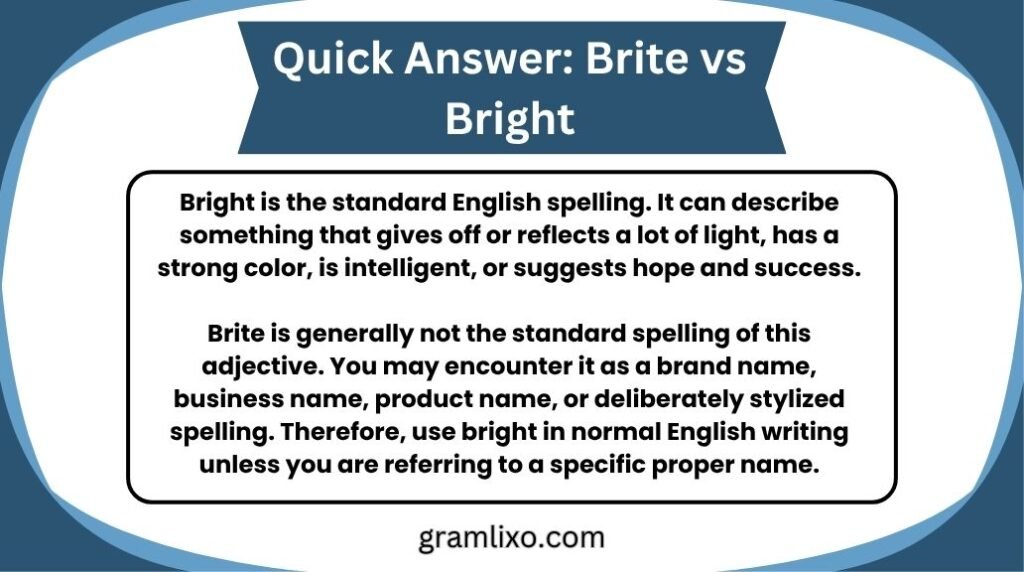
Embed is the preferred and more common spelling in modern English. Imbed is also a legitimate spelling, especially in American English, but it is considerably less common.
If you are unsure which one to use, choose embed. It is the safest choice for everyday, academic, professional, technical, and digital writing.
Understanding the Basics of Imbed vs Embed
At first glance, imbed and embed seem like completely different words. In practice, however, they are variants of the same verb.
Both can mean to place something firmly inside, within, or as part of something else. The word can be used literally, such as placing an object into a material, or figuratively, such as making an idea an established part of a culture.
It can also be used in technology. For example, you can embed a video into a webpage or embed an image in an email. Merriam-Webster specifically includes the insertion of media such as graphics, video, and audio into digital documents among the meanings of embed.
Imbed vs Embed Comparison Table
| Form | Type | Meaning | Example | Correct/Incorrect |
|---|---|---|---|---|
| embed | Verb | To place or fix something firmly inside something else | Please embed the video in the article. | ✅ Correct |
| imbed | Verb | Same basic meaning as embed | The scientist imbedded the sample in resin. | ✅ Correct, but less common |
| embedded | Past tense/past participle/adjective | Firmly placed or incorporated | The image is embedded in the document. | ✅ Correct |
| imbedded | Past tense/past participle/adjective | Variant of embedded | The sample was imbedded in the material. | ✅ Correct, but less common |
The key point is simple:
Embed is the preferred form. Imbed is a valid but less common variant.
Merriam-Webster gives embed as the main entry and describes imbed as a less common spelling.
What Does “Embed” Mean?
The verb embed generally means to fix, insert, or place something firmly within another thing.
For example:
- The technician embedded the sensor inside the device.
- The thorn was embedded in her finger.
- Please embed the video in your presentation.
- These values are deeply embedded in the culture.
The meaning changes slightly depending on context, but the basic idea remains the same: something becomes firmly placed within something else.
Cambridge defines embed as fixing something firmly into a substance and also uses the word for inserting text, images, sound, or video into a computer file, email, or website.
Physical Meaning of Embed
In a physical context, embed means to place something securely inside another material.
Example:
The stone was embedded in the wall.
Here is the sentence breakdown:
- The stone = the object being placed
- was embedded = was firmly positioned
- in the wall = the surrounding material
The stone is not merely touching the wall. It is firmly set into it.
Another example:
The nail was embedded in the wooden board.
The nail has been driven into the wood, so embedded describes its position.
Figurative Meaning of Embed
Embed can also describe ideas, beliefs, emotions, habits, or traditions that become deeply established.
Example:
Respect for education is deeply embedded in the community.
This does not mean that respect is physically inside something. Instead, it means the idea has become a strong and established part of the community.
Another example:
The tradition is embedded in local culture.
The tradition has become an integral part of that culture.
Merriam-Webster includes this figurative sense, defining embed as making something an integral part of something else.
What Does “Imbed” Mean?
Imbed has essentially the same meaning as embed.
It can mean to place something firmly within another substance, make something an integral part of something else, or insert digital content into a document.
The important difference is not meaning. It is frequency and preference.
Merriam-Webster describes imbed as a “less common spelling” of embed. Cambridge likewise directs readers from imbed to embed and labels imbed as a US form.
For example:
The researcher imbedded the specimen in a supporting material.
This sentence is grammatically acceptable.
However, most modern readers would be more accustomed to:
The researcher embedded the specimen in a supporting material.
That is why embed is usually the better choice.
Is “Imbed” a Real Word?
Yes. ✅
This is one of the most important points about imbed vs embed.
Imbed is a real English word. It is not merely a spelling error. Major dictionaries recognize it as a variant of embed. Merriam-Webster lists it as a less common spelling, while Cambridge lists it as a US variant.
So saying “imbed is always wrong” would be inaccurate.
A better explanation is:
Imbed is correct, but embed is more common and generally preferred.
This distinction matters because English contains many spelling variants that differ in popularity without one being grammatically impossible.
Is “Embed” More Common Than “Imbed”?
Yes.
Embed is the dominant form in modern general English, especially in professional, academic, technical, and digital contexts.
That is particularly noticeable online because technology frequently uses the word embed.
You might see:
- Embed a YouTube video.
- Embed an image.
- Embed the code.
- Embed a link.
- Embedded content.
- Embedded software.
- Embedded systems.
Merriam-Webster includes digital media among the meanings of embed, and its dictionary entry uses examples involving video, audio, advertisements, and email.
Because technology overwhelmingly favors embed, readers may perceive imbed as unusual even though it is legitimate.
When Should You Use “Embed”?
Use embed when you want the standard, widely recognized spelling.
It works particularly well in:
Websites
You can embed the video directly on your homepage.
Emails
Please embed the image below the introduction.
Presentations
I embedded the chart into the final slide.
Academic Writing
The researcher embedded the analysis within a broader theoretical framework.
Technical Writing
The manufacturer embedded a sensor into the device.
Everyday Writing
The tiny piece of glass was embedded in the surface.
In virtually all of these situations, embed is the natural choice.
When Can You Use “Imbed”?
You can use imbed when following a source, style, historical usage, or established terminology that prefers the variant.
For example:
The material was imbedded into the surrounding structure.
This is not automatically a grammatical error.
However, if you are writing for a broad modern US audience and have no reason to prefer the variant, embed is usually the clearer and more conventional choice.
This is especially true for:
- SEO content
- Business communication
- Website copy
- Academic assignments
- Professional reports
- Technical documentation
- Marketing content
- Online articles
Test Tip 🧠
If you are unsure, ask yourself:
“Which spelling would I expect to see in a modern dictionary, website, or technical instruction?”
In most cases, the answer is embed.
Embedded vs Imbedded
The same variation appears in the past participle and adjective forms.
Preferred Form: Embedded
The video is embedded in the article.
The sensor is embedded inside the machine.
Her beliefs are deeply embedded in her worldview.
Variant Form: Imbedded
The video is imbedded in the article.
The sensor is imbedded inside the machine.
The tradition is deeply imbedded in the community.
Both forms can be found, but embedded is much more common.
Merriam-Webster lists both embedded and imbedded, while Cambridge also recognizes imbedded as a US variant.
Embedding vs Imbeding: Be Careful With the Spelling
There is another small spelling issue worth knowing.
The correct forms are:
- embedding ✅
- imbedding ✅
- imbeding ❌
When embed takes -ing, the final consonant is doubled:
embed → embedding
Similarly:
imbed → imbedding
Merriam-Webster lists embedding and imbedding as the corresponding forms.
Examples
We are embedding the video into the page.
The engineer is embedding the sensor into the device.
If you choose the less common imbed, the corresponding form is imbedding, not imbeding.
Imbed vs Embed in Technology
Technology is one area where embed is overwhelmingly natural.
Think about websites, social platforms, presentations, documents, and software.
You might:
- embed a YouTube video
- embed an image
- embed a social media post
- embed HTML code
- embed audio
- embed a chart
- embed a widget
- embed a link
- embed external content
For example:
The developer embedded the video player into the webpage.
The meaning is that the video content appears within the webpage rather than requiring the user to leave the page.
Merriam-Webster explicitly defines embed as inserting media such as a graphic, video, or audio clip into a computer document, including websites and email.
Cambridge similarly explains that embed can mean including text, sound, images, or video in a computer file, email, or website.
Why “Embed” Is Better for Digital Writing
Digital terminology tends to standardize around embed.
That means phrases such as these are much more natural:
- embedded video
- embedded image
- embedded content
- embedded code
- embedded media
- embedded link
For technology-related writing, choosing embed avoids unnecessary confusion.
Imbed vs Embed in Professional Writing
Imagine you are writing an email to your manager.
You could write:
I have imbedded the chart below for your review.
This is grammatically acceptable.
But this sounds more conventional:
I have embedded the chart below for your review.
The second version is more likely to match the vocabulary used in modern business communication.
Professional writing benefits from familiar language. Using the most common form helps your reader process the sentence quickly.
A Professional Example
Less common:
I have imbedded the requested report into the presentation.
Preferred:
I have embedded the requested report into the presentation.
The meaning is identical, but embedded is the more familiar choice.
Imbed vs Embed in Everyday Conversation
In everyday conversation, people are more likely to say embed.
For example:
Can you embed the image in the document?
The chip is embedded inside the device.
That belief is deeply embedded in our culture.
Although imbed is legitimate, it may sound unusual simply because most speakers encounter embed more often.
This is a useful distinction:
Grammatical correctness and common usage are not always the same thing.
A word can be correct but uncommon.
Imbed vs Embed in Creative Writing
Creative writers have more freedom.
You might use either form depending on the style, period, voice, or source you are imitating.
For example:
The memory was embedded deep within her heart.
Or:
The memory was imbedded deep within her heart.
Both can convey the intended figurative meaning.
However, embedded remains the more familiar modern spelling.
If your goal is readability for a general audience, choosing the common form is usually best.
Imbed vs Embed on Social Media and Texting
Social media and texting are informal, so either form may appear.
However, embed is still preferable when discussing digital content.
For example:
I embedded the video in the post.
That is clearer and more natural than:
I imbedded the video in the post.
The second version is not necessarily grammatically wrong, but it may look unfamiliar to readers.
Fast-moving digital communication tends to reward familiar spelling.
A Real-Life Workplace Case Study
Imagine Sarah works for a marketing company. Her manager sends her an email:
“Please add the customer testimonial video to the campaign page.”
Sarah completes the task and replies:
“Done! I embedded the customer testimonial video on the campaign page.”
This is ideal.
Now imagine she writes:
“Done! I imbedded the customer testimonial video on the campaign page.”
The manager will probably understand it immediately. The sentence is not meaningless or automatically grammatically incorrect because imbed is a recognized variant.
Still, embedded is the better professional choice because it is the standard and more familiar form.
The Lesson
When two recognized forms have the same meaning, the more common form is often the safest choice in broad professional communication.
That is why embed wins in most modern contexts.
Grammar Rules: Why “Embed” Is Usually Preferred
The central grammar rule is actually simpler than many people expect.
Embed and imbed are variant spellings of the same verb.
The issue is therefore primarily one of usage and preference, not a difference in grammatical function.
Merriam-Webster’s entry for embed lists imbed as a less common variant.
Cambridge also presents imbed as a US variant of embed.
So you do not need to memorize two different meanings.
Instead, remember this hierarchy:
Embed = standard/common choice
Imbed = valid but less common variant
This is especially useful for writers who want their work to sound natural to a broad American audience.
Why Do People Confuse Imbed and Embed?
There are several reasons.
1. They Sound the Same
Both words are pronounced essentially the same way.
That means listening cannot help you distinguish them.
2. The Meanings Are the Same
Unlike many confusing word pairs, these two forms do not have significantly different meanings.
That makes the spelling distinction harder to remember.
3. Both Appear in Dictionaries
A writer may look up imbed, discover that it exists, and wonder whether embed is actually wrong.
It is not.
Both are recognized.
4. Fast Typing
When people type quickly, they often choose whichever spelling comes to mind first.
5. Autocorrect
Autocorrect can sometimes reinforce an unfamiliar spelling or fail to change a valid variant.
6. Lack of Exposure
Someone who mostly reads older or specialized American texts may encounter imbed more frequently than someone who primarily reads modern websites and technical documentation.
Common Grammar Confusions Similar to Imbed vs Embed
Understanding other confusing word pairs can improve your overall writing accuracy.
| Confusing Pair | Correct Difference | Example |
|---|---|---|
| its / it’s | Its shows possession; it’s means it is | The dog wagged its tail. |
| your / you’re | Your shows possession; you’re means you are | You’re doing a great job. |
| their / there / they’re | Possession, location, and they are | They’re over there with their friends. |
| affect / effect | Usually verb vs. noun | Weather can affect travel. |
| then / than | Time/order vs. comparison | Better late than never. |
| accept / except | Receive/agreed to vs. excluding | Everyone came except John. |
| embed / imbed | Same basic meaning; embed is more common | Embed the video in the page. |
The important difference is that embed and imbed are variants, while many of the other pairs have different meanings or grammatical functions.
Why Choosing the Common Form Matters
You might wonder: If imbed is correct, why should you care?
The answer is clarity.
Good writing is not only about avoiding technically incorrect words. It is also about choosing language that readers recognize immediately.
1. Clarity
Familiar spelling reduces hesitation.
2. Professionalism
Modern professional writing usually favors widely recognized forms.
3. Digital Communication
Websites, emails, software documentation, and online publishing frequently use embed.
4. Search Optimization
When writing for search engines, using the commonly recognized spelling helps align your content with how users phrase questions and search queries.
5. Reader Confidence
Consistent, familiar vocabulary makes your writing feel polished.
“The clearest word is often the one your reader recognizes first.”
That principle applies far beyond imbed vs embed.
Special Exception: Is “Imbed” Ever the Better Choice?
Yes, but the situation is usually specific.
You may prefer imbed when:
- You are quoting a source that uses it.
- You are preserving an author’s original spelling.
- A particular publication or style guide prefers it.
- You are working with terminology or literature where imbed is established.
- You intentionally want to preserve a specific regional or historical style.
The important point is that there is no universal rule saying imbed must never be used.
Major dictionaries recognize it. Merriam-Webster calls it a less common spelling, and Cambridge identifies it as a US variant.
Therefore, calling imbed “wrong” in every situation would be too absolute.
Does British English Prefer “Embed”?
Generally, embed is the standard form in British English.
Cambridge lists embed as the main entry and identifies imbed as a US form.
So if you are writing for an international audience, embed is an especially safe choice.
This gives you an easy rule:
For general English, especially international and professional writing, use “embed.”
How to Use “Embed” Correctly in a Sentence
Here are several examples across different situations.
Digital Content
Please embed the video below the introduction.
Website Development
The developer embedded the map into the webpage.
Physical Object
The glass fragment was embedded in the wood.
Ideas and Beliefs
The tradition is deeply embedded in the community.
Technology
The manufacturer embedded a processor into the device.
Journalism
The reporter was embedded with the military unit.
Merriam-Webster includes this journalism-related meaning as well, describing an embedded journalist as someone attached to a military unit or another group for reporting purposes.
Quick Recap Checklist
Use this checklist whenever you are unsure about imbed vs embed.
| Question | If Yes → Use |
|---|---|
| Are you writing for a general audience? | embed |
| Are you writing professional content? | embed |
| Are you writing about websites or digital media? | embed |
| Are you writing technical documentation? | embed |
| Are you following a source that specifically uses “imbed”? | imbed |
| Do you need the most common modern form? | embed |
| Are you preserving historical or stylistic wording? | imbed, if appropriate |
Practice Examples
Example 1:
Please ___ the video into the article.
Answer: embed
Please embed the video into the article.
Example 2:
The sensor was ___ inside the machine.
Answer: embedded
The sensor was embedded inside the machine.
Example 3:
The scientist ___ the specimen in resin.
Answer: embedded is the preferred modern form.
The scientist embedded the specimen in resin.
Imbed vs Embed: Easy Memory Trick 🧠
Here is a simple trick:
Think “Web = Embed”
If you are talking about:
- websites
- videos
- images
- social media posts
- code
- emails
- digital documents
think:
Embed it.
The word embed is the form you will see most often in modern digital language.
For general writing, you can simply remember:
When in doubt, embed.
You will almost always be making the most conventional choice.
FAQs About Imbed vs Embed
1. Is “imbed” correct English?
Yes. Imbed is a recognized English word and a variant of embed. Merriam-Webster describes it as a less common spelling, while Cambridge identifies it as a US variant.
2. Which is correct: imbed or embed?
Both are correct, but embed is the more common and generally preferred form in modern English. Use embed when you want the safest choice for professional, academic, technical, or general writing.
3. Is “imbed” American English?
Yes. Cambridge identifies imbed as a US form, while embed is the main dictionary form.
4. Should I use “embed” or “imbed” on a website?
Use embed. It is the standard and much more familiar spelling in digital and technical contexts. For example, write “embed a video,” “embedded image,” or “embedded content.”
5. Is “imbedded” grammatically correct?
Yes. Imbedded is the less common variant of embedded. Both forms are recognized, but embedded is much more common.
6. Is “imbed” a spelling mistake?
Not necessarily. Imbed is a legitimate variant, not simply a misspelling. However, if you want conventional modern usage, especially in professional or digital writing, choose embed.
Conclusion
The confusion between imbed vs embed is understandable because the two words have the same basic meaning and nearly identical pronunciation. The good news is that the rule is simple: embed is the standard, common form, while imbed is a legitimate but less common US variant. Merriam-Webster and Cambridge both recognize this relationship.
Use embed when you are writing emails, articles, websites, academic papers, technical documentation, social media content, or professional communication. It is especially natural when discussing digital content such as videos, images, audio, and code.
You can use imbed when a source, style, historical context, or specific convention calls for it, but there is usually no reason to choose it over the more familiar form.
So, if you remember only one thing, remember this:
When you’re unsure, choose “embed.” ✅
The simplest spelling is often the strongest choice—and in modern English, embed is the clear winner.

Hi, I’m Lisa Jones, a grammar enthusiast and writer at Gramlixo. I enjoy making English grammar simple, clear, and easy to apply in everyday writing.
[…] |Imbed vs Embed: What’s the Difference and Which One Should You Use? […]
[…] |Imbed vs Embed: What’s the Difference and Which One Should You Use? […]