Have you ever wondered about at the house vs. in the house and which phrase is correct? You are not alone.
These two expressions look almost identical, but they can communicate slightly different ideas about location. At the house vs. in the house is a common English grammar question because both phrases are correct, yet they are used in different situations.
“At the house” generally treats the house as a location or destination, while “in the house” emphasizes that someone or something is physically inside the building. I know this distinction can feel confusing at first, especially when you are writing quickly or speaking naturally.
In this guide, I’ll explain the difference with simple rules, practical examples, common mistakes, and easy tips so you can confidently choose the right phrase every time.
|Minuet vs Minute: What’s the Difference?
|Soo vs So: What’s the Difference and Which One Is Correct?
|Unregister vs Deregister: What’s the Difference and Which One Is Correct?
Quick Answer: At the House vs. In the House
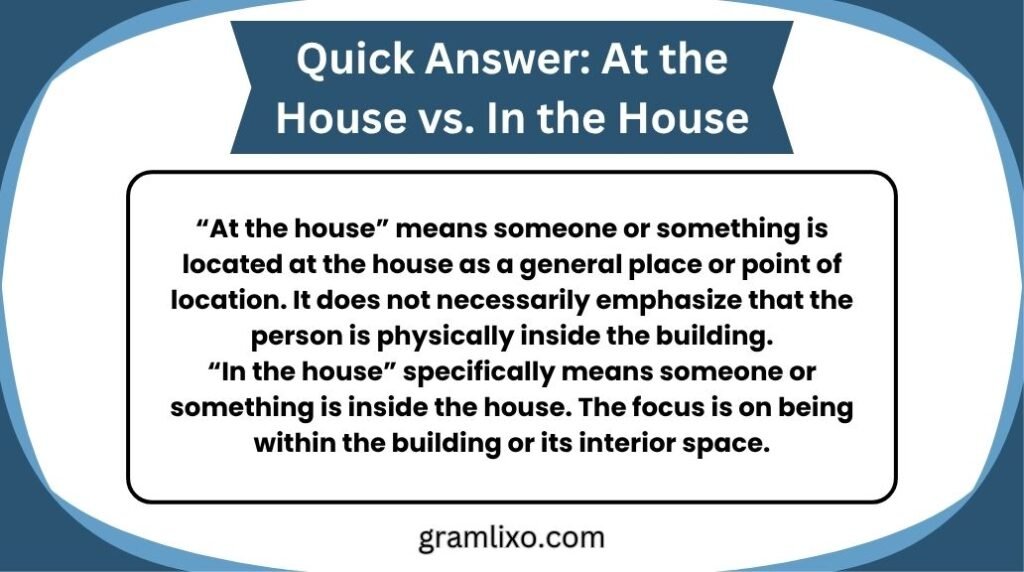
“At the house” means someone or something is located at the house as a general place or point of location. It does not necessarily emphasize that the person is physically inside the building.
“In the house” specifically means someone or something is inside the house. The focus is on being within the building or its interior space.
Simple rule:
👉 At the house = location in general
👉 In the house = inside the building
For example:
- Sarah is at the house. → Sarah is at that property/location.
- Sarah is in the house. → Sarah is specifically inside the building.
Both phrases can be grammatically correct. The context determines which one is more appropriate.
Understanding the Basics of At the House vs. In the House
The key difference between these expressions comes from the prepositions at and in.
English commonly uses at to identify a particular place or point, while in can indicate that someone or something is within an enclosed space. Cambridge Dictionary describes at as a preposition used to identify a particular place or position.
Think of it this way:
At points to a location.
In points to the inside of a space.
Comparison Table
| Form | Type | Meaning | Example | Correct/Incorrect |
|---|---|---|---|---|
| at the house | Prepositional phrase | At the location of the house | We met at the house. | ✅ Correct |
| in the house | Prepositional phrase | Inside the house | The children are in the house. | ✅ Correct |
| at house | Prepositional phrase | Missing article in most ordinary contexts | We met at house. | ❌ Usually incorrect |
| in house | Prepositional phrase | Missing article in ordinary literal use | She is in house. | ❌ Usually incorrect |
| at the house | Location expression | At or around a specific house | The workers are at the house. | ✅ Correct |
| in the house | Interior-location expression | Inside a specific house | The workers are in the house. | ✅ Correct |
The important point is that neither “at the house” nor “in the house” is automatically wrong.
They simply communicate different spatial perspectives.
What Does “At the House” Mean?
“At the house” identifies the house as a place or location.
The speaker is generally saying that someone or something is at that particular house, without making the exact indoor/outdoor position the main point.
For example:
My brother is at the house.
This sentence tells us where your brother is, but it does not necessarily tell us whether he is:
- inside the living room,
- standing outside,
- sitting on the porch,
- working in the yard,
- standing near the garage, or
- somewhere else on the property.
The house is simply the relevant location.
Example 1: General Location
The contractor is at the house.
Breakdown:
- The contractor = subject
- is = linking verb
- at the house = prepositional phrase showing location
The sentence tells us that the contractor is at the house. It does not focus on whether he is currently inside.
Example 2: Meeting Location
I’ll meet you at the house at six.
Here, at the house identifies the meeting location.
The sentence does not necessarily mean:
“I will meet you inside the house.”
Instead, the house is being used as the reference point for the meeting.
You could meet:
- in the driveway,
- on the porch,
- near the front door,
- in the yard, or
- inside the house.
The phrase leaves those details open.
What Does “In the House” Mean?
“In the house” emphasizes the interior of the building.
If you say:
My brother is in the house.
You are specifically communicating that your brother is inside the house.
This is the clearest difference between the two expressions.
Example 1: Physical Interior
The children are in the house.
This means the children are inside the building.
It contrasts naturally with:
The children are outside the house.
Example 2: Something Located Inside
There is a strange noise in the house.
The phrase in the house tells us that the noise is coming from somewhere inside the building.
You would not normally use at the house if your intention is specifically to emphasize the interior.
Compare:
There is someone at the house.
This could mean someone is at the property.
But:
There is someone in the house.
This strongly suggests that someone is physically inside.
At the House vs. In the House: The Easiest Way to Remember
Here is a simple mental picture:
🏠 At the house → Imagine standing somewhere around the property and pointing toward the house.
🚪 In the house → Imagine walking through the door and standing inside.
That gives you this useful rule:
Use “at” when the house is mainly a location.
Use “in” when the interior of the house matters.
For example:
- We are at the house. → The house is our location.
- We are in the house. → We are inside the house.
When Should You Use “At the House”?
There are several common situations where at the house sounds natural.
1. Talking About Someone’s Location
Is Tom at the house?
The speaker wants to know whether Tom is at that location.
The question does not necessarily ask whether Tom is indoors.
A natural answer could be:
Yes, he’s at the house. He’s working in the yard.
This demonstrates why at is useful. Tom is at the property, but he is not necessarily inside the house.
2. Talking About a Meeting Point
Let’s meet at the house.
The house serves as the meeting location.
You might meet someone:
- outside the front door,
- in the driveway,
- on the porch,
- or inside.
The exact position is not specified.
3. Talking About Work Being Done at a Property
The electricians are at the house today.
This means the electricians are working at that location.
It does not necessarily mean every electrician is physically inside the building every moment.
One person might be outside near the electrical panel while another works indoors.
4. Referring to a Particular Property
There’s a new family at the house next door.
Here, at the house identifies the location.
The focus is the property rather than the interior.
When Should You Use “In the House”?
Use in the house when you specifically mean inside the building.
1. Talking About People Indoors
Everyone is in the house.
This means everyone is inside.
The sentence naturally contrasts with:
Everyone is outside.
2. Talking About Objects
My keys are in the house.
This tells the listener that the keys are somewhere inside the building.
Compare:
My keys are at the house.
That could mean the keys are somewhere at the property, but it is less precise if you specifically want to say they are indoors.
3. Talking About Sounds
I heard a noise in the house.
This strongly suggests that the sound came from inside.
For example:
I heard footsteps in the house.
The listener understands that the footsteps are occurring indoors.
4. Talking About Safety
The children are safe in the house.
The phrase emphasizes that they are inside the building.
A Simple “Inside Test” for Choosing the Right Phrase
Here is an easy test.
Ask yourself:
Am I emphasizing the inside of the building?
If the answer is yes, choose in the house.
If the answer is no, and you are simply identifying the location, at the house may be more appropriate.
Test Examples
Question: Is the person specifically inside?
Yes → She is in the house.
Question: Are you simply identifying where the person is?
Yes → She is at the house.
This test works in many everyday situations.
At the House vs. In the House in Real Conversations
Imagine two friends talking on the phone.
Conversation A
“Where’s Jake?”
“He’s at the house.”
The first speaker wants to know Jake’s general location.
Conversation B
“Where’s Jake?”
“He’s in the house.”
Now the answer gives more specific information: Jake is indoors.
The difference is subtle but useful.
Another example:
The delivery driver is at the house.
This means the driver has reached the property.
But:
The delivery driver is in the house.
This means the driver has entered the building.
The second sentence gives a much more specific location.
Case Study: A Workplace Conversation
Imagine that a home renovation company is working on a customer’s property.
A project manager calls an employee.
Manager: “Where are you?”
Employee: “I’m at the house.”
Manager: “Are you inside?”
Employee: “No. I’m outside checking the electrical box.”
Here, at the house is perfect because the employee is at the property.
Now imagine a different situation:
Manager: “Where are you?”
Employee: “I’m in the house.”
Manager: “What are you doing?”
Employee: “I’m checking the wiring in the kitchen.”
Here, in the house is appropriate because the employee is specifically indoors.
What Does This Case Study Teach?
The choice depends on what information you want the listener to receive.
- General location → at the house
- Interior location → in the house
Neither expression is inherently superior.
Grammar Rules Behind “At” and “In”
Prepositions can be difficult because English does not always translate spatial relationships directly from one language to another.
Cambridge Grammar explains that prepositions commonly show relationships involving space, time, or other connections. It also describes at as a way of referring to a particular place or position.
The important distinction here is perspective.
“At” Treats a Place as a Point or Location
Consider:
I’m at the house.
The house is functioning as the relevant location.
Similar constructions include:
- at the office
- at school
- at the station
- at the door
- at the store
- at the airport
Cambridge gives examples such as “at the entrance” and “at the table” to illustrate location viewed as a particular point or place.
“In” Treats a Place as an Interior or Enclosed Space
Consider:
I’m in the house.
The house is being viewed as an enclosed space, and the person is inside it.
Similar expressions include:
- in the office
- in the room
- in the car
- in the building
- in the kitchen
- in the garage
Therefore, the choice is not simply about memorizing one phrase. It is about understanding the spatial relationship.
Is “At the House” Always About Being Outside?
No. This is an important point.
Some learners mistakenly believe:
at the house = outside
in the house = inside
That is a useful shortcut, but it is not a perfect rule.
Someone can be at the house and also be inside it.
For example:
We had dinner at the house.
This could mean that dinner took place inside the house.
The phrase at the house is focusing on the house as the location of the event.
By contrast:
We had dinner in the house.
This more strongly emphasizes that the dinner occurred inside the building.
So, at does not automatically mean outside.
Why “At the House” Can Include the Interior
English often uses at to identify a location without specifying exactly where within that location something happens.
Consider:
We had a meeting at the office.
The meeting might occur inside an office building.
Likewise:
We had a meeting at the house.
The meeting could happen inside the house.
The speaker is focusing on the location as a whole.
This is why context matters so much.
At the House vs. In the House in Different Contexts
Everyday Conversation
Both phrases are common in casual speech.
Examples:
Are you at the house?
Yes, I’m at the house.
Or:
Are the kids in the house?
Yes, they’re in the living room.
The first exchange is about general location.
The second emphasizes the interior.
Professional Writing
In professional communication, precision can be important.
For example:
The technician will be at the house between 10 a.m. and noon.
This tells the customer where the technician will be working.
If the specific location matters:
The technician will be in the house during the inspection.
This indicates that the technician will be inside the building.
A professional email might say:
The inspector is currently at the house and will begin the interior inspection shortly.
This is especially precise because it distinguishes the general location from the later interior activity.
Creative Writing
Writers can use the distinction deliberately.
She stood at the house, staring at the dark windows.
This creates an image of someone near the property.
Compare:
She stood in the house, staring at the dark windows.
Now the character is inside.
The preposition changes the reader’s mental picture.
Social Media and Texting
In texting, people often use these expressions casually.
Examples:
“I’m at the house rn.”
“Everyone’s in the house.”
Both can be perfectly understandable.
However, if you’re writing a formal message, avoid unnecessary abbreviations and make the location clear.
“At the House” vs. “At Home”
These phrases are related, but they are not identical.
At home normally refers to the place where someone lives.
Cambridge defines at home as being at the house, apartment, or other place where you live.
For example:
I’m at home.
This usually means:
I am at my residence.
But:
I’m at the house.
usually identifies a particular house as a location.
For example, someone might say:
I’m at my parents’ house.
The speaker is not necessarily talking about their own home.
Compare:
I’m at home.
= I’m at my residence.
I’m at the house.
= I’m at a particular house.
I’m in the house.
= I’m inside the particular house.
“At the House” vs. “In the House”: Common Mistakes
Learners commonly confuse these phrases because both can describe location.
Here are some frequent mistakes.
Mistake 1: Assuming “At” Always Means Outside
❌ At the house always means outside.
Not necessarily.
✅ At the house identifies the house as the location.
Mistake 2: Assuming “In” Is Always Better
Some learners think:
“If someone is at a house, they must be in the house.”
Not necessarily.
Someone could be:
- in the yard,
- on the driveway,
- on the porch,
- near the garage,
- or inside the building.
Mistake 3: Leaving Out “The”
In ordinary literal expressions, learners may write:
❌ She is at house.
Usually, this should be:
✅ She is at the house.
Likewise:
❌ She is in house.
Usually:
✅ She is in the house.
There are special expressions such as in-house that follow different rules, which we will discuss later.
Similar Grammar Confusions
The confusion between at the house and in the house is part of a larger pattern in English.
| Confusing Forms | Correct Difference |
|---|---|
| it’s / its | “It’s” = it is; “its” = possessive |
| your / you’re | “Your” = possession; “you’re” = you are |
| their / there / they’re | Possession, location, and “they are” |
| then / than | Time/order vs. comparison |
| affect / effect | Usually verb vs. noun |
| to / too / two | Direction, excess/also, number |
| in / on | Interior/enclosed space vs. surface or position |
| at / in | Location/point vs. interior or enclosed space |
Why Do These Errors Happen?
Several factors contribute:
Fast typing:
When people type quickly, they may choose the first preposition that comes to mind.
Autocorrect:
Phones and writing software can sometimes suggest or preserve a form that is grammatically inappropriate for the context.
Lack of knowledge:
Many learners memorize phrases without understanding why one preposition works better than another.
Native-language influence:
A person’s first language may organize location differently from English.
The best solution is not simply memorization. It is understanding the meaning behind the preposition.
Why the Difference Matters
You might wonder whether this tiny distinction really matters.
Sometimes it does.
1. Clarity
Compare:
Someone is at the house.
with:
Someone is in the house.
The second sentence gives a clearer indication that the person is indoors.
This can matter in practical situations.
2. Professionalism
Clear preposition use makes professional writing sound polished.
Compare:
The technician is at the house.
with an unclear sentence such as:
The technician is house.
The first is grammatically complete and natural.
3. Digital Communication
Text messages, emails, workplace chats, and online instructions depend heavily on concise communication.
When a location matters, choosing the correct preposition helps prevent misunderstandings.
4. Accuracy
Good grammar is not only about following rules. It is about communicating exactly what you mean.
As a useful principle:
Good grammar makes your meaning easier to see.
The distinction between at and in is a small example of that larger principle.
Special Exception: “In-House”
There is an important related expression: in-house.
In-house is different from the ordinary phrase in the house.
For example:
The company has an in-house designer.
Here, in-house generally means that the designer works within the organization rather than being an outside contractor.
Another example:
We handle the project in-house.
This does not necessarily mean someone is physically inside a house.
It means the work is handled internally.
So don’t confuse:
The children are in the house.
with:
The company handles the work in-house.
The first is a literal spatial expression.
The second is an established adjective/adverbial expression with a broader meaning.
What About “At the House” in Names or Events?
Sometimes at the house may appear in the names of events, businesses, organizations, or creative works.
In those situations, the phrase may have a specialized meaning determined by the name itself.
For ordinary grammar, however, the standard distinction remains:
at the house → location
in the house → inside the building
A title, brand, or proper name should not be used as evidence that the ordinary grammatical rule has changed.
How Native US English Speakers Use These Phrases
In American English, context frequently determines which expression sounds most natural.
For example:
I’m at the house.
is natural when someone asks where you are.
But if someone asks:
Is anyone inside?
you would likely answer:
Yes, they’re in the house.
Likewise:
The plumber is at the house.
sounds natural when discussing a service visit.
But:
The plumber is in the house.
is more specific if you need to tell someone that the plumber has entered the building.
This shows why English prepositions should be understood through meaning and context, not through rigid one-to-one translations.
Quick Recap Checklist
Use this table when you’re unsure.
| Question | If Yes → Use |
|---|---|
| Am I talking about a house as a general location? | at the house |
| Am I emphasizing that someone is inside? | in the house |
| Could the person be outside but still at the property? | at the house |
| Do I specifically mean inside the building? | in the house |
| Am I identifying a meeting or work location? | Usually at the house |
| Am I describing an interior location? | in the house |
| Am I talking about someone’s own residence generally? | Often at home |
Practice Example 1
The repair crew is ___ the house.
If you mean the crew has arrived at the property:
✅ The repair crew is at the house.
If you mean the crew is specifically working indoors:
✅ The repair crew is in the house.
Practice Example 2
I left my wallet ___ the house.
If you mean the wallet is somewhere inside the building:
✅ I left my wallet in the house.
Practice Example 3
I’ll see you ___ the house at 7.
If the house is the meeting location:
✅ I’ll see you at the house at 7.
At the House vs. In the House: A One-Sentence Rule
If you need to remember only one thing, remember this:
Use “at the house” for the house as a general location, and “in the house” when you specifically mean inside the building.
That single rule will solve most everyday situations.
Frequently Asked Questions
1. Is “at the house” grammatically correct?
Yes. “At the house” is grammatically correct when you are referring to a particular house as a location. For example: “I’ll meet you at the house.”
2. Is “in the house” grammatically correct?
Yes. “In the house” is grammatically correct when you mean physically inside the house. For example: “The children are in the house.”
3. What is the main difference between “at the house” and “in the house”?
The main difference is focus. “At the house” focuses on the house as a location, while “in the house” emphasizes being inside the building.
4. Does “at the house” mean someone is outside?
No. “At the house” does not necessarily mean outside. Someone can be inside the house and still be described as being “at the house” when the speaker is treating the house as the general location.
5. Should I say “at home” or “in the house”?
It depends on your meaning. Use “at home” when you mean someone’s residence in general. Use “in the house” when you specifically want to emphasize that someone is inside the building. Cambridge similarly distinguishes the personal idea of home from the physical building referred to as a house.
6. Is “at the house” better than “in the house”?
Neither is automatically better. They communicate different meanings. Choose “at the house” for a general location and “in the house” when the interior is important.
Conclusion
Understanding at the house vs. in the house becomes much easier once you stop treating the two phrases as interchangeable. “At the house” generally presents the house as a location or point where someone or something is situated. “In the house” specifically highlights the interior of the building. For example, “The technician is at the house” tells us where the technician is working, while “The technician is in the house” tells us that the technician is inside. Context can make both expressions appropriate, so there is no need to think of one as universally correct and the other as wrong. When you’re unsure, ask yourself whether you’re identifying a location or emphasizing an interior space. Once that distinction becomes natural, choosing between at the house and in the house will feel almost automatic. Remember: at points to the place; in takes you inside.

Hi, I’m Lisa Jones, a grammar enthusiast and writer at Gramlixo. I enjoy making English grammar simple, clear, and easy to apply in everyday writing.
[…] |At the House vs In the House: What’s the Difference? […]