Have you ever wondered whether time slot vs timeslot is the correct way to write this common scheduling term? You are not alone. This small spelling difference can create confusion when writing emails, booking instructions, schedules, workplace messages, or professional documents.
I know how easy it is to assume that two frequently used words should eventually be combined into one, especially when English has many compound words.
However, time slot vs timeslot is a case where knowing the standard form can make your writing clearer and more polished. In standard US English, time slot is generally preferred when referring to a specific period reserved or assigned for an appointment, meeting, event, class, delivery, or other activity.
While timeslot can appear in technical, informal, or specialized contexts, the two-word form is the safer choice for most professional and formal writing.
Let’s explore the difference with clear rules and examples. ✍️
|At the House vs In the House: What’s the Difference?
|Minuet vs Minute: What’s the Difference?
|Soo vs So: What’s the Difference and Which One Is Correct?
Quick Answer: Time Slot vs Timeslot
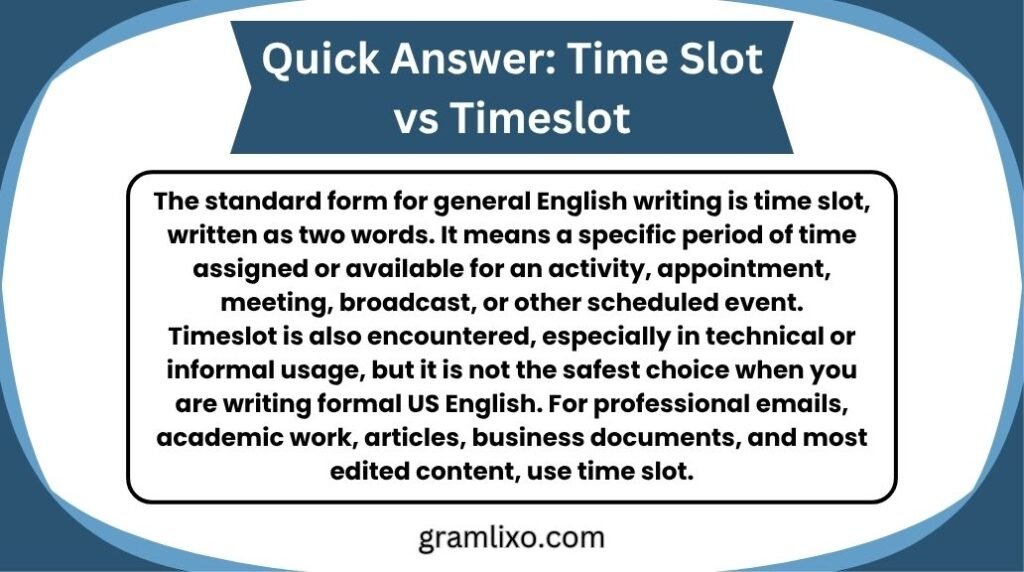
The standard form for general English writing is time slot, written as two words. It means a specific period of time assigned or available for an activity, appointment, meeting, broadcast, or other scheduled event.
Timeslot is also encountered, especially in technical or informal usage, but it is not the safest choice when you are writing formal US English. For professional emails, academic work, articles, business documents, and most edited content, use time slot.
Correct: Please select a time slot for your appointment.
Preferred: We have several time slots available tomorrow.
Less standard in general writing: Please select a timeslot for your appointment.
The easiest rule to remember is:
For standard writing, use “time slot” as two words.
Understanding the Basics of Time Slot vs Timeslot
The confusion comes from the fact that time slot functions as a single concept even though it is written as two words.
English contains thousands of compound expressions. Some are written as one word, some as two words, and others with a hyphen. Unfortunately, there is no universal rule that tells us exactly when two words must become one.
For example:
- bedroom → one word
- classroom → one word
- bus stop → two words
- time zone → two words
- high-speed → hyphenated
- time slot → two words
The word slot can mean a position or place in an arrangement or sequence. Merriam-Webster specifically defines slot as a place or position in an organization, arrangement, or sequence. That meaning naturally extends to a position on a schedule.
Adding time tells us what kind of slot we mean.
Time + slot = time slot
A time slot is therefore a period or position in a schedule.
Comparison Table
| Form | Type | Meaning | Example | Correct/Incorrect |
|---|---|---|---|---|
| time slot | Open compound noun | A scheduled or available period | Choose a time slot for your interview. | ✅ Preferred |
| time slots | Plural open compound noun | Multiple scheduled periods | Three time slots are available. | ✅ Preferred |
| timeslot | Closed compound | Same general meaning | Choose a timeslot. | ⚠️ Less standard |
| timeslots | Plural closed form | Multiple time periods | Several timeslots are available. | ⚠️ Less standard |
| time-slot | Hyphenated compound | Same general concept | Choose a time-slot. | ⚠️ Usually unnecessary |
The key takeaway is simple: time slot is the form you should normally choose.
What Does “Time Slot” Mean?
A time slot is a specific period of time that has been reserved, assigned, scheduled, or made available for something.
Merriam-Webster defines time broadly enough to include a point or period when something occurs and defines slot as a place or position in an arrangement or sequence. Together, these concepts explain the meaning of time slot.
For example:
I booked a time slot for my dentist appointment.
Here, the appointment is the activity, while the time slot is the period reserved for that activity.
Another example:
The interview has been assigned a 30-minute time slot.
The phrase tells us that the interview has a specific period in the schedule.
Common things that can have time slots
You can use time slot for:
- appointments
- meetings
- interviews
- classes
- exams
- deliveries
- consultations
- presentations
- television programs
- radio programs
- events
- customer-service calls
- work shifts
- reservations
- online sessions
- tours
- training sessions
The term is extremely flexible because scheduling is involved in so many areas of modern life.
Why Is “Time Slot” Written as Two Words?
The simplest explanation is that time slot is normally treated as an open compound noun.
An open compound is a combination of words that work together as a unit while remaining visually separate.
Consider:
- coffee shop
- school bus
- credit card
- time zone
- time limit
- time slot
Each expression contains multiple words, but the words work together to create a specific concept.
The fact that time slot is frequently used does not automatically mean that it should become timeslot.
That is an important lesson in English spelling.
Frequent use does not automatically create a closed compound
English has changed many words over time. Some expressions that were once written separately eventually became single words.
For instance:
- web site → website
- on line → online
- data base → database
Because time slot is frequently used, some writers naturally assume that timeslot must be the next stage of its development.
That assumption is understandable, but it is not a reliable spelling rule.
For standard writing, it is better to follow established dictionary and editorial usage rather than guessing based on frequency.
Merriam-Webster’s current material uses time slot in example sentences, including references to television programming and scheduled appointments.
Is “Timeslot” Wrong?
This question requires a little nuance.
It would be too simplistic to claim that timeslot never appears in English. It does appear in real-world usage, particularly in technical writing, software environments, online content, and some specialized contexts.
For example, Wiktionary records timeslot as an English noun meaning a conventionally defined time interval in a schedule and lists time slot and time-slot as alternative forms.
So the issue is not that readers cannot understand timeslot.
They almost certainly can.
The issue is which form is the safest and most appropriate choice for standard writing.
For general US English, especially in polished professional writing, time slot is the better choice.
Think of it this way:
Timeslot: recognizable, but less conventional.
Time slot: standard, familiar, and professionally safe.
Therefore, if you are writing an article, email, school assignment, business report, or formal document, choose time slot.
Correct Meanings and Uses of “Time Slot”
1. Time slot for an appointment
One of the most common uses involves appointments.
Example:
I would like to reserve a time slot for Friday morning.
Sentence breakdown
- I = subject
- would like = verb phrase
- to reserve = infinitive
- a time slot = noun phrase
- for Friday morning = prepositional phrase describing the slot
The phrase tells the reader that the speaker wants a specific period reserved.
2. Time slot for a meeting
In professional environments, time slot is extremely common.
Example:
Do you have a time slot available for a meeting tomorrow?
The phrase sounds natural and professional.
You could also write:
Please let me know which time slot works best for you.
This is especially useful when several possible meeting times exist.
3. Time slot for a class
Schools, universities, training centers, and online learning platforms often organize classes into scheduled periods.
Example:
The afternoon time slot is available for the workshop.
Here, the phrase identifies a specific period in the schedule.
4. Time slot for television
Television programming is another common context.
Example:
The show moved to a later time slot.
This means the program was assigned a different scheduled period for broadcasting.
Merriam-Webster’s example material includes the phrase time slot when discussing a show’s regular broadcast schedule.
5. Time slot for delivery
Businesses often allow customers to choose delivery periods.
Example:
Customers can select a two-hour delivery time slot.
The phrase is useful because it indicates a window during which the delivery is expected.
Time Slot vs Time Window
These expressions are related, but they are not always identical.
A time slot is usually an assigned or available period in a schedule.
A time window is a period during which something can or should happen.
Compare:
I booked a 2 p.m. time slot.
This suggests that 2 p.m. has been assigned to you.
Now compare:
Your package will arrive within a two-hour time window.
This suggests a range rather than one scheduled appointment position.
Quick distinction
Time slot: a scheduled or selectable position.
Time window: a period during which something may happen.
Both are correct, but they emphasize slightly different ideas.
Time Slot vs Time Frame
A time frame usually describes the period needed or allowed for something.
For example:
We expect the project to be completed within a three-month time frame.
A time slot, however, usually refers to a scheduled period.
We scheduled the presentation for the 10 a.m. time slot.
So:
- time slot = scheduled position
- time frame = broader period or duration
Using the right phrase makes your meaning more precise.
Test Tip: How to Check Your Usage
Here is an easy test.
Ask yourself:
Am I talking about a specific position or period on a schedule?
If the answer is yes, time slot is probably the expression you need.
For example:
I need a time ___ for my appointment.
The blank refers to a scheduled period.
Therefore:
I need a time slot for my appointment. ✅
If you are still unsure about the spelling, replace the phrase with scheduled period.
If the sentence still makes sense, you are probably dealing with the scheduling concept of a time slot.
A Real-Life Case Study: The Workplace Email
Imagine that Sarah works as a project manager.
She needs to schedule a meeting with three employees. She sends this email:
Hi team,
Please let me know which time slot works best for you on Thursday. I currently have openings at 10 a.m., 1 p.m., and 3 p.m.
Thanks!
This is clear, natural, and professional.
Now imagine she writes:
Please let me know which timeslot works best for you.
The meaning is still understandable. Most readers will know what she means.
However, the two-word form is preferable in polished professional writing:
Please let me know which time slot works best for you.
This example shows why the distinction matters. The closed form may not prevent understanding, but the open form is the safer editorial choice.
Grammar Rules Behind “Time Slot”
The expression time slot functions as a noun phrase.
The first noun, time, modifies the second noun, slot.
This structure is common in English.
Compare:
- time zone
- time limit
- time period
- time frame
- time schedule
- time slot
The second element is the main noun.
In time slot, the main noun is slot.
That means the plural is formed by pluralizing slot, not time:
one time slot
two time slots
Not:
two times slot ❌
And not:
two time slotses ❌
Merriam-Webster’s evidence
Merriam-Webster defines slot as a place or position in an arrangement or sequence and provides examples involving scheduled time slots.
This supports the standard construction used in edited English.
The Associated Press Stylebook is also a major editorial reference used by newsrooms, classrooms, and corporate offices. Its guidance on time expressions reinforces the importance of consistent, clear scheduling language in professional writing.
Why Do People Write “Timeslot”?
There are several reasons.
1. Fast typing
When people type quickly, spaces are often omitted.
For example:
- infront instead of in front
- alot instead of a lot
- atleast instead of at least
- timeslot instead of time slot
The reader may understand the meaning, but fast typing does not determine standard spelling.
2. Autocorrect and software
Modern software can contribute to spelling variation.
A keyboard, database, content management system, or software interface may store compound terms without spaces.
For example, a technical system might use:
timeslot_id
as a database field.
That does not mean the surrounding prose should necessarily use timeslot.
3. Pattern recognition
People naturally compare time slot with words such as:
- timetable
- timescale
- timeframe
- timeline
- timestamp
Because several time-related terms are closed compounds, timeslot can look perfectly logical.
But English spelling is not always perfectly logical.
4. Online usage
Once a spelling appears frequently online, people begin to assume it is standard.
Search engines may show both versions.
Social media users may use the closed form.
Websites may use it inconsistently.
That visibility can make timeslot feel more established than it is in conventional edited prose.
Common Mistakes With Time Slot vs Timeslot
Mistake 1: Writing “timeslot” in formal documents
Less preferred:
Please select your preferred timeslot.
Better:
Please select your preferred time slot.
Mistake 2: Adding an unnecessary hyphen
Less preferred:
Choose your time-slot carefully.
Better:
Choose your time slot carefully.
The hyphen is generally unnecessary when the phrase is being used as an ordinary noun.
Mistake 3: Confusing “time slot” with “time frame”
These expressions are related but different.
The meeting has a 30-minute time slot. ✅
The project has a six-month time frame. ✅
The first describes a scheduled period.
The second describes a broader period for completion.
Similar Grammar and Spelling Confusions
The confusion surrounding time slot vs timeslot belongs to a much larger pattern in English.
| Confusion | Correct Form | Meaning |
|---|---|---|
| its / it’s | its / it’s | Possessive vs contraction |
| your / you’re | your / you’re | Possessive vs contraction |
| their / there / they’re | their / there / they’re | Possession, location, contraction |
| a lot / alot | a lot | A large amount |
| in front / infront | in front | Position |
| at least / atleast | at least | Minimum amount |
| time slot / timeslot | time slot | Scheduled period |
| each other / eachother | each other | Mutual relationship |
| in to / into | Depends on meaning | Direction or separate words |
| everyday / every day | Depends on meaning | Adjective vs frequency |
These mistakes happen because English spelling contains many expressions that look as though they should be combined.
The solution is not to rely solely on what looks familiar.
Instead, check the established form.
Time Slot in Everyday Conversation
In everyday speech, people commonly use time slot.
Examples:
What time slot did you book?
I have a free time slot after lunch.
Can we find another time slot?
The 4 p.m. time slot works for me.
Which time slot is available?
These sentences sound natural in American English.
You do not need to force the word into a single unit simply because it represents one concept.
Remember that spoken English does not show spaces anyway. When people say the phrase aloud, you hear:
time slot
The spelling issue only appears when you write it.
Time Slot in Professional Writing
Professional writing is where the distinction becomes especially important.
Use time slot in:
- business emails
- reports
- proposals
- schedules
- newsletters
- customer-service messages
- booking pages
- workplace communication
- academic writing
- presentations
Example
Please choose a convenient time slot for your consultation.
This is polished and easy to understand.
Another example:
We have three available time slots for the interview.
Again, the open form is the safest choice.
Professional writing benefits from consistency. Small spelling choices may seem insignificant, but consistent language helps your writing look carefully edited.
Time Slot in Creative Writing
Creative writing is more flexible.
A novelist, screenwriter, blogger, or journalist might encounter timeslot in dialogue or in a character’s speech.
For example:
“They moved our show to a terrible timeslot,” he complained.
If the closed spelling is intentionally part of a particular character’s voice or a quoted source, the writer may preserve it.
However, when the writer is using standard narration, time slot remains the safer choice.
Creative writing gives authors more stylistic freedom, but intentional style should not be confused with standard spelling.
Time Slot in Social Media and Texting
Social media and texting are informal environments.
People often shorten words, remove spaces, ignore capitalization, or use unconventional spellings.
You might see:
Need a timeslot for tomorrow?
The message is understandable.
But if you are writing an official social-media announcement for a business, use the standard form:
Book your time slot today!
This distinction is useful for brands.
Informal communication allows flexibility, but professional public-facing communication benefits from standard language.
Why “Time Slot” Matters
At first glance, the difference between time slot and timeslot may seem extremely small.
After all, adding or removing one space does not usually change the meaning.
But writing is about more than basic comprehension.
1. Clarity
Standard spelling helps readers process information quickly.
When readers encounter familiar forms, they do not have to stop and wonder whether a strange spelling is intentional.
2. Professionalism
Correct spelling contributes to the overall impression of your writing.
A business email containing consistent, standard language appears more polished.
3. Digital communication
Online writing is often consumed quickly.
Readers scan:
- emails
- booking pages
- forms
- schedules
- notifications
- articles
Clear language makes these interactions easier.
4. Search and content quality
For website owners and content creators, using the standard spelling helps maintain consistency throughout a page.
If your page targets the keyword time slot vs timeslot, you can naturally discuss both forms while using time slot as the preferred expression.
Good writing is not about using complicated words. It is about choosing clear words consistently.
Special Exception: Technical and Brand-Specific Usage
There is an important exception.
A company, software product, database, API, application, or technical system may officially use timeslot as a name.
For example, a software interface might contain a field called:
timeslot
If that is the official identifier, you should preserve its exact spelling when referring to the technical element.
This is similar to product names and programming identifiers.
You should not rewrite an official technical identifier merely to make it conform to ordinary prose.
However, there is a difference between the identifier and normal English around it.
For example:
Select a time slot before entering the
timeslot_idvalue.
The first phrase is ordinary English.
The second is a technical identifier.
That distinction is important.
Also, some sources do record timeslot as a lexical form. Wiktionary, for example, lists it as an English noun and gives “time slot” as an alternative form.
Therefore, calling timeslot completely nonexistent would be inaccurate. The more useful conclusion is that time slot is the preferred general-purpose form for standard US English, while timeslot can occur in specialized or informal usage.
Time Slot vs Timeslot: Quick Recap Checklist
Use this checklist whenever you are unsure.
| Question | If Yes → Use |
|---|---|
| Am I writing standard US English? | time slot |
| Am I writing a professional email? | time slot |
| Am I writing an academic assignment? | time slot |
| Am I writing website content? | time slot |
| Am I describing an appointment period? | time slot |
| Am I describing a television schedule? | time slot |
| Am I talking about multiple scheduled periods? | time slots |
| Is “timeslot” an official software identifier? | Keep timeslot |
| Is the spelling part of an official brand or product name? | Preserve the official spelling |
Practice Examples
Example 1
Please choose a ___ for your consultation.
Answer: time slot ✅
Example 2
We have four available ___ tomorrow.
Answer: time slots ✅
Example 3
The software uses the field
timeslot.
Answer: Correct if that is the system’s official identifier. ✅
Frequently Asked Questions About Time Slot vs Timeslot
1. Is “time slot” or “timeslot” correct?
Time slot is the preferred form for standard general English, especially in professional and formal writing. Timeslot also appears in some technical, informal, and specialized contexts, but it is safer to write time slot in ordinary prose.
2. Is “time slot” one word or two?
Time slot is normally written as two words. It is an open compound noun consisting of time and slot.
3. What is the plural of “time slot”?
The plural is time slots.
Example:
We have three time slots available.
Do not write times slots or time slot’s when you simply mean more than one.
4. Should I write “time-slot” with a hyphen?
In ordinary noun usage, time slot without a hyphen is the preferred choice. A hyphen may appear in specialized editorial contexts, but it is generally unnecessary in a normal sentence.
5. Can “timeslot” ever be used?
Yes. Timeslot appears in real-world English, including some technical, digital, and specialized contexts. Wiktionary records it as a noun for a conventionally defined time interval in a schedule.
However, for standard professional writing, time slot is the safer choice.
6. Is “time slot” the same as “time window”?
Not always. A time slot usually refers to a scheduled or selectable period, while a time window generally refers to a period during which something may happen.
For example:
I booked a 3 p.m. time slot.
The delivery will arrive within a two-hour time window.
Final Answer: Time Slot vs Timeslot
When choosing between time slot vs timeslot, use time slot as your default in standard US English. It is written as two words and refers to a specific period assigned or available for an appointment, meeting, class, broadcast, delivery, or other scheduled activity.
Merriam-Webster’s treatment of slot supports the scheduling sense, and its example material uses time slot in actual English usage.
Timeslot is not simply meaningless or incomprehensible. It appears in some technical, digital, informal, and specialized contexts, and some dictionaries or lexical resources record it. But when your goal is polished, clear, professional writing, time slot is the better choice.
Remember the rule:
One scheduled period = a time slot. Multiple scheduled periods = time slots.
So, whether you are writing an email, article, report, booking page, school assignment, or business message, keep the space between time and slot.
When in doubt, choose clarity: write “time slot.” ✍️

I’m Michael Williams, an English writer and grammar enthusiast at Gramlixo. I’m passionate about making grammar easier to learn and helping readers write with greater confidence.

[…] |Time Slot vs Timeslot: Which Spelling Is Correct? […]