Have you ever paused while writing and wondered whether to say “in the street vs on the street”? You are not alone.
These two expressions look almost identical, but the prepositions in and on can create a meaningful difference in context. I know how confusing this can feel because English often uses prepositions in ways that do not seem logical at first.
The good news is that both “in the street” and “on the street” are grammatically correct, but they are generally used to describe different situations.
In American English, “on the street” is especially common when referring to a location along a particular street, such as a home, business, or general location. “In the street” usually emphasizes being physically within the roadway or street area itself.
Understanding in the street vs on the street will help you communicate more naturally and accurately in everyday and professional English.
|Emasculate vs Demasculate: Which Word Is Correct?
|Soo vs So: What’s the Difference and Which One Is Correct?
|Brite vs Bright: What’s the Difference and Which One Is Correct?
Quick Answer: In the Street vs On the Street
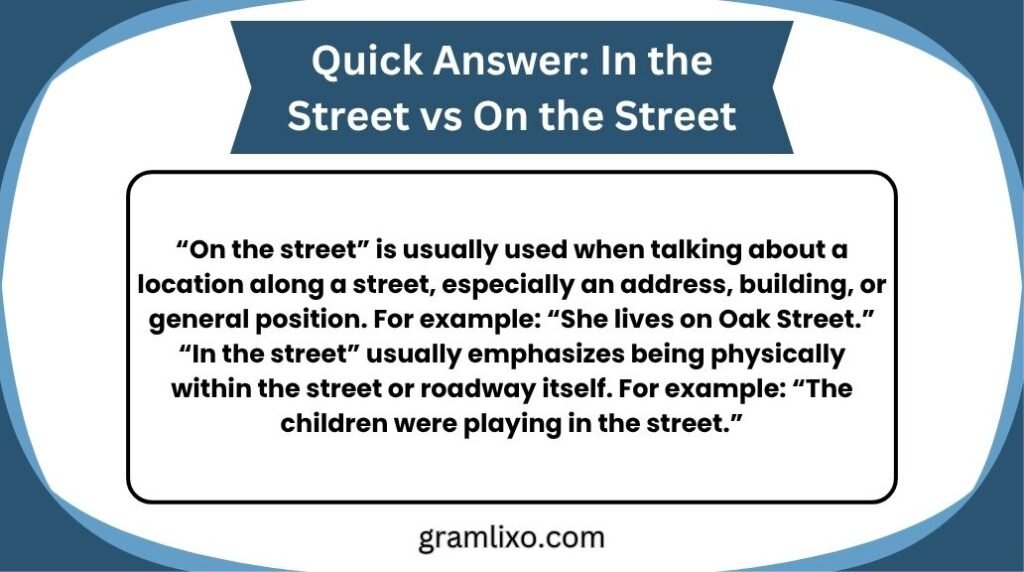
“On the street” is usually used when talking about a location along a street, especially an address, building, or general position. For example: “She lives on Oak Street.”
“In the street” usually emphasizes being physically within the street or roadway itself. For example: “The children were playing in the street.”
So, the simplest rule is:
On the street = located along a street.
In the street = physically within the street area or roadway.
Both expressions are correct; the intended meaning determines which one you should use.
Understanding the Basics of In the Street vs On the Street
The key to understanding these expressions is to think about how in and on normally work.
The preposition in often describes something that is inside or within a particular area. The preposition on can describe something positioned on a surface or located along a route or line.
Cambridge explains that on can be used for a position along a road, while in commonly describes a location within a larger area.
A street can be understood in more than one way:
- As a road or physical roadway
- As a location or address
- As a general public area
- As the area containing sidewalks, buildings, and other features
That is why both prepositions can occur naturally.
Comparison Table
| Form | Type | Meaning | Example | Correct/Incorrect |
|---|---|---|---|---|
| on the street | Prepositional phrase | Located along or associated with a street | She lives on the street. | ✅ Correct |
| in the street | Prepositional phrase | Physically within the street or roadway | The ball is in the street. | ✅ Correct |
| on Main Street | Location phrase | Located at an address along Main Street | Our office is on Main Street. | ✅ Correct |
| in Main Street | Location phrase | Generally unnatural in US English for an address | She lives in Main Street. | ❌ Usually incorrect |
| in the middle of the street | Location phrase | Physically inside the roadway | The car stopped in the middle of the street. | ✅ Correct |
| on the street | Idiomatic phrase | Sometimes homeless, unemployed, or without a home | He could end up on the street. | ✅ Correct |
Merriam-Webster defines a street as a thoroughfare and gives examples such as “They live on a busy street.” It also records “on the street” and “in the street” as variants in certain idiomatic meanings.
What Does “On the Street” Mean?
“On the street” is one of the most common expressions in American English.
It usually refers to a person, building, business, or activity located along a street or associated with street life.
Example 1: Talking About a Home
I live on Pine Street.
Here, the speaker is not claiming to live physically on the pavement.
Instead, the speaker means:
- Their home is located along Pine Street.
- Pine Street is the address location.
- Their house or apartment is associated with that street.
This is why American English commonly uses:
I live on Main Street.
rather than:
I live in Main Street.
Cambridge specifically gives examples such as “We live on the same street” and “Diane’s house is on Cherry Street.”
Example 2: Talking About a Business
There is a new coffee shop on the street.
The phrase can mean that the coffee shop is located along that street.
For example:
The restaurant is on Fifth Avenue.
The restaurant is not literally sitting on the road surface. It is located at an address along Fifth Avenue.
Example 3: Describing Someone’s Location
I saw Sarah on the street yesterday.
This usually means that the speaker encountered Sarah while she was out in the public street area.
The exact physical position may not matter. The important idea is that Sarah was out in the street environment.
What Does “In the Street” Mean?
“In the street” usually emphasizes physical presence within the street area itself, particularly the roadway.
For example:
The dog is in the street.
This suggests that the dog is physically in the roadway or street rather than safely on a sidewalk or inside a yard.
Another example:
A car was blocking traffic in the street.
The car is physically occupying the roadway.
Example 1: A Ball in the Road
The ball rolled into the street.
The ball moved from somewhere else into the roadway.
You could then say:
The ball is in the street.
The preposition in highlights the ball’s position within the street.
Example 2: Children Playing
The children were playing in the street.
This tells us that the children were physically in the roadway or street area.
The sentence may also carry a safety implication because children playing in an active roadway can be dangerous.
Example 3: Standing in the Road
Don’t stand in the street.
This means:
Don’t stand within the roadway.
Here, in makes the physical location especially clear.
“On the Street” vs “In the Street” in Everyday Situations
One of the easiest ways to understand the difference is to imagine a typical city block.
Picture a street with:
- Houses 🏠
- Sidewalks
- Cars 🚗
- Shops
- Pedestrians
- A roadway
Now consider these sentences:
My apartment is on the street.
The apartment is associated with the street.
The children are in the street.
The children are physically in the street area.
There is a bakery on the street.
The bakery is located along the street.
A bicycle is lying in the street.
The bicycle is physically within the roadway.
This mental picture makes the distinction much easier.
Why “On” Is Used With Street Names
This is one of the most important rules for American English learners.
When giving an address or identifying a location along a named street, on is generally preferred.
Correct Examples
- I live on Maple Street.
- She works on Main Street.
- The bank is on Fifth Avenue.
- Their office is on Market Street.
- We met at a restaurant on King Street.
Usually Incorrect in American English
- ❌ I live in Maple Street.
- ❌ The bank is in Main Street.
- ❌ She works in Fifth Avenue.
The issue is not that in can never occur with a street name. English has regional and contextual variation, and expressions such as “in Main Street” can be encountered in some varieties of English. But for standard American English when giving a street location, on is the natural choice.
Cambridge’s grammar guidance explains that on can refer to a position along a road, while its dictionary examples use on with named streets.
Why “In” Is Used for Physical Position
Now imagine someone standing directly in the roadway.
You could say:
He is in the street.
The word in emphasizes that he is physically within the boundaries of the street.
Compare:
He lives on the street.
with:
He is standing in the street.
The first sentence is about location along a street.
The second sentence is about physical position within the street.
Sentence Breakdown
He lives on the street.
- He = subject
- lives = verb
- on = preposition
- the street = location
Meaning: His home is located along that street.
He is standing in the street.
- He = subject
- is standing = verb phrase
- in = preposition
- the street = physical location
Meaning: His body is physically within the street area.
Is “In the Street” Ever Used for General Location?
Yes.
The distinction is useful, but it is not an absolute mathematical rule.
English speakers sometimes use “in the street” to describe activity taking place in a street or public street environment.
For example:
People were dancing in the street.
The sentence does not necessarily mean every person was standing in the exact center of the roadway. It describes an activity occurring in the street environment.
Similarly:
There was a parade in the street.
This means the street was being used for the parade.
Cambridge gives examples involving people walking and moving in the street, demonstrating that the expression is a normal part of English.
Is “On the Street” Ever Used for Physical Location?
Absolutely.
For example:
I saw him on the street.
This can simply mean that you encountered him while you were both outside.
It does not necessarily mean that he was standing directly on the pavement or road.
Similarly:
There were hundreds of people on the street.
This can refer broadly to people occupying the street environment, including sidewalks and other public areas.
In American English, on the street can therefore be broader than a strictly physical “surface” interpretation.
Important Difference: Sidewalk vs Roadway
A useful practical distinction is:
On the street
Often refers broadly to being out along or around a street.
I saw my neighbor on the street.
In the street
More strongly suggests being within the roadway or street itself.
The child ran into the street.
This distinction becomes especially important when safety is involved.
Compare:
The children were on the street.
This could describe children outside in the street area.
But:
The children were in the street.
This more strongly suggests that they were physically in the roadway.
The Difference Between “On the Street” and “On a Street”
The choice between the and a also matters.
On a street
This means one street among many.
I saw a small bookstore on a street near downtown.
The exact street may not be important.
On the street
This usually refers to a specific or contextually understood street.
I’ll meet you on the street outside the office.
The listener understands which street is being discussed.
On Main Street
When a specific street name is used, English normally uses:
on Main Street
not:
on the Main Street
unless the context requires the article for a special reason.
In the Street vs In the Streets
Another important distinction is singular versus plural.
In the street
Usually refers to one specific street.
A truck broke down in the street.
In the streets
Often refers to streets generally, especially when describing large-scale public activity.
People gathered in the streets.
This expression can be used for:
- protests
- celebrations
- demonstrations
- crowds
- public gatherings
For example:
Thousands of people filled the streets after the victory.
The plural form creates a broader image of public activity.
On the Street as an Idiom
“On the street” can have meanings beyond physical location.
Merriam-Webster lists an idiomatic meaning in which “on the street” can refer to someone being idle, unhoused, or out of work.
For example:
Without financial help, he could end up on the street.
Here, the sentence does not simply describe someone’s physical location.
It means the person could become homeless.
Cambridge similarly records “on the streets” as an expression meaning without a home.
Another Example
The company is putting hundreds of workers on the street.
Depending on context, this can mean that the workers are being left unemployed or without their jobs.
Therefore, always consider whether “on the street” is being used literally or idiomatically.
Case Study: A Real-Life Workplace Conversation
Imagine that Emma is meeting a colleague for lunch.
She sends this message:
“I’m waiting on the street outside the office.”
Her colleague understands that Emma is outside and near the office.
Now imagine Emma writes:
“I’m waiting in the street.”
That sounds more specific. It could suggest that Emma is physically standing in the roadway.
If Emma is actually standing on the sidewalk, the first version is more natural.
Another Workplace Example
Suppose an office is located at 125 Market Street.
A professional email might say:
Our office is on Market Street, next to the public library.
This clearly identifies the office’s location.
But if a delivery truck is blocking traffic, you might write:
A delivery truck is currently in the street outside our office.
Now in describes the truck’s physical position in the roadway.
The difference is small in form but significant in meaning.
Grammar Rules: Why Are Both Forms Correct?
The important point is that neither expression is inherently “wrong.”
The prepositions perform different functions.
Rule 1: Use “on” for a Location Along a Street
Use on when referring to something located along a street or associated with a named street.
Examples:
- She lives on Oak Street.
- The store is on Main Street.
- We met on the street.
- Their office is on Fifth Avenue.
Cambridge specifically describes on as being used for a position along a road or river and gives named-street examples.
Rule 2: Use “in” for Physical Presence Within the Street
Use in when you want to emphasize physical presence inside the street or roadway.
Examples:
- The car is in the street.
- The children are in the street.
- Don’t walk in the street.
- There is broken glass in the street.
Merriam-Webster’s examples include “in the street” for something physically located in the street.
Rule 3: Context Can Make Both Possible
Sometimes both expressions are grammatically possible but communicate different ideas.
There were people on the street.
This gives a broad picture of people being out in the street area.
There were people in the street.
This more strongly focuses on people physically occupying the street.
Neither is automatically wrong.
Test Tip: Ask One Simple Question
When you’re unsure, ask:
Am I talking about a location along the street, or something physically within the street?
If you mean a location along the street:
Use ON.
She lives on Oak Street.
If you mean physical presence inside the roadway:
Use IN.
The dog is in the street.
This simple test will solve many cases.
Common Mistakes With In the Street vs On the Street
English learners often make preposition mistakes because prepositions do not always translate directly between languages.
A learner may think:
“A street is a place, so I should use in.”
But English does not always work that way.
Another person may think:
“The street is a surface, so I should always use on.”
That is also too simplistic.
The correct preposition depends on meaning.
Mistake 1: Using “In” With a Street Address
❌ I live in Main Street.
Better in standard American English:
✅ I live on Main Street.
Mistake 2: Using “On” for the Middle of the Road
Consider:
The car is in the middle of the street.
This is natural because the car is physically occupying the roadway.
Mistake 3: Treating Every Situation as Identical
Not every sentence involving “street” follows exactly the same pattern.
For example:
There is a restaurant on the street.
and:
There are tables in the street.
Both can be correct because they describe different relationships to the street.
Why Do These Mistakes Happen?
Several everyday factors contribute to preposition mistakes.
1. Fast Typing ⌨️
When people type quickly, they often choose the first preposition that comes to mind.
2. Autocorrect 📱
Autocorrect may not recognize a context-based grammar choice and can encourage a form that looks familiar.
3. Lack of Knowledge
If someone has never learned the difference between location along a street and physical position within a street, the distinction can seem arbitrary.
4. Influence From Another Language
Many languages use different preposition systems. A direct translation may therefore produce an unnatural English sentence.
5. Overgeneralization
After learning that we say “on the street,” a learner might incorrectly use on in every situation.
The opposite can happen too.
Similar Grammar Confusions
The in the street vs on the street problem belongs to a larger family of commonly confused English forms.
| Confusion | Correct Forms | Main Difference |
|---|---|---|
| in the street / on the street | Both can be correct | Meaning and physical relationship |
| it’s / its | Both correct | “It’s” = it is; “its” = possessive |
| your / you’re | Both correct | “Your” = possession; “you’re” = you are |
| their / there / they’re | All correct | Possession, place, contraction |
| affect / effect | Both correct | Usually verb vs noun, depending on context |
| then / than | Both correct | Time/order vs comparison |
| farther / further | Both correct | Physical distance vs broader use |
| lay / lie | Both correct | Different verb patterns |
| fewer / less | Both correct | Countable vs generally uncountable quantities |
The lesson is important: a word or preposition should not be judged in isolation. Context determines the correct choice.
Usage in Different Contexts
Everyday Conversation
In casual conversation, on the street is extremely common.
I saw Jake on the street this morning.
There’s a new café on the street.
Use in the street when physical position matters.
Your bike is in the street!
Don’t leave the toys in the street.
Professional Writing
Professional communication benefits from precise location language.
Better:
Our headquarters is located on Jefferson Street.
More specific physical situation:
A construction vehicle is currently in the street outside the building.
In professional writing, choosing the right preposition can prevent unnecessary ambiguity.
Creative Writing
Creative writers have more flexibility because they may want to create a particular image.
For example:
Rain shimmered on the street beneath the city lights.
Here, on creates an image of the wet street surface.
Another example:
A lone figure stood in the street.
Here, in emphasizes physical presence within the street.
The choice can therefore affect the mental picture created for the reader. 🌧️🌃
Social Media and Texting
Informal digital communication often uses shortened or casual structures.
You might see:
I’m on the street. Come outside!
Or:
There’s a dog in the street.
Both are natural, depending on the intended meaning.
Even in texting, however, using the right preposition helps avoid confusion.
Why It Matters
Correct preposition use matters because small words can carry significant meaning.
1. Clarity
Compare:
The children are on the street.
with:
The children are in the street.
The second can create a stronger impression that the children are in the roadway.
2. Professionalism
Correct grammar makes emails, reports, instructions, and workplace messages easier to understand.
3. Digital Communication
Messages are often short, so each word has to do more work.
A single preposition can change how the reader interprets a location.
4. Natural English
Knowing common preposition patterns helps you sound more like a fluent American English speaker.
As a useful principle:
Precision makes simple writing stronger.
Special Exceptions and Edge Cases
There is no special brand-name exception that changes the general grammar rule, but there are idiomatic and regional variations worth knowing.
For example, “on the street” can mean homeless or without a home:
He was left on the street.
Merriam-Webster recognizes “on the street” as an idiomatic expression with meanings including being unhoused or out of work.
Also, British and American English can differ in how certain location expressions are framed. In standard American English, however, “on Main Street” is the normal choice for a street address.
Cambridge also demonstrates that both in and on occur naturally with street-related contexts, depending on meaning.
In the Street vs On the Street: More Examples
Use “on the street”
- I met her on the street.
- He lives on the same street.
- The restaurant is on Main Street.
- There is a pharmacy on the street.
- We found a parking space on the street.
- She works on Elm Street.
- They opened a store on the street.
Use “in the street”
- The ball is in the street.
- A tree fell in the street.
- The children were playing in the street.
- There was water in the street.
- A car stopped in the street.
- Don’t stand in the street.
- The parade moved in the street.
A Simple Mental Picture
Imagine a map.
If you point to a building and say:
The building is on Main Street.
You are identifying its location along the street.
Now imagine zooming in.
A person is standing directly in the roadway.
You say:
The person is in the street.
Think:
ON = along the street
IN = within the street
This is not a perfect rule for every idiom, but it is an excellent practical guide for everyday American English.
Quick Recap Checklist
Use this checklist whenever you are unsure.
| Question | If Yes → Use |
|---|---|
| Are you giving a street address or identifying where a building is located? | ON |
| Are you saying someone lives along a particular street? | ON |
| Are you describing something physically occupying the roadway? | IN |
| Are you describing an object located within the street? | IN |
| Are you using an idiom such as “on the street” meaning homeless? | ON |
| Are you describing general street activity? | ON or IN, depending on the intended meaning |
Practice Example 1
Question: Where does Maria live?
✅ Maria lives on Oak Street.
Practice Example 2
Question: Where is the soccer ball?
✅ The soccer ball is in the street.
Practice Example 3
Question: Where is the new restaurant located?
✅ The new restaurant is on Main Street.
Practice: Choose the Correct Preposition
Try filling in the blanks before checking the answers.
1. The children are playing ___ the street.
Answer: in
The children are playing in the street.
The sentence emphasizes their physical location.
2. She lives ___ Washington Street.
Answer: on
She lives on Washington Street.
This is a street address/location.
3. There is a car ___ the street blocking traffic.
Answer: in
There is a car in the street blocking traffic.
The car is physically occupying the roadway.
4. I saw my old friend ___ the street.
Answer: on
I saw my old friend on the street.
This describes encountering someone while out in the street environment.
5. Our office is ___ Main Street.
Answer: on
Our office is on Main Street.
This is a standard American English location pattern.
FAQs About In the Street vs On the Street
1. Is “in the street” grammatically correct?
Yes. “In the street” is grammatically correct when you mean that someone or something is physically within the street or roadway, or when the context describes activity taking place there.
Example:
The children were playing in the street.
2. Is “on the street” grammatically correct?
Yes. “On the street” is grammatically correct and is especially common when describing a location along a street.
Example:
She lives on Main Street.
It can also have idiomatic meanings, including being without a home.
3. Should I say “I live in Main Street” or “I live on Main Street”?
In standard American English, say:
I live on Main Street.
On is the normal preposition for identifying a location along a named street. Cambridge provides examples such as houses being on named streets.
4. What is the difference between “in the street” and “on the street”?
“On the street” generally describes a location along or associated with a street, while “in the street” more strongly describes physical presence within the roadway or street area.
For example:
The shop is on the street.
The car is in the street.
Both are correct because they describe different relationships to the street.
5. Can “on the street” mean homeless?
Yes. “On the street” can be an idiomatic expression meaning homeless, unhoused, unemployed, or without stable accommodation, depending on context. Merriam-Webster and Cambridge both document this usage.
Example:
Without assistance, he could end up on the street.
6. Which is more common: “in the street” or “on the street”?
Neither is universally “more correct.” “On the street” is especially common for addresses and general street locations, while “in the street” is common when emphasizing physical presence within the roadway or street area.
The correct choice depends on what you want to communicate.
Final Takeaway: In the Street vs On the Street
The difference between in the street vs on the street becomes much easier once you stop treating the two expressions as competing versions of the same phrase. Both are correct, but they normally highlight different relationships with a street.
Use “on the street” when talking about a location along a street, especially when giving an address or describing where a building or person is located. For example, “I live on Main Street.”
Use “in the street” when emphasizing physical presence within the street or roadway, as in “The ball is in the street.”
Remember the simplest rule:
🛣️ ON = location along the street
🚗 IN = physically within the street
Once you learn to focus on the meaning rather than simply memorizing the preposition, choosing between in the street and on the street becomes natural. When in doubt, ask yourself: “Am I describing where something is located along the street, or where it is physically inside the street?” That one question will guide you to the right choice most of the time.

I’m Robert Williams, an English grammar writer at Gramlixo. I focus on breaking down confusing grammar rules into simple explanations and useful examples.