Cooking instructions often contain words that look almost identical, and marinade vs marinate is one of the most common examples. If you have ever wondered whether you should say “marinate the chicken” or “marinade the chicken,” you are not alone. The two words are closely related, but they do not normally serve the same grammatical role in American English.
The easiest way to remember the difference is simple: marinade usually refers to the seasoned liquid or mixture, while marinate is the verb that describes the action of soaking food in that mixture.
For example, you can make a marinade and then marinate the chicken in it. Cambridge defines marinade primarily as a noun for a mixture used to flavor or tenderize food, while marinate is the verb meaning to put food in such a mixture.
Understanding this distinction can make recipes, cooking instructions, restaurant descriptions, and everyday writing much clearer. Let’s break down marinade vs marinate so you can use both words confidently.
|Woe Is Me vs Whoa Is Me: Which One Is Correct?
|Hanged vs Hung: What’s the Difference?
|Tear vs Tare: Meaning, Differences, Uses, and Examples
Quick Answer: Marinade vs Marinate
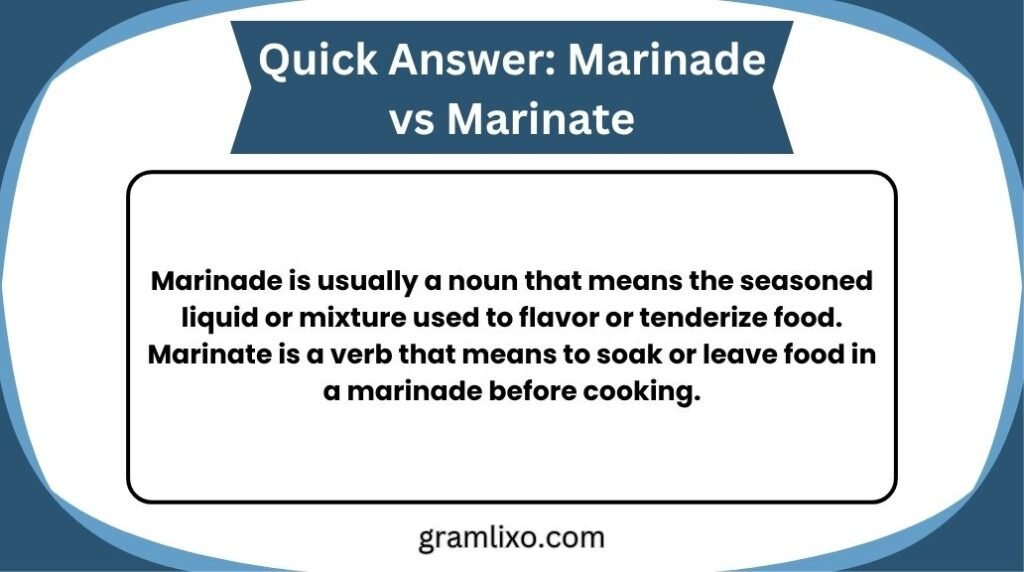
Marinade is usually a noun that means the seasoned liquid or mixture used to flavor or tenderize food. Marinate is a verb that means to soak or leave food in a marinade before cooking.
- Marinade = the mixture
- Marinate = the action
Example:
“Prepare a garlic marinade, then marinate the chicken for four hours.”
That one sentence shows the difference perfectly.
Understanding the Basics: Marinade vs Marinate
The words marinade and marinate come from the same family, so it is easy to confuse them. They are related in meaning but differ in grammatical function.
A marinade is generally the substance or mixture. It may contain ingredients such as oil, vinegar, wine, herbs, spices, citrus juice, or other seasonings.
To marinate means to put food into that mixture and leave it there for a period of time.
Cambridge describes a marinade as a mixture used before cooking to add flavor or make food more tender. It defines marinate as the process of putting food in a marinade or leaving food in one.
Comparison Table
| Form | Type | Meaning | Example | Correct/Incorrect |
|---|---|---|---|---|
| marinade | Noun | A seasoned mixture used for soaking food | “The marinade contains garlic and lemon.” | ✅ Correct |
| marinate | Verb | To soak food in a marinade | “Marinate the chicken overnight.” | ✅ Correct |
| marinated | Past participle/adjective | Food that has been soaked in a marinade | “We served marinated vegetables.” | ✅ Correct |
| marinating | Present participle/gerund | The act of soaking food in a marinade | “The beef is marinating.” | ✅ Correct |
| marinade | Verb | To soak food in a marinade | “Marinade the chicken.” | ⚠️ Possible, but less standard in American English |
| marinate | Noun | A seasoned liquid or mixture | “Add the marinate to the bowl.” | ❌ Generally incorrect |
The important point is that marinade is overwhelmingly familiar as a noun in American English, while marinate is the standard verb for the action. Some dictionaries do recognize marinade as a verb, but it is less common and may sound unusual to many American English speakers. Oxford lists marinade as a verb as well as marinate, while American Heritage also gives marinade a verbal meaning.
What Does “Marinade” Mean?
Marinade as a Noun
The most common use of marinade is as a noun.
A marinade is a seasoned liquid or mixture in which food is soaked before cooking. It can be used with meat, fish, poultry, vegetables, tofu, and other foods.
For example:
- “The marinade contains olive oil, garlic, and lemon juice.”
- “I made a spicy marinade for the chicken.”
- “Pour the marinade over the vegetables.”
- “This marinade has a strong garlic flavor.”
In each sentence, marinade names a thing.
You can usually replace it with a phrase such as “seasoned mixture” or “flavoring mixture.”
“I made a marinade.”
means:
“I made a seasoned mixture for soaking the food.”
That is why the noun form works naturally in recipes.
How to Identify the Noun
Try placing a, the, or this before the word.
- a marinade ✅
- the marinade ✅
- this marinade ✅
- a marinate ❌
This is a quick grammatical clue that you are dealing with the noun marinade.
What Does “Marinate” Mean?
Marinate as a Verb
Marinate is the standard verb used when you describe the action of soaking food in a marinade.
For example:
- “Marinate the chicken for two hours.”
- “Let the steak marinate overnight.”
- “We marinated the tofu in soy sauce.”
- “The vegetables are marinating in the refrigerator.”
Here, marinate tells us what someone is doing.
Cambridge defines marinate as putting food in a mixture of oil, vinegar or wine, and spices before cooking, often to add flavor or soften the food.
Common Forms of “Marinate”
Because marinate is a verb, it can change according to tense and grammatical structure.
| Form | Example |
|---|---|
| marinate | “Marinate the chicken.” |
| marinates | “She marinates the vegetables.” |
| marinated | “We marinated the steak.” |
| marinating | “He is marinating the tofu.” |
Notice that the spelling changes naturally according to normal English verb rules.
Marinade vs Marinate in Simple Sentences
Sometimes the fastest way to understand the difference is to put the words side by side.
Using “Marinade”
- “The marinade smells delicious.”
- “I prepared a lemon marinade.”
- “Pour the marinade over the chicken.”
- “The marinade contains garlic and herbs.”
In these examples, marinade is the mixture.
Using “Marinate”
- “Marinate the chicken for three hours.”
- “The steak should marinate overnight.”
- “We need to marinate the vegetables.”
- “She is marinating the fish.”
Here, marinate describes the action.
Using Both Together
You can also use both words in one sentence:
“Prepare the marinade and marinate the chicken for four hours.”
This is an excellent example because the grammatical difference is immediately visible.
Marinade = thing.
Marinate = action.
The Easy Memory Trick
Here is a simple trick you can remember whenever you are unsure.
Think: “What or What to Do?”
If you are talking about what the mixture is, use marinade.
“What did you make?”
“I made a marinade.”
If you are talking about what you do with the food, use marinate.
“What should I do with the chicken?”
“Marinate it.”
So remember:
Marinade = what you use. 🥣
Marinate = what you do. 🍗
This distinction works especially well for recipe instructions.
Correct Meanings and Uses
1. “Marinade” for the Seasoned Mixture
Use marinade when referring to the liquid or mixture.
Example:
“The marinade includes olive oil, garlic, lemon juice, and black pepper.”
Breakdown:
- The marinade = noun
- includes = verb
- olive oil, garlic, lemon juice, and black pepper = ingredients
The word marinade identifies the mixture itself.
2. “Marinate” for the Action
Use marinate when telling someone to soak food in the mixture.
Example:
“Marinate the chicken for at least two hours.”
Breakdown:
- Marinate = verb
- the chicken = object
- for at least two hours = time expression
The sentence gives an instruction, so a verb is required.
3. “Marinated” for Food That Has Been Soaked
Marinated is the past participle of marinate and is frequently used as an adjective.
Examples:
- “We ordered marinated chicken.”
- “The restaurant serves marinated vegetables.”
- “The marinated steak was ready for the grill.”
Here, marinated describes the food.
4. “Marinating” for an Ongoing Process
Use marinating when the process is currently happening.
Examples:
- “The chicken is marinating in the refrigerator.”
- “I am marinating the tofu right now.”
- “The vegetables were marinating for several hours.”
The -ing form shows an ongoing or continuing action.
Test Tip: Replace the Word
When you are unsure whether to use marinade or marinate, try replacing the word.
If “mixture” works:
Use marinade.
“The marinade is spicy.”
Try:
“The mixture is spicy.”
That works.
If “soak” works:
Use marinate.
“Marinate the chicken.”
Try:
“Soak the chicken in the mixture.”
The meaning is close enough to confirm that you need a verb.
This simple substitution test can help you catch many mistakes quickly.
A Real-Life Case Study
Imagine that you are sending an email to a coworker about a company barbecue.
You might write:
“I prepared the marinade for the chicken. Please marinate the chicken for about four hours before we grill it.”
This example uses both words correctly.
The first sentence identifies the mixture:
the marinade
The second sentence describes the action:
marinate the chicken
Now imagine someone writes:
“I prepared the marinate for the chicken.”
That sounds incorrect in standard American English because the writer is naming a mixture. The noun marinade is the natural choice.
Likewise:
“Please marinade the chicken.”
is not the usual American English choice. Marinate is the standard verb.
Grammar Rules: Why Are They Different?
The main reason is grammatical function.
Marinade commonly functions as a noun:
“The marinade is ready.”
Marinate functions as a verb:
“Marinate the chicken.”
This is similar to many other English word pairs in which related words have different grammatical roles.
For example:
- advice = noun
- advise = verb
Or:
- practice = noun
- practise = verb in British English
With marinade and marinate, the relationship is slightly different because dictionaries recognize some overlap.
Cambridge lists marinade as a noun and also records it as a verb referring users to marinate. Oxford similarly lists marinade as a verb meaning the same as marinate.
However, marinate remains the clearest and most familiar verb choice in American English. Collins also defines American English marinate as soaking food in a marinade.
So, for clear US English writing:
Use “marinade” as the noun and “marinate” as the verb.
That distinction is especially useful for formal writing, recipes, educational content, and professional communication.
Is “Marinade” Ever a Verb?
Yes, and this is an important exception.
Some dictionaries recognize marinade as a verb. Oxford lists it as an alternative to marinate, and American Heritage defines the verb marinade as soaking food in a marinade.
For example:
“Marinade the chicken for several hours.”
This usage exists, but it is not generally the first choice for American English speakers.
If your goal is to write naturally and avoid confusion, marinate is the safer verb.
Compare:
- “Marinate the chicken.” — natural and standard
- “Marinade the chicken.” — recognized by some dictionaries, but less conventional
This is why saying that “marinade” can never be a verb would be too absolute. English dictionaries document the verbal use.
Common Mistakes With Marinade vs Marinate
Mistake 1: Using “Marinate” as a Noun
❌ “Pour the marinate over the steak.”
In standard American English, this should normally be:
✅ “Pour the marinade over the steak.”
The mixture is a marinade.
Mistake 2: Using “Marinade” as a Verb
❌ “Marinade the chicken overnight.”
For standard American English, the clearer version is:
✅ “Marinate the chicken overnight.”
The action requires the verb marinate.
Mistake 3: Confusing “Marinated” With “Marinade”
❌ “The marinade chicken is ready.”
✅ “The marinated chicken is ready.”
Marinated describes chicken that has been soaked in a marinade.
Mistake 4: Confusing “Marinating” With “Marinade”
❌ “The chicken is marinade.”
✅ “The chicken is marinating.”
The first sentence incorrectly uses a noun where a participle is required.
Why Do These Mistakes Happen?
There are several reasons.
Fast Typing
When people type quickly, they often choose the word that looks most familiar. Because marinade and marinate share most of their letters, it is easy to type one instead of the other.
Autocorrect
Autocorrect can also contribute to confusion. If you type a less common form or make a small spelling error, software may automatically replace it with another word.
Lack of Knowledge
Some writers simply have not learned the grammatical difference. Since the words have related meanings and nearly identical spellings, the confusion is understandable.
Pronunciation
The pronunciation difference can also cause uncertainty. In American English, marinade as a noun is commonly pronounced roughly like “MAIR-uh-nahd,” while marinate is pronounced roughly like “MAIR-uh-nayt.” Cambridge provides separate pronunciations for the two words.
Similar Grammar Confusions
The marinade vs marinate problem is part of a larger pattern in English: words that look or sound similar but perform different grammatical jobs.
| Confusing Pair | Correct Difference | Example |
|---|---|---|
| marinade / marinate | noun / verb | “Make a marinade.” / “Marinate the chicken.” |
| advice / advise | noun / verb | “She gave advice.” / “I advise caution.” |
| practice / practise | noun / verb in British English | “Good practice.” / “They practise daily.” |
| affect / effect | usually verb / noun | “It may affect us.” / “The effect was clear.” |
| your / you’re | possessive / contraction | “Your book.” / “You’re ready.” |
| its / it’s | possessive / contraction | “Its color.” / “It’s red.” |
| then / than | time/result / comparison | “First, then later.” / “Taller than me.” |
| advice / advise | noun / verb | “Her advice helped.” / “I advise waiting.” |
Learning these patterns can improve both grammar accuracy and writing confidence.
Usage in Different Contexts
Everyday Conversation
In casual conversation, you might say:
“I need to marinate the chicken.”
Or:
“This marinade is really good.”
Both sound natural.
If you are discussing dinner plans, marinate is usually the action word:
“I’ll marinate the steak before dinner.”
Professional Writing
In professional writing, precision is particularly useful.
For example:
“Please marinate the chicken for four hours before cooking.”
This is clear and direct.
In a restaurant or food-production context, you might also write:
“The marinade contains soy sauce, garlic, ginger, and sesame oil.”
Using the appropriate grammatical form makes instructions easier to follow.
Creative Writing
Creative writers may use these words to make food descriptions more vivid.
“The rich citrus marinade filled the kitchen with a fresh aroma.”
Or:
“She let the vegetables marinate while preparing the rest of the meal.”
The distinction remains the same even when the writing becomes more descriptive.
Social Media and Texting
Informal communication often ignores strict grammar rules, but the distinction can still help.
For example:
“Making my favorite marinade tonight! 😋”
or:
“Letting the chicken marinate overnight. 🍗”
These forms are short, natural, and grammatically clear.
Why the Difference Matters
Clarity in Communication
A small grammatical difference can change how easily a reader understands a sentence.
Compare:
“Make the marinade.”
and:
“Marinate the chicken.”
The first tells you to prepare the mixture. The second tells you what to do with the food.
Professionalism
Correct word choice can make recipes, menus, food blogs, restaurant instructions, and professional documents appear more polished.
Accuracy in Digital Communication
Online recipes are often scanned quickly. Clear language helps readers understand instructions without stopping to interpret what the writer means.
Better Search-Friendly Content
For content creators, using words according to their actual grammatical roles also helps create clearer explanations around related search terms. Natural usage is more valuable than repeating the keyword unnaturally.
A Short Reminder
Clear words make clear instructions.
That principle applies especially well to cooking language.
Special Exception: When “Marinade” Is a Verb
The most important exception is that marinade is not exclusively a noun.
Some major dictionaries recognize marinade as a verb meaning essentially the same thing as marinate. Oxford lists marinade as an alternative verb, and American Heritage gives it the meaning “to soak” food in a marinade.
This means:
“Marinade the chicken.”
is not simply an invented word.
However, if you are writing for a general American English audience and want the most conventional verb, marinate is the better choice.
The key distinction is therefore:
Most common noun: marinade
Most common verb: marinate
That is more accurate than claiming that one form is always grammatically possible and the other is always grammatically impossible.
Pronunciation Difference
Pronunciation can also help you remember the distinction.
Marinade
As a noun in American English, marinade is commonly pronounced approximately:
MAIR-uh-nahd
Marinate
Marinate is commonly pronounced approximately:
MAIR-uh-nayt
The ending is the biggest clue:
- marinade → “-nahd”
- marinate → “-nayt”
Cambridge’s American English entries give different pronunciations for the two forms.
Marinade vs Marinate in Recipe Instructions
Recipes provide one of the easiest places to see the distinction.
Example 1
“Prepare a simple marinade with olive oil, lemon juice, garlic, and herbs.”
Here, marinade is the mixture.
Example 2
“Marinate the chicken for at least two hours.”
Here, marinate is the action.
Example 3
“The chicken should be marinated before grilling.”
Here, marinated describes the completed process.
Example 4
“The chicken is marinating in the refrigerator.”
Here, marinating describes an ongoing process.
These four forms are related:
marinade → mixture
marinate → action
marinated → completed action/result
marinating → ongoing action
How to Choose the Right Word
Ask yourself one question:
“Am I naming the mixture or describing the action?”
If you are naming the mixture:
Use marinade.
“The marinade contains honey.”
If you are describing the action:
Use marinate.
“Marinate the chicken in honey and soy sauce.”
If you are describing food that has undergone the process:
Use marinated.
“The marinated chicken is ready.”
If the process is happening now:
Use marinating.
“The chicken is marinating.”
This four-part system covers most everyday uses.
Quick Recap Checklist
| Question | If Yes → Use |
|---|---|
| Are you naming the seasoned mixture? | marinade |
| Are you telling someone to soak food? | marinate |
| Are you describing food already soaked in the mixture? | marinated |
| Are you describing the process happening now? | marinating |
| Are you writing formal or standard US English? | Prefer marinate as the verb |
Practice Examples
1. “I made a spicy ______ for the chicken.”
Answer: marinade
2. “We should ______ the steak before grilling it.”
Answer: marinate
3. “The ______ vegetables were full of flavor.”
Answer: marinated
Frequently Asked Questions
Is marinade a noun or a verb?
Marinade is most commonly a noun meaning a seasoned mixture used to soak food. Some dictionaries also recognize marinade as a verb meaning marinate, but marinate is the more conventional verb in American English.
Is it “marinate the chicken” or “marinade the chicken”?
For standard American English, “marinate the chicken” is the clearest and most conventional choice.
“Marinate the chicken for three hours.”
Some dictionaries recognize marinade as a verb, but marinate is generally preferable when you want the standard verb form.
What is a marinade?
A marinade is a seasoned liquid or mixture in which food is soaked before cooking. It may contain ingredients such as oil, vinegar, wine, herbs, spices, or other flavoring ingredients.
What does marinate mean?
Marinate means to soak or leave food in a marinade before cooking, usually to add flavor and sometimes to help make the food more tender.
Can vegetables be marinated?
Yes. Although the words are often associated with meat, vegetables can also be marinated. The verb marinate can describe soaking various foods in a seasoned mixture.
Is “marinaded” correct?
Yes. Marinaded is used as the past tense and past participle of the verb marinade when that verbal form is chosen. However, with the standard verb marinate, the corresponding form is marinated. Collins and Oxford both document the forms associated with marinade as a verb.
Final Conclusion
The difference between marinade vs marinate becomes easy once you focus on grammatical function. Marinade is usually a noun that names the seasoned mixture used to flavor or tenderize food. Marinate is the standard verb that describes putting food into that mixture and leaving it there before cooking.
For example, you can make a marinade and then marinate the chicken. Afterward, you can describe the food as marinated chicken. This simple pattern works in recipes, everyday conversation, professional writing, and online content.
Although dictionaries recognize marinade as a verb in some varieties and contexts, marinate is the clearer and more conventional verb for standard American English.
So remember the simplest rule: the marinade is the mixture; to marinate is the action. Once you remember that distinction, you will rarely confuse these two words again.

I’m Robert Williams, an English grammar writer at Gramlixo. I focus on breaking down confusing grammar rules into simple explanations and useful examples.


[…] |Marinade vs Marinate: What’s the Difference? […]