Have you ever paused while writing a sentence and wondered whether it should be “a hilarious” or “an hilarious”? You are not alone. The confusion usually happens because hilarious begins with the letter h, while the choice between a and an depends on pronunciation, not simply on the first letter.
The good news is that the rule is straightforward. In standard modern American English, “a hilarious” is the correct and natural form because hilarious begins with a pronounced /h/ sound. For example, we say, “That was a hilarious story,” not “That was an hilarious story.”
This distinction is important because English articles are based on sound. We use a before a consonant sound and an before a vowel sound. Since hilarious is pronounced with an audible /h/ sound, a hilarious is the standard choice.
In this guide, we will examine a hilarious vs. an hilarious, explain the grammar rule, explore common mistakes, and give you practical examples so you can use the correct form confidently. 😊
|Any Problem vs Any Problems: Which One Is Correct?
|Worn vs Warn: What’s the Difference?
|Indolence vs Insolence: Meaning, Differences, Examples, and Correct Usage
Quick Answer: A Hilarious or An Hilarious?
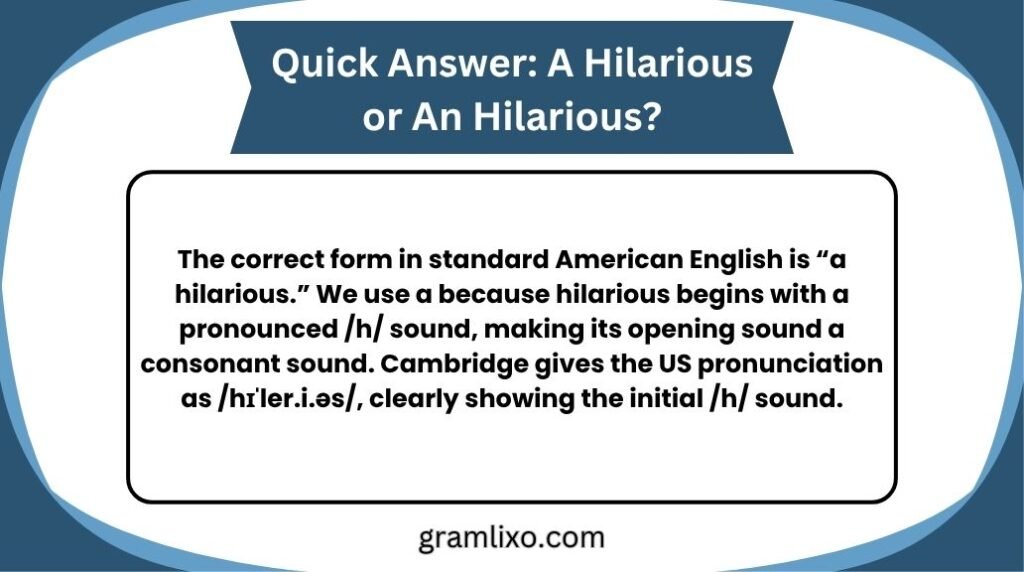
The correct form in standard American English is “a hilarious.” We use a because hilarious begins with a pronounced /h/ sound, making its opening sound a consonant sound. Cambridge gives the US pronunciation as /hɪˈler.i.əs/, clearly showing the initial /h/ sound.
Correct: She told a hilarious story.
Incorrect in standard usage: She told an hilarious story.
The key is simple: choose the article according to the sound that follows it, not merely the written letter.
Understanding the Basics of A Hilarious vs. An Hilarious
To understand why a hilarious is correct, you first need to understand how English uses the indefinite articles a and an.
Both words are indefinite articles. They refer to one person, thing, event, idea, or example without identifying it as a specific known item.
The basic rule is:
- Use a before a consonant sound.
- Use an before a vowel sound.
For example:
- a book
- a teacher
- a funny story
- an apple
- an interesting idea
- an unusual event
Notice that the rule is based on sound, not spelling.
The word hilarious begins with a pronounced /h/ sound. Therefore, it takes a, not an.
A Hilarious vs. An Hilarious Comparison Table
| Form | Type | Meaning | Example | Correct/Incorrect |
|---|---|---|---|---|
| a hilarious | Indefinite article + adjective | One extremely funny person, thing, event, or situation | It was a hilarious mistake. | ✅ Correct |
| an hilarious | Indefinite article + adjective | Intended to mean the same thing | It was an hilarious mistake. | ❌ Nonstandard in modern US English |
| hilarious | Adjective | Extremely funny | The movie was hilarious. | ✅ Correct |
| a funny | Indefinite article + adjective | One funny person, thing, event, or situation | She told a funny joke. | ✅ Correct |
The most important point is that hilarious starts with a consonant sound, even though its first letter is h.
What Does Hilarious Mean?
Before discussing the article, it helps to understand the word itself.
Hilarious is an adjective meaning extremely funny or causing a lot of laughter. Cambridge Dictionary classifies it as an adjective and defines it as something extremely funny and likely to cause considerable laughter.
For example:
The comedian told a hilarious story.
Here:
- The = definite article
- comedian = noun
- told = verb
- a = indefinite article
- hilarious = adjective
- story = noun
The adjective hilarious describes the noun story. Because story is a singular countable noun, we need an article before the adjective-noun combination.
So we say:
a hilarious story
Not:
an hilarious story
Why “A Hilarious” Is Correct
The main reason is pronunciation.
The word hilarious begins with the sound /h/. That sound is a consonant sound.
Cambridge lists the US pronunciation as /hɪˈler.i.əs/ and explicitly identifies the initial sound as /h/.
Because the initial sound is a consonant sound, the correct indefinite article is a.
Example 1: A Hilarious Story
She told us a hilarious story.
The word following a begins with the /h/ sound:
a + hilarious
This follows the same pattern as:
- a happy child
- a helpful teacher
- a hilarious story
- a humorous comment
- a historical event
The written letter h does not automatically require an.
Example 2: A Hilarious Movie
We watched a hilarious movie last night.
Again, hilarious starts with a pronounced /h/. Therefore:
a hilarious movie ✅
Example 3: A Hilarious Mistake
I made a hilarious mistake during the presentation.
The mistake was extremely funny, so hilarious describes mistake.
The article remains a because the next sound is /h/.
Why “An Hilarious” Sounds Wrong to Most American English Speakers
The phrase “an hilarious” can sometimes appear in older writing, historical texts, or varieties of English influenced by older pronunciation patterns. However, in contemporary standard American English, a hilarious is the natural and recommended choice.
The reason is pronunciation.
When speakers say hilarious, they normally pronounce the /h/:
hilarious → /hɪˈler.i.əs/
That makes the opening sound similar to other words beginning with pronounced h:
- a happy
- a healthy
- a helpful
- a hilarious
- a historic
Therefore, saying an hilarious can sound unnatural to a modern American English speaker.
The Real Rule: Articles Depend on Sound
This is one of the most useful grammar rules to remember.
Do not ask:
“Does the word begin with a vowel letter?”
Instead, ask:
“Does the word begin with a vowel sound?”
This explains many common English article patterns.
Words Beginning With Consonant Letters and Sounds
Use a:
- a house
- a hotel
- a hilarious story
- a university
- a useful tool
Notice something interesting about university. It begins with the letter u, but its first sound is /j/, similar to the beginning of you. That is a consonant sound.
Therefore:
a university
not:
an university
Words Beginning With Vowel Letters and Sounds
Use an:
- an apple
- an orange
- an idea
- an unusual situation
- an interesting story
The first sound is a vowel sound, so an is appropriate.
What About the Word “Hour”?
This is where the rule becomes especially useful.
We say:
an hour
Why?
Because the h is silent.
Hour is pronounced with a vowel sound at the beginning. Therefore:
an hour ✅
Compare that with:
a hilarious story ✅
The h in hilarious is pronounced.
This gives you a simple comparison:
| Word | Initial Sound | Correct Article |
|---|---|---|
| hilarious | /h/ | a hilarious |
| happy | /h/ | a happy |
| house | /h/ | a house |
| hour | vowel sound | an hour |
| honest | vowel sound | an honest |
| honor | vowel sound | an honor |
The spelling alone does not determine the article.
Correct Meanings and Uses of “A Hilarious”
The phrase a hilarious normally appears before a singular countable noun.
For example:
That was a hilarious joke.
Here, hilarious modifies joke.
A Hilarious Joke
A joke can be described as hilarious when it causes strong laughter.
He told a hilarious joke at dinner.
Breakdown:
- a = indefinite article
- hilarious = adjective
- joke = singular countable noun
A Hilarious Person
You can also describe someone’s personality or behavior.
She is a hilarious person.
Here, hilarious describes the person.
However, context matters. Calling someone “hilarious” usually means that person is extremely funny, entertaining, or consistently makes people laugh.
A Hilarious Situation
You can use the phrase to describe something funny that happens.
We ended up in a hilarious situation at the airport.
The situation itself caused amusement.
A Hilarious Mistake
Mistakes can sometimes be funny rather than serious.
He made a hilarious mistake during the meeting.
This means the mistake was amusing or caused laughter.
A Hilarious Story
Stories are commonly described as hilarious.
My grandfather told us a hilarious story about his childhood.
The story is extremely funny.
Test Tip: The “Say It Aloud” Method
Here is an easy test.
Say the phrase naturally aloud:
a hilarious
You will hear the /h/ sound immediately.
Now compare it with:
an hilarious
For most modern American English speakers, the second version sounds awkward.
The Three-Second Test
When you are unsure about a or an, follow these steps:
- Say the next word aloud.
- Listen to its first sound.
- If it begins with a consonant sound, use a.
- If it begins with a vowel sound, use an.
For hilarious:
hilarious → /h/ → consonant sound → a
So:
a hilarious ✅
Case Study: A Workplace Email
Imagine that an employee is writing a message to a coworker after a funny presentation.
Incorrect Version
Thanks for the presentation. It was an hilarious explanation of the new process.
The phrase an hilarious is not the standard choice in contemporary American English.
Correct Version
Thanks for the presentation. It was a hilarious explanation of the new process.
This version follows standard article usage.
Why the Correct Version Works
The noun phrase is:
a + hilarious + explanation
The article comes before the adjective, but the article is determined by the pronunciation of the adjective immediately following it.
Because hilarious starts with /h/, we use a.
This rule is useful in professional emails, reports, presentations, blogs, academic writing, and everyday communication.
Grammar Rules: Why “A” Comes Before Hilarious
The indefinite articles a and an are used before singular countable nouns.
When an adjective comes between the article and the noun, the article is selected according to the sound of the adjective.
Consider:
a book
Now add an adjective:
a funny book
Now replace funny with hilarious:
a hilarious book
The structure is:
article + adjective + noun
Because hilarious starts with a consonant sound, the article remains a.
What Merriam-Webster Adds to the Picture
Merriam-Webster identifies hilarious as a word related to the idea of being extremely amusing, and its word-history material notes that hilarious ultimately comes from the Latin hilarus, meaning cheerful.
The important grammar point, however, is not the word’s origin. Modern usage depends on its current pronunciation.
In contemporary American English, hilarious is pronounced with an audible initial /h/, so a hilarious is the standard construction.
A Hilarious vs. An Hilarious: Pronunciation Matters
English learners often make article choices based on spelling.
That approach works sometimes, but it fails with many words.
For example:
a university
The first letter is u, but the pronunciation begins with a /y/ sound.
Similarly:
an hour
The first letter is h, but the h is silent.
Now consider:
a hilarious story
The first letter is h, and the /h/ is pronounced.
This gives us three different patterns:
- a university → consonant /y/ sound
- an hour → vowel sound because h is silent
- a hilarious story → consonant /h/ sound
That is why listening to pronunciation is more reliable than looking only at spelling.
Common Mistakes With A Hilarious and An Hilarious
Why do people write an hilarious?
There are several possible reasons.
1. Confusion About the Letter H
Some writers remember a simplified rule:
“Words beginning with vowels use an.”
They may then see hilarious and wonder whether the h behaves like a vowel.
It does not.
The /h/ sound is pronounced.
2. Confusion With “An Hour”
Many learners correctly learn:
an hour
They may then assume every word beginning with h takes an.
That is incorrect.
The silent h in hour is what creates the vowel sound. The h in hilarious is pronounced.
3. Fast Typing
People often write quickly, especially in emails, messages, and online comments.
Fast typing can cause article mistakes even when the writer knows the rule.
4. Autocorrect
Autocorrect and predictive text can sometimes reinforce an incorrect phrase if similar wording has appeared frequently in a user’s writing or online data.
Always read the complete sentence after typing.
5. Lack of Knowledge
Some learners simply have not encountered the sound-based rule yet.
Once you understand it, the difference becomes much easier.
Similar Grammar Confusions
The confusion between a hilarious and an hilarious belongs to a larger group of common English mistakes.
| Confusion | Correct Form | Why |
|---|---|---|
| its / it’s | its = possession; it’s = it is | Different grammatical functions |
| your / you’re | your = possession; you’re = you are | Different meanings |
| their / there / they’re | Different meanings | Homophones |
| a / an | Based on sound | Article rule |
| then / than | Different meanings | Time vs. comparison |
| affect / effect | Usually verb vs. noun | Different grammatical roles |
| fewer / less | Usually countable vs. uncountable | Different noun types |
| who / whom | Subject vs. object in formal usage | Different grammatical functions |
These mistakes are common because English contains many words and forms that look or sound similar.
Usage in Different Contexts
Everyday Conversation
In everyday American English, a hilarious is completely natural.
Examples:
That was a hilarious joke!
I just watched a hilarious video.
She told me a hilarious story.
These sound normal and conversational.
Professional Writing
Professional writing should use the standard form:
The team shared a hilarious anecdote during the presentation.
You might use hilarious in an informal workplace setting, although more formal documents may prefer words such as amusing, humorous, or entertaining, depending on the context.
Creative Writing
Writers can use a hilarious naturally:
He described the incident as a hilarious disaster that nobody would ever forget.
Creative writing allows flexibility in tone, but standard grammar still provides the foundation.
Social Media and Texting
Social media is more relaxed, so users often ignore conventional grammar.
You may encounter:
That was hilarious 😂
or:
I just saw a hilarious video!
The second sentence uses the standard article correctly.
In casual texting, grammar may be abbreviated, but when you are writing a polished caption, blog post, article, or professional message, a hilarious is the better choice.
Why This Grammar Rule Matters
At first, a hilarious vs. an hilarious may seem like a tiny issue. It is a tiny issue—but small grammar choices can make a big difference in polished writing.
1. Clarity
Correct article usage makes sentences easier to process.
She told a hilarious story.
The sentence sounds natural and effortless.
2. Professionalism
In professional communication, small grammar mistakes can affect how polished your writing appears.
A correct article helps your writing look carefully edited.
3. Digital Communication
Blogs, websites, emails, social media posts, and online publications are read quickly. Clear grammar helps readers understand your meaning without distraction.
4. Confidence
Knowing the rule makes writing faster.
Instead of stopping to wonder whether it is a hilarious or an hilarious, you can confidently choose:
a hilarious
A useful reminder is:
“Articles follow sounds, not letters.”
That short sentence can save you from many similar mistakes.
Special Exception: Historical or Variant Usage
There is an important distinction between modern standard usage and historical or stylistic variation.
You may occasionally find “an hilarious” in older literature, historical documents, or writing influenced by older pronunciation conventions. English article usage has changed over time, and pronunciation itself can vary across periods, regions, and speakers.
That does not mean an hilarious is the recommended choice for modern American English.
For contemporary US English, especially in:
- blogs
- academic writing
- professional emails
- websites
- educational content
- business communication
- SEO articles
the safest standard form is:
a hilarious
There is no common modern American English pronunciation of hilarious that requires an.
Is “An Hilarious” Ever Acceptable?
In modern standard American English, a hilarious is the form you should normally use.
If you encounter an hilarious in a published source, it does not automatically mean the writer is using modern standard American grammar. It could reflect:
- historical usage
- regional usage
- editorial style
- an individual pronunciation
- an older text
- a simple grammatical error
For your own writing, especially when aiming for clear standard US English, choose a hilarious.
A Simple Memory Trick
Here is an easy way to remember the rule:
H Is Heard → Use A
If you hear the h, use a.
hilarious → h is heard → a hilarious
If the h is silent and the word begins with a vowel sound, use an.
hour → h is silent → an hour
Think:
Heard H = A
Silent H = AN
This is not a complete rule for every English word, but it is an excellent shortcut for words beginning with h.
More Examples of Correct Usage
Here are several natural examples:
- That was a hilarious joke.
- We watched a hilarious movie.
- She told a hilarious story.
- He made a hilarious comment.
- They had a hilarious conversation.
- It was a hilarious mistake.
- We witnessed a hilarious scene.
- She shared a hilarious memory.
- He gave a hilarious explanation.
- The comedian created a hilarious character.
In every example, hilarious begins with a pronounced /h/, so a is correct.
What If “Hilarious” Comes After the Noun?
If hilarious appears after the noun, the article question may disappear.
For example:
The movie was hilarious.
There is no article immediately before hilarious because hilarious is functioning as a subject complement after the linking verb was.
Compare:
It was a hilarious movie.
Here, hilarious comes before the singular countable noun movie, so an article is required.
This distinction is useful:
Adjective before singular countable noun:
a hilarious movie
Adjective after linking verb:
The movie was hilarious.
A Hilarious in Questions
The same rule applies in questions.
Did you hear a hilarious story?
Was that a hilarious joke?
Did she tell a hilarious anecdote?
The question structure does not change the article.
The adjective still begins with the /h/ sound.
A Hilarious in Negative Sentences
The same principle applies to negative sentences.
It wasn’t a hilarious movie.
He didn’t tell a hilarious story.
That wasn’t a hilarious joke.
The article remains a.
A Hilarious in Plural Sentences
Remember that a and an are singular indefinite articles.
Therefore, you do not use either one with a plural noun.
Correct:
They told hilarious stories.
Not:
They told a hilarious stories.
And not:
They told an hilarious stories.
The article disappears because stories is plural.
Quick Recap Checklist
Use this checklist whenever you are unsure.
| Question | If Yes → Use |
|---|---|
| Does the next word begin with a consonant sound? | a |
| Does hilarious have a pronounced /h/? | a hilarious |
| Are you writing standard modern American English? | a hilarious |
| Is the h silent, as in hour? | an |
| Is the noun plural? | Usually no a/an |
| Is hilarious used after a linking verb? | Usually no article before the adjective |
Practice Example 1
She told ___ hilarious story.
Answer:
She told a hilarious story.
Practice Example 2
We watched ___ hilarious video.
Answer:
We watched a hilarious video.
Practice Example 3
It was ___ hilarious mistake.
Answer:
It was a hilarious mistake.
Frequently Asked Questions
1. Is it “a hilarious” or “an hilarious”?
The standard form in modern American English is “a hilarious.” The word hilarious begins with a pronounced /h/ consonant sound, so a is used.
2. Why do we say “a hilarious”?
We say “a hilarious” because English articles depend on pronunciation. Since hilarious begins with the consonant sound /h/, it takes a.
3. Is “an hilarious” grammatically correct?
In contemporary standard American English, “an hilarious” is not the normal or recommended form. You should use “a hilarious” in modern US English writing.
4. Does every word beginning with H use “a”?
No. It depends on pronunciation. We say a hilarious story because the /h/ is pronounced, but an hour because the h in hour is silent.
5. Can I say “the hilarious”?
Yes. The follows a different rule. For example:
The hilarious story made everyone laugh.
Use the when referring to a specific person, thing, or situation known from context.
6. Is “hilarious” a noun or an adjective?
Hilarious is an adjective. It describes something extremely funny or amusing. For example:
That was a hilarious joke.
Here, hilarious describes the noun joke.
Conclusion
When deciding between “a hilarious” and “an hilarious,” the correct choice for standard modern American English is “a hilarious.” The reason is simple: hilarious begins with a clearly pronounced /h/ consonant sound. Since a is used before consonant sounds, we say “a hilarious story,” “a hilarious joke,” and “a hilarious mistake.”
The confusion often comes from words such as hour, honest, and honor, where the h is silent and an is appropriate. But hilarious does not follow that pattern. Its initial /h/ is pronounced, which makes a hilarious the natural standard form.
Remember the easiest rule: articles depend on sound, not spelling. If you can hear the /h/ in hilarious, choose a.
So, the next time you hesitate, don’t overthink it. Write:
a hilarious ✅
Heard “H”? Choose “A”—and keep your grammar hilarious for the right reasons! 😄

I’m Christopher Garcia, an English writer and grammar enthusiast at Gramlixo. I enjoy making grammar easy to understand through clear explanations and practical examples.
[…] |A Hilarious or An Hilarious: Which Is Correct? […]