If you have ever written an email, filled out a form, worked with software, or read a technical instruction, you may have paused over unregister vs deregister. 🤔
Both words seem to describe the opposite of registering something, so it is natural to wonder whether one is correct and the other is wrong.
The good news is that both “unregister” and “deregister” are legitimate English verbs. In many situations, they can be used interchangeably to describe removing someone or something from a registration, list, database, service, or system.
“Unregister” is especially common in technology and software contexts, while “deregister” often sounds more formal and is frequently used for official records, organizations, vehicles, courses, and administrative processes.
In this guide, I’ll explain the difference between unregister vs deregister, show you when to use each word, examine common mistakes, and give you practical examples. By the end, you will know exactly which word fits your sentence—and why. ✅
|Its-Self vs. Itself: Which Is Correct? A Complete Grammar Guide
|Imbed vs Embed: What’s the Difference and Which One Should You Use?
|Brite vs Bright: What’s the Difference and Which One Is Correct?
Quick Answer: Unregister vs Deregister
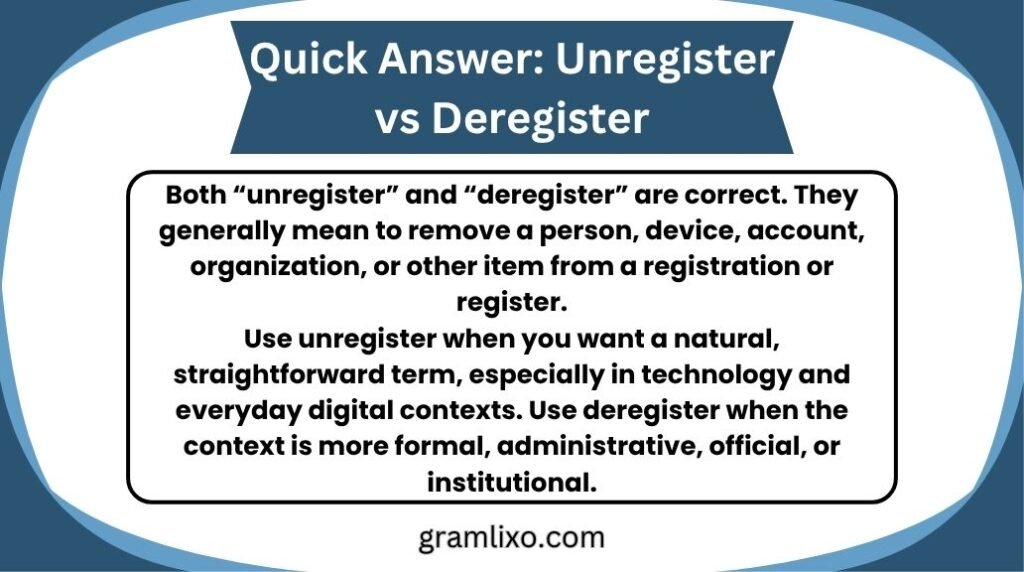
Both “unregister” and “deregister” are correct. They generally mean to remove a person, device, account, organization, or other item from a registration or register.
Use unregister when you want a natural, straightforward term, especially in technology and everyday digital contexts. Use deregister when the context is more formal, administrative, official, or institutional.
Example:
- “Please unregister your old device from the account.”
- “The company decided to deregister the vehicle.”
The exact choice often depends more on context and style than on grammatical correctness.
Understanding the Basics of Unregister vs Deregister
At their core, both verbs describe reversing or ending a registration.
The important point is that neither word should automatically be labeled “incorrect.” Dictionaries and English-language references recognize deregister as a verb meaning to remove someone or something from a register. Collins, for example, defines deregister as removing oneself, a car, or another item from a register.
Likewise, unregister is used to mean undoing a registration process.
Comparison Table
| Form | Type | Meaning | Example | Correct/Incorrect |
|---|---|---|---|---|
| register | Verb | To officially record or enroll | “Please register your account.” | ✅ Correct |
| unregister | Verb | To undo or reverse registration | “Unregister the old device.” | ✅ Correct |
| deregister | Verb | To remove from a register | “The company deregistered the vehicle.” | ✅ Correct |
| registered | Adjective/past participle | Officially recorded | “The vehicle is registered.” | ✅ Correct |
| unregistered | Adjective/past participle | Not registered | “The device is unregistered.” | ✅ Correct |
| deregistered | Past tense/past participle | Removed from a register | “The account was deregistered.” | ✅ Correct |
So, if you have been wondering whether “unregister” is a mistake because “deregister” sounds more formal, the answer is no. Both forms exist.
What Does “Unregister” Mean?
Unregister means to undo a registration or remove something from a registered status or system.
The word is formed from:
un- + register = unregister
The prefix un- often expresses reversal or removal. In this case, unregister suggests reversing the action of registering.
For example:
“I need to unregister my old phone.”
This means the speaker wants to remove the phone from a registration or account.
Unregister in Technology
One of the most common places you will see unregister is in technology.
You might:
- unregister a device
- unregister an application
- unregister a user
- unregister an event listener
- unregister a domain
- unregister an account
- unregister from a service
For example:
“You should unregister the old device before adding the new one.”
Here, unregister clearly communicates the idea of removing an existing association.
In programming, the word can be especially natural because developers frequently use pairs such as:
- register / unregister
- subscribe / unsubscribe
- connect / disconnect
- install / uninstall
Merriam-Webster similarly recognizes the broader linguistic pattern in words such as uninstall, meaning to remove software from a computer system.
Sentence Breakdown
Consider:
“Please unregister your account before creating a new one.”
- Please = polite introductory word
- unregister = main verb
- your account = direct object
- before creating a new one = time-related phrase
The sentence tells the reader to reverse the account’s registration.
What Does “Deregister” Mean?
Deregister means to remove someone or something from a register.
Collins defines the word as removing oneself, a car, or another item from a register.
The structure is:
de- + register = deregister
The prefix de- can indicate removal, reversal, or separation from a particular condition or process.
Examples of Deregister
You can deregister:
- a vehicle
- a company
- a student
- a professional
- a business
- a course enrollment
- a phone number
- a device
- shares
- an organization
For example:
“The owner decided to deregister the vehicle.”
This sounds particularly natural in an administrative or official context.
Another example is:
“Students must deregister from the course before the deadline.”
This is formal and appropriate for university instructions.
Sentence Breakdown
“The company plans to deregister its shares.”
- The company = subject
- plans = main verb
- to deregister = infinitive
- its shares = object
The sentence describes an official administrative action.
Unregister vs Deregister: Are They Synonyms?
In many contexts, yes.
Both words can describe removing a person, object, or account from a registration system.
For example:
“You can unregister from the service at any time.”
and:
“You can deregister from the service at any time.”
Both can communicate essentially the same idea.
However, their tone and preferred contexts can differ.
Unregister Usually Feels More Direct
“Unregister” often sounds:
- modern
- technical
- digital
- straightforward
- user-friendly
For example:
“Unregister your device.”
That sounds perfectly natural in a software interface.
Deregister Often Feels More Formal
“Deregister” often sounds:
- administrative
- official
- institutional
- regulatory
- procedural
For example:
“The organization was deregistered from the official registry.”
That sentence has a formal, bureaucratic tone.
The distinction is not an absolute grammar rule. It is primarily a matter of usage, context, and register.
When Should You Use “Unregister”?
Use unregister when you are talking about reversing a registration, especially in digital or technical settings.
1. Software and Apps
“Unregister the application before reinstalling it.”
2. Devices
“I need to unregister my old tablet.”
3. Online Services
“Users can unregister from the mailing system.”
4. Programming
“The script preregisters the event handler.”
5. Accounts
“You can unregister the account from this device.”
These examples are natural because the word fits the idea of undoing an earlier registration action.
When Should You Use “Deregister”?
Use deregister when the situation involves a formal register, official record, institution, or administrative process.
1. Vehicles
“The owner deregistered the vehicle.”
2. Universities
“Students must deregister before leaving the program.”
3. Businesses
“The company plans to deregister from the official registry.”
4. Professional Registration
“The practitioner chose to deregister from the professional body.”
5. Official Records
“The organization was deregistered after failing to meet the requirements.”
These contexts make deregister sound particularly appropriate.
Is “Unregister” More Common in American English?
In modern American English, unregister is especially familiar in technology and software.
Think about the language used in digital systems:
- register a device
- unregister a device
- register a component
- unregister a component
- register an event
- unregister an event
This symmetrical structure is very common in technical writing.
However, you should not conclude that deregister is wrong in American English. It is a legitimate English word and is used in formal and administrative contexts.
Likewise, regional preferences can vary. Dictionary.com labels deregister as British in its entry, while Collins provides the term in its English dictionaries and gives examples of administrative use.
For a US audience, unregister may feel more natural in many software-related situations, while deregister remains appropriate when the context itself is formal.
Is “Deregister” More Formal Than “Unregister”?
Generally, yes, although this is a tendency rather than an unbreakable rule.
Compare:
“Please unregister your phone.”
with:
“The company must deregister the vehicle.”
The first sounds like ordinary technical instructions. The second sounds like an official administrative procedure.
This difference is sometimes called register or style level.
Informal or Technical
“Unregister your old device.”
Formal or Administrative
“The organization must deregister from the national register.”
Both sentences are grammatically sound.
The best choice depends on the audience.
Grammar Rules Behind Unregister and Deregister
There is no basic grammar rule stating that only one of these verbs is correct.
Both are verbs, and both can be conjugated normally.
Present Tense
- I unregister
- You unregister
- He preregisters
- She preregisters
- They unregister
Similarly:
- I deregister
- You deregister
- He deregisters
- She deregisters
- They deregister
Past Tense
- unregistered
- deregistered
Present Participle
- unregistering
- deregistering
Examples
“She preregisters her old device every year.”
“She deregisters her vehicle after selling it.”
“They unregistered from the service.”
“They deregistered from the program.”
All of these forms follow normal English verb patterns.
Collins explicitly lists the conjugation of deregister, including deregistered as the past form and past participle.
What About “Unregistered” vs “Deregistered”?
This is where an important distinction can sometimes appear.
Unregistered
Unregistered can simply mean not registered.
For example:
“The device is unregistered.”
This tells us about its current status. It does not necessarily tell us how it got there.
Perhaps the device was never registered.
Deregistered
Deregistered more strongly suggests that something was actively removed from registration.
For example:
“The vehicle was deregistered last month.”
This suggests that it had a registered status and someone or some authority removed it.
This distinction can be useful in technical writing and programming.
However, real-world usage does not always maintain this distinction perfectly. Context determines the intended meaning.
A Simple Test Tip 🧠
Here is an easy way to choose between the two:
Ask yourself:
“Am I talking about reversing a registration in a digital or everyday system?”
If yes, unregister is often a natural choice.
“Unregister this device.”
“Am I talking about officially removing something from a formal register?”
If yes, deregister may be the better stylistic choice.
“Deregister the vehicle.”
But Remember
This is a style guide, not a strict grammar law.
If the context supports unregister, it is not automatically wrong simply because deregister sounds more formal.
Case Study: An Office Email
Imagine that an employee has left a company, and the IT department needs to remove the employee’s old laptop from the organization’s system.
A natural IT email might say:
“Please unregister the old laptop from the company account before assigning it to another employee.”
Why does unregister work well here?
Because the email deals with:
- technology
- an account
- device management
- a software system
Now imagine an administrative department handling a company vehicle:
“Please deregister the vehicle before transferring ownership.”
Here, deregister feels more suitable because the action involves an official vehicle record.
The Lesson
The two words can describe similar actions, but context influences which one sounds more natural.
Common Mistakes With Unregister vs Deregister
Because the words have almost identical meanings, people sometimes assume that one must be grammatically wrong.
That assumption causes several common mistakes.
Mistake 1: Thinking “Unregister” Is Not a Word
Incorrect belief:
“Deregister is the only correct form.”
Why it is wrong:
Unregister is an established English verb meaning to undo registration.
Correct:
“You can unregister the device.”
Mistake 2: Thinking “Deregister” Is a Spelling Error
Some writers see deregister and assume the writer intended unregister.
That is also incorrect.
Deregister is a legitimate verb. Collins defines it as removing someone or something from a register.
Correct:
“The organization was deregistered.”
Mistake 3: Using “Unregistered” When You Mean “Deregistered”
Compare:
“The account is unregistered.”
This describes a status.
Versus:
“The account was deregistered.”
This emphasizes the action that removed it.
The distinction is subtle but useful.
Why Do These Mistakes Happen?
Fast Typing ⌨️
When people type quickly, they may choose whichever form comes to mind first.
Autocorrect 📱
Software can sometimes push writers toward familiar words or alter unfamiliar ones.
Lack of Knowledge
If someone has never encountered deregister, they may assume unregister is the only possible form.
Likewise, someone familiar with formal administrative English may prefer deregister and mistakenly think unregister is incorrect.
Different Workplace Terminology
A software company may consistently use unregister, while a government department may consistently use deregister.
That creates different expectations.
Similar Grammar Confusions
The unregister vs deregister question is part of a much larger pattern in English. Many words look similar but have different functions.
| Confusion | Correct Difference | Example |
|---|---|---|
| its / it’s | Possessive vs. “it is” | “The dog wagged its tail.” |
| your / you’re | Possessive vs. “you are” | “You’re early.” |
| their / there / they’re | Possession, location, “they are” | “They’re over there.” |
| affect / effect | Usually verb vs. noun | “The change affected sales.” |
| then / than | Time vs. comparison | “Better than before.” |
| accept / except | Receive vs. exclude | “Everyone came except Tom.” |
| advice / advise | Noun vs. verb | “I advise you to listen.” |
| loose / lose | Not tight vs. misplace/fail to win | “Don’t lose your keys.” |
The lesson is simple: similar-looking words are not always interchangeable, but in the case of unregister and deregister, both can legitimately describe reversing registration.
Usage in Different Contexts
Everyday Conversation
In everyday conversation, unregister may sound more natural when discussing accounts, devices, websites, or services.
“I need to unregister my old phone.”
“Can I unregister from this event?”
In a formal administrative conversation, deregister may be preferred.
“You need to deregister the vehicle before moving it abroad.”
Professional Writing
Both words can appear in professional writing.
Technical Professional Writing
“Users can unregister their devices through the settings menu.”
Administrative Professional Writing
“Applicants may deregister from the program before the stated deadline.”
The important thing is consistency.
If your organization has a preferred term, follow its style guide.
Creative Writing
Creative writing gives you more flexibility.
An author might write:
“He quietly unregistered himself from every online service.”
Or:
“She decided to deregister her name from the official list.”
The choice can help establish tone.
Unregister feels modern and digital.
Deregister can feel institutional or formal.
Social Media and Texting
On social media, people generally favor shorter and more familiar language.
You might see:
“I just unregistered my old phone.”
However, ordinary users may also avoid both terms and say:
“I removed my old phone from my account.”
That can be even clearer.
Remember that the best word is not always the most sophisticated word. Clarity comes first.
Unregister vs Deregister in Technology
Technology is one of the most interesting areas for this comparison.
Software developers often use register and unregister as a natural pair.
For example:
“The application registers the event listener when it starts and preregisters it when it closes.”
This pairing makes the relationship immediately obvious.
Technical language often values symmetrical terminology.
Compare:
- register / unregister
- install / uninstall
- connect / disconnect
- subscribe / unsubscribe
- enable / disable
In these cases, unregister can be especially intuitive.
That does not make deregister wrong. It simply means that unregister fits common technical terminology particularly well.
Unregister vs Deregister in Official Contexts
Formal organizations may prefer deregister because the word emphasizes removal from an official register.
Examples include:
“The agency deregistered the company.”
“The owner deregistered the vehicle.”
“The student deregistered from the course.”
“The organization was deregistered from the national database.”
Collins’ examples include administrative and organizational uses of deregister, supporting this formal usage pattern.
What Does “Register” Have to Do With It?
Understanding register makes the two words easier to understand.
To register means to officially record, enroll, or enter something into a system or list.
For example:
“I registered for the conference.”
The opposite action can then be expressed as:
“I unregistered from the conference.”
or:
“I deregistered from the conference.”
Both communicate the idea of reversing the registration.
The choice depends on context and preferred terminology.
Special Exception: Product and Software Terminology
There is an important practical exception to any simple “formal vs. informal” rule.
Some software products, APIs, programming frameworks, and technical systems define their own terminology.
If a program’s documentation specifically says unregister, use unregister.
If official documentation says deregister, use deregister.
For example, a developer should not replace a documented function called unregister() with deregister() merely because the latter sounds more formal.
In technical environments, the system’s established terminology takes priority.
This is especially important for:
- API documentation
- programming guides
- software interfaces
- command-line tools
- database systems
- developer documentation
In technical writing, consistency is often more valuable than trying to impose a general linguistic preference.
Why This Difference Matters
You might wonder: if both words are correct, why spend time learning the difference?
Because good writing is not only about avoiding grammatical errors. It is also about choosing language that helps readers understand your meaning quickly.
1. Clarity in Communication
A well-chosen verb reduces confusion.
“Unregister the device.”
is immediately understandable to many technology users.
Meanwhile:
“Deregister the vehicle.”
sounds appropriate for an official administrative instruction.
2. Professionalism
Using terminology that matches the context makes your writing look more polished.
A software help page may sound awkward if it suddenly uses unnecessarily bureaucratic language.
Likewise, a government form may sound overly casual if it uses informal technical terminology.
3. Accuracy in Digital Communication
Modern communication happens across:
- apps
- websites
- emails
- dashboards
- support tickets
- software documentation
- online forms
Because registration systems are everywhere, knowing the difference between these words helps you communicate precisely.
4. Audience Awareness
A useful principle is:
Choose the word your audience will understand most naturally.
That is often more important than choosing the word that sounds more sophisticated.
A Memorable Rule to Remember
Here is a simple rule:
Unregister often sounds natural in technology; deregister often sounds natural in formal or official contexts.
But remember the second half:
Both are correct English verbs.
Do not mark unregister as wrong simply because you prefer deregister.
And do not assume deregister is too formal to be grammatically correct in everyday contexts.
Quick Recap Checklist
| Question | If Yes → Use |
|---|---|
| Am I reversing a registration in software? | Unregister |
| Am I removing a device from an account? | Unregister |
| Am I writing technical instructions? | Unregister often works well |
| Am I removing something from an official register? | Deregister |
| Am I discussing a vehicle’s official status? | Deregister often fits |
| Am I writing formal administrative material? | Deregister may be preferable |
| Does the software documentation use “unregister”? | Unregister |
| Does the official organization use “deregister”? | Deregister |
| Am I simply saying something is not registered? | Unregistered |
Practice Examples
1. “I want to remove my old phone from the account.”
Best technical wording:
“I want to unregister my old phone.”
2. “The company officially removed the vehicle from its register.”
Best formal wording:
“The company deregistered the vehicle.”
3. “The device was never added to the system.”
Best status description:
“The device is unregistered.”
FAQs About Unregister vs Deregister
1. Is “unregister” a correct word?
Yes. “Unregister” is a valid English verb meaning to undo a registration or remove something from a registration system. It is especially common in technical and digital contexts.
2. Is “deregister” grammatically correct?
Yes. “Deregister” is a correct English verb meaning to remove someone or something from a register. It is often used in formal, administrative, institutional, and regulatory contexts.
3. Are unregister and deregister synonyms?
In many situations, yes. Both can mean to reverse a registration or remove something from a registered list or system. However, unregister often feels more technical or digital, while deregister can sound more formal or administrative.
4. Should I use “unregister” or “deregister” in technical writing?
Unregister is often a natural choice, especially when discussing software, devices, accounts, event handlers, or digital systems. However, always follow the terminology used by the specific software or technical documentation.
5. Is “unregistered” the same as “deregistered”?
Not always. Unregistered can simply mean that something is not registered. Deregistered more strongly suggests that something was actively removed from a register. Context can determine whether that distinction matters.
6. Which is better: “unregister from” or “deregister from”?
Both can be correct.
Examples:
“I need to unregister from the service.”
“I need to deregister from the course.”
Choose the form that best matches the context and the terminology used by the organization or system.
Final Conclusion
The debate over unregister vs deregister is easier to solve once you understand that both words are correct. They generally describe the reversal or removal of a registration, but they can carry slightly different stylistic associations.
Unregister is especially natural in technology, software, account management, and digital communication. Deregister often sounds more formal and is common when discussing official registers, vehicles, organizations, courses, and administrative procedures. Dictionaries such as Collins recognize deregister as meaning to remove someone or something from a register, while references also document unregister as the act of undoing registration.
The key is not to memorize one word as “right” and the other as “wrong.” Instead, consider your context, audience, and established terminology.
When in doubt, remember this simple rule: unregister for many digital and technical situations; deregister for many formal and official situations—but both are valid. ✨

I’m Robert Williams, an English grammar writer at Gramlixo. I focus on breaking down confusing grammar rules into simple explanations and useful examples.



[…] |Unregister vs Deregister: What’s the Difference and Which One Is Correct? […]
[…] |Unregister vs Deregister: What’s the Difference and Which One Is Correct? […]