Have you ever written “aging” and wondered whether you should have written “ageing” instead? You are not alone. The two spellings look almost identical, sound the same, and carry the same basic meaning, so the confusion is understandable. The good news is that aging vs ageing is not really a difference in meaning or grammar. The main difference is regional spelling.
In standard American English, aging is the preferred spelling. In British English and several other varieties of English, ageing is commonly used.
Both forms describe the process of becoming older or something that is becoming older. Cambridge Dictionary specifically identifies aging as the US spelling of ageing and ageing as the UK spelling of aging.
So, if you are writing for a US audience, choose aging. If you are following British English conventions, ageing is usually the better choice.
This guide explains the difference between aging vs ageing, their meanings, grammar, usage, common mistakes, examples, and the easiest way to remember which spelling to use.
|Die vs Dice: What’s the Difference and When Should You Use Each?
|Appal vs Appall: What’s the Difference and Which Spelling Is Correct?
|At the House vs In the House: What’s the Difference?
Quick Answer: Aging vs Ageing
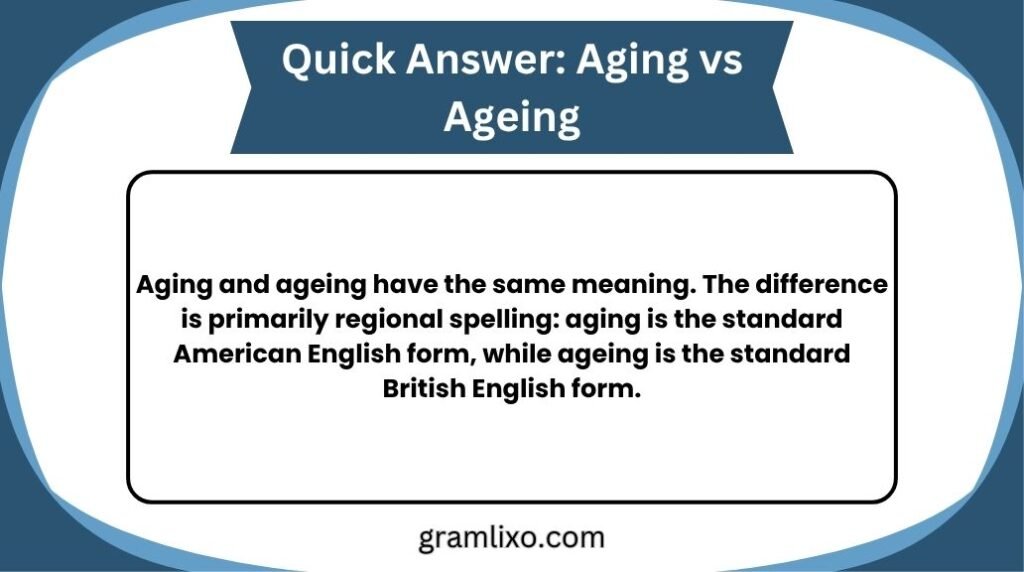
Aging and ageing have the same meaning. The difference is primarily regional spelling: aging is the standard American English form, while ageing is the standard British English form.
For US English, write:
The aging population is growing rapidly.
For British English, you may see:
The ageing population is growing rapidly.
Neither spelling changes the basic meaning of the sentence.
Understanding the Basics of Aging vs Ageing
The simplest way to understand aging vs ageing is to think about the spelling conventions of different English-speaking regions.
Aging is preferred in American English.
Ageing is preferred in British English.
Both forms come from the verb age, which means to become older or to cause something to become older. Cambridge Dictionary lists aging as the US spelling and ageing as the UK spelling.
Comparison Table
| Form | Type | Meaning | Example | Correct/Incorrect |
|---|---|---|---|---|
| aging | Present participle / gerund | Becoming older | The aging process is natural. | ✅ Correct in US English |
| ageing | Present participle / gerund | Becoming older | The ageing process is natural. | ✅ Correct in UK English |
| age | Verb | To become older | People age naturally. | ✅ Correct |
| aged | Past tense / past participle | Became older; made older | She has aged considerably. | ✅ Correct |
| ageing in US writing | Regional variant | Same meaning | The ageing process is natural. | ⚠️ Understandable, but US style usually prefers aging |
| aging in UK writing | Regional variant | Same meaning | The aging population is growing. | ⚠️ Understandable, but UK style usually prefers ageing |
The key point is that neither aging nor ageing is inherently wrong. The appropriate spelling depends on the variety of English you are using.
What Does “Aging” Mean?
Aging refers to the process of becoming older. It can describe people, animals, objects, organizations, systems, populations, and even food or beverages.
For example:
- Aging is a natural part of life.
- The aging population needs better healthcare services.
- The company is replacing its aging computer systems.
- The chef explained the benefits of aging cheese.
As a noun, aging can refer to the process itself:
Aging is a complex biological process.
As an adjective, aging can describe someone or something that is getting older:
The aging building needs extensive repairs.
Cambridge Dictionary gives aging meanings related to getting older and describes it as the US spelling of ageing.
Sentence Breakdown
Consider:
The aging population requires additional resources.
- The = article
- aging = adjective
- population = noun
- requires = verb
- additional resources = object/complement
Here, aging describes the population.
What Does “Ageing” Mean?
Ageing has the same basic meaning as aging. It refers to becoming older or the process of getting older.
For example:
The ageing population requires additional resources.
The meaning is essentially identical to:
The aging population requires additional resources.
The difference is spelling convention.
Cambridge identifies ageing as the UK spelling of aging.
Sentence Breakdown
The ageing process affects everyone differently.
- The = article
- ageing = adjective
- process = noun
- affects = verb
- everyone = object
- differently = adverb
The spelling ageing is natural in British English.
Aging vs Ageing in American English
If your article, website, school assignment, business document, or publication follows American English, use aging.
Examples
- The aging population is creating new economic challenges.
- Scientists study the effects of aging on the human body.
- The company has an aging workforce.
- Anti-aging products are widely marketed in the United States.
- Aging infrastructure can become expensive to maintain.
For a US English grammar article, aging should generally be your default spelling.
This is especially important if you are writing SEO content for a US audience. Consistency matters more than trying to mix regional forms.
Aging vs Ageing in British English
If you are writing according to British English, ageing is generally preferred.
Examples
- The ageing population presents new challenges.
- The ageing process is different for everyone.
- Researchers are studying healthy ageing.
- The government introduced a program for an ageing workforce.
British English commonly retains the -e- before -ing in this word.
Why Does “Age” Become “Aging” or “Ageing”?
The spelling difference comes from different English spelling conventions.
The base verb is:
age
When the -ing ending is added, American English commonly uses:
aging
British English commonly uses:
ageing
This is one of those cases where regional spelling conventions developed differently.
It is similar to other American and British spelling differences, although the exact spelling pattern varies from word to word.
For example:
- US: color / UK: colour
- US: favorite / UK: favourite
- US: center / UK: centre
- US: aging / UK: ageing
The important thing is not to treat one form as grammatically superior in every situation.
Is “Aging” or “Ageing” More Correct?
Neither spelling is universally more correct.
The better question is:
Which variety of English are you using?
If you use American English, choose aging.
If you use British English, choose ageing.
Cambridge explicitly lists aging as the American spelling and ageing as the British spelling.
Easy Rule
US English → aging 🇺🇸
UK English → ageing 🇬🇧
That simple rule solves most questions about aging vs ageing.
Aging as a Noun
Aging can function as a noun when it refers to the process of becoming older.
Examples:
Aging is a natural part of life.
Scientists are researching healthy aging.
The study examines aging and memory.
In these examples, aging names a process.
The same is true of ageing in British English:
Ageing is a natural process.
The study examines ageing and memory.
The grammatical role remains the same; only the spelling changes.
Aging as an Adjective
Aging can also work as an adjective.
It describes someone or something that is becoming older or has become older.
Examples:
- an aging actor
- an aging building
- an aging population
- an aging computer
- an aging workforce
- an aging infrastructure system
Consider this sentence:
The city is replacing its aging bridges.
Here, aging modifies bridges.
It tells us that the bridges are getting older.
The British equivalent would be:
The city is replacing its ageing bridges.
Aging as Part of a Verb Phrase
The -ing form can also appear in progressive verb structures.
For example:
The population is aging rapidly.
Here, aging is part of the verb phrase is aging.
Breakdown:
- The population = subject
- is = auxiliary verb
- aging = present participle
- rapidly = adverb
British English can use:
The population is ageing rapidly.
Again, the meaning does not change.
What About “Aged”?
Do not confuse aging/ageing with aged.
Aged is another form of the verb age.
Examples:
She has aged significantly since I last saw her.
The cheese was aged for several months.
The building looked aged and neglected.
Cambridge lists aged as the past tense and past participle of age.
So the basic forms are:
- age → base verb
- aging/ageing → present participle/gerund
- aged → past tense/past participle
Test Tip: How Can You Check the Correct Spelling?
Use this three-step test.
Step 1: Identify Your Audience
Are you writing for Americans?
Use aging.
Are you writing for British readers?
Use ageing.
Step 2: Check Your Style Guide
If your organization has a style guide, follow it.
For example, a US publication may require American spelling throughout its content.
Step 3: Keep It Consistent
Do not randomly switch between:
aging
and
ageing
in the same article.
Choose one regional spelling and use it consistently.
Test Tip: If your content is specifically for a US audience, aging is almost always the safer choice.
Case Study: A Workplace Example
Imagine a US company is preparing an annual report.
An employee writes:
Our company is investing in technology to replace ageing equipment.
The sentence is understandable. However, if the company follows American English conventions, the editor may change it to:
Our company is investing in technology to replace aging equipment.
Why?
Because aging is the standard American spelling.
Now imagine a British company writing the same sentence:
Our company is investing in technology to replace ageing equipment.
That version is perfectly natural in British English.
The Lesson
The choice is not about changing the meaning.
It is about maintaining the correct regional spelling convention.
This distinction is especially useful for international businesses, publishers, bloggers, students, and content creators.
Grammar Rules for Aging vs Ageing
The grammar rule is straightforward.
The verb is:
age
Its present participle can be written as:
aging in American English
or
ageing in British English.
Its past form is:
aged
The important point is that aging and ageing are not two different grammatical forms. They are spelling variants of the same form.
Cambridge’s dictionary entries explicitly identify the regional relationship between the two spellings.
Is “Ageing” Grammatically Wrong in the US?
No.
It is better described as a British spelling rather than a grammatical error.
A US editor might prefer:
aging
over:
ageing
But that does not mean ageing is meaningless or inherently ungrammatical.
Likewise, a British editor would normally prefer ageing but would understand aging.
Common Mistakes With Aging vs Ageing
The biggest mistake is assuming that one spelling is always correct everywhere.
Mistake 1: Treating “Ageing” as a Misspelling
Some American writers see ageing and assume it is simply incorrect.
It is not.
It is the standard British spelling.
Mistake 2: Mixing Regional Spellings
A writer might use:
aging
in one paragraph and:
ageing
in another.
That can make the document look inconsistent.
Mistake 3: Using British Spelling in US-Focused Content
If your website targets US readers and uses American English, aging is generally the better choice.
Mistake 4: Blaming Autocorrect
Autocorrect and spell-checking tools can create confusion because their dictionaries may use different regional settings.
A British English spell checker may accept ageing as its preferred form.
A US English spell checker may favor aging.
Why Do These Mistakes Happen?
Common reasons include:
- Fast typing: Writers may not notice regional spelling differences.
- Autocorrect: Software may use a different English dictionary.
- Lack of knowledge: Writers may not realize both forms are legitimate.
- International exposure: People read content from multiple English-speaking countries.
- Copying sources: Writers may unintentionally adopt another country’s spelling.
- Mixed-language settings: A device can sometimes use different regional dictionaries.
Similar Grammar and Spelling Confusions
The aging vs ageing issue belongs to a much larger group of English-language confusions.
| Confusion | Correct Difference |
|---|---|
| it’s vs its | It’s = it is; its = possessive |
| your vs you’re | Your = possessive; you’re = you are |
| they’re vs their vs there | Different meanings and grammatical roles |
| affect vs effect | Usually verb vs noun, though usage varies |
| then vs than | Then relates to time; than is used in comparisons |
| principal vs principle | Principal = person/main; principle = rule or belief |
| color vs colour | US vs UK spelling |
| center vs centre | US vs UK spelling |
| aging vs ageing | US vs UK spelling |
Unlike it’s vs its, however, aging vs ageing does not involve two different meanings.
It is primarily a regional spelling difference.
Aging vs Ageing in Different Contexts
Everyday Conversation
In casual speech, the difference is invisible because aging and ageing are pronounced the same.
For example:
Everyone is aging.
A British speaker may write:
Everyone is ageing.
When spoken aloud, the spelling distinction disappears.
Professional Writing
Professional writing requires consistency.
If you are writing an American business report, use:
aging workforce
aging infrastructure
aging population
If you are writing for a British publication, use:
ageing workforce
ageing infrastructure
ageing population
Choosing one form based on your target audience makes your writing look more polished.
Academic Writing
Academic writing should follow the required style guide and regional variety of English.
For a US university paper, aging will generally fit American English conventions.
For a British academic publication, ageing may be expected.
Always check the publication or institution’s style requirements when they exist.
Creative Writing
Creative writers have more flexibility.
If your narrator, publication, or setting is British, ageing may feel more natural.
If your story uses American English, aging is generally more appropriate.
For example:
The aging detective stared at the old photograph.
A British version could be:
The ageing detective stared at the old photograph.
The atmosphere and meaning remain the same.
Social Media and Texting
Social media users frequently mix American and British spelling.
You may see:
aging gracefully ✨
or:
ageing gracefully ✨
Both are understandable.
However, brands and professional creators should maintain consistent spelling, especially when building a recognizable editorial style.
Why the Difference Matters
At first glance, aging vs ageing may seem like a tiny spelling issue. In practice, small details like this can affect the quality and consistency of your writing.
1. Clarity
Consistent regional spelling helps readers understand the language variety being used.
2. Professionalism
A polished document usually follows one spelling system rather than switching between regional conventions.
3. Editorial Consistency
Editors want a document to follow a predictable style.
If most of your article uses American spelling, suddenly writing ageing can look inconsistent.
4. Digital Communication
Websites, blogs, emails, and social posts are often read internationally. Consistent spelling helps establish a clear editorial voice.
A Short Quote
“Consistency makes writing easier to trust.”
The principle is simple: when your spelling choices are consistent, readers can focus on your message instead of noticing avoidable inconsistencies.
Special Exceptions and Edge Cases
There is no major grammatical exception that changes the fundamental rule for aging vs ageing.
However, specialized terms can sometimes appear with either spelling depending on the region or publication.
For example:
- anti-aging is common in American English.
- anti-ageing is common in British English.
- healthy aging is common in US English.
- healthy ageing is common in UK English.
- aging process is standard in US-oriented writing.
- ageing process is standard in UK-oriented writing.
Cambridge also lists compounds such as anti-aging and anti-ageing, reflecting the regional spelling distinction.
Important Point
Do not assume that every dictionary, website, or software program will use the same regional preference. Always consider the intended variety of English.
Aging vs Ageing: US English vs UK English
| Feature | American English 🇺🇸 | British English 🇬🇧 |
|---|---|---|
| Preferred spelling | aging | ageing |
| Meaning | Becoming older | Becoming older |
| Pronunciation | Same | Same |
| Grammar | Same | Same |
| Common phrase | aging population | ageing population |
| Process | aging process | ageing process |
| Compound | anti-aging | anti-ageing |
This table captures the central difference.
There is no major difference in meaning.
The primary distinction is regional spelling.
Quick Recap Checklist
Use this checklist whenever you are unsure.
| Question | If Yes → Use |
|---|---|
| Am I writing standard US English? | aging |
| Am I writing standard UK English? | ageing |
| Am I describing the process of becoming older? | aging/ageing, depending on region |
| Am I describing something that is becoming old? | aging/ageing, depending on region |
| Am I writing for a US-focused website? | aging |
| Am I following British spelling conventions? | ageing |
| Am I talking about the past form of “age”? | aged |
Practice Examples
1. US English:
The aging population needs improved healthcare services.
2. UK English:
The ageing population needs improved healthcare services.
3. Past form:
The building has aged considerably over the years.
Frequently Asked Questions
1. Is aging or ageing correct?
Both are correct. Aging is the standard American English spelling, while ageing is the standard British English spelling.
2. Should I use aging in American English?
Yes. If you are writing in standard American English, aging is generally the preferred spelling.
3. Is ageing wrong in the United States?
No. Ageing is recognizable and valid as a British spelling, but American English normally prefers aging.
4. Do aging and ageing have different meanings?
No. They have the same basic meaning. Both refer to the process of becoming older or describe something that is becoming older.
5. Why does British English use ageing?
Ageing reflects the British spelling convention of retaining the e before the -ing ending in this word. American English commonly uses the shorter form aging.
6. How do I remember aging vs ageing?
Use this simple memory rule:
US = aging
UK = ageing
If you are writing for an American audience, leave out the extra e.
Conclusion
The difference between aging vs ageing is much simpler than it first appears. Both words describe the same process of becoming older, and both are legitimate English spellings. The key difference is regional usage.
For American English, use aging:
The aging population is increasing.
For British English, use ageing:
The ageing population is increasing.
Neither form changes the underlying meaning or grammar. The most important thing is to identify your target audience and remain consistent throughout your writing. Cambridge Dictionary confirms that aging is the US spelling and ageing is the UK spelling.
If you are writing SEO content, business material, academic work, or general articles for US readers, aging should be your default choice. If your audience follows British English, choose ageing instead.
Remember: US English drops the extra “e” — aging. UK English keeps it — ageing.

Hi, I’m Lisa Jones, a grammar enthusiast and writer at Gramlixo. I enjoy making English grammar simple, clear, and easy to apply in everyday writing.
[…] |Aging vs Ageing: What Is the Difference? […]
[…] |Aging vs Ageing: What Is the Difference? […]