If you have ever wondered about thus far vs so far, you are not alone. These two expressions are easy to confuse because both generally mean “up to now” or “up to this point.”
For example, you can say, “The project is going well so far” or “The project is going well thus far.” Both sentences are grammatically correct, but they create slightly different tones. So far is more common and natural in everyday American English, while thus far usually sounds more formal, polished, or literary.
Understanding the difference between thus far vs so far can help you choose the right expression for conversations, emails, academic writing, professional reports, and online content.
In this guide, we will explain their meanings, grammar, usage, differences, common mistakes, and practical examples so you can use both expressions confidently.
|Giving vs Given: Understanding the Difference With Clear Examples
|Day Off vs Off Day: What’s the Difference?
|Aging vs Ageing: What Is the Difference?
Quick Answer: Thus Far vs So Far
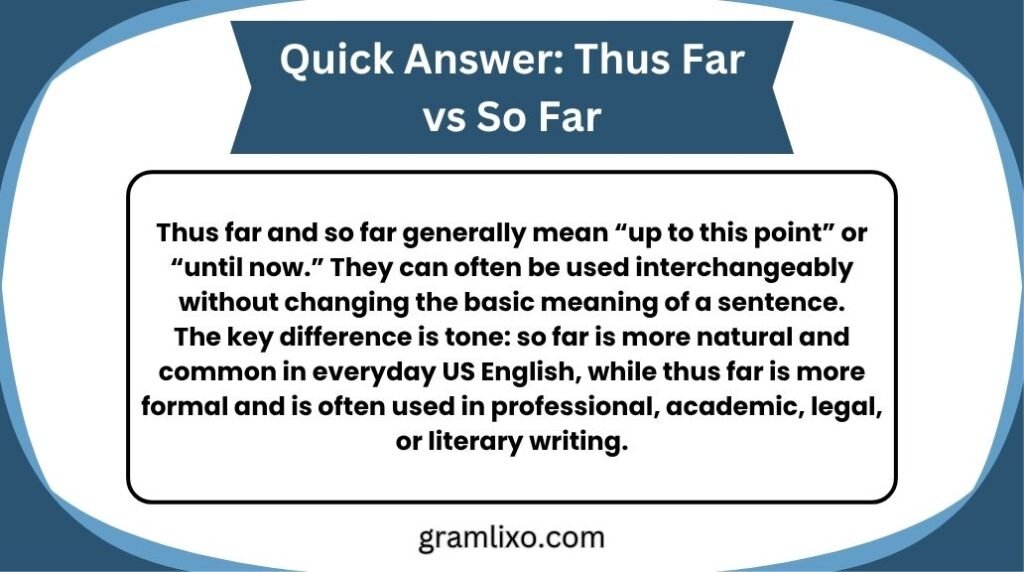
Thus far and so far generally mean “up to this point” or “until now.” They can often be used interchangeably without changing the basic meaning of a sentence.
The key difference is tone: so far is more natural and common in everyday US English, while thus far is more formal and is often used in professional, academic, legal, or literary writing.
Example:
- So far, everything is going well. → Natural and conversational.
- Thus far, everything is going well. → More formal or polished.
Understanding the Basics of Thus Far vs So Far
To understand thus far vs so far, start with their shared meaning.
Both expressions describe something that has continued from the past until the present point.
What Does “So Far” Mean?
So far means:
- up to now
- until now
- up to this point
- as of the present time
It is extremely common in everyday English.
Examples:
I have read three chapters so far.
This means I have read three chapters up to now.
So far, the weather has been beautiful.
This means the weather has been beautiful until this point.
What Does “Thus Far” Mean?
Thus far has essentially the same basic meaning:
- up to this point
- until now
- up to now
However, thus far often sounds more formal.
Examples:
Thus far, the research has produced promising results.
The company has avoided major problems thus far.
These sentences are correct, but they sound more formal than their versions with so far.
Comparison Table
| Form | Type | Meaning | Example | Correct/Incorrect |
|---|---|---|---|---|
| so far | Adverbial phrase | Up to now | We have received five applications so far. | ✅ Correct |
| thus far | Adverbial phrase | Up to this point | We have received five applications thus far. | ✅ Correct |
| so far | Adverbial phrase | Until now | So far, nobody has complained. | ✅ Correct |
| thus far | Adverbial phrase | Until now | Thus far, nobody has complained. | ✅ Correct |
| so farther | Incorrect expression | — | We have progressed so farther. | ❌ Incorrect |
| thus farther | Incorrect expression in this meaning | — | We have progressed thus farther. | ❌ Incorrect |
The important point is that thus far and so far are both legitimate expressions. The choice usually depends on tone, context, and style.
Correct Meanings and Uses
Using “So Far” to Mean “Up to Now”
The most common use of so far is to describe something that has happened between an earlier point and now.
Example
I have completed five assignments so far.
Breakdown:
- I = subject
- have completed = present perfect verb phrase
- five assignments = object
- so far = tells us the time period extends up to now
The phrase so far tells the reader that the situation may continue.
You could complete more assignments later.
More examples
- We have sold 200 tickets so far.
- She has visited three states so far.
- I have learned a lot so far.
- The team has won four games so far.
- We haven’t had any problems so far.
These are all natural in everyday American English.
Using “Thus Far” in the Same Meaning
You can replace so far with thus far in many sentences.
I have completed five assignments thus far.
The basic meaning remains the same.
However, the sentence sounds more formal.
Compare:
Conversational:
The project is going well so far.
Formal:
The project is progressing well thus far.
Neither is grammatically wrong. The second simply has a more formal tone.
“So Far” in Everyday Conversation
If you are speaking with friends, family members, classmates, or coworkers in a casual setting, so far is usually the better choice.
For example:
How is your new job going so far?
That sounds completely natural.
You could say:
How is your new job going thus far?
It is grammatically possible, but it sounds unusually formal for casual conversation.
Other natural examples include:
- How are you liking the movie so far?
- So far, I really like this restaurant.
- I’ve finished half the book so far.
- The trip has been great so far.
- So far, so good!
The expression “so far, so good” is particularly common. It means that everything has been satisfactory up to the present moment.
“Thus Far” in Formal Writing
Thus far can work especially well when the writing has a formal or analytical tone.
For example:
The evidence gathered thus far supports the original hypothesis.
This sounds appropriate in a research or professional context.
Compare it with:
The evidence gathered so far supports the original hypothesis.
The second sentence is also correct. It simply sounds more straightforward and conversational.
Formal examples
- The investigation has revealed no major issues thus far.
- The study has produced encouraging findings thus far.
- No significant changes have been observed thus far.
- The organization has maintained its policy thus far.
- The negotiations have remained productive thus far.
Can “Thus Far” and “So Far” Always Replace Each Other?
Not always perfectly.
In many sentences, the two phrases can be exchanged without changing the factual meaning.
However, they can create different stylistic effects.
Example
So far, I am enjoying the course.
This sounds natural and personal.
Thus far, I am enjoying the course.
This sounds more formal and somewhat unusual in casual conversation.
So, while the meaning is similar, the register can change.
Think of it this way:
So far = everyday and natural
Thus far = formal and polished
Test Tip: Replace It With “Up to Now”
Here is a simple test.
If you can replace the expression with “up to now” or “until now”, you probably have the correct use.
Example
We have completed six stages so far.
Try:
We have completed six stages up to now.
The meaning works.
Now try:
We have completed six stages thus far.
That also works.
This tells you that both expressions can function as time expressions meaning up to the present point.
Quick Test
Ask yourself:
“Am I talking about what has happened until this point?”
If yes, so far or thus far may work.
Then ask:
“Is this casual or formal?”
- Casual → so far
- Formal → thus far
Case Study: Workplace Communication
Imagine a manager sending an update to employees about a new software system.
Casual workplace message
The new system has worked well so far. We have only experienced a few minor issues.
This sounds natural and friendly.
Formal workplace report
The new system has performed effectively thus far. Only a few minor issues have been identified.
This version sounds more formal and report-like.
Both communicate essentially the same information.
The difference is primarily tone and register.
Why This Matters
When communicating professionally, word choice can influence how polished your message sounds.
If you are writing:
- a formal report
- an academic paper
- a business analysis
- a legal document
- an official statement
thus far may fit naturally.
If you are writing:
- an email to a coworker
- a text message
- a casual blog post
- a conversation
- social media content
so far is usually more natural.
Grammar Rules for Thus Far vs So Far
Both thus far and so far can function as adverbial expressions.
They provide information about time or the current stage of a situation.
Present Perfect + So Far
One very common structure is:
Subject + present perfect + so far
Example:
We have completed ten lessons so far.
The present perfect have completed connects the past action to the present.
The phrase so far emphasizes the current total.
Present Perfect + Thus Far
The same structure works with thus far:
We have completed ten lessons thus far.
Again, the meaning is essentially:
We have completed ten lessons up to this point.
Past Tense Can Also Occur
The expression is not restricted to the present perfect.
For example:
So far, the experiment was successful.
However, depending on the intended meaning, the present perfect may be more natural when the situation continues to the present.
Compare:
The experiment has been successful so far.
This strongly suggests the experiment is still ongoing.
What Does Merriam-Webster Say?
Merriam-Webster recognizes thus as an adverb with meanings connected to “in this or that manner” and related uses. The expression thus far developed as a way of indicating progression up to a particular point.
In modern English, thus far is established usage rather than an incorrect or outdated construction.
Likewise, so far is a standard English expression meaning up to now or until now.
Therefore, neither phrase should be treated as grammatically wrong simply because one sounds more formal than the other.
The important distinction is appropriate usage and style, not correctness.
Common Mistakes With Thus Far vs So Far
Many mistakes involving these expressions happen because writers focus on the individual words instead of the complete expression.
Mistake 1: Writing “So Farther”
❌ We have progressed so farther.
This is incorrect when you mean up to now.
Correct:
✅ We have progressed so far.
Farther usually relates to physical distance or, in some styles, figurative advancement.
Mistake 2: Adding an Unnecessary “Until”
❌ Until so far, everything has been fine.
This combination is unnatural.
Use:
✅ So far, everything has been fine.
Or:
✅ Until now, everything has been fine.
Mistake 3: Assuming “Thus Far” Is Wrong
Some people see thus far and assume it is old-fashioned or grammatically incorrect.
That is not true.
✅ Thus far, the plan has been successful.
The expression is grammatically acceptable. It simply has a more formal tone.
Mistake 4: Using “Thus Far” in Every Sentence
Even though thus far is correct, repeating it throughout an article can make your writing feel stiff.
Instead, vary your language naturally:
- so far
- until now
- up to now
- to date
- as of now
Choose the expression that fits the context.
Why Do People Make These Mistakes?
Fast Typing
When people type quickly, they may write whatever expression comes to mind first. This can lead to forms such as “so farther” or unnecessary combinations.
Autocorrect
Autocorrect can sometimes change words unexpectedly, especially when you type quickly or use unusual phrases.
Lack of Knowledge
People may understand the general idea but not know which expression is standard.
Reading examples and learning common word patterns can solve this problem.
Similar Grammar Confusions
English contains many pairs that look or sound similar but have different functions.
| Confusion | Correct Forms | Main Difference |
|---|---|---|
| its / it’s | its, it’s | Possession vs. “it is” |
| your / you’re | your, you’re | Possession vs. “you are” |
| their / there / they’re | their, there, they’re | Possession, place, contraction |
| then / than | then, than | Time vs. comparison |
| farther / further | farther, further | Distance vs. broader/figurative use |
| affect / effect | affect, effect | Usually verb vs. noun |
| to / too / two | to, too, two | Different grammatical functions |
| so far / thus far | so far, thus far | Similar meaning; different tone |
Unlike its/it’s or your/you’re, the pair thus far vs so far is not mainly a correctness problem.
Both forms can be correct.
The real issue is selecting the expression that best suits your writing.
Usage in Different Contexts
Everyday Conversation
For everyday speech, so far is clearly the more natural option.
How is your new phone working so far?
So far, I love it.
Using thus far in these situations may sound overly formal.
Professional Writing
Both expressions can work in professional writing.
For straightforward communication:
Sales have increased steadily so far this year.
For a more formal report:
Sales have increased steadily thus far this year.
The second option has a more formal tone.
Academic Writing
Thus far can be useful in academic writing when discussing research progress or existing evidence.
Researchers have identified several possible explanations thus far.
However, academic writing does not require thus far. So far can still be appropriate when the tone is clear and natural.
Creative Writing
Creative writers have more freedom.
Thus far can create a reflective, dramatic, or literary tone.
Thus far, his journey had been peaceful.
Meanwhile:
So far, his journey had been peaceful.
The first sounds more deliberate. The second sounds more direct.
Social Media and Texting
Use so far.
For example:
This vacation is amazing so far! 🌴
So far, this is my favorite song! 🎵
Thus far would generally feel too formal for a casual text unless you are intentionally being humorous or dramatic.
Why the Difference Matters
Choosing between thus far vs so far may seem like a tiny detail, but small word choices influence how readers perceive your writing.
Clarity
So far is immediately familiar to most English speakers.
That makes it excellent for clear, accessible communication.
Professionalism
Thus far can provide a more formal tone when the context calls for it.
For example:
No significant concerns have been reported thus far.
This sounds appropriate in an official report.
Digital Communication
Online writing often rewards clarity and simplicity.
Because so far is short and familiar, it is often the better choice for:
- websites
- emails
- social posts
- online guides
- customer communication
A simple rule is:
Choose the expression that sounds natural for your audience.
Formal does not automatically mean better.
A Short Quote to Remember
“Simple words often make the clearest writing.”
When so far communicates your meaning perfectly, there is no need to replace it with the more formal thus far.
Special Exception and Edge Cases
There is no major grammatical exception that makes thus far or so far universally correct or incorrect.
However, there are some situations worth noting.
“Thus” Has Other Meanings
The word thus does not always mean “so far.”
For example:
He explained the problem thus.
Here, thus means something like “in this way.”
Another example:
The evidence was incomplete; thus, the conclusion was uncertain.
Here, thus means “therefore” or “as a result.”
So you should not assume that thus = so far in every sentence.
The specific expression thus far has the meaning up to this point.
“So” Has Many Meanings Too
The word so can indicate:
- degree
- result
- similarity
- manner
- emphasis
For example:
She is so happy.
Here, so does not mean “up to now.”
But in:
She has been happy so far.
so far means up to now.
The complete phrase matters.
Quick Recap Checklist
Use this checklist whenever you are unsure about thus far vs so far.
| Question | If Yes → Use |
|---|---|
| Do you mean “up to now”? | So far / Thus far |
| Is the writing casual? | So far |
| Is the writing conversational? | So far |
| Is the writing formal or academic? | Thus far may fit better |
| Are you writing a formal report? | Thus far may fit better |
| Do you want the simplest expression? | So far |
| Do you want a more formal tone? | Thus far |
Practice Example 1
I have enjoyed the course ___.
Both work:
✅ I have enjoyed the course so far.
✅ I have enjoyed the course thus far.
But so far sounds more natural in ordinary conversation.
Practice Example 2
___, the investigation has revealed no major problems.
Both are possible:
✅ So far, the investigation has revealed no major problems.
✅ Thus far, the investigation has revealed no major problems.
For an official report, thus far may sound more appropriate.
Practice Example 3
How is your new job going ___?
Best choice:
✅ so far
How is your new job going so far?
Thus far is grammatically possible but unnecessarily formal for this casual question.
FAQs About Thus Far vs So Far
1. Is “thus far” the same as “so far”?
Yes. In most contexts, thus far and so far mean “up to now” or “up to this point.” The main difference is tone. So far is more common and conversational, while thus far tends to sound more formal.
2. Is “so far” grammatically correct?
Yes. So far is a standard English expression meaning up to now or until now.
Example:
We have completed five tasks so far.
3. Is “thus far” formal?
Yes. Thus far generally has a more formal, literary, academic, or official tone than so far.
Example:
The research has produced encouraging results thus far.
4. Should I use “thus far” in everyday conversation?
Usually, so far is better for everyday conversation because it sounds more natural.
Instead of:
How is your trip going thus far?
Most speakers would naturally say:
How is your trip going so far?
5. Can “thus far” and “so far” be used interchangeably?
Often, yes. They can frequently replace each other without changing the basic meaning. However, replacing one with the other can change the tone of the sentence.
6. Is “so farther” correct?
No. When you mean “up to now,” the correct expression is so far, not so farther.
Correct:
We have come a long way so far.
Incorrect:
We have come a long way so farther.
Conclusion
Understanding thus far vs so far is easier once you recognize that both expressions generally mean “up to now” or “up to this point.” Neither expression is inherently wrong. The biggest difference is their style and level of formality.
So far is the more common choice in everyday American English. It sounds natural in conversations, emails, texts, websites, and casual writing. Thus far is also correct, but it usually sounds more formal, polished, academic, literary, or official.
When you are unsure, ask yourself two simple questions: What do I mean? and Who am I writing for? If you mean “up to now” and want a natural, conversational expression, choose so far. If you are writing in a formal context and want a more elevated tone, thus far may be a better fit.
The easiest rule to remember is simple: “So far” is everyday English; “thus far” is the more formal alternative.

I’m Robert Williams, an English grammar writer at Gramlixo. I focus on breaking down confusing grammar rules into simple explanations and useful examples.
[…] |Thus Far vs So Far: What’s the Difference? […]