Have you ever wondered about the difference between bespeckled vs bespectacled? These two words look and sound surprisingly similar, but they describe completely different things. Bespeckled refers to something covered or marked with small spots, dots, or specks, while bespectacled describes someone who is wearing glasses or spectacles.
The confusion often comes from their similar spelling and pronunciation, especially when you encounter these words in descriptive or formal writing. For example, a wall can be bespeckled with paint, while a professor can be bespectacled because he or she is wearing glasses.
Understanding bespeckled vs bespectacled is important when you want your writing to be accurate, clear, and natural. Once you connect speck with spots and spectacles with glasses, the distinction becomes much easier to remember.
In this guide, we will explain their meanings, differences, correct usage, common mistakes, examples, and simple memory tricks so you can confidently choose the right word every time.
|Tear vs Tare: Meaning, Differences, Uses, and Examples
|Giving vs Given: Understanding the Difference With Clear Examples
|Day Off vs Off Day: What’s the Difference?
Quick Answer: Bespeckled vs Bespectacled
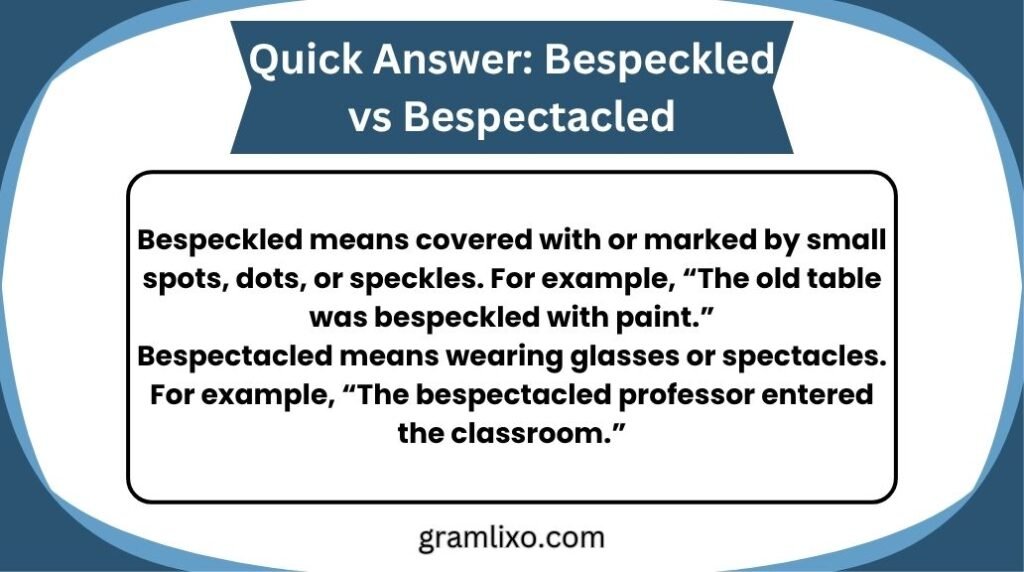
Bespeckled means covered with or marked by small spots, dots, or speckles. For example, “The old table was bespeckled with paint.”
Bespectacled means wearing glasses or spectacles. For example, “The bespectacled professor entered the classroom.”
The easiest rule to remember
- Bespeckled = covered with spots or specks. 🔵
- Bespectacled = wearing glasses. 👓
If you are talking about spots, dots, marks, or small particles, use bespeckled.
If you are talking about a person wearing glasses, use bespectacled.
Understanding the Basics of Bespeckled vs Bespectacled
The biggest difference between bespeckled vs bespectacled comes from the words they are built from.
Bespeckled is related to speckle, which means a small spot or mark. Merriam-Webster defines speckle as a little speck of color and also uses the verb to mean marking something with speckles.
Bespectacled is related to spectacles, an older term for eyeglasses. Merriam-Webster defines bespectacled as an adjective meaning “wearing spectacles.”
Although the spelling is similar, the meanings are very different.
Comparison Table
| Form | Type | Meaning | Example | Correct/Incorrect |
|---|---|---|---|---|
| bespeckled | Adjective | Covered with small spots or specks | The blue vase was bespeckled with white dots. | Correct |
| bespectacled | Adjective | Wearing glasses or spectacles | The bespectacled teacher smiled. | Correct |
| bespeckled | Adjective | Wearing glasses | The bespeckled doctor adjusted his glasses. | Incorrect for this meaning |
| bespectacled | Adjective | Covered with spots | The bespectacled wall was covered in paint spots. | Incorrect for this meaning |
| speckled | Adjective | Marked with small spots | She wore a speckled dress. | Correct |
| spectacled | Adjective | Wearing or having spectacles | The spectacled scientist took notes. | Correct |
The key is to focus on the middle part of each word:
bespeckled → speck → spots
bespectacled → spectacles → glasses
That simple connection can prevent most mistakes.
What Does Bespeckled Mean?
Bespeckled is an adjective that describes something marked, covered, or dotted with small spots or specks.
The word comes from bespeckle, a verb meaning to speckle or besprinkle. Merriam-Webster lists bespeckle as a verb meaning “speckle” or “besprinkle.”
A speck can be a very small mark or particle. Therefore, when something is bespeckled, it has numerous small marks or spots on it.
Examples of Bespeckled
- The white shirt was bespeckled with mud.
- Her face was bespeckled with tiny freckles.
- The artist created a bespeckled background.
- The old book’s cover was bespeckled with dust.
- The bird had bespeckled feathers.
- The night sky looked bespeckled with stars.
In each example, the word describes a surface or appearance containing small spots, marks, or particles.
Sentence Breakdown
Consider this sentence:
“The painter’s apron was bespeckled with blue paint.”
- The painter’s apron = the thing being described.
- was = linking verb.
- bespeckled = adjective describing the apron.
- with blue paint = explains what created the spots.
The meaning is that small drops or spots of blue paint covered the apron.
Another Example
“The strawberry was bespeckled with tiny seeds.”
Here, bespeckled does not describe a person’s clothing or glasses. It describes the strawberry’s spotted appearance.
What Does Bespectacled Mean?
Bespectacled is an adjective describing someone who is wearing glasses or spectacles.
Merriam-Webster defines bespectacled as “wearing spectacles.” Its current dictionary entry also gives the children’s definition as “wearing glasses.”
The word is commonly used to describe people.
Examples of Bespectacled
- The bespectacled professor explained the lesson.
- A bespectacled man was sitting near the window.
- The journalist interviewed a bespectacled scientist.
- The bespectacled woman smiled at the camera.
- We spoke with a bespectacled doctor.
- The novel features a bespectacled detective.
The word does not mean that the person has spots on them. It specifically points to glasses or spectacles.
Sentence Breakdown
Consider:
“The bespectacled professor walked into the lecture hall.”
- The professor = person being described.
- bespectacled = tells us that the professor was wearing glasses.
- walked into = verb phrase.
- the lecture hall = destination.
The adjective gives the reader a quick visual detail.
Bespeckled vs Bespectacled: The Core Difference
The simplest way to understand the difference is to identify the noun behind each adjective.
Bespeckled Comes From Speckle
A speck is a small spot or mark.
So:
speck → speckle → bespeckled
Examples:
- bespeckled paper
- bespeckled skin
- bespeckled feathers
- bespeckled stone
- bespeckled clothing
Bespectacled Comes From Spectacles
Spectacles are glasses.
So:
spectacles → bespectacled
Examples:
- bespectacled teacher
- bespectacled writer
- bespectacled professor
- bespectacled scientist
- bespectacled man
Memory Trick 🧠
Think:
SPECK = SPOTS
SPECTACLES = GLASSES
If you remember those two connections, you will rarely confuse the words.
Correct Meanings and Uses
Using Bespeckled for Physical Appearance
Bespeckled is useful when describing a person or animal covered with small spots.
For example:
“The child’s cheeks were bespeckled with freckles.”
Here, the cheeks contain many small marks.
Another example:
“The puppy had a bespeckled coat.”
This means the puppy’s coat had small spots or specks.
Using Bespeckled for Objects
You can also use bespeckled for objects and surfaces.
Examples:
- a bespeckled wall
- a bespeckled table
- a bespeckled notebook
- a bespeckled canvas
- a bespeckled window
Example:
“The window was bespeckled with raindrops.”
The tiny raindrops created many small visible spots.
Using Bespectacled for People
Bespectacled normally describes a person wearing glasses.
Examples:
“The bespectacled librarian helped me find the book.”
“A bespectacled student raised her hand.”
“The bespectacled engineer reviewed the design.”
The word can sound somewhat descriptive or literary, so in casual conversation, wearing glasses is often more natural.
For example:
Natural everyday speech:
“The man wearing glasses helped me.”
More descriptive:
“The bespectacled man helped me.”
Both communicate the same basic idea.
Can Bespeckled and Bespectacled Be Used for the Same Person?
Yes, but only if you are describing two different features.
For example:
“The bespectacled artist had a bespeckled shirt.”
Here:
- bespectacled artist = the artist was wearing glasses.
- bespeckled shirt = the shirt had small spots or marks.
A single person can even be described using both words:
“The bespectacled painter stood beside his bespeckled canvas.”
The painter is wearing glasses, while the canvas contains numerous small marks or spots.
This example is a great way to remember that the words are not interchangeable.
Test Tip: How to Choose the Right Word
When you are unsure between bespeckled vs bespectacled, ask yourself one question:
“Am I talking about spots or glasses?”
If the answer is spots, choose:
Bespeckled
If the answer is glasses, choose:
Bespectacled
Try these:
The wall was covered with tiny paint spots.
→ The wall was bespeckled.
The woman was wearing glasses.
→ The woman was bespectacled.
The bird had many tiny spots on its feathers.
→ The bird was bespeckled.
The professor wore glasses.
→ The professor was bespectacled.
This test works because it focuses on meaning rather than spelling.
Bespeckled vs Bespectacled in Real-Life Writing
Imagine that you are writing an email about a conference.
You might write:
“I spoke with a bespectacled researcher after the presentation.”
This tells the reader that the researcher was wearing glasses.
Now imagine describing the conference room:
“The old wooden table was bespeckled with coffee stains.”
This tells the reader that the table had many small marks.
Notice how the two words perform different descriptive jobs.
Workplace Example
Incorrect:
“I spoke with the bespeckled manager who was wearing glasses.”
If you mean that the manager was wearing glasses, bespectacled is the more precise choice.
Better:
“I spoke with the bespectacled manager.”
However, if the manager’s jacket had small spots of paint, you could write:
“I spoke with the manager in a bespeckled jacket.”
The context determines the correct word.
Grammar Rules Behind Bespeckled and Bespectacled
Both bespeckled and bespectacled are adjectives.
They can appear before nouns:
- a bespeckled surface
- a bespectacled man
They can also appear after linking verbs:
- The surface was bespeckled.
- The man was bespectacled.
The important distinction is not grammatical category. Both are adjectives. The difference is meaning.
Bespeckled as an Adjective
Bespeckled describes an appearance involving spots or small marks.
“The paper was bespeckled with ink.”
Bespectacled as an Adjective
Bespectacled describes a person who is wearing spectacles.
“The writer was bespectacled.”
Merriam-Webster’s dictionary entry identifies bespectacled specifically as an adjective and defines it as “wearing spectacles.”
Likewise, Merriam-Webster identifies bespeckle as a verb related to speckle and besprinkle, reinforcing the connection between bespeckled and small spots or marks.
Therefore, standard dictionary usage supports a clear semantic distinction rather than treating the words as interchangeable spellings.
Is Bespeckled a Correct Word?
Yes. Bespeckled is a legitimate English word.
It is the adjective form associated with bespeckle, which Merriam-Webster defines as “speckle” or “besprinkle.”
For example:
“The stone was bespeckled with moss.”
“The dress was bespeckled with tiny flowers.”
The word can be especially useful in descriptive and creative writing because it gives a vivid visual impression.
Is Bespectacled a Correct Word?
Yes. Bespectacled is also a standard English word.
Merriam-Webster lists it as an adjective meaning wearing spectacles and records its first known use as 1742.
For example:
“The bespectacled librarian looked over her glasses.”
“A bespectacled scientist presented the findings.”
Although the word is somewhat formal or literary, it is grammatically correct.
Common Mistakes With Bespeckled vs Bespectacled
Why do people confuse these words?
The main reason is their similar spelling.
Both contain:
be + spec + …
When people type quickly, their brains may recognize the general shape of the word without carefully processing the rest.
Mistake 1: Using Bespeckled for Glasses
Incorrect:
“The bespeckled professor adjusted his glasses.”
This sentence is grammatically possible only if the professor himself is covered with specks. If your intended meaning is simply that he wears glasses, bespectacled is the correct word.
Better:
“The bespectacled professor adjusted his glasses.”
Mistake 2: Using Bespectacled for Spots
Incorrect:
“The bespectacled butterfly had beautiful black spots.”
If you mean the butterfly’s body or wings were covered with spots, bespeckled is more appropriate.
Better:
“The butterfly had beautifully bespeckled wings.”
Why These Errors Happen
Common causes include:
- Fast typing: Writers may select the familiar-looking word without checking its meaning.
- Autocorrect: Spell-checking software may not understand the intended context.
- Lack of knowledge: Many readers encounter these words infrequently.
- Visual similarity: The two words share several letters.
- Limited vocabulary exposure: Someone who has mainly heard these words rather than read them may confuse their meanings.
Similar Grammar and Vocabulary Confusions
The confusion between bespeckled vs bespectacled is similar to other pairs that look or sound alike but have different meanings.
| Confusing Words | Correct Difference |
|---|---|
| its / it’s | its shows possession; it’s means “it is” or “it has” |
| your / you’re | your shows possession; you’re means “you are” |
| their / there / they’re | Possession / place / “they are” |
| affect / effect | Usually verb / noun, depending on context |
| then / than | Time or sequence / comparison |
| accept / except | Receive or agree / excluding |
| advice / advise | Noun / verb |
| loose / lose | Not tight / fail to keep or misplace |
| compliment / complement | Praise / something that completes or enhances |
| bespeckled / bespectacled | Covered with spots / wearing glasses |
The lesson is simple: similar spelling does not mean identical meaning.
Bespeckled vs Bespectacled in Everyday Conversation
In everyday American English, you are more likely to say:
“He is wearing glasses.”
than:
“He is bespectacled.”
That does not make bespectacled incorrect. It simply means that the word has a more descriptive, formal, or literary flavor.
Likewise, you might say:
“The wall has little spots all over it.”
instead of:
“The wall is bespeckled.”
But bespeckled can be useful when you want a concise descriptive adjective.
Everyday Examples
Bespeckled:
“The old mirror was bespeckled with water droplets.”
Bespectacled:
“The bespectacled cashier gave me my receipt.”
Both are correct because each adjective matches its intended meaning.
Bespeckled vs Bespectacled in Professional Writing
Professional writing benefits from precise vocabulary.
Suppose you are describing a scientist in a report:
“The bespectacled researcher presented the findings.”
This is grammatically correct, although the researcher wearing glasses may be more neutral and direct.
If you are describing a document:
“The printed pages were bespeckled with ink.”
That can be an effective descriptive sentence.
In professional communication, however, avoid using unusual vocabulary simply to sound sophisticated. Choose the word that communicates your meaning most clearly.
Best Practice
Use bespeckled when the visual detail about spots matters.
Use bespectacled when the visual detail about glasses matters.
If the detail does not matter, you may not need either word.
Bespeckled vs Bespectacled in Creative Writing
Creative writers often have more reason to use both words.
Consider:
“The bespectacled detective leaned over the bespeckled map.”
This sentence creates a clear visual scene:
- The detective is wearing glasses.
- The map contains numerous small marks or spots.
Another example:
“Under the bespeckled stars, the bespectacled astronomer checked his notes.”
Here, bespeckled describes the appearance of the stars against the night sky, while bespectacled describes the astronomer.
This kind of precise vocabulary can make descriptive writing more vivid without requiring a long explanation.
Bespeckled vs Bespectacled in Social Media and Texting
In texting, most people would probably use simpler language.
Instead of:
“Look at that bespectacled guy!”
someone might write:
“Look at that guy with glasses!”
Instead of:
“The sky was bespeckled with stars.”
someone might write:
“The sky was full of stars.”
Still, both words are perfectly useful in captions, posts, or creative descriptions when you want a distinctive style.
For example:
“A bespectacled bookworm with a bespeckled notebook. 📚👓”
That sentence deliberately uses both words for wordplay.
Why the Difference Matters
Knowing the difference between bespeckled vs bespectacled may seem like a small vocabulary detail, but precise word choice matters.
1. Clarity in Communication
Imagine writing:
“The bespeckled doctor entered the room.”
A reader may understand that the doctor was covered in spots or marks.
If you meant that the doctor was wearing glasses, your description is inaccurate.
2. Professionalism
Correct word choice shows attention to detail. In professional writing, even small vocabulary errors can distract readers.
3. Digital Communication
Online writing moves quickly. People often type messages without reviewing every word. Knowing common confusing terms helps reduce accidental mistakes.
4. Stronger Descriptions
Precise vocabulary lets you communicate more information in fewer words.
Compare:
“The man who was wearing glasses entered the room.”
with:
“The bespectacled man entered the room.”
The second sentence is shorter and more descriptive.
Likewise:
“The wall had lots of tiny spots on it.”
can become:
“The wall was bespeckled.”
A Simple Writing Principle
Choose the word that describes the feature you actually mean.
That rule works far beyond these two words.
Special Exception and Edge Cases
There is no major grammatical exception that makes bespeckled mean “wearing glasses” or bespectacled mean “covered with spots.”
The distinction remains stable.
However, context can make descriptions more creative.
For example:
“The bespectacled artist painted a bespeckled portrait.”
Here, both words appear together, and each retains its normal meaning.
You may also encounter spectacled without the prefix be-. It can similarly describe someone wearing spectacles.
Likewise, speckled is a common alternative to bespeckled.
For example:
“The bird has speckled feathers.”
This is perfectly natural.
Bespeckled can sometimes sound more literary or expressive than speckled, while speckled is often the simpler everyday choice.
Bespeckled vs Speckled
Because bespeckled and speckled are closely related, they deserve a quick comparison.
Speckled
Speckled means marked with small spots or specks.
“The eggs were speckled with brown spots.”
Bespeckled
Bespeckled also describes something covered or marked with small specks.
“The eggs were bespeckled with brown spots.”
Both can work in appropriate contexts, although speckled is generally more familiar and common.
The important point is that neither means “wearing glasses.”
Bespectacled vs Spectacled
Similarly, bespectacled and spectacled are related.
Bespectacled means wearing spectacles.
Spectacled can also describe someone or something associated with spectacles, and it is found in compounds such as descriptions of animals with distinctive markings around the eyes.
For ordinary human descriptions, however:
“a bespectacled professor”
is a straightforward and well-established construction.
Merriam-Webster specifically defines bespectacled as “wearing spectacles.”
Quick Recap Checklist
Use this checklist whenever you hesitate between the two words.
| Question | If Yes → Use |
|---|---|
| Does it describe small spots or specks? | Bespeckled |
| Does it describe someone wearing glasses? | Bespectacled |
| Can I replace the word with “covered with spots”? | Bespeckled |
| Can I replace the word with “wearing glasses”? | Bespectacled |
| Am I describing a spotted surface? | Bespeckled |
| Am I describing a person with spectacles? | Bespectacled |
Practice Examples
1. The scientist wearing glasses entered the laboratory.
Correct:
The bespectacled scientist entered the laboratory.
2. The old photograph was covered with tiny marks.
Correct:
The old photograph was bespeckled with tiny marks.
3. The detective wearing glasses studied the map, which had many small ink marks.
Correct:
The bespectacled detective studied the bespeckled map.
Practice Quiz: Bespeckled or Bespectacled?
Choose the correct word in each sentence.
1. The ______ professor adjusted his glasses.
Answer: bespectacled
The professor is wearing glasses.
2. The old painting was ______ with tiny spots.
Answer: bespeckled
The painting has small marks or spots.
3. The ______ scientist examined the sample.
Answer: bespectacled
The scientist is wearing spectacles.
4. The bird had ______ feathers.
Answer: bespeckled
The feathers contained small spots.
5. A ______ writer sat quietly in the corner.
Answer: bespectacled
The writer was wearing glasses.
These examples reinforce the central rule: spots = bespeckled; glasses = bespectacled.
Frequently Asked Questions About Bespeckled vs Bespectacled
1. What is the difference between bespeckled and bespectacled?
Bespeckled means covered or marked with small spots or specks. Bespectacled means wearing glasses or spectacles. For example, a wall can be bespeckled with paint, while a person can be bespectacled because they are wearing glasses.
2. Is bespeckled a real word?
Yes. Bespeckled is a correct English adjective related to the verb bespeckle, which means to speckle or besprinkle. It describes something covered or marked with small spots or specks.
3. Does bespectacled mean wearing glasses?
Yes. Bespectacled means wearing spectacles or glasses. Merriam-Webster lists it as an adjective with the definition “wearing spectacles.”
4. Can a person be both bespeckled and bespectacled?
Yes. A person can be bespectacled if they wear glasses and bespeckled if their clothing, skin, or another feature is covered with small spots. For example, “The bespectacled painter had a bespeckled shirt.”
5. Is bespeckled the same as speckled?
They are closely related. Both can describe something marked with small spots or specks. Speckled is generally more familiar in everyday English, while bespeckled can sound more descriptive or literary.
6. Which word should I use for someone wearing glasses?
Use bespectacled if you want a concise adjective meaning “wearing glasses.” In everyday conversation, however, “wearing glasses” is often more natural and direct.
Final Comparison: Bespeckled vs Bespectacled
The difference between bespeckled vs bespectacled becomes simple once you look at the words they come from.
Bespeckled is connected to speckle, so it describes something marked with small spots, dots, or specks. You can have a bespeckled wall, shirt, animal, photograph, surface, or canvas.
Bespectacled is connected to spectacles, so it describes a person who is wearing glasses. You can have a bespectacled professor, scientist, writer, student, doctor, or detective.
The two words are both grammatically correct adjectives, but they are not interchangeable. Merriam-Webster confirms the relevant meanings: bespeckle is associated with speckling or besprinkling, while bespectacled means wearing spectacles.
The easiest memory trick is:
SPECK → SPOTS → BESPECKLED
SPECTACLES → GLASSES → BESPECTACLED
Once you remember that connection, this vocabulary confusion becomes much easier to avoid.
Final Rule to Remember
If you mean spots, use “bespeckled.” If you mean glasses, use “bespectacled.”
Precise words make clear writing stronger—and this tiny distinction can make a big difference. ✍️

Hi, I’m Lisa Jones, a grammar enthusiast and writer at Gramlixo. I enjoy making English grammar simple, clear, and easy to apply in everyday writing.
[…] |Bespeckled vs Bespectacled: Meaning, Difference, and Correct Usage […]