Have you ever typed a sentence and suddenly stopped because you were unsure whether alright vs all-right was the correct form? You are not alone. These forms look almost identical, sound the same, and can sometimes appear to carry the same meaning.
Yet their grammatical roles and standard usage can be confusing, especially because all right, alright, and all-right are not equally common or equally appropriate in every situation.
The good news is that the difference becomes much easier once you understand one simple rule: all right is the standard spelling for the common expression meaning “okay,” “acceptable,” “safe,” or “well,” while alright is a recognized alternative that is more informal and less favored in edited writing. The hyphenated all-right is a separate, less common adjective form used before a noun in certain informal constructions.
In this guide, we will examine alright vs all-right in detail, including meanings, grammar rules, examples, professional usage, common mistakes, and practical tests. ✍️
|Indolence vs Insolence: Meaning, Differences, Examples, and Correct Usage
|Its-Self vs. Itself: Which Is Correct? A Complete Grammar Guide
|Propose vs Purpose: What’s the Difference? Meaning, Usage, and Examples
Quick Answer: Alright vs All-Right
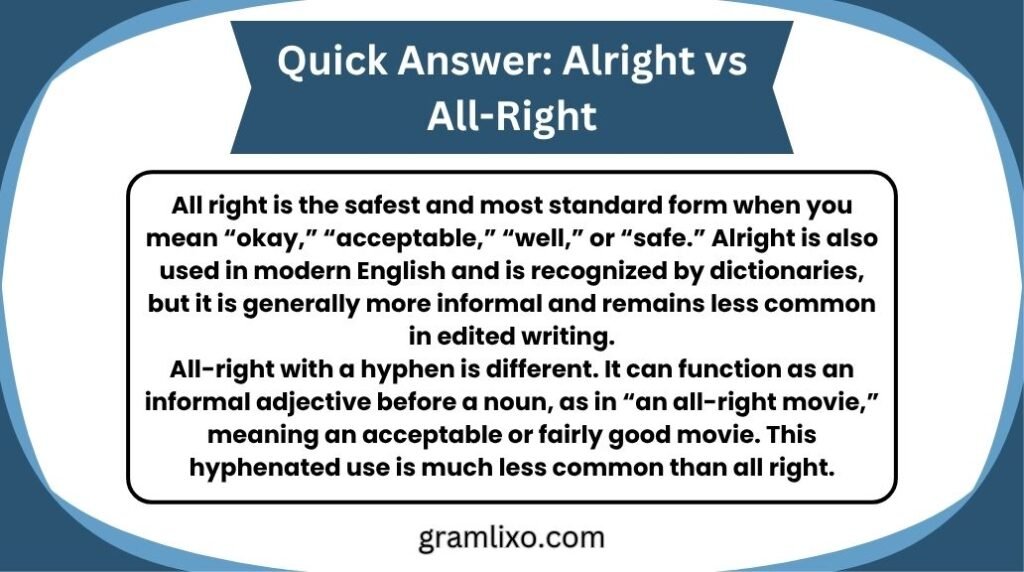
All right is the safest and most standard form when you mean “okay,” “acceptable,” “well,” or “safe.” Alright is also used in modern English and is recognized by dictionaries, but it is generally more informal and remains less common in edited writing.
All-right with a hyphen is different. It can function as an informal adjective before a noun, as in “an all-right movie,” meaning an acceptable or fairly good movie. This hyphenated use is much less common than all right.
The simplest rule
- All right → standard choice in most writing.
- Alright → accepted, but more informal.
- All-right → uncommon hyphenated adjective used in specific contexts.
If you are writing an essay, business email, academic paper, or formal article, all right is usually the best choice.
Understanding the Basics of Alright vs All-Right
The confusion begins because the three forms are pronounced essentially the same but are written differently.
Basic comparison table
| Form | Type | Meaning | Example | Correct/Incorrect |
|---|---|---|---|---|
| all right | Adjective, adverb, interjection | Okay, satisfactory, safe, well, agreed | “Are you all right?” | ✅ Standard |
| alright | Adjective or adverb | Same basic meaning as all right | “Everything will be alright.” | ✅ Accepted, informal |
| all-right | Informal adjective | Acceptable, agreeable, fairly good | “It was an all-right movie.” | ✅ Specialized/less common |
| allright | — | Nonstandard spelling | “Everything is allright.” | ❌ Incorrect |
| all-right as a general replacement for all right | — | Not normally used | “Are you all-right?” | ❌ Usually incorrect |
The most important distinction is that all right is normally written as two separate words.
Merriam-Webster lists all right as both an adjective and an adverb and gives meanings such as “satisfactory,” “safe,” “well,” “good,” “certainly,” and “satisfactorily.”
Merriam-Webster also has an entry for alright, defining it as equivalent to all right. Its usage guide notes that all right remains much more common in published writing, although alright is increasingly found there as well.
Correct Meanings and Uses
1. All right meaning “okay” or “acceptable”
The most common use of all right is to say that something is acceptable or satisfactory.
Example:
The movie was all right.
Here, all right means that the movie was acceptable but probably not outstanding.
Sentence breakdown
- The movie = subject
- was = linking verb
- all right = adjective phrase describing the movie
Another example:
The food was all right, but I have had better.
This suggests that the food was satisfactory but not excellent.
2. All right meaning “safe” or “well”
You can also use all right when talking about someone’s physical or emotional condition.
Example:
Are you all right?
This can mean:
- Are you safe?
- Are you okay?
- Are you injured?
- Are you feeling well?
Merriam-Webster specifically defines all right as meaning “safe” or “well.”
Example:
After the accident, everyone was all right.
Here, all right means that everyone was safe or unharmed.
3. All right as an expression of agreement
All right can also function as an interjection.
Example:
All right, let’s start the meeting.
Here, it means something like:
- Okay.
- Let’s proceed.
- I agree.
Another example:
“Can you finish this today?”
“All right, I’ll do it.”
The expression shows agreement or acceptance.
4. All right meaning “satisfactorily”
Sometimes all right functions as an adverb.
Example:
She is doing all right in school.
Here, all right describes how she is doing.
It means:
She is doing reasonably well.
Merriam-Webster lists this adverbial meaning as “well enough” or “satisfactorily.”
5. All right meaning “certainly”
There is another interesting use.
Example:
He was the person responsible, all right.
In this sentence, all right means something like certainly or without doubt.
Merriam-Webster includes this meaning under the adverbial use of all right.
When Should You Use “Alright”?
The word alright is much more interesting than many grammar guides suggest.
Some older style guides treated alright as simply wrong. However, modern dictionaries recognize it as an established spelling.
Merriam-Webster defines alright as meaning all right and explains that the spelling dates to the 19th century. It also notes that the objection to alright has historically been connected largely to its newer spelling rather than to a clear difference in meaning.
Example
Everything will be alright.
This is understandable and widely used.
Another example:
Alright, let’s get started.
This is common in casual dialogue and informal writing.
So, is “alright” wrong?
Not exactly.
It is better to describe alright as accepted but informal or less preferred in formal edited writing, rather than simply calling it incorrect.
Cambridge, for example, labels alright as nonstandard in its dictionary treatment, while Merriam-Webster recognizes it as a dictionary entry and notes its increasing use.
This difference between dictionaries illustrates an important point about modern English: dictionaries do not always agree on how strongly a particular spelling should be recommended.
Best practical advice
Use:
all right
when you want the safest choice.
Use:
alright
when writing casual dialogue, informal messages, or other contexts where a conversational tone is appropriate.
What About “All-Right”?
Now we reach the least common form in this comparison.
All-right with a hyphen can function as an informal adjective before a noun.
For example:
We watched an all-right movie.
Here, all-right describes movie.
It means something like:
acceptable, fairly good, or satisfactory.
Dictionary.com separately records all-right as an informal adjective meaning agreeable, acceptable, or commendable.
Example
It was an all-right performance.
This means the performance was acceptable, although perhaps not impressive.
Another example:
He did an all-right job.
This means he did an acceptable or reasonably good job.
Why is the hyphen used?
The hyphen helps signal that all-right is functioning as a compound modifier before a noun.
Compare:
an all-right performance
with:
The performance was all right.
In the first sentence, all-right directly modifies performance.
In the second sentence, all right follows the linking verb was and functions as a predicate adjective phrase.
However, the hyphenated form is relatively uncommon. In ordinary writing, you will much more often see all right.
All Right vs All-Right: A Crucial Difference
Consider these two sentences:
The restaurant was all right.
We had an all-right meal.
The first sentence uses all right as a predicate adjective.
The second uses all-right as a compound modifier before the noun meal.
But remember: all-right is not simply a fancy version of all right that should be used everywhere.
You should not write:
Are you all-right?
The standard form is:
Are you all right?
Likewise:
All right, let’s go.
not:
All-right, let’s go.
Test Tip: The Easy Way to Choose
When you are unsure, ask yourself:
“Am I using this as the normal expression meaning okay?”
If yes, use:
all right
For example:
Are you all right?
That’s all right.
All right, I’ll help you.
Everything is all right.
“Am I using a less formal single-word alternative?”
If yes, alright may work.
Everything is alright.
Alright, let’s go.
“Is it an informal adjective directly before a noun?”
If yes, all-right may be possible.
an all-right performance
But because this form is uncommon, rewriting the sentence with all right or another adjective is often clearer.
Case Study: A Workplace Email
Imagine that an employee has finished a difficult project.
Informal message
Alright, the report is finished. Everything looks good.
This sounds conversational.
Professional version
All right, the report is finished. Everything looks good.
The second version is safer for professional communication because all right is the standard established form.
An even more polished email might say:
The report is complete, and everything looks good.
This eliminates the expression entirely.
Why this matters
Professional writing is not just about whether a word can be understood. It is also about choosing wording that fits the expected level of formality.
If you are writing:
- a business email,
- an academic assignment,
- a formal report,
- a cover letter,
- a professional article,
all right is generally the better choice.
Grammar Rules for Alright vs All-Right
Rule 1: “All right” is the standard form
The safest general rule is to write all right as two words.
Examples:
Are you all right?
Everything is all right.
Is it all right if I leave early?
All right, let’s begin.
Merriam-Webster’s dictionary gives these kinds of uses under all right and identifies the expression as an adjective, adverb, or interjection depending on context.
Rule 2: “Alright” is an accepted alternative
Modern English contains many words that developed from phrases.
Think about:
- already
- altogether
- always
- almost
Because these words eventually became established as single words, it is understandable that alright developed in a similar direction.
Merriam-Webster explains that alright dates to the mid-19th century and has increasingly appeared in published writing, although all right remains more common.
Therefore, calling alright an obvious spelling mistake is too simplistic.
Rule 3: “All-right” has a specialized use
The hyphenated version is not the normal spelling of the expression.
Instead, all-right can appear as an informal compound adjective.
Example:
It was an all-right experience.
However, because this construction is relatively uncommon, many writers would choose a simpler adjective:
It was an acceptable experience.
or:
It was a decent experience.
Rule 4: Never write “allright”
One spelling should be avoided:
❌ allright
The normal choices are:
✅ all right
✅ alright
✅ all-right, when the specific hyphenated adjective use applies.
What Do Major Dictionaries Say?
Understanding dictionary treatment helps resolve the debate.
Merriam-Webster
Merriam-Webster has separate entries for all right and alright. It states that alright means the same thing as all right, while noting that all right remains more common in published writing.
Cambridge Dictionary
Cambridge treats all right as the standard form and labels alright as nonstandard in its American English dictionary treatment.
Oxford Learner’s Dictionaries
Oxford lists all right and notes alright as a nonstandard or informal alternative.
What does this mean for writers?
The practical conclusion is simple:
If you want maximum acceptance across formal English contexts, choose “all right.”
That does not mean that alright has disappeared or has no legitimate modern use. It means that all right remains the safest conventional choice.
Common Mistakes With Alright vs All-Right
People make mistakes with these forms for several reasons.
1. Fast typing
When people type quickly, they often combine words.
For example:
all right → alright
This happens naturally because the two words are pronounced together.
2. Autocorrect
Phones and writing software can influence spelling habits.
If someone repeatedly sees alright accepted by their keyboard, they may assume that it is always the preferred form.
Autocorrect is useful, but it is not a complete grammar authority.
3. Lack of knowledge
Many writers simply have never learned that the standard form is all right.
Because alright looks logical, it can feel completely natural.
4. Confusing informal and formal writing
A word can be common without being the best choice for every situation.
That distinction matters here.
Alright is frequently encountered in:
- texting,
- casual messages,
- online conversations,
- dialogue,
- informal articles.
But all right remains the safer choice for formal edited prose.
Similar Grammar Confusions
| Confusion | Correct Standard Form | Common Mistake |
|---|---|---|
| it’s vs its | depends on meaning | confusing contraction and possession |
| your vs you’re | depends on meaning | confusing possession and contraction |
| their vs they’re | depends on meaning | confusing possession and contraction |
| then vs than | depends on meaning | confusing time and comparison |
| all right vs alright | all right is safest | treating informal alright as universally preferred |
| all right vs all-right | depends on grammatical role | using the hyphen everywhere |
| a lot vs alot | a lot | writing alot |
| in to vs into | depends on meaning | treating them as interchangeable |
The larger lesson is that English spelling often depends on grammatical function and context, not merely pronunciation.
Usage in Different Contexts
Everyday Conversation
In everyday speech, you do not have to worry about the spelling because all right and alright sound essentially the same.
For example:
“Are you all right?”
“Yeah, I’m all right.”
In spoken English, the distinction disappears.
Professional Writing
For professional writing, choose all right.
Better:
Please let me know if this schedule is all right with you.
Less formal:
Please let me know if this schedule is alright with you.
The second sentence is understandable, but the first follows the more traditional standard.
Academic Writing
Academic writing generally benefits from conventional spelling.
Prefer:
The results are all right, but additional research is needed.
rather than:
The results are alright, but additional research is needed.
However, if you are quoting a source exactly, preserve the original wording.
Creative Writing
Creative writing gives you greater flexibility.
A novelist may deliberately use alright because it reflects the way a character speaks.
For example:
“Alright, I’m coming!”
This may feel more natural in informal dialogue.
Writers can use spelling as part of voice and characterization.
Social Media and Texting
In casual digital communication, alright is extremely common.
For example:
Alright, see you tomorrow! 😊
There is little practical confusion.
In a text message, the difference between all right and alright usually has no effect on comprehension.
Why the Difference Matters
You might wonder why anyone should care about one space or one hyphen.
The answer is clarity and context.
1. Clarity
Using the conventional form makes your meaning easier to interpret.
Is everything all right?
is immediately recognizable as the standard expression.
2. Professionalism
In formal writing, conventional spelling demonstrates attention to detail.
That matters in:
- resumes,
- reports,
- school assignments,
- business correspondence,
- published content.
3. Digital communication
Online writing moves quickly, but written communication still creates an impression.
A consistent writing style helps readers trust the content.
4. Reader expectations
Different audiences have different expectations.
A text message can comfortably use:
Alright, I’ll be there.
A formal report is better with:
All right, the next section examines the results.
As Merriam-Webster notes, all right remains much more common in published writing.
Good writing is not only about being understood; it is also about choosing words that fit the situation.
Special Exception: The Hyphenated “All-Right”
The hyphenated form deserves special attention because it is easy to overuse.
Dictionary.com records all-right as an informal adjective meaning agreeable, acceptable, or commendable.
For example:
It was an all-right movie.
Here, the hyphenated compound works as a modifier before movie.
But do not assume that every occurrence of all right should become all-right when it appears near a noun.
Correct:
The movie was all right.
Possible informal compound adjective:
It was an all-right movie.
Incorrect as a general replacement:
Are you all-right?
The third example should normally be:
Are you all right?
This is an important distinction because hyphens should not be added simply because two words appear next to each other.
Alright vs All-Right in Sentences
Here are practical examples to make the difference clearer.
Standard “all right”
Are you all right after the long trip?
Meaning: Are you okay?
Standard “all right” for permission
Is it all right if I call you later?
Meaning: Is it acceptable?
Standard “all right” for agreement
All right, I’ll meet you at six.
Meaning: Okay; I agree.
Standard “all right” for satisfactory quality
The presentation was all right.
Meaning: It was acceptable.
Informal “alright”
Alright, let’s move on.
Meaning: Okay, let’s continue.
Informal “alright”
I think everything will be alright.
Meaning: Everything will be okay.
Hyphenated “all-right”
We had an all-right experience.
Meaning: The experience was acceptable or fairly good.
Incorrect “allright”
❌ Everything is allright.
Correct alternatives
✅ Everything is all right.
✅ Everything is alright.
Quick Recap Checklist
Use this checklist whenever you are unsure.
| Question | If Yes → Use |
|---|---|
| Do you mean “okay,” “safe,” or “well”? | all right |
| Are you writing formally? | all right |
| Are you writing an academic or professional document? | all right |
| Are you writing casual dialogue or a text? | alright can be used |
| Are you using an informal compound adjective before a noun? | all-right may be appropriate |
| Are you tempted to write “allright”? | ❌ Never use it |
Practice Example 1
Question: Is everything ___ after the accident?
Answer:
Is everything all right after the accident?
Why? Because it means safe or okay.
Practice Example 2
Question: ___, I’ll send the file tonight.
Answer:
All right, I’ll send the file tonight.
Why? It expresses agreement.
Practice Example 3
Question: The performance was ___.
Answer:
The performance was all right.
Why? It means satisfactory or acceptable.
FAQs About Alright vs All-Right
1. Is “alright” grammatically correct?
Alright is recognized by major dictionaries, but it is less conventional than all right. Merriam-Webster lists alright as an adjective or adverb meaning all right, while noting that all right remains more common in published writing.
For formal writing, all right is the safest choice.
2. Is “all right” or “alright” correct?
All right is the safest standard form. Alright is also widely used, especially in informal writing, but some dictionaries and style traditions still consider it nonstandard or informal.
3. Is “all-right” correct?
Yes, but only in specific contexts. All-right can function as an informal compound adjective meaning acceptable or fairly good, as in “an all-right movie.” It should not replace the ordinary expression all right.
4. Should I use “alright” in formal writing?
It is better to use all right in formal writing.
For example:
Please let me know if this is all right.
This is the safest choice for professional, academic, and edited writing.
5. Why do people write “alright” if “all right” is standard?
Alright developed as a newer single-word spelling of the older expression all right. Merriam-Webster traces alright to the 19th century and explains that the spelling has become increasingly common, even though all right remains more frequent in published writing.
6. Is “allright” ever correct?
No. Allright is not the standard spelling.
Use:
all right
or, in informal contexts where appropriate:
alright
Do not write:
❌ allright
Final Conclusion
The easiest way to remember alright vs all-right is to start with the standard form: all right. Use it when you mean “okay,” “acceptable,” “safe,” “well,” or “agreed.” It is the safest choice for professional, academic, and formal writing.
Alright is a recognized modern alternative and is common in informal communication, although it remains less favored in edited writing. All-right, meanwhile, is a much less common hyphenated adjective used in specific informal constructions, such as “an all-right movie.”
So, when in doubt, remember this simple rule: write “all right” as two words. Use alright when an informal style suits your context, and reserve all-right for the specialized compound-adjective use. Most importantly, never write allright.
When you want the safest spelling, keep it simple: all right is all right. ✅

I’m Robert Williams, an English grammar writer at Gramlixo. I focus on breaking down confusing grammar rules into simple explanations and useful examples.
[…] |Alright vs All-Right: Which One Is Correct? […]
[…] |Alright vs All-Right: Which One Is Correct? […]