Have you ever typed “pajamas” and wondered why someone else wrote “pyjamas”? 🤔 You are not alone. The difference between pajamas vs pyjamas can be confusing because both spellings refer to the same type of comfortable clothing worn for sleeping. The main difference is not meaning—it is regional spelling.
In American English, pajamas is the standard spelling. In British English and several other varieties of English, pyjamas is commonly used. Both words describe loose clothing worn in bed, usually consisting of a top and matching pants or trousers.
This spelling difference is similar to other American and British variations, such as color vs colour, favorite vs favourite, and center vs centre. Neither spelling is inherently wrong. The correct choice depends largely on the variety of English you are using and the audience you are writing for.
For American readers and writers, however, the answer is simple: use “pajamas.” 🇺🇸
Understanding the distinction can help you write more consistently, especially in school assignments, professional communication, websites, product descriptions, and other forms of formal writing.
|Extensible vs Extendible: What’s the Difference?
|Accent vs Ascent vs Assent: Meaning, Differences, and Correct Usage
|Heard vs Herd vs Hurd: What’s the Difference?
Quick Answer: Pajamas vs Pyjamas
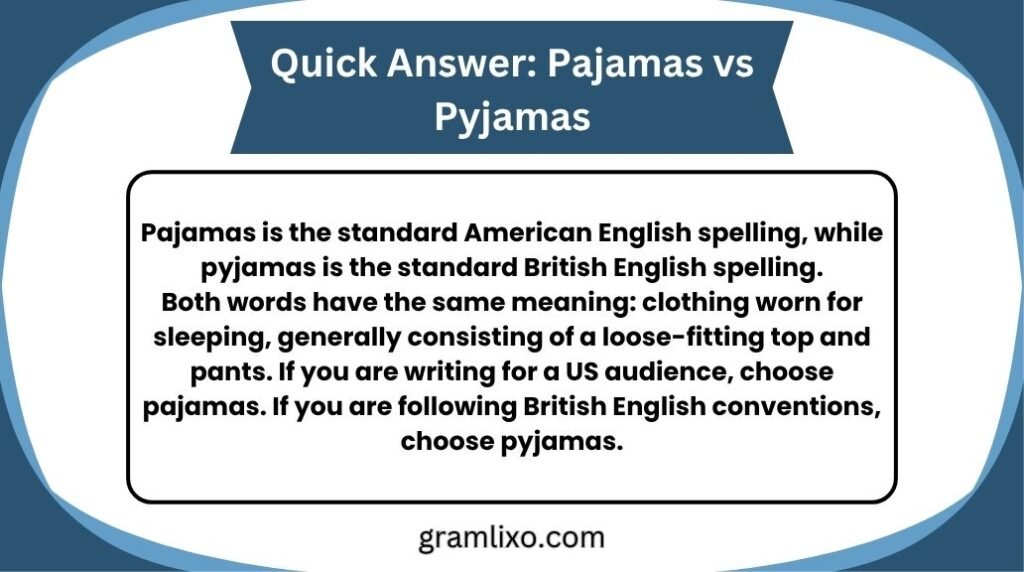
Pajamas is the standard American English spelling, while pyjamas is the standard British English spelling.
Both words have the same meaning: clothing worn for sleeping, generally consisting of a loose-fitting top and pants. If you are writing for a US audience, choose pajamas. If you are following British English conventions, choose pyjamas.
Quick rule:
🇺🇸 American English → pajamas
🇬🇧 British English → pyjamas
Cambridge Dictionary explicitly identifies pajamas as the US spelling of pyjamas and defines the word as clothing worn in bed.
Understanding the Basics of Pajamas vs Pyjamas
The easiest way to understand pajamas vs pyjamas is to recognize that they are not two different things.
They are two regional spellings of the same word.
Pajamas
Pajamas is the preferred spelling in American English.
Examples:
- I bought a new pair of pajamas.
- My daughter wears pink pajamas to bed.
- These pajamas are very comfortable.
- I forgot to pack my pajamas for the trip.
Pyjamas
Pyjamas is the traditional spelling used in British English.
Examples:
- I bought a new pair of pyjamas.
- She changed into her pyjamas before dinner.
- His pyjamas are made of cotton.
- Don’t forget to pack your pyjamas.
The meaning remains essentially the same.
Comparison Table
| Form | Type | Meaning | Example | Correct/Incorrect |
|---|---|---|---|---|
| pajamas | American English | Clothes worn for sleeping | I bought new pajamas. | Correct in US English |
| pyjamas | British English | Clothes worn for sleeping | I bought new pyjamas. | Correct in UK English |
| pajama | Singular American form | Relating to or describing sleepwear | She wore a pajama top. | Correct |
| pyjama | Singular British form | Relating to or describing sleepwear | She wore a pyjama top. | Correct |
| pajamas in British writing | Regional mismatch | Same meaning, different convention | I bought pajamas. | Usually avoided in consistent UK English |
| pyjamas in American writing | Regional mismatch | Same meaning, different convention | I bought pyjamas. | Usually avoided in consistent US English |
The key point is that neither “pajamas” nor “pyjamas” is universally wrong. The spelling depends on the English variety.
Why Are There Two Spellings?
English has developed differently in different regions.
When words move between languages and cultures, their spelling can change over time. Pajamas/pyjamas is one example of this larger pattern.
The word ultimately comes from a term associated with South Asian clothing and traces back through languages including Hindi and Urdu to Persian. English adopted the word and developed different spelling conventions.
Over time, American English and British English established different preferences.
The result is:
- pajamas → American English
- pyjamas → British English
This is not unusual.
Consider these examples:
| American English | British English |
|---|---|
| pajamas | pyjamas |
| color | colour |
| favorite | favourite |
| center | centre |
| theater | theatre |
| realize | realise |
| traveling | travelling |
These differences do not necessarily indicate different meanings. They often reflect different spelling conventions.
Correct Meanings and Uses
What Does “Pajamas” Mean?
Pajamas refers to clothing worn for sleeping or relaxing at home.
In American English, the word commonly describes a matching set consisting of:
- a shirt or top
- pants or bottoms
For example:
I put on my pajamas before going to bed.
Here, pajamas refers to the clothing the speaker wears for sleeping.
Another example:
My son refuses to wear his pajamas.
The word is still functioning as a noun referring to sleepwear.
What Does “Pyjamas” Mean?
Pyjamas has the same basic meaning.
The spelling is primarily associated with British English and other varieties influenced by British spelling conventions.
For example:
I need to buy new pyjamas.
This sentence is perfectly normal in British English.
An American writer would typically write:
I need to buy new pajamas.
The meaning does not change.
Pajama as an Adjective
The singular form pajama can also be used before another noun.
For example:
- pajama pants
- pajama top
- pajama set
- pajama party
- pajama bottoms
- pajama shirt
Examples:
She bought a new pajama set.
The children are having a pajama party.
I need a comfortable pajama top.
In British English, you may see:
- pyjama top
- pyjama party
- pyjama set
- pyjama bottoms
Again, the distinction is primarily spelling.
Cambridge lists pyjama as the British form and pajama as the US form.
Is “Pajamas” Singular or Plural?
This is another point that sometimes confuses learners.
Pajamas is generally treated as a plural noun.
That is why we commonly say:
I bought a pair of pajamas.
Rather than:
I bought a pajama.
When referring to the complete sleepwear set, a pair of pajamas is a natural expression in American English.
However, pajama is also used as a singular modifier in compounds:
pajama pants
pajama shirt
pajama set
So there is an important distinction.
Complete sleepwear
I bought a pair of pajamas.
Modifier
I bought a pajama set.
The same pattern appears with British pyjamas and pyjama.
Is “Pajamas” More Correct Than “Pyjamas”?
Not universally.
This is one of the most important points about pajamas vs pyjamas.
If you are writing American English, pajamas is the correct standard spelling.
If you are writing British English, pyjamas is the standard spelling.
Therefore, it is better to say:
Pajamas is correct in American English, while pyjamas is correct in British English.
Instead of saying:
Pyjamas is wrong.
That statement would be inaccurate.
Cambridge Dictionary specifically labels pajamas as the US spelling of pyjamas and pyjamas as the UK spelling of pajamas.
Test Tip: How to Choose the Right Spelling
Here is a simple test.
Ask yourself:
Who is going to read this?
If your audience is primarily American:
✅ Use pajamas
If your audience is primarily British:
✅ Use pyjamas
If you are writing for an international audience, either form can be understood, but consistency is important.
Easy memory trick
Think:
America → pajamas → A
Britain → pyjamas → Y
You can remember:
Pajamas has an A for American English.
It is not a formal grammar rule, but it is a useful memory device. 🧠
Case Study: A Workplace Email
Imagine an American employee sending an email to coworkers about a charity event.
American English version
Subject: Pajama Day Reminder
Don’t forget that Friday is our company pajama day! Employees are encouraged to wear comfortable pajamas while following the usual workplace guidelines.
This is appropriate for a US workplace.
Now imagine the same message being prepared for a British audience:
Subject: Pyjama Day Reminder
Don’t forget that Friday is our company pyjama day! Employees are encouraged to wear comfortable pyjamas while following the usual workplace guidelines.
The message has the same meaning.
The spelling changes because the intended variety of English has changed.
What does this teach us?
It demonstrates that regional spelling can matter in professional writing.
If your company uses American English throughout its website and internal documents, suddenly switching to British spellings can make the writing look inconsistent.
Likewise, a British publication may prefer pyjamas throughout its content.
Consistency is more important than trying to declare one spelling universally correct.
Grammar Rules for Pajamas vs Pyjamas
Are Both Forms Grammatically Correct?
Yes.
The difference is mainly orthographic and regional, not grammatical.
Pajamas and pyjamas refer to the same type of clothing.
The grammar surrounding them remains essentially the same.
For example:
These pajamas are comfortable.
And:
These pyjamas are comfortable.
Both sentences are grammatical.
The spelling changes, but the sentence structure does not.
What Do Standard Dictionaries Say?
Major dictionaries recognize the regional distinction.
Cambridge Dictionary identifies pajamas as the US spelling of pyjamas. It defines the word as soft, loose clothing worn in bed.
Cambridge also identifies pyjamas as the UK spelling of pajamas.
Merriam-Webster is a major reference authority for American English, and its dictionary resources distinguish regional usage and pronunciation where appropriate. Its pronunciation guidance explains that dictionaries can record accepted variations rather than assuming that every English word has only one universal form.
Therefore, writers should think of pajamas vs pyjamas as a regional spelling distinction rather than a simple correct-versus-incorrect grammar problem.
Common Mistakes With Pajamas vs Pyjamas
Why do people get this word wrong?
There are several common reasons.
1. Fast Typing
When people type quickly, they often rely on memory instead of consciously checking spelling.
Someone who normally reads British English may automatically type:
pyjamas
Even if they are writing for an American audience.
Similarly, an American writer may instinctively use:
pajamas
in a British English assignment.
Fast typing makes these switches more likely.
2. Autocorrect
Autocorrect can also create confusion.
Your device may recognize both forms because both spellings are legitimate English words.
As a result, it may not flag pyjamas as a spelling error even when you are writing American English.
That does not mean the word is wrong. It simply means your chosen regional spelling may not match your intended style guide.
3. Lack of Knowledge
Some writers simply do not know that American and British English use different spellings.
They may assume that one spelling is a typo.
For example, an American learner may see:
pyjamas
and think:
“Someone forgot to spell pajamas correctly.”
But pyjamas is a legitimate British spelling.
Likewise, a British reader should not automatically assume that pajamas is misspelled.
4. Exposure to Different Varieties of English
The internet has made regional English boundaries less obvious.
An American reader might regularly encounter British websites, television shows, books, and social media posts.
A British reader might regularly encounter American websites and entertainment.
As a result, both spellings appear in everyday digital communication.
Similar Spelling Confusions
The confusion around pajamas vs pyjamas is part of a much larger pattern.
| Confusion | Correct distinction |
|---|---|
| it’s vs its | it’s = it is; its = possessive |
| your vs you’re | your = possessive; you’re = you are |
| their vs they’re | their = possessive; they’re = they are |
| there vs their | there = location; their = possession |
| color vs colour | American vs British spelling |
| favorite vs favourite | American vs British spelling |
| center vs centre | American vs British spelling |
| pajamas vs pyjamas | American vs British spelling |
| realize vs realise | American vs British spelling |
| theater vs theatre | American vs British spelling |
Notice that not every confusion works in the same way.
It’s vs its involves different grammatical functions.
Pajamas vs pyjamas, on the other hand, is mainly a regional spelling difference.
Usage in Different Contexts
Everyday Conversation
In casual American conversation, pajamas is the natural choice.
Examples:
I’m still wearing my pajamas.
Did you pack your pajamas?
These pajamas are so soft.
In British English, the equivalent would normally use pyjamas.
Because both forms are widely recognizable, communication is unlikely to fail either way. The difference is mainly about matching the audience’s preferred variety of English.
Professional Writing
Professional writing requires greater consistency.
Suppose you are writing a US-based company’s product description:
These cotton pajamas are lightweight and breathable.
That is appropriate for American English.
If the company targets the United Kingdom:
These cotton pyjamas are lightweight and breathable.
The product itself has not changed. Only the regional spelling has.
Best practice
Choose one English variety and use it consistently throughout the document.
Do not write:
Our pajamas are comfortable, and these pyjamas are available in five colors.
That sentence mixes American and British conventions.
A consistent American version would be:
Our pajamas are comfortable, and these pajamas are available in five colors.
A consistent British version would be:
Our pyjamas are comfortable, and these pyjamas are available in five colours.
Creative Writing
Creative writers have more flexibility.
If you are writing a character from Britain, using pyjamas may help maintain authentic British spelling.
If your narrator or setting follows American English, pajamas is usually more appropriate.
For example:
Emma pulled on her pajamas and walked downstairs.
This feels natural in American English.
For a British character:
Emma pulled on her pyjamas and walked downstairs.
The spelling can contribute to the overall linguistic setting of a story.
Social Media and Texting
Social media is much more flexible.
You may see:
- pajamas
- pyjamas
- PJs
- pjs
- PJ’s
However, PJs or PJs is often used informally as a shortened form.
Examples:
Pajama day! 😴
Movie night in my PJs! 🍿
New pyjamas, better sleep.
Social media users generally care more about speed and personality than strict regional consistency.
Still, if you are representing a professional brand, consistent spelling remains important.
Pajamas vs Pyjamas in SEO and Online Content
For website owners, bloggers, and content creators, regional spelling can also affect search behavior.
A US-focused website will usually benefit from naturally using pajamas, because that is the spelling expected in American English.
A UK-focused website may naturally use pyjamas.
However, there is no need to force both spellings repeatedly into an article.
Instead, write naturally and make the regional distinction clear when relevant.
For example:
In American English, the word is spelled pajamas, while British English uses pyjamas.
This single sentence can answer the searcher’s question directly.
For SEO, clarity should come before excessive repetition.
Why It Matters
At first glance, the difference between pajamas vs pyjamas may seem too small to matter.
After all, everyone knows what the word means.
But spelling choices can communicate important information about your intended English variety.
1. Clarity
Using consistent spelling helps readers understand the style of English you are following.
2. Professionalism
In business writing, consistency makes content look more polished.
A document that randomly switches between American and British spelling can appear poorly edited.
3. Digital Communication
Websites, emails, advertisements, and social media posts reach international audiences.
Knowing regional spelling differences helps writers avoid unnecessary confusion.
4. Audience Awareness
Using pajamas for an American audience shows that you understand American spelling conventions.
Using pyjamas for a British audience demonstrates the same awareness.
A useful principle
Good writing is not just about being correct; it is also about being consistent.
That principle applies far beyond this one word.
Special Exceptions and Edge Cases
There is no major grammatical exception that makes pajamas suddenly mean something different from pyjamas.
However, there are a few related forms worth knowing.
Pajama
The singular form pajama appears especially when the word modifies another noun.
Examples:
- pajama pants
- pajama top
- pajama set
- pajama party
Pyjama
The British equivalent is:
- pyjama pants
- pyjama top
- pyjama set
- pyjama party
Pajama Party
In American English, pajama party is a common expression for a social gathering where people wear sleepwear, often associated with children or teenagers.
You may also see:
pajama party
pajama night
pajama day
In British English, these can become:
pyjama party
pyjama night
pyjama day
Is “Pajamas” the American Spelling?
Yes.
For US English, pajamas is the standard spelling.
If you are writing:
- a US school assignment
- an American blog
- an American product description
- a US business email
- American advertising copy
- a US-focused website
then pajamas is generally the preferred form.
Example:
Our store sells comfortable pajamas for men, women, and children.
Is “Pyjamas” the British Spelling?
Yes.
Pyjamas is the standard British spelling.
For British English writing, you will commonly see:
I bought new pyjamas.
She changed into her pyjamas.
These pyjamas are made from cotton.
Cambridge Dictionary labels pyjamas as UK and pajamas as US.
Can Americans Use “Pyjamas”?
They can, but it would generally look like a British spelling choice.
There is nothing inherently ungrammatical about the word.
For example:
I love these pyjamas.
An American reader will almost certainly understand it.
However, if you are writing consistently in American English, pajamas is the better choice.
The same principle applies in reverse.
A British writer can use pajamas, but pyjamas better matches standard British spelling conventions.
Can British Writers Use “Pajamas”?
Yes, the meaning will be understood.
However, pajamas is the American spelling.
If you are writing for a British audience and want to follow British English conventions, use pyjamas.
This is especially important in:
- edited publications
- academic writing
- formal reports
- newspapers
- professional websites
- educational materials
Quick Recap Checklist
Use this checklist whenever you are unsure.
| Question | If Yes → Use |
|---|---|
| Am I writing for an American audience? | pajamas |
| Am I writing for a British audience? | pyjamas |
| Is my website written in US English? | pajamas |
| Is my document following UK English? | pyjamas |
| Am I using American spelling such as “color”? | pajamas |
| Am I using British spelling such as “colour”? | pyjamas |
| Do I want consistent US spelling? | pajamas |
| Do I want consistent UK spelling? | pyjamas |
Practice Example 1
You are writing a US blog post:
I bought new ______ for winter.
✅ pajamas
Practice Example 2
You are writing a British novel:
She changed into her ______ before going to bed.
✅ pyjamas
Practice Example 3
You are writing a US product description:
These cotton ______ are soft and breathable.
✅ pajamas
Practice: Choose the Correct Form
Try these examples yourself.
1. American English
I need to buy a new pair of ______.
Answer: pajamas
2. British English
Don’t forget to pack your ______.
Answer: pyjamas
3. American English
The children are having a ______ party.
Answer: pajama
4. British English
She bought a comfortable ______ set.
Answer: pyjama
5. American English
These ______ are too warm for summer.
Answer: pajamas
The trick is not memorizing two completely different words. Instead, remember that they are regional spellings of the same word.
FAQs About Pajamas vs Pyjamas
1. Is “pajamas” or “pyjamas” correct?
Both are correct. Pajamas is the standard American English spelling, while pyjamas is the standard British English spelling.
2. Which spelling should I use in the United States?
Use pajamas. It is the standard US spelling.
3. Is “pyjamas” a misspelling of “pajamas”?
No. Pyjamas is a legitimate British English spelling. It is not a spelling mistake simply because American English uses pajamas.
4. Do pajamas and pyjamas mean the same thing?
Yes. Both refer to clothing worn for sleeping, usually consisting of a top and pants or trousers.
5. Why does American English use “pajamas”?
English has developed different spelling conventions in different regions. American English generally uses pajamas, while British English retains pyjamas.
6. Which spelling is better for a US website?
Use pajamas if the website targets an American audience. It matches standard American English spelling and provides consistency with other US spellings.
Final Comparison: Pajamas vs Pyjamas
| Feature | Pajamas | Pyjamas |
|---|---|---|
| Meaning | Sleepwear | Sleepwear |
| English variety | American English | British English |
| Main region | United States | United Kingdom |
| Singular form | pajama | pyjama |
| Common phrase | pajama party | pyjama party |
| Correct in US English | Yes | Usually avoided in consistent US style |
| Correct in UK English | Usually avoided in consistent UK style | Yes |
| Meaning difference | None | None |
The most important thing to remember is that the difference is spelling, not meaning.
Conclusion
The difference between pajamas vs pyjamas is simple once you understand regional English spelling. Pajamas is the standard American English spelling, while pyjamas is the standard British English spelling. Both words refer to the same comfortable clothing worn for sleeping.
If you are writing for readers in the United States, choose pajamas. If you are following British English conventions, choose pyjamas. Neither spelling should automatically be labeled incorrect because each belongs to a recognized variety of English.
The best approach is to consider your audience and remain consistent throughout your writing. If your article uses American spellings such as color, favorite, and center, then pajamas is the natural choice. If it follows British conventions such as colour, favourite, and centre, then pyjamas fits better.
So, when in doubt, remember one easy rule:
🇺🇸 American English = pajamas. 🇬🇧 British English = pyjamas.
Different spelling, same sleepwear. 😴

I’m Michael Williams, an English writer and grammar enthusiast at Gramlixo. I’m passionate about making grammar easier to learn and helping readers write with greater confidence.
[…] |Pajamas vs Pyjamas: Which Spelling Is Correct? […]