Have you ever written “extensible” and wondered whether “extendible” might actually be the better choice? You are not alone. The words extensible vs extendible create confusion because they look almost identical, sound similar, and share the same basic idea: something that can be extended, enlarged, expanded, or made longer.
The good news is that this is not a case where one spelling is always correct and the other is always wrong. Extensible and extendible are both valid adjectives. The bigger difference is one of usage, frequency, and context.
In modern American English, extensible is especially common when discussing software, systems, designs, structures, and things that can accept future additions. Extendible is also correct and can describe something that can be extended, but it is generally less common.
Understanding extensible vs extendible can help you choose the word that sounds most natural in professional writing, technical documentation, everyday communication, and academic work.
|A Hilarious or An Hilarious: Which Is Correct?
|Ingrained vs Engrained: Which Spelling Is Correct?
|Emasculate vs Demasculate: Which Word Is Correct?
Quick Answer: Extensible vs Extendible
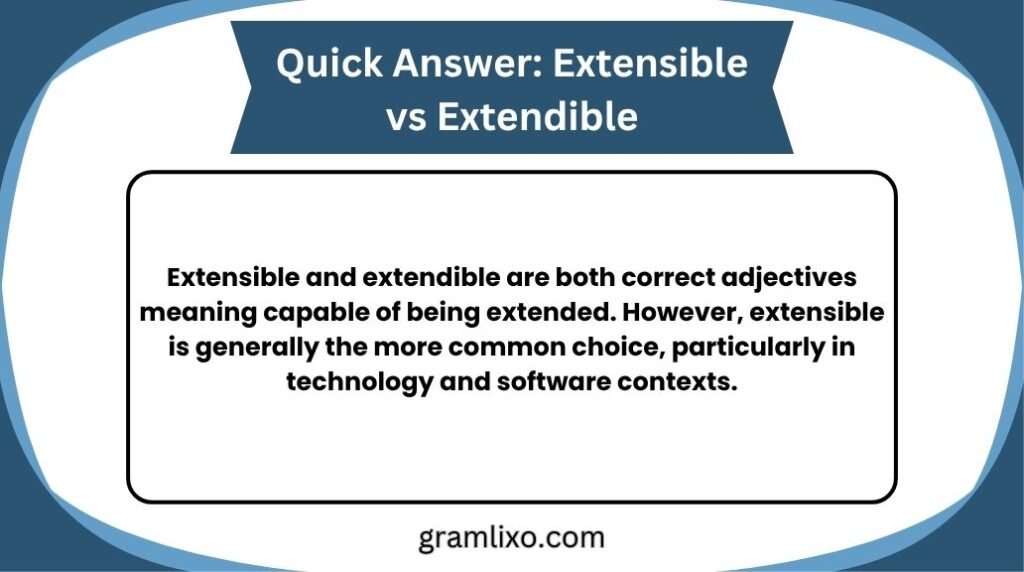
Extensible and extendible are both correct adjectives meaning capable of being extended. However, extensible is generally the more common choice, particularly in technology and software contexts.
For example:
- The software has an extensible architecture. ✅
- The table has an extendible design. ✅
- The contract is extendible for another year. ✅
So, if you are unsure which word to use, extensible is usually the safer and more widely recognized choice, especially when talking about systems, software, or designs that can be expanded.
Understanding the Basics of Extensible vs Extendible
At their core, both words are connected to the verb extend.
The verb extend means to make something longer, larger, broader, or more extensive. Merriam-Webster gives several meanings for extend, including causing something to become longer, increasing its area or volume, and broadening its scope or application.
The suffix -ible can form adjectives describing something that is capable of undergoing a particular action. The form extensible is also built around the idea of something being capable of extension.
Comparison Table
| Form | Type | Meaning | Example | Correct/Incorrect |
|---|---|---|---|---|
| extensible | Adjective | Capable of being extended or expanded | The platform has an extensible architecture. | ✅ Correct |
| extendible | Adjective | Capable of being extended | The contract is extendible for another year. | ✅ Correct |
| extendable | Adjective | Capable of being extended | The table has an extendable section. | ✅ Correct |
| extensible | Adjective | Designed to allow future additions or expansion | The software is highly extensible. | ✅ Correct |
| extendible | Adjective | Able to be prolonged or enlarged | The deadline is extendible under certain conditions. | ✅ Correct |
| extensible as a noun | — | Not normally used as a noun | The extensible… | ❌ Incorrect usage |
| extendible as a noun | — | Not normally used as a noun | The extendible… | ❌ Incorrect usage |
The key takeaway is simple: both extensible and extendible are adjectives, and both are correct.
What Does “Extensible” Mean?
Extensible means capable of being extended, enlarged, expanded, or developed further.
It is especially common when something has been designed to accommodate additional features, functions, components, or capabilities.
For example:
The software uses an extensible architecture.
This means the architecture can be expanded with additional features or components.
Another example:
The system was designed to be extensible.
Here, extensible suggests that the system can grow or adapt without requiring a complete redesign.
Extensible in Technology
The word is extremely common in technical writing.
You may see expressions such as:
- extensible software
- extensible architecture
- extensible framework
- extensible platform
- extensible API
- extensible system
- extensible design
- extensible language
- extensible database
- extensible application
In these situations, extensible often carries an important idea beyond simple physical extension. It can mean that something has been intentionally designed so that developers or users can add functionality later.
For example:
The application provides an extensible plugin system.
The sentence suggests that additional plugins can be added without fundamentally replacing the entire application.
This meaning is closely associated with the modern technical concept of extensibility—the ability of a system to support future additions or modifications.
What Does “Extendible” Mean?
Extendible also means capable of being extended.
Merriam-Webster includes extendible among the words associated with extend, while Collins defines extendible in American English as synonymous with extensible and extendable.
For example:
The warranty is extendible for an additional two years.
This means the warranty can be extended for another two years.
Another example:
The deadline is extendible under special circumstances.
This means the deadline can be moved to a later date under certain conditions.
Extendible in Practical English
Extendible can be especially natural when talking about something that can be prolonged or physically extended.
Examples include:
- extendible contract
- extendible deadline
- extendible warranty
- extendible loan
- extendible table
- extendible ladder
- extendible agreement
That does not mean extensible would always be wrong in these contexts. Rather, extendible may fit the idea of something being capable of extension, while extensible is often preferred when discussing design or expandability.
Extensible vs Extendible: The Main Difference
The easiest way to understand the distinction is to focus on context.
Extensible Often Suggests Future Expansion
When something is designed so that additional functions or features can be added, extensible is usually the better choice.
For example:
The software has an extensible architecture.
This implies that the architecture can accommodate future development.
Similarly:
We need an extensible platform that can support new integrations.
The emphasis is on future growth and adaptability.
Extendible Often Emphasizes the Ability to Be Extended
Extendible can focus more directly on whether something can be extended.
For example:
The lease is extendible for another six months.
The main idea is simply that the lease can be prolonged.
Another example:
The dining table is extendible.
Here, the physical table can be made longer.
A Simple Rule
Think of the difference this way:
Extensible = designed or capable of expanding, especially in functionality.
Extendible = capable of being extended, prolonged, or made larger.
There is overlap, so this is a usage preference rather than an absolute grammatical rule.
Is “Extensible” Correct?
Yes. Extensible is completely correct.
It is a standard English adjective and is particularly common in technical and professional contexts.
Examples:
- The framework is extensible.
- The software has an extensible architecture.
- We need an extensible design.
- The platform provides an extensible API.
- The system is highly extensible.
Merriam-Webster’s dictionary listings include extensible among words related to extend, alongside extendible, extendability, and extendibility.
Is “Extendible” Correct?
Yes. Extendible is also correct.
This is an important point because many people mistakenly assume that extendible is simply a misspelling of extensible. It is not.
For example:
The contract is extendible.
That sentence is grammatically correct.
You can also write:
The warranty is extendible for another year.
Again, this is correct.
Collins specifically lists extendible as an adjective meaning extensible or extendable.
Which Is More Common: Extensible or Extendible?
In many modern contexts, especially software and technology, extensible is the more familiar choice.
For example, technical writers commonly talk about:
- extensible architecture
- extensible software
- extensible systems
- extensible frameworks
- extensible programming languages
The noun extensibility is also widely used to describe the capacity of a system to accommodate future extensions.
By contrast, extendible remains a legitimate English word but is generally less prominent in modern technical terminology.
This difference in frequency explains why some readers may see extendible and think it looks unusual even though it is correct.
Correct Meanings and Uses
1. Extensible Software
Use extensible when software can be expanded with additional functionality.
Example:
The application has an extensible plugin architecture.
Breakdown:
- application = the software
- extensible = capable of being expanded
- plugin architecture = a structure that allows additional components
The sentence means the application can gain new functionality through plugins.
2. Extensible Systems
An extensible system can accommodate additional components or features.
We built an extensible system that can support future requirements.
Here, extensible emphasizes future development.
3. Extendible Contracts
Use extendible when describing an agreement that can be prolonged.
The contract is extendible for another six months.
The contract does not necessarily become more sophisticated. Its duration can simply be increased.
4. Extendible Deadlines
The deadline is extendible with manager approval.
The deadline can be moved to a later date.
5. Extendible Physical Objects
This is an extendible dining table.
The table can physically become longer.
You could also say:
This is an extendable dining table.
In everyday modern English, extendable may sound more natural than either extensible or extendible for some physical objects.
Test Tip: How Can You Choose?
When you are unsure between extensible and extendible, ask yourself:
Am I talking about future functionality, adaptability, or system design?
If yes, extensible will often be the most natural choice.
The platform is extensible.
Am I simply saying that something can be prolonged, lengthened, or extended?
If yes, extendible may work well.
The agreement is extendible.
The Quick Substitution Test
Try replacing the word with:
capable of being extended
If the sentence still makes sense, both extensible and extendible may potentially work.
Then ask whether you are discussing technical expandability or simply extension.
Case Study: Workplace Email
Imagine that a manager sends this email:
Our software platform is extensible, so the development team can add new reporting features later.
This is a natural use of extensible because the subject is software architecture and future functionality.
Now imagine a different email:
Your service agreement is extendible for an additional twelve months.
Here, extendible is natural because the agreement’s duration can be extended.
Why the Context Matters
Compare the two:
Software:
Our platform is extensible.
Contract:
Our contract is extendible.
Both are grammatically correct.
The difference comes from the meaning the writer wants to emphasize.
The first focuses on expandability and future functionality.
The second focuses on prolongation.
Grammar Rules Behind Extensible and Extendible
There is no grammatical rule stating that only one of these forms is correct.
Both words function as adjectives.
Extensible
The software is extensible.
Here, extensible describes the software.
Extendible
The agreement is extendible.
Here, extendible describes the agreement.
Both constructions follow normal adjective usage.
Merriam-Webster’s dictionary resources list extendible as a legitimate adjective and also identify extendable and extensible as related forms.
Therefore, calling extendible a “wrong spelling” would be inaccurate.
Why Do the Words Look Different?
The words come from the same basic concept of extension, but English has several adjective-forming patterns.
English does not always produce only one predictable form from a verb.
Compare:
- extend → extensible
- extend → extendible
- extend → extendable
All three can be found in English.
However, frequency and context determine which one sounds most natural.
Extensible vs Extendible in American English
For US English readers, extensible is especially recognizable in technical and professional writing.
For example:
The company is building an extensible software platform.
This sounds natural in a technology context.
Meanwhile:
The contract is extendible.
is also perfectly understandable and grammatically acceptable.
If your goal is to write for a technical audience, extensible will often be the stronger choice.
If your goal is to describe something whose period, length, or scope can simply be increased, extendible can be appropriate.
Common Mistakes
Why do people confuse these words?
Several factors contribute to the confusion.
1. Similar Spelling
The words differ by only a few letters:
- extensible
- extendible
That makes them easy to mix up.
2. Similar Meaning
Both words communicate the basic idea of something being capable of extension.
When two words have almost identical meanings, writers may assume one must be wrong.
3. Fast Typing
When typing quickly, people often write the first form that comes to mind.
For example:
extensible
may accidentally become:
extendible
or vice versa.
4. Autocorrect
Autocorrect can sometimes reinforce whichever spelling you typed first. Since both words are legitimate, a spell-checker may not flag either one.
5. Lack of Knowledge
Many writers have simply never encountered extendible before.
As a result, they may assume:
“It must be a typo.”
But dictionary evidence shows that extendible is an established English adjective.
Similar Grammar Confusions
The confusion between extensible and extendible is similar to other pairs where two forms look or sound alike.
| Confusing Pair | Correct Usage |
|---|---|
| it’s / its | It’s = it is; its = possessive |
| your / you’re | Your = possessive; you’re = you are |
| there / their / they’re | Different meanings and grammatical roles |
| affect / effect | Usually verb vs. noun, with exceptions |
| than / then | Comparison vs. sequence |
| accept / except | Receive vs. exclude |
| advice / advise | Noun vs. verb |
| extensible / extendible | Both are valid adjectives with overlapping meanings |
The important difference is that extensible vs extendible is not really a right-versus-wrong pair.
That makes it different from:
your / you’re
where choosing the wrong form can create a grammatical error.
With extensible and extendible, the main issue is usually style, frequency, and context.
Usage in Different Contexts
Everyday Conversation
In casual conversation, you may rarely need either word.
Instead, people often use simpler alternatives:
The table can be extended.
We can extend the deadline.
The contract can be extended.
These sentences are clear and natural.
Professional Writing
Both forms can appear in professional writing.
However, extensible is particularly useful in technology and business discussions.
We need an extensible platform that can support future growth.
For agreements and deadlines:
The contract is extendible upon renewal.
The best choice depends on the intended meaning.
Creative Writing
Creative writers may use either adjective when describing physical or conceptual expansion.
For example:
The strange bridge had an extensible structure that seemed to grow toward the horizon.
Or:
The magical corridor was extendible, stretching farther whenever the travelers moved forward.
Creative writing gives you more freedom, so sound and imagery can influence the choice.
Social Media and Texting
In social media posts and text messages, neither word is especially common.
People are more likely to write:
Can we extend the deadline?
rather than:
Is the deadline extendible?
Similarly, a developer might write:
This tool is extensible.
in a technical post, but a casual user might simply say:
You can add more features to this tool.
Simple language is often preferable in informal communication.
Extensible vs Extendible in Technology
Technology is one area where the distinction becomes particularly useful.
Extensible Architecture
An extensible architecture is designed to accommodate additional functionality.
For example:
The application uses an extensible architecture that supports third-party plugins.
This suggests that the original system was designed with future expansion in mind.
Extensible Framework
Developers chose an extensible framework for the new project.
The framework can be adapted or expanded as requirements change.
Extensible API
The API provides an extensible interface for future integrations.
Again, the emphasis is on future capability.
This technical meaning is why extensible is so common in software terminology. Extensibility is widely understood in software engineering as a system’s ability to accommodate new functionality without undermining existing functionality.
Extensible vs Extendible in Contracts
Legal and business contexts can work differently.
Consider:
The lease is extendible for one additional year.
The meaning is straightforward: the lease can be prolonged.
You could also write:
The lease can be extended for one additional year.
The second version is often clearer because it uses the familiar verb extend.
Similarly:
The warranty is extendible.
means the warranty can be extended.
When maximum clarity matters, especially for a broad audience, the phrase can be extended may be easier to understand than either adjective.
Extensible vs Extendible vs Extendable
There is a third word worth knowing: extendable.
All three forms can describe something capable of being extended.
| Word | Basic Meaning | Common Impression |
|---|---|---|
| extensible | Capable of being extended or expanded | Common in technical contexts |
| extendible | Capable of being extended | Valid but generally less common |
| extendable | Capable of being extended | Natural and straightforward |
Merriam-Webster lists extendable and notes extendible as a less common alternative.
For example:
The software is extensible.
sounds technical.
The deadline is extendable.
sounds straightforward.
The contract is extendible.
is also correct.
The choice depends heavily on context and audience.
Why It Matters
Choosing the right word matters because good writing is not only about avoiding grammatical errors. It is also about making your meaning immediately clear.
1. Clarity
A familiar word reduces confusion.
If you are writing for software developers, extensible architecture is immediately recognizable.
2. Professionalism
Using established terminology makes professional writing sound more polished.
For example:
We designed an extensible platform.
sounds precise in a technology report.
3. Digital Communication
Online writing is often scanned quickly. Readers want to understand a sentence without stopping to interpret unusual wording.
4. Consistency
If your document uses extensible throughout a technical discussion, switching randomly between extensible and extendible may make your terminology feel inconsistent.
As a useful principle:
“Choose the word that makes your meaning easiest to understand.”
That is often more valuable than trying to force a strict distinction where English allows overlap.
Special Exception: Historical and Technical Usage
There is an interesting historical point here.
Extendible is not a modern mistake. Historical dictionaries have recorded it as an adjective meaning capable of being extended. Webster’s 1828 dictionary, for example, defined extendible as something capable of being extended, stretched, enlarged, widened, or expanded.
So, if you encounter extendible in older writing or formal documents, there is no reason to automatically assume it is incorrect.
Likewise, extensible is an established dictionary word, and Merriam-Webster lists it among the vocabulary associated with extend.
The difference is primarily about modern usage and context, not grammatical legitimacy.
Quick Recap Checklist
Use this checklist when deciding between extensible and extendible.
| Question | If Yes → Use |
|---|---|
| Am I discussing software or system design? | Extensible |
| Am I describing future functionality? | Extensible |
| Am I discussing an expandable platform or framework? | Extensible |
| Am I saying that a contract can be prolonged? | Extendible can work |
| Am I saying that a deadline can be prolonged? | Extendible can work |
| Am I describing something physically capable of being extended? | Extendible/extendable |
| Do I want the most common technical term? | Extensible |
| Do I simply mean “capable of being extended”? | Either can work |
Practice Examples
1. The software needs to support future plugins.
Better:
The software needs to be extensible. ✅
2. The agreement can continue for another year.
Possible:
The agreement is extendible for another year. ✅
3. The table can become longer.
Possible:
The table is extendable. ✅
Practice: Choose the Better Word
Example 1
We need an ______ architecture that can support future features.
Answer: extensible
Why? The sentence discusses software architecture and future functionality.
Example 2
The insurance policy is ______ for another six months.
Answer: extendible can work.
Why? The policy’s duration can be prolonged.
Example 3
The platform was designed to be highly ______.
Answer: extensible
Why? The sentence describes a platform that can accommodate additional capabilities.
Example 4
The deadline is ______ if the client approves the request.
Answer: extendible can work.
Why? The deadline can be moved to a later date.
Frequently Asked Questions
Is “extensible” or “extendible” correct?
Both are correct. They are adjectives that describe something capable of being extended. Extensible is especially common in technical and software contexts, while extendible is also valid and can be used for things such as contracts, deadlines, and other items that can be prolonged.
Is “extendible” a real word?
Yes. Extendible is a real and standard English word. It means capable of being extended. Historical dictionaries have also recorded the word, so it is not simply a misspelling of extensible.
Is “extensible” more common than “extendible”?
Generally, yes, especially in modern technical writing. The term extensible is very common when discussing software, architecture, systems, frameworks, and future functionality.
Should I use “extensible” for software?
Yes. Extensible is usually the most natural choice for software and technology. For example, “The application has an extensible architecture” clearly communicates that the software can accommodate additional functionality.
Is “extendible” a spelling mistake?
No. Extendible is not a spelling mistake. It is a legitimate adjective meaning capable of being extended. However, if you are writing technical documentation, extensible may be the more familiar and conventional choice.
What is the difference between extensible and extendable?
Both can mean capable of being extended. Extensible is particularly common when discussing systems or designs that can accommodate additional functionality. Extendable is a straightforward general adjective and can be especially natural for physical objects or periods of time.
Conclusion
The extensible vs extendible question is easier once you know that both words are correct. They share the basic meaning of being capable of being extended, enlarged, expanded, or prolonged. The real difference is usually context and usage preference, not grammar.
Use extensible when you are talking about software, systems, architecture, frameworks, platforms, or anything designed to support future expansion. For example, “The software has an extensible architecture” is natural and widely understood.
Use extendible when you want to describe something that can be extended, particularly a contract, deadline, agreement, warranty, or similar item. It is a valid English adjective, not a misspelling.
If you are still unsure, remember the simplest rule: extensible is usually the safer choice for technical expansion, while extendible can describe something capable of being extended in a broader sense.
When in doubt, choose the word that makes the intended meaning clearest—because good English is not just correct; it is clear.

Hi, I’m Lisa Jones, a grammar enthusiast and writer at Gramlixo. I enjoy making English grammar simple, clear, and easy to apply in everyday writing.
[…] |Extensible vs Extendible: What’s the Difference? […]