Have you ever written a sentence like “This option is better then the other one” and suddenly wondered whether better than vs better then is the correct choice? You are not alone. These two words sound very similar in everyday speech, so it is easy to confuse them when writing quickly, texting, or relying on autocorrect. However, better than and better then do not have the same grammatical function.
The correct expression for making a comparison is better than. The word than is used when you compare two people, things, actions, situations, or ideas. The word then, on the other hand, is mainly used to talk about time, sequence, or what happens next.
For example, you should write, “This laptop is better than my old one.” You should not write, “This laptop is better then my old one.”
Understanding the difference is simple once you connect than with comparison and then with time or sequence. In this guide, we will explain better than vs better then, show you practical examples, cover common mistakes, and give you easy memory tricks to make the correct choice every time.
|Pajamas vs Pyjamas: Which Spelling Is Correct?
|Unregister vs Deregister: What’s the Difference and Which One Is Correct?
|Introduction to vs. Introduction of: What’s the Difference?
Quick Answer: Better Than vs Better Then
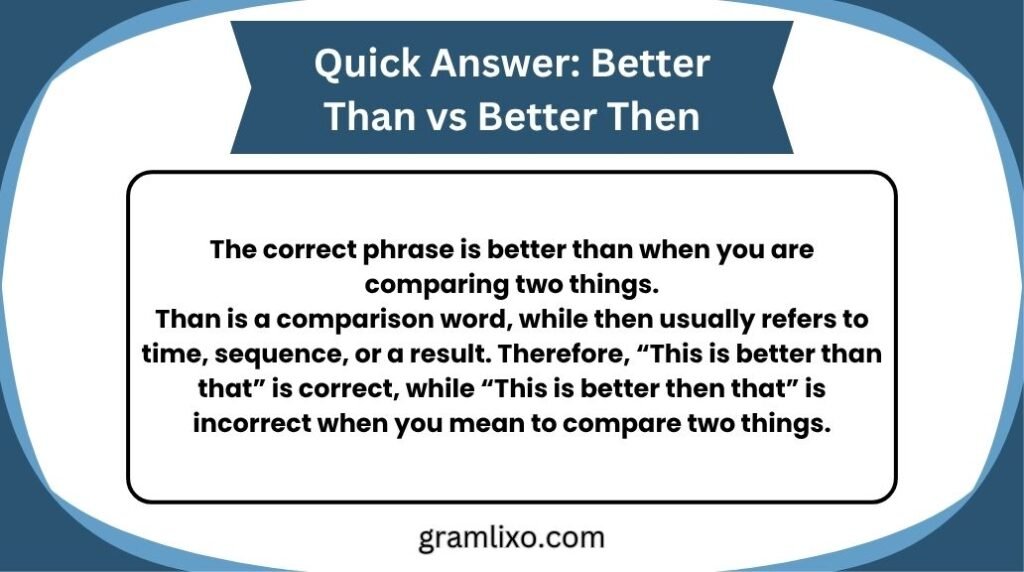
The correct phrase is better than when you are comparing two things.
Than is a comparison word, while then usually refers to time, sequence, or a result. Therefore, “This is better than that” is correct, while “This is better then that” is incorrect when you mean to compare two things.
Easy rule:
👉 Comparison = than
👉 Time or sequence = then
Examples:
- This book is better than the movie. ✅
- She runs better than I do. ✅
- I finished my work, then I went home. ✅
- This book is better then the movie. ❌
Understanding the Basics of Better Than vs Better Then
The confusion between better than vs better then happens because than and then are pronounced similarly in many varieties of English. Their meanings, however, are different.
What Does “Than” Mean?
Than is used primarily to introduce the second part of a comparison.
It commonly appears after comparative words such as:
- better
- worse
- bigger
- smaller
- faster
- slower
- older
- younger
- easier
- harder
- stronger
- weaker
- more
- less
For example:
My new phone is better than my old phone.
Here, better establishes a comparison, and than introduces what the phone is being compared with.
What Does “Then” Mean?
Then generally relates to time, sequence, or consequence.
For example:
We ate dinner, then we watched a movie.
The word then tells us what happened next.
It can also describe a particular time:
I lived in Chicago then.
In this sentence, then refers to a previous period of time.
It can also express a consequence:
If you agree, then we can start.
So, while than is strongly associated with comparison, then is associated with time, sequence, or consequence.
Comparison Table
| Form | Type | Meaning | Example | Correct/Incorrect |
|---|---|---|---|---|
| than | Conjunction/preposition | Used for comparison | She is better than me. | ✅ Correct |
| then | Adverb | Refers to time or sequence | We ate, then we left. | ✅ Correct |
| better than | Comparative phrase | Shows superiority in comparison | This plan is better than the old one. | ✅ Correct |
| better then | Incorrect comparison phrase | Attempts to use “then” for comparison | This plan is better then the old one. | ❌ Incorrect |
The most important point is simple: Use “than” after “better” when you are making a comparison.
Why “Better Than” Is Correct
The adjective good has the comparative form better.
When you compare one thing with another, you normally use better than.
Consider:
Sarah is better than Emma at tennis.
The sentence compares Sarah’s tennis ability with Emma’s.
The structure is:
Subject + comparative adjective + than + comparison
For example:
- This restaurant is better than that one.
- My new job is better than my previous job.
- Winter is better than summer for skiing.
- This explanation is better than the first one.
- Reading is better than scrolling all day.
In every case, than introduces the thing being compared.
“Better Than” With People
You can compare people’s abilities, performance, or qualities using better than.
Examples:
Maria is better than me at math.
He is better than his brother at basketball.
She speaks English better than I do.
You are better than I expected.
The important feature is that a comparison is taking place.
“Better Than” With Things
You can also compare objects:
This computer is better than my old computer.
This camera is better than the one I used last year.
The newer model is better than the previous version.
Again, than is correct because the sentence compares two things.
“Better Than” With Actions
The comparison does not have to involve nouns.
You can compare actions as well:
She sings better than I do.
He cooks better than his roommate.
I sleep better than I used to.
They performed better than expected.
The same rule applies. If you are comparing performance, quality, or degree, use than.
What Does “Then” Actually Mean?
Understanding then makes it easier to avoid using it incorrectly.
Then for Sequence
One of the most common uses of then is to show what happens next.
For example:
First, wash the vegetables. Then, cut them into small pieces.
The actions occur in a sequence.
Another example:
I finished my homework, then I went outside.
The first event is finishing homework. The second event is going outside.
Then for Time
Then can also refer to a particular point or period in time.
For example:
I was living in New York then.
Here, then means “at that time.”
Another example:
Things were different then.
This means things were different at that earlier time.
Then for Consequence
Sometimes then introduces a result or consequence.
For example:
If you are ready, then we can leave.
The meaning is approximately:
“If you are ready, the next result is that we can leave.”
Another example:
If you don’t want the job, then don’t accept it.
Here, then connects a condition with a consequence.
Then for Logical Progression
You may also see then in reasoning:
If the evidence is accurate, then the conclusion makes sense.
This is not a comparison. Therefore, then is appropriate.
Better Than vs Better Then: The Core Grammar Rule
The simplest grammar rule is:
Use “than” for comparisons and “then” for time, sequence, or consequence.
This rule explains most cases.
Comparison = Than
Ask yourself:
Am I comparing two things?
If the answer is yes, choose than.
Examples:
- My car is faster than yours.
- This method is easier than the old method.
- The second option is better than the first.
- She is more experienced than I am.
- Today is warmer than yesterday.
Sequence = Then
Ask yourself:
Am I saying what happens next?
If yes, use then.
Examples:
- Finish your work, then take a break.
- We went shopping, then we had dinner.
- First, read the instructions; then begin.
- He called me, then he sent an email.
Time = Then
If you mean “at that time,” use then.
Examples:
- I was younger then.
- We lived there then.
- Things were easier then.
A Simple Memory Trick
One of the easiest ways to remember the difference between than and then is to associate each word with a concept.
Think “Than = Comparison”
Both than and comparison are short grammar words, but the easiest mental connection is:
THAN → COMPARE
Whenever you see words such as:
- better
- worse
- bigger
- smaller
- faster
- slower
- more
- less
think than.
Examples:
better than
faster than
more expensive than
less difficult than
Think “Then = Next”
A useful mental association for then is:
THEN → NEXT
If you can replace then with “next” or “after that,” it is probably correct.
For example:
I finished dinner, then I washed the dishes.
You could say:
I finished dinner, and after that, I washed the dishes.
That confirms that then is appropriate.
Correct Meanings and Uses
Better Than for Superiority
The most common use of better than is to show that one thing has greater quality, ability, or value than another.
This solution is better than the previous one.
The sentence means that the first solution is superior to the second.
More examples:
- This restaurant is better than the one downtown.
- My new headphones sound better than my old ones.
- The revised plan is better than the original.
- Her second presentation was better than her first.
Better Than for Skills
Better than can describe someone’s greater ability.
James plays guitar better than I do.
The comparison concerns guitar-playing ability.
Other examples:
- She writes better than I do.
- He drives better than his brother.
- They performed better than expected.
- I understand the topic better than before.
Better Than for Choices
You can use better than when comparing options.
Option A is better than Option B.
This is especially common in workplace communication.
Examples:
- This strategy is better than the alternative.
- A short meeting is better than a long email.
- The second design is better than the first.
- This approach is better than doing nothing.
Test Tip: How to Choose Between Than and Then
When you are unsure, use one of these two tests.
Test 1: The Comparison Test
Ask:
Am I comparing two things?
If yes, use than.
This phone is better than that phone.
Yes, two phones are being compared.
Test 2: The “Next” Test
Try replacing the word with next or after that.
We finished work, then we went home.
“After that” works, so then is correct.
But:
This phone is better after that my phone.
That does not make sense.
Therefore, than is correct:
This phone is better than my phone.
Case Study: A Workplace Email
Imagine an employee is writing an email to a manager about two possible project plans.
Incorrect Version
I think Plan B is better then Plan A because it will save us more time.
The writer intends to compare Plan B and Plan A. Therefore, then is incorrect.
Correct Version
I think Plan B is better than Plan A because it will save us more time.
Now the sentence clearly communicates the comparison.
The grammar structure is:
Plan B + is + better + than + Plan A
This example shows why the difference matters in professional writing. A single incorrect word may not completely destroy the meaning, but it can make the writing look careless.
Another Workplace Example
Suppose a manager writes:
Let’s review the first proposal, then compare it with the second proposal.
Here, then is correct because it describes sequence:
- Review the first proposal.
- Compare it with the second proposal.
But if the manager writes:
The second proposal is better than the first proposal.
Than is correct because the manager is comparing the proposals.
Grammar Authority: What Do Standard Dictionaries Say?
Standard English dictionaries distinguish than and then as different words with different grammatical functions.
Merriam-Webster treats dictionary entries as sources of word meanings, parts of speech, and usage information, and its pronunciation materials also illustrate why words such as than and then can be easy to confuse in speech.
The grammatical distinction is straightforward:
- Than is used to introduce a comparison.
- Then is used primarily for time, sequence, or consequence.
This distinction is not merely a matter of style. The two words perform different jobs in English.
For example:
The blue car is faster than the red car.
This sentence compares two cars.
But:
We tested the blue car, then we tested the red car.
This sentence describes the order of two actions.
The spelling changes because the meaning changes.
Common Mistakes With Better Than vs Better Then
Why do people make this mistake so often?
There are several common reasons.
1. Fast Typing
When people type quickly, they may select the wrong word without noticing.
For example:
This option is better then the other one.
The writer may know that than is correct but simply type then automatically.
2. Similar Pronunciation
In ordinary conversation, than and then can sound very similar. This makes it difficult for some writers to remember which spelling represents the comparison word.
3. Autocorrect
Autocorrect and predictive text can sometimes encourage the wrong choice.
A phone keyboard may predict then because it is a common word. If you are typing quickly, you might accept the suggestion without checking the sentence.
4. Lack of Grammar Knowledge
Some learners simply have not been taught the difference clearly.
Once they learn the basic rule, the distinction becomes much easier.
5. Confusing Common Word Pairs
English contains many pairs that sound similar but have different meanings.
For example:
| Confusing Words | Correct Use |
|---|---|
| than / then | comparison vs. time/sequence |
| your / you’re | possession vs. you are |
| its / it’s | possession vs. it is |
| their / there / they’re | possession / place / they are |
| to / too / two | direction/infinitive / also / number |
| affect / effect | usually verb / usually noun |
| accept / except | receive/agree / excluding |
| lose / loose | misplace / not tight |
| advice / advise | noun / verb |
Learning these distinctions can significantly improve writing accuracy.
Better Than vs Better Then in Different Contexts
Everyday Conversation
In casual conversation, people frequently use comparisons.
Examples:
This pizza is better than the one we had yesterday.
I feel better than I did this morning.
This route is better than the other one.
Although the conversation is informal, than remains the correct comparison word.
Professional Writing
Professional writing requires extra care because grammar mistakes can affect credibility.
Use better than when comparing:
- proposals
- products
- strategies
- results
- employees’ performance
- business decisions
- project outcomes
Example:
The updated process is better than the previous system because it reduces processing time.
Creative Writing
Creative writers also use better than for comparisons.
For example:
The quiet village seemed better than the crowded city.
Or:
Nothing was better than the sound of rain against the window.
Creative writing may be flexible in style, but the underlying grammar remains important.
Social Media and Texting
People often make spelling mistakes on social media because posts and messages are written quickly.
You might see:
This song is better then the original.
The intended meaning is still clear, but the grammatically correct version is:
This song is better than the original.
Informal communication does not change the standard spelling.
Why Better Than vs Better Then Matters
At first, confusing than and then may seem like a tiny issue. In many casual messages, readers can understand what you mean.
Still, correct word choice matters.
Clarity
Using the correct word makes your meaning immediately clear.
Compare:
This method is better than the old method.
with:
This method is better then the old method.
The first sentence follows standard grammar. The second contains a word-choice error.
Professionalism
In professional emails, applications, reports, and business documents, small errors can influence how carefully your writing is perceived.
Correct grammar shows attention to detail.
Digital Communication
Online writing is often created quickly. Because of this, common errors such as than/then, your/you’re, and its/it’s appear frequently.
Taking a few seconds to proofread can prevent these mistakes.
A Useful Reminder
Clear writing makes your meaning easier to trust.
You do not need complicated vocabulary to write well. Accurate, simple word choice is often more effective.
Special Exceptions and Edge Cases
There is no standard grammatical exception that makes better then correct when you are making a comparison.
If your intended meaning is:
A is better in quality than B.
then the standard form is:
A is better than B.
However, then can appear near better in a sentence when it serves its own grammatical function.
For example:
If you think you can do better, then try again.
Here, then is correct because it introduces a consequence.
The sentence does not mean “better than.” Instead, it means:
If you think you can do better, in that case, try again.
Another example:
We should finish this task first, then look for a better solution.
Here, then indicates sequence. The word better belongs to a separate phrase.
This is an important distinction. The presence of the word better does not automatically mean than must appear immediately afterward. You must examine what the sentence actually means.
Better Than vs Better Then: Side-by-Side Examples
| Incorrect | Correct | Why? |
|---|---|---|
| This phone is better then mine. | This phone is better than mine. | Comparison |
| She sings better then me. | She sings better than me. | Comparison |
| This plan is better then the old one. | This plan is better than the old one. | Comparison |
| My results are better then last year. | My results are better than last year. | Comparison |
| Finish your work, than call me. | Finish your work, then call me. | Sequence |
| We ate dinner than watched TV. | We ate dinner, then watched TV. | Sequence |
| I lived there than. | I lived there then. | Time |
| If that happens, than we will leave. | If that happens, then we will leave. | Consequence |
The key is to look at the meaning rather than just the sound.
Better Than: Common Sentence Patterns
Learning common sentence patterns can make correct usage automatic.
Pattern 1: Better Than + Noun
This book is better than that book.
My car is better than his car.
Pattern 2: Better Than + Pronoun
She is better than me at tennis.
He is better than him at chess.
In formal contexts, you may encounter more traditional constructions such as:
She is better than I am at tennis.
Both structures occur in modern English, with the longer version making the grammatical comparison explicit.
Pattern 3: Better Than + Clause
She performs better than I expected.
The results were better than we predicted.
Here, than introduces a clause rather than a single noun.
Pattern 4: Better Than + Previous State
I feel better than I did yesterday.
The weather is better than it was last week.
Again, the sentence compares two conditions.
Common Expressions With “Than”
Once you understand the rule, you will notice than in many everyday expressions.
Examples include:
- better than ever
- better than expected
- better than before
- better than nothing
- better than usual
- better than average
- more than enough
- less than expected
- faster than before
- easier than it looks
- harder than expected
Consider:
The results were better than expected.
This is a comparison between the actual results and what was expected.
Common Expressions With “Then”
Similarly, then appears in many expressions involving time or sequence.
Examples include:
- back then
- until then
- since then
- by then
- just then
- then and there
- every now and then
- first this, then that
Examples:
I was much younger back then.
We had never spoken until then.
She arrived just then.
First we study, then we practice.
These expressions have nothing to do with comparison.
A Practical Editing Strategy
If you frequently confuse than and then, use this three-step editing method.
Step 1: Find the Word
Look for than or then in your sentence.
Step 2: Identify the Meaning
Ask:
- Is this a comparison?
- Is this about time?
- Is this showing what happens next?
- Is this introducing a consequence?
Step 3: Replace It Mentally
For than, try:
compared with
For then, try:
next, afterward, or at that time
Example:
My new job is better than my old job.
Try “compared with”:
My new job is better compared with my old job.
The comparison test works.
Now consider:
I finished my shift, then I went home.
Try “afterward”:
I finished my shift; afterward, I went home.
That confirms then.
Quick Recap Checklist
Use this checklist whenever you are unsure.
| Question | If Yes → Use |
|---|---|
| Am I comparing two things? | than |
| Does the sentence follow “better”? | Usually than if a comparison follows |
| Am I comparing people or abilities? | than |
| Am I describing what happens next? | then |
| Can I replace the word with “after that”? | then |
| Does it mean “at that time”? | then |
| Does it introduce a result after a condition? | then |
| Does it mean “compared with”? | than |
Practice Examples
1. This movie is better ___ the first one.
Answer: than
This movie is better than the first one.
2. Finish the report, ___ send it to your manager.
Answer: then
Finish the report, then send it to your manager.
3. I feel much better ___ I did yesterday.
Answer: than
I feel much better than I did yesterday.
Practice: Can You Choose the Correct Word?
Try these before checking the answers.
- My new computer is better ___ my old one.
- We went to the store and ___ came home.
- She performs better ___ expected.
- I was living in Texas back ___.
- This option is cheaper ___ the other one.
- First, save the file; ___ close the program.
- He is better at math ___ I am.
- Things were different ___.
Answers
- than
- then
- than
- then
- than
- then
- than
- then
If you remember only one rule, remember this:
Than compares. Then sequences.
FAQs About Better Than vs Better Then
1. Is “better than” or “better then” correct?
Better than is correct when you are comparing two things, people, actions, or situations. Then is not the standard comparison word.
Example:
This option is better than the other one.
2. Why is “better then” incorrect?
Then normally refers to time, sequence, or consequence. It does not introduce a standard comparison.
For example:
We finished dinner, then we watched a movie.
But:
The movie was better than the book.
3. Is “than” always used after “better”?
Not necessarily. Better can appear without than when the comparison is understood.
For example:
I feel better today.
However, when you explicitly introduce the thing being compared, use than:
I feel better than I did yesterday.
4. How can I remember than vs then?
Remember:
Than = comparison.
Then = time or sequence.
You can also think:
Than = compare
and
Then = next
This simple association works in most everyday situations.
5. Can “then” ever appear in a sentence containing “better”?
Yes. The words can appear in the same sentence when they perform different jobs.
For example:
If you think you can do better, then try again.
Here, better means improve or perform at a higher level, while then introduces the consequence.
6. Is “better than me” grammatically correct?
Yes, better than me is common in modern English, especially in conversation and informal writing.
For example:
She plays tennis better than me.
In more formal or traditional grammar, you may also see:
She plays tennis better than I do.
Both constructions are widely used, but the second makes the comparison more explicit.
Final Conclusion
The difference between better than vs better then becomes easy once you understand what each word does. Use than when you are making a comparison. Use then when you are talking about time, sequence, or consequence.
So, when you want to say that one thing is superior to another, the correct expression is better than:
This plan is better than the original plan.
When you want to describe what happens next, use then:
Finish the plan, then send it to the team.
The mistake usually happens because than and then sound similar, especially in fast speech. Fast typing, autocorrect, and unfamiliarity with the distinction can make the problem even more common. Fortunately, the solution is simple.
Whenever you see a comparison, think THAN. Whenever you see time or sequence, think THEN.
Remember: Than compares; then tells you what happens next.

I’m Robert Williams, an English grammar writer at Gramlixo. I focus on breaking down confusing grammar rules into simple explanations and useful examples.
[…] |Better Than vs Better Then: Which One Is Correct? […]