Have you ever paused before writing an email because you were unsure whether to say “my apology” or “my apologies”? You are not alone. The two expressions look almost identical, but they are commonly used in different situations. Understanding my apology vs my apologies can help you sound more natural, professional, and precise in both everyday and formal communication.
In simple terms, “my apology” usually refers to one specific apology, while “my apologies” is a common expression used to say that you are sorry, especially when you are apologizing for an inconvenience, mistake, absence, or interruption. The plural form may seem strange when you are apologizing for only one thing, but “my apologies” is an established expression in English.
This distinction matters because choosing the wrong expression can make an otherwise polished sentence sound awkward. Whether you are writing an email to a coworker, responding to a friend, or posting a professional message, knowing when to use each phrase makes your writing clearer.
Let’s examine my apology vs my apologies carefully and learn exactly when each expression works. 😊
|Shall vs Will: What’s the Difference and When Should You Use Each?
|Any Problem vs Any Problems: Which One Is Correct?
|Alright vs All-Right: Which One Is Correct?
Quick Answer: My Apology vs My Apologies
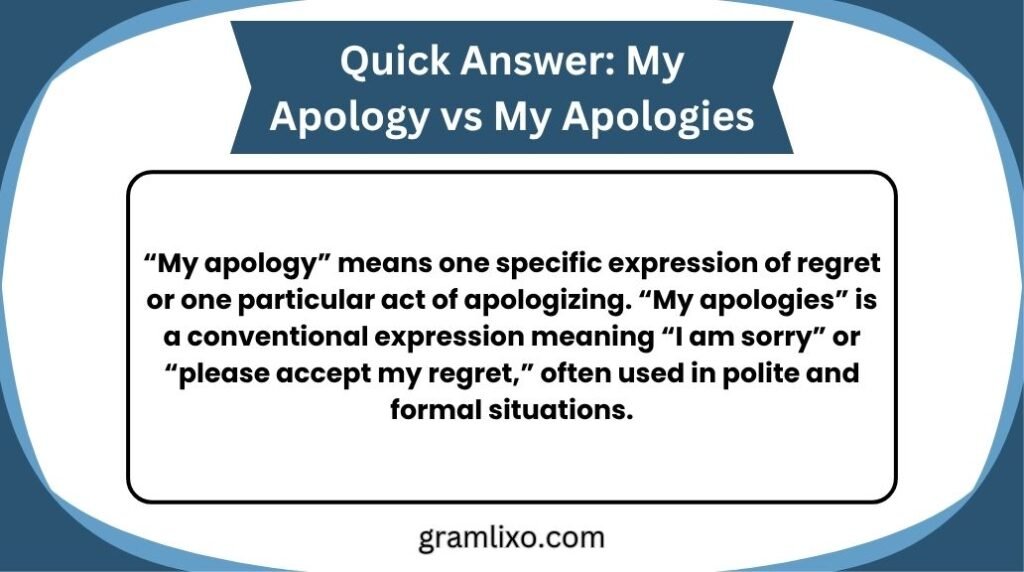
“My apology” means one specific expression of regret or one particular act of apologizing. “My apologies” is a conventional expression meaning “I am sorry” or “please accept my regret,” often used in polite and formal situations.
For example:
- I hope you accept my apology for what I said. ✅
- My apologies for the delay. ✅
- My apology for the delay. Grammatically possible in some contexts, but less natural as a fixed expression.
- My apologies is especially natural when offering a brief, polite expression of regret.
The key point is that “apology” is singular, while “apologies” is plural. However, the phrase “my apologies” has become a conventional way to express regret and does not necessarily mean that you are making several separate apologies.
Understanding the Basics of My Apology vs My Apologies
The easiest way to understand the difference is to focus on whether you are talking about a particular apology or using a set expression of regret.
An apology is a noun. It refers to an expression of regret for something wrong, rude, inconvenient, or disappointing.
Its plural form is apologies.
Merriam-Webster defines apology as an admission of error or discourtesy accompanied by an expression of regret. It also gives “apologies” as the plural form and provides examples such as giving someone one’s apologies when unable to attend.
Comparison Table
| Form | Type | Meaning | Example | Correct/Incorrect |
|---|---|---|---|---|
| my apology | Singular noun phrase | One specific apology | Please accept my apology. | ✅ Correct |
| my apologies | Plural noun phrase / conventional expression | An expression of regret; “I am sorry” | My apologies for the delay. | ✅ Correct |
| an apology | Singular noun | One apology | She gave me an apology. | ✅ Correct |
| apologies | Plural noun | More than one apology or a conventional expression of regret | Please accept my apologies. | ✅ Correct |
| my apologize | Incorrect noun phrase | Incorrect form because apologize is a verb | My apologize for the mistake. | ❌ Incorrect |
| I apologize | Verb phrase | I am expressing regret | I apologize for the mistake. | ✅ Correct |
The Simple Rule
Remember this:
Use “my apology” when referring to one specific apology. Use “my apologies” when using the established expression of regret.
For example:
Please accept my apology for the misunderstanding.
Here, you are talking about one particular apology.
But:
My apologies for the misunderstanding.
Here, my apologies works as a polite expression meaning that you are sorry.
Both sentences can communicate regret, but their structure and tone are slightly different.
What Does “My Apology” Mean?
“My apology” is a singular noun phrase. It refers to one specific apology made by the speaker.
The word my is a possessive determiner, and apology is a singular count noun.
Example 1: A Specific Mistake
Please accept my apology for the mistake.
Breakdown:
- Please accept = polite request
- my = shows possession
- apology = one expression of regret
- for the mistake = identifies the reason for the apology
The sentence treats the apology as a specific thing.
Example 2: Referring to a Previous Apology
I hope you understand my apology.
This sentence refers to a particular apology that has already been made or is being discussed.
Example 3: A Formal Situation
I would like to offer my apology for the confusion.
This is grammatically correct and can sound formal. However, many speakers would naturally choose:
I would like to offer my apologies for the confusion.
The plural version is particularly common in formal expressions.
When “My Apology” Sounds Natural
Use my apology when you are talking about a specific apology as an object or event.
Common patterns include:
- accept my apology
- receive my apology
- understand my apology
- reject my apology
- offer my apology
- hear my apology
For example:
She accepted my apology after our disagreement.
The speaker is referring to one particular apology.
What Does “My Apologies” Mean?
“My apologies” is the plural form of my apology, but it is also a well-established expression used to say “I am sorry.”
It is especially common in polite, professional, and formal communication.
For example:
My apologies for the late response.
This means:
I am sorry for responding late.
It does not necessarily mean that you are making several separate apologies.
Merriam-Webster specifically notes that apologies can be used as an expression of regret when someone cannot do something, such as being unable to attend.
Common Examples
- My apologies for being late.
- My apologies for the confusion.
- My apologies for the inconvenience.
- My apologies for the delayed response.
- My apologies, but I cannot attend the meeting.
All of these are natural.
Why Is It Plural?
This is one of the most common questions about my apology vs my apologies.
The answer is that English contains many fixed expressions whose wording does not always match the literal situation.
When someone says:
My apologies for the delay.
They are not necessarily counting multiple apologies.
Instead, my apologies functions as a conventional polite expression of regret.
Oxford’s American English dictionary likewise lists apology as a noun whose plural is apologies and notes that “my apologies” can be used as a formal expression of regret.
My Apology vs My Apologies: The Core Difference
The distinction becomes much easier when you look at the purpose of each phrase.
“My apology” focuses on a specific apology
Example:
He accepted my apology after the argument.
The speaker is referring to one particular act of apologizing.
“My apologies” often functions as a polite expression
Example:
My apologies for the delay.
The speaker is simply expressing regret.
So the difference is not that one phrase is correct and the other is incorrect. Both are grammatically valid. The important difference is how they are normally used.
Compare These Sentences
She accepted my apology.
This sounds like a specific apology was made and received.
My apologies for the delay.
This is a direct expression of regret.
I offered my apology to the customer.
This treats the apology as a particular action.
My apologies to the customer for the inconvenience.
This is a conventional formal expression.
“My Apology” vs “My Apologies” in Professional Writing
Professional communication is one of the most common places where people encounter this distinction.
Imagine you responded to an email two days late.
You could write:
My apologies for the delayed response.
This is natural, concise, and professional.
You could also write:
Please accept my apology for the delayed response.
This is also correct but sounds slightly more deliberate and formal.
Another option is:
I apologize for the delayed response.
This is direct and professional.
Which Sounds Most Natural?
For a short professional email, these are all possible:
- My apologies for the delay.
- Please accept my apology for the delay.
- I apologize for the delay.
The choice depends on tone.
My apologies is concise and polite.
Please accept my apology is more formal and emphasizes the apology itself.
I apologize is direct and active.
Case Study: A Workplace Email
Imagine an employee accidentally sends an important report several hours late.
Here are three possible messages.
Version 1: Concise
My apologies for the delay. I have attached the completed report.
This is polite and efficient.
Version 2: More Formal
Please accept my apology for the delay in submitting the report. I have attached the completed document for your review.
This sounds more formal.
Version 3: Direct
I apologize for the delay in submitting the report. The completed document is attached.
This is clear and professional.
All three communicate essentially the same idea.
The important lesson is that “my apology” and “my apologies” are not competing between correct and incorrect grammar. They are different grammatical choices with different common patterns.
Grammar Rules Behind “My Apology vs My Apologies”
The grammar itself is straightforward.
Rule 1: “Apology” Is Singular
Apology is a singular noun.
Examples:
- an apology
- my apology
- her apology
- his apology
- the apology
Example:
I accepted his apology.
There is one specific apology.
Rule 2: “Apologies” Is Plural
Apologies is the plural form of apology.
Examples:
- my apologies
- her apologies
- his apologies
- their apologies
Example:
Please accept my apologies.
Grammatically, this is plural.
Rule 3: “Apologize” Is a Verb
Do not confuse apology with apologize.
Apology = noun
Apologize = verb
Examples:
I apologize for the mistake.
Please accept my apology for the mistake.
Incorrect:
Please accept my apologize. ❌
The verb apologize cannot be used as the noun in that sentence.
Merriam-Webster identifies apology as a noun and gives apologies as its plural form.
A Useful Test Tip
When deciding between my apology and my apologies, ask yourself:
Am I talking about one specific apology?
If yes, my apology is usually appropriate.
She accepted my apology.
Am I simply expressing regret?
If yes, my apologies is often the natural choice.
My apologies for the inconvenience.
Am I using a verb?
If yes, use I apologize.
I apologize for the confusion.
This three-part test is easy to remember:
Specific apology → my apology
Polite expression of regret → my apologies
Action of saying sorry → I apologize
Common Expressions With “My Apology”
Here are several natural expressions using the singular form:
- Please accept my apology.
- I hope you accept my apology.
- She accepted my apology.
- He rejected my apology.
- I offered my apology.
- My apology was sincere.
- I want to make my apology clear.
Notice that these sentences often treat the apology as a specific thing.
Example
My apology was accepted by the manager.
The sentence refers to one particular apology.
Common Expressions With “My Apologies”
The plural expression is especially common in polite statements:
- My apologies for the delay.
- My apologies for the confusion.
- My apologies for the inconvenience.
- My apologies for the misunderstanding.
- My apologies for interrupting.
- My apologies, but I cannot attend.
- Please accept my apologies.
These expressions are particularly useful in business emails and formal correspondence.
Common Mistakes With My Apology vs My Apologies
Many mistakes happen because the phrases are so similar.
Mistake 1: Assuming “My Apologies” Is Grammatically Wrong
Some learners think:
“I made only one mistake, so I must say ‘my apology.’”
That logic is understandable, but it misses the conventional use of my apologies.
My apologies for the delay is perfectly natural even when there is only one reason for the apology.
Mistake 2: Using “My Apologize”
Incorrect:
My apologize for being late. ❌
Correct:
My apology for being late. ✅
Or:
My apologies for being late. ✅
Or:
I apologize for being late. ✅
Mistake 3: Using the Wrong Plural
Incorrect:
My apologys for the delay. ❌
Correct:
My apologies for the delay. ✅
The spelling changes from -y to -ies when the noun becomes plural.
Mistake 4: Confusing “Apology” With “Apologies”
A writer may use my apology automatically because it appears logical.
For example:
My apology for the inconvenience.
This is not necessarily ungrammatical, but my apologies for the inconvenience is generally more idiomatic as a standalone expression of regret.
Similar Grammar Confusions
The confusion surrounding my apology vs my apologies is part of a larger pattern in English. Small differences in spelling or grammatical form can change how a sentence works.
| Confusion | Correct Form | Why |
|---|---|---|
| it’s vs its | Depends on meaning | It’s = it is; its = possession |
| your vs you’re | Depends on meaning | Your = possession; you’re = you are |
| there vs their | Depends on meaning | There = place; their = possession |
| then vs than | Depends on meaning | Then = time; than = comparison |
| advice vs advise | Depends on grammar | Advice = noun; advise = verb |
| apology vs apologize | Depends on grammar | Apology = noun; apologize = verb |
| my apology vs my apologies | Depends on context | Singular specific apology vs conventional plural expression |
Why Do These Mistakes Happen?
Fast Typing
People often type quickly, especially in emails, text messages, and workplace chats. When writing quickly, it is easy to choose a familiar-looking word without checking its grammatical role.
Autocorrect
Autocorrect can sometimes replace words automatically. If you type quickly, you may not notice that the software has changed the word.
Lack of Knowledge
Learners may know that apology means “sorry” but may not know why native speakers frequently say my apologies.
Understanding the grammatical pattern makes the choice easier.
Usage in Different Contexts
The best form can depend on where and how you are communicating.
Everyday Conversation
In casual conversation, people often say:
Sorry about that.
I’m sorry.
I apologize.
My apologies.
“My apologies” can sound slightly more formal than “I’m sorry.”
For example:
My apologies. I thought you had already left.
This is polite and natural, although a casual speaker might simply say:
Sorry. I thought you had already left.
Professional Writing
My apologies is very common in professional emails.
Example:
My apologies for the delayed response.
It is short, respectful, and appropriate for many workplace situations.
Creative Writing
In fiction, the choice depends on the character’s personality and the scene.
A formal character might say:
My apologies, Madam.
A casual character might say:
I’m sorry.
A character discussing a specific event might say:
Please accept my apology.
The wording can therefore help establish tone and personality.
Social Media and Texting
Social media usually favors shorter expressions.
You might see:
My apologies! 😅
Or:
Sorry about that!
“My apologies” can sound playful, formal, sarcastic, or genuinely polite depending on context.
For example:
My apologies for disappearing from the group chat. 😂
The grammar is formal, but the emoji makes the tone casual.
Why “My Apologies” Can Sound More Formal
The phrase my apologies has a polished, conventional quality.
Compare:
Sorry for the delay.
My apologies for the delay.
Both are correct.
However, my apologies can sound more formal and professional.
That makes it useful for:
- business emails
- customer service
- workplace communication
- formal invitations
- professional correspondence
- polite refusals
For casual situations, sorry may be more natural.
Why This Difference Matters
Correct word choice is not only about avoiding grammar mistakes. It also helps communicate your intended tone.
1. Clarity
Choosing the right expression makes your meaning easier to understand.
Please accept my apology.
Clearly identifies a specific apology.
My apologies for the delay.
Clearly expresses regret.
2. Professionalism
In professional communication, small language choices can affect how polished your message sounds.
Compare:
My apologize for the delay. ❌
with:
My apologies for the delay. ✅
The second version is grammatically correct and professional.
3. Digital Communication
Email and messaging have made short expressions of regret extremely common.
A simple sentence such as:
My apologies for the late reply.
can communicate the message efficiently without requiring a long explanation.
A Useful Reminder
Good grammar makes your meaning easier to trust.
The goal is not to use complicated language. The goal is to choose the form that communicates your meaning naturally.
Is “My Apology” Incorrect?
No. “My apology” is not incorrect.
This is an important point.
Some people assume that because my apologies is more common as a polite expression, my apology must be wrong.
That is not true.
For example:
Please accept my apology.
This is completely correct.
The phrase simply emphasizes one specific apology.
Similarly:
I hope you will accept my apology for my rude behavior.
This is grammatically sound.
The choice depends on context and intended meaning.
Is “My Apologies” Always Better?
No.
You should not automatically replace every occurrence of my apology with my apologies.
Consider:
She accepted my apology.
Changing it to:
She accepted my apologies.
changes the grammatical number and can suggest multiple apologies.
If you are referring to one specific apology, the singular form may be the better choice.
Compare
He accepted my apology after I admitted my mistake.
One particular apology.
My apologies for the inconvenience.
A conventional expression of regret.
The context determines the best choice.
Special Exception and Edge Cases
There is an interesting expression:
I make no apology for…
This means that the speaker does not feel sorry or does not believe an apology is necessary.
For example:
I make no apology for defending my decision.
This does not mean the speaker is apologizing. Instead, it means the speaker refuses to apologize for something.
The plural form can also appear:
I make no apologies for my writing style.
Both make no apology and make no apologies occur in English.
Another related expression is:
With apologies to…
For example:
With apologies to Shakespeare, this version takes a different approach.
Here, apologies is part of an established expression and does not necessarily refer to several separate apologies.
Merriam-Webster also records meanings and uses of apology beyond simply saying “sorry,” including a sense involving defense or justification.
“My Apology” vs “My Apologies” vs “I Apologize”
These three expressions are worth comparing.
| Expression | Grammar | Typical Use | Example |
|---|---|---|---|
| My apology | Singular noun phrase | One specific apology | Please accept my apology. |
| My apologies | Plural noun phrase / fixed expression | General or polite expression of regret | My apologies for the delay. |
| I apologize | Verb phrase | Directly stating the action | I apologize for the delay. |
This table gives you a simple framework for choosing the right expression.
A Simple Tone Comparison
My apology → specific and formal
My apologies → polite and conventional
I apologize → direct and professional
I’m sorry → natural and conversational
All four can be correct.
Quick Recap Checklist
Use this checklist whenever you are unsure.
| Question | If Yes → Use |
|---|---|
| Am I referring to one specific apology? | my apology |
| Am I using a standard expression of regret? | my apologies |
| Am I directly stating that I am sorry? | I apologize |
| Am I speaking casually? | I’m sorry |
| Am I writing a professional email? | my apologies or I apologize |
| Am I discussing an apology that someone accepted or rejected? | my apology |
Practice Example 1
_____ for the delayed response.
Best answer:
My apologies for the delayed response. ✅
Why? It is a conventional expression of regret.
Practice Example 2
She finally accepted _____.
Best answer:
my apology ✅
Why? The sentence refers to one particular apology.
Practice Example 3
_____ for misunderstanding your instructions.
Possible answer:
I apologize for misunderstanding your instructions. ✅
Or:
My apologies for misunderstanding your instructions. ✅
Both work, but they use different grammatical structures.
Frequently Asked Questions
1. Is “my apology” grammatically correct?
Yes. “My apology” is grammatically correct when you are referring to one specific apology. For example, “Please accept my apology for the mistake” is correct.
2. Is “my apologies” grammatically correct?
Yes. “My apologies” is grammatically correct and is a common expression meaning “I am sorry” or “please accept my regret.” It is especially common in formal and professional communication.
3. Should I say “my apology” or “my apologies”?
Use my apology when referring to one specific apology. Use my apologies when expressing regret as a conventional phrase, such as “My apologies for the delay.”
4. Why do people say “my apologies” when there is only one mistake?
Because “my apologies” is an established expression of regret. The plural form does not necessarily mean that the speaker is apologizing for several separate mistakes.
5. Is “my apologize” correct?
No. “My apologize” is incorrect because apologize is a verb, while my normally modifies a noun phrase here. Use my apology, my apologies, or I apologize, depending on the sentence.
6. Which is more professional: “my apology” or “my apologies”?
Both can be professional. “My apologies” is especially natural as a short expression of regret in emails, while “my apology” is useful when referring to one specific apology. “I apologize” is another highly professional option.
Final Takeaway: My Apology vs My Apologies
The difference between my apology vs my apologies is simple once you understand how each phrase functions.
“My apology” is a singular noun phrase that normally refers to one particular apology. For example, “Please accept my apology” treats the apology as a specific expression of regret.
“My apologies” is the plural form of apology and is also a well-established expression meaning “I am sorry.” It is especially common when apologizing for delays, inconveniences, interruptions, misunderstandings, or other problems.
When in doubt, remember three simple choices:
- My apology → one specific apology.
- My apologies → a conventional expression of regret.
- I apologize → the direct verb form.
Neither my apology nor my apologies is automatically wrong. The right choice depends on the role the phrase plays in your sentence.
Once you recognize that difference, this common English confusion becomes much easier to handle. So the next time you are writing an email or message, don’t overthink it: specific apology = “my apology,” polite expression of regret = “my apologies.” ✔️

Hi, I’m Lisa Jones, a grammar enthusiast and writer at Gramlixo. I enjoy making English grammar simple, clear, and easy to apply in everyday writing.


[…] |My Apology vs My Apologies: Which One Is Correct? […]