Have you ever written a sentence like “What does this word means?” and then wondered whether mean or means is actually correct? You are not alone. The confusion between mean vs means is common because both forms come from the same verb, but they do not work in the same grammatical situations. The correct choice depends mainly on the subject of the sentence and whether mean is being used as a verb, noun, or adjective.
In everyday English, mean can express what something signifies, what someone intends, or what a word represents. Means is commonly used as the third-person singular present form of the verb, as in “She means what she says.” It can also be a plural noun, as in “We need the means to solve the problem.”
Understanding mean vs means becomes much easier once you identify the subject and the role the word plays in the sentence.
This guide explains the difference in simple US English, provides clear examples, and shows you exactly when to use each form. By the end, you will be able to choose between mean and means with confidence. 😊
|Elude vs Allude: Meaning, Differences, Examples, and Correct Usage
|Bespeckled vs Bespectacled: Meaning, Difference, and Correct Usage
|Attain vs Obtain: What Is the Difference and When Should You Use Each?
Quick Answer: Mean vs Means
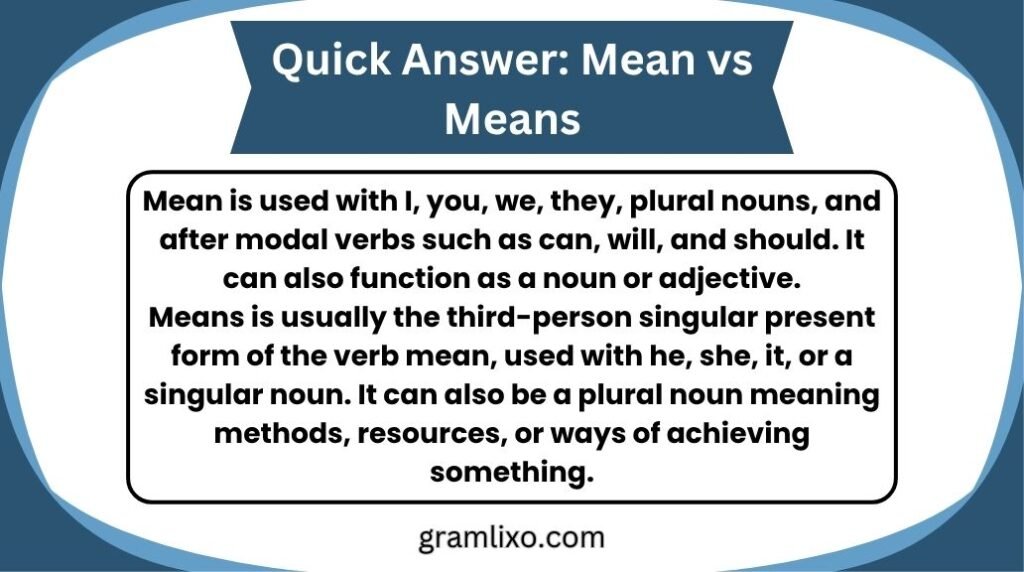
Mean is used with I, you, we, they, plural nouns, and after modal verbs such as can, will, and should. It can also function as a noun or adjective.
Means is usually the third-person singular present form of the verb mean, used with he, she, it, or a singular noun. It can also be a plural noun meaning methods, resources, or ways of achieving something.
- I mean what I say.
- You mean a lot to me.
- They mean well.
- She means what she says.
- The word means something different here.
- We need the means to complete the project.
The key is simple: subject-verb agreement determines whether you need “mean” or “means” when they are verbs.
Understanding the Basics: Mean vs Means
The first thing to understand is that mean and means can have more than one grammatical function.
As verbs, they belong to the same verb:
- I mean.
- You mean.
- We mean.
- They mean.
- He means.
- She means.
- It means.
The -s ending appears with a third-person singular subject in the simple present tense.
However, means can also be a noun. In that use, it does not simply mean the third-person form of mean. It can refer to a method, way, or resources.
Comparison Table
| Form | Type | Meaning | Example | Correct/Incorrect |
|---|---|---|---|---|
| mean | Verb | To intend, signify, or express | I mean what I say. | ✅ Correct |
| means | Verb | Third-person singular form of mean | She means what she says. | ✅ Correct |
| mean | Verb | Base form after modal verbs | They will mean it. | ✅ Correct |
| means | Noun | Methods or ways | We need the means to succeed. | ✅ Correct |
| mean | Adjective | Unkind, unpleasant, or stingy | That was a mean comment. | ✅ Correct |
| means | Verb with I | Incorrect subject-verb agreement | I means what I say. | ❌ Incorrect |
| mean | Verb with she | Incorrect subject-verb agreement | She mean what she says. | ❌ Incorrect |
This table shows why mean vs means cannot be decided simply by memorizing one spelling. You must look at how the word functions in the sentence.
Correct Meanings and Uses of “Mean”
1. “Mean” as a Verb Meaning “Signify”
One of the most common uses of mean is to say that something has a particular meaning or represents something.
Examples:
- What does this word mean?
- What does this symbol mean?
- This phrase means something different in another context.
- Red lights mean stop.
- These numbers mean that sales are increasing.
Notice the subject-verb relationship:
What does this word mean?
The auxiliary verb does already carries the third-person singular marking. Therefore, the main verb stays in its base form: mean, not means.
This is one of the most important rules in the entire mean vs means discussion.
Incorrect:
❌ What does this word means?
Correct:
✅ What does this word mean?
2. “Mean” as a Verb Meaning “Intend”
Mean can also mean intend.
Examples:
- I mean to call you tonight.
- We mean no harm.
- They mean to finish the work today.
- Did you mean to say that?
- What do you mean?
With he, she, or it, use means in a simple present affirmative sentence:
- She means well.
- He means what he says.
- The manager means to improve the system.
Again, the form depends on the subject.
3. “Mean” in Questions
Questions often create confusion because auxiliary verbs such as do and does change the verb form.
Compare:
What do you mean?
What does she mean?
Not:
❌ What does she means?
The reason is that does already marks the third-person singular form. The main verb therefore returns to its base form, mean.
The same pattern occurs with many other verbs:
- What does he want?
- What does she know?
- What does it mean?
You would not write:
- ❌ What does he wants?
- ❌ What does she knows?
- ❌ What does it means?
This is a powerful test for avoiding errors.
Correct Meanings and Uses of “Means”
1. “Means” as a Third-Person Singular Verb
The most common grammatical use of means is as the third-person singular present form of mean.
Use means with:
- he
- she
- it
- a singular person
- a singular thing
- a singular noun phrase
Examples:
- He means well.
- She means what she says.
- It means you should stop.
- This sign means danger.
- The message means something important.
Here, means is a verb.
2. “Means” as a Plural Noun
There is another important use of means: it can be a plural noun meaning methods, ways, or resources.
Examples:
- We need new means of communication.
- Education can be a means of improving your career.
- They found several means to solve the problem.
- The company has the financial means to expand.
In this sense, means is not the third-person form of the verb mean. It is a noun.
For example:
The internet is a means of communication.
Here, means means a method or way.
You can also say:
They used several means to accomplish the task.
Here, means refers to several methods or approaches.
3. “By Means Of”
The expression by means of means using or through the use of something.
Examples:
- We solved the problem by means of careful planning.
- The message was delivered by means of a secure system.
- They traveled by means of public transportation.
This expression is relatively formal and is more common in professional, academic, and technical writing.
In casual conversation, people often simply say using or through:
We solved the problem using careful planning.
That sentence sounds more natural in everyday speech.
Mean vs Means in Questions
Questions are one of the biggest sources of mistakes.
Consider these examples:
Correct
What does this sentence mean?
Incorrect
What does this sentence means?
Why?
Because does is the auxiliary verb, and the main verb must remain in its base form.
The same principle applies to:
Does this word mean something else?
Not:
❌ Does this word means something else?
But in an affirmative sentence, the third-person singular form is required:
This word means something else.
This creates a useful contrast:
| Sentence Type | Correct Form |
|---|---|
| Affirmative with she/he/it | She means it. |
| Question with does | Does she mean it? |
| Negative with does not | She doesn’t mean it. |
| Affirmative with I/you/we/they | They mean it. |
| Question with do | Do they mean it? |
The Easy Rule
If you see does, think:
Does + mean
If you see do, think:
Do + mean
If there is no auxiliary verb and the subject is he, she, it, think:
He/she/it + means
Mean vs Means After Modal Verbs
Another common situation involves modal verbs.
Modal verbs include:
- can
- could
- may
- might
- must
- shall
- should
- will
- would
After a modal verb, use the base form mean.
Examples:
- It can mean several things.
- This could mean trouble.
- They may mean something else.
- She might mean that as a joke.
- It should mean the same thing.
- That will mean more work.
Incorrect:
❌ It can means several things.
Correct:
✅ It can mean several things.
Why? Modal verbs are followed by the base form of the main verb.
This rule applies beyond mean:
- She can go, not “can goes.”
- He will come, not “will comes.”
- They should know, not “should knows.”
- It might work, not “might works.”
So when you are deciding between mean vs means, check whether a modal verb comes immediately before the word.
Mean vs Means in Negative Sentences
Negative sentences also follow a predictable pattern.
With do not or does not, use mean, not means.
Examples:
- I don’t mean that.
- We don’t mean to offend anyone.
- They don’t mean any harm.
- She doesn’t mean that.
- He doesn’t mean to be rude.
- It doesn’t mean the plan has failed.
Notice:
She means it.
But:
She doesn’t mean it.
The -s disappears because doesn’t already carries the third-person singular grammatical marking.
Incorrect:
❌ She doesn’t means it.
Correct:
✅ She doesn’t mean it.
This is one of the easiest mistakes to fix once you understand auxiliary verbs.
Test Tip: How to Choose Between Mean and Means
When you are unsure, use this three-step test.
Step 1: Find the subject
Ask: Who or what is doing the action?
- I → mean
- You → mean
- We → mean
- They → mean
- He → means
- She → means
- It → means
Step 2: Look for “do,” “does,” or a modal
If you see:
- do
- does
- don’t
- doesn’t
- can
- could
- will
- would
- should
- might
- may
- must
the verb after it should normally be mean.
Step 3: Ask whether “means” is actually a noun
If means refers to a method, way, or resources, it is a noun.
Example:
We need the means to complete the project.
Here, changing it to mean would not work.
Case Study: Mean vs Means in the Workplace
Imagine an employee sends this email to a manager:
“I wanted to ask what this new policy means for our team.”
This sentence is correct.
Why?
The subject is this new policy, which is singular. Therefore:
This new policy means something.
But the email uses a question structure:
What does this new policy mean for our team?
The word does requires the base form mean.
Now imagine the employee writes:
❌ What does this new policy means for our team?
This is incorrect because both does and means are attempting to express the same third-person singular grammatical marking.
A polished workplace sentence would be:
“Could you clarify what this new policy means for our team?”
This version uses means correctly because the structure is:
this new policy + means
There is no does immediately before the main verb.
Practical Lesson
In professional writing, small grammar differences can affect clarity. A sentence such as “What does this means?” may look minor, but correcting it to “What does this mean?” makes the writing cleaner and more professional.
Grammar Rules Explained
The core rule behind mean vs means is subject-verb agreement.
In the simple present tense, most English verbs take -s when the subject is third-person singular.
For example:
- I work.
- You work.
- They work.
- She works.
The same pattern applies to mean:
- I mean.
- You mean.
- We mean.
- They mean.
- He means.
- She means.
- It means.
Merriam-Webster’s grammar resources explain the basic distinction between nouns and verbs and note that verbs can express actions, occurrences, or states of being. This grammatical framework helps explain why means can function either as a verb form or as a noun depending on the sentence.
Why “Does It Mean?” Is Correct
The auxiliary does is already marked for third-person singular.
Therefore:
Does + subject + base verb
Examples:
- Does she know?
- Does he want?
- Does it work?
- Does this mean anything?
Not:
- ❌ Does she knows?
- ❌ Does he wants?
- ❌ Does it works?
- ❌ Does this means anything?
The same principle works with doesn’t:
It doesn’t mean that.
Not:
❌ It doesn’t means that.
Dictionary Support
Major dictionaries recognize multiple meanings and grammatical functions for mean. For example, dictionary references describe mean as a verb used to express intention or significance and also recognize means as the third-person singular form.
Merriam-Webster also distinguishes grammatical categories such as nouns and verbs, which is especially relevant because means can function as a noun as well as a verb.
Common Mistakes With Mean vs Means
Mistake 1: Adding “s” After “does”
Incorrect:
❌ What does this means?
Correct:
✅ What does this mean?
This happens because writers see a singular subject and automatically add -s to the verb. However, does has already taken care of that grammatical requirement.
Mistake 2: Forgetting “s” in an Affirmative Sentence
Incorrect:
❌ She mean what she says.
Correct:
✅ She means what she says.
There is no auxiliary does here, so the main verb needs the third-person singular form.
Mistake 3: Using “Means” After a Modal
Incorrect:
❌ It might means something.
Correct:
✅ It might mean something.
After might, use the base form.
Mistake 4: Confusing the Noun “Means” With the Verb
Consider:
We need the means to solve the problem.
Here, means is a noun.
But:
The result means that we need more time.
Here, means is a verb.
The spelling is identical, but the grammatical role is different.
Similar Grammar Confusions
The confusion between mean vs means is part of a larger pattern. English contains many pairs that look or sound similar but perform different grammatical jobs.
| Confusion | Correct Usage | Common Error |
|---|---|---|
| it’s / its | It’s raining. / The dog wagged its tail. | Mixing contraction and possessive |
| your / you’re | Your car is here. / You’re early. | ❌ Your early |
| their / they’re | Their house is large. / They’re ready. | Mixing possession and contraction |
| who’s / whose | Who’s coming? / Whose book is this? | Confusing contraction and possessive |
| then / than | First this, then that. / Taller than me. | Using then for comparison |
| affect / effect | The news affected me. / The effect was clear. | Confusing verb and noun |
| mean / means | They mean it. / She means it. | Incorrect subject-verb agreement |
Why Do These Mistakes Happen?
There are several common reasons:
Fast typing: People often type quickly and do not reread every sentence.
Autocorrect: Automatic corrections can sometimes replace a word with a grammatically inappropriate form.
Lack of knowledge: A writer may know what they want to say but not understand the subject-verb rule behind the sentence.
Sound similarity: When speaking, the difference between forms may not always feel important, so the wrong form can carry over into writing.
Habit: Seeing phrases such as “what does it mean” repeatedly can help, but without understanding the rule, writers may still accidentally type “what does it means.”
The solution is not simply memorizing hundreds of examples. Understanding the underlying structure is more useful.
Usage in Different Contexts
Mean vs Means in Everyday Conversation
Both forms are extremely common in everyday speech.
Examples:
- What do you mean?
- What does that mean?
- I mean it.
- She means well.
- They mean no harm.
- This means a lot to me.
The phrase What do you mean? is especially common when asking someone to clarify their statement.
Mean vs Means in Professional Writing
Professional writing requires careful subject-verb agreement.
Examples:
- The new policy means that employees must update their records.
- These changes mean that the process will take longer.
- What does this change mean for customers?
- The report means that we need additional resources.
In formal writing, always check whether mean or means agrees with the subject.
Mean vs Means in Creative Writing
Creative writing often uses these words to express emotion, intention, or symbolism.
Examples:
Her silence meant more than words could explain.
What did his smile mean?
The broken clock means something different to every character.
Creative writing can be flexible in style, but standard subject-verb agreement still matters.
Mean vs Means in Social Media and Texting
Informal digital communication often contains abbreviations and missing punctuation, but the standard grammar remains the same.
Examples:
- What do u mean?
- What does this mean?
- I mean it 😂
- She means everything to me ❤️
Texting may be informal, but using the correct form makes your meaning easier to understand.
Why Mean vs Means Matters
At first glance, mean vs means may seem like a tiny grammar issue. However, small grammar choices contribute to the overall clarity and professionalism of writing.
1. Clarity in Communication
Correct grammar makes your message easier to understand.
Compare:
What does this means?
with:
What does this mean?
The second sentence follows standard grammar and immediately communicates the intended question.
2. Professionalism
Emails, reports, applications, business documents, and academic work benefit from accurate grammar.
A small error may not completely change the meaning, but repeated errors can make writing appear less polished.
3. Accuracy in Digital Communication
Digital communication moves quickly. Messages are often written on phones, social media platforms, workplace chat apps, and email.
Because people read quickly, grammatical accuracy helps prevent confusion.
4. Better Language Confidence
Once you understand the rule, you do not have to guess.
You can quickly identify:
She means it.
but:
Does she mean it?
The difference becomes automatic.
“Clear writing starts with clear choices.”
When you choose the right grammatical form, your reader can focus on your message instead of the mistake.
Special Exceptions and Edge Cases
There is no unusual spelling exception that changes the basic subject-verb rule for mean and means, but there is an important semantic distinction.
“Means” Can Be a Noun
The word means can refer to a method, method of achieving something, or available resources.
Examples:
- They found a means of solving the issue.
- We need several means of communication.
- She has the financial means to purchase the property.
In these examples, means is a noun.
“Mean” Can Also Be a Noun
The word mean has additional meanings beyond the verb.
In mathematics, the mean is a type of average.
For example:
The mean of 10, 20, and 30 is 20.
Merriam-Webster’s thesaurus also treats mean as a term associated with an average or middle point in certain contexts.
“Mean” Can Be an Adjective
Mean can also describe someone or something as unkind or unpleasant.
Examples:
- That was a mean thing to say.
- He made a mean joke.
- Don’t be mean to your brother.
It can have other adjective meanings as well, including average or intermediate in particular contexts.
Therefore, not every appearance of mean is a verb.
Mean vs Means: Quick Recap Checklist
Use this checklist whenever you are unsure.
| Question | If Yes → Use |
|---|---|
| Is the subject I? | mean |
| Is the subject you? | mean |
| Is the subject we? | mean |
| Is the subject they? | mean |
| Is the subject he? | means |
| Is the subject she? | means |
| Is the subject it? | means |
| Is there “does” before the verb? | mean |
| Is there “doesn’t” before the verb? | mean |
| Is there a modal verb such as can or will? | mean |
| Does the word refer to methods or resources? | means |
| Is it a mathematical average? | mean |
Practice Example 1
What does this word ___?
Answer:
mean
Correct sentence:
What does this word mean?
Practice Example 2
She ___ that she is sorry.
Answer:
means
Correct sentence:
She means that she is sorry.
Practice Example 3
They can ___ several things by that statement.
Answer:
mean
Correct sentence:
They can mean several things by that statement.
More Examples of Mean vs Means
Here are additional examples to make the difference easier to remember.
Use “Mean”
- I mean what I say.
- You mean a lot to me.
- We mean no disrespect.
- They mean well.
- What do you mean?
- What did she mean?
- It can mean several things.
- This could mean trouble.
- They will mean something different to each person.
- We don’t mean to cause problems.
Use “Means”
- She means well.
- He means what he says.
- It means you should wait.
- This sign means danger.
- The result means we need more time.
- The message means something important.
- Her silence means a lot.
- The change means that we must adapt.
- The word means something different here.
- This symbol means “warning.”
Use “Means” as a Noun
- We need the means to solve this problem.
- Education is a means of personal development.
- They used several means to reach their goal.
- The company has the financial means to expand.
- We need a reliable means of communication.
A Simple Memory Trick
Here is an easy way to remember the difference:
He, She, It → Means
Think:
She means.
He means.
It means.
I, You, We, They → Mean
Think:
I mean.
You mean.
We mean.
They mean.
Does → Mean
Whenever you see does, use:
does + mean
Never:
❌ does + means
Modal → Mean
Whenever a modal verb appears, use:
can mean
will mean
might mean
should mean
not:
❌ can means
❌ will means
❌ might means
This simple pattern solves most mean vs means questions.
FAQs About Mean vs Means
1. What is the difference between mean and means?
Mean is the base form of the verb and is used with I, you, we, and they, as well as after auxiliary and modal verbs. Means is the third-person singular present form used with he, she, or it. Means can also be a plural noun meaning methods, ways, or resources.
2. Is it “What does it mean” or “What does it means”?
The correct form is “What does it mean?” The auxiliary verb does requires the base form mean, not means.
3. Is “She mean” or “She means” correct?
“She means” is correct in a standard affirmative sentence. Because she is a third-person singular subject, the verb takes the -s form.
4. Is “It means” grammatically correct?
Yes. “It means” is grammatically correct because it is a third-person singular subject.
Example:
It means that we need more time.
5. Can “means” be a noun?
Yes. Means can be a noun meaning a method, way, or resources.
Example:
We need the means to complete the project.
6. Why is “does means” incorrect?
In a standard present-tense question or negative construction, does already carries the third-person singular marking. Therefore, the following main verb stays in its base form.
Correct:
Does it mean that?
Incorrect:
❌ Does it means that?
Conclusion
Understanding mean vs means becomes much easier when you focus on the sentence structure instead of memorizing isolated examples. Mean is the base form used with I, you, we, and they, and it also follows auxiliary and modal verbs such as do, does, can, will, should, and might. Means is the third-person singular present form used with he, she, it, or another singular subject.
Remember the most useful rule: “She means,” but “Does she mean?” The first sentence does not have an auxiliary verb, so the main verb takes -s. The second uses does, so the main verb returns to mean.
Also remember that means can be a noun meaning a method, way, or resources, while mean has other roles as a noun and adjective.
Once you learn these patterns, choosing between mean and means becomes quick and natural.
When in doubt, check the subject, look for an auxiliary or modal verb, and ask what role the word plays. Clear grammar makes clear communication.

I’m Sarah Martinez, a writer and English language enthusiast at Gramlixo. I love explaining grammar concepts in a clear and practical way that anyone can understand.