
Have you ever written a sentence such as “I lended him some money” and then wondered whether it should be “I lent him some money”? You are not alone. Lent vs lended is a common grammar confusion because the verb lend does not follow the regular pattern many English verbs use. While regular verbs often form their past tense by adding -ed, lend changes to lent instead.
If you are unsure about lent vs lended, the key rule is simple: lent is the standard past tense and past participle of lend, while lended is not standard English in ordinary modern usage. For example, “I lent my friend $20” is correct, while “I lended my friend $20” is incorrect.
This distinction matters in everyday conversations, emails, school assignments, business writing, and online communication. Once you understand how lend changes form, you can avoid this mistake easily.
|Mean vs Means: What’s the Difference and How to Use Them Correctly?
|Shall vs Will: What’s the Difference and When Should You Use Each?
|Pajamas vs Pyjamas: Which Spelling Is Correct?
Quick Answer: Lent vs Lended
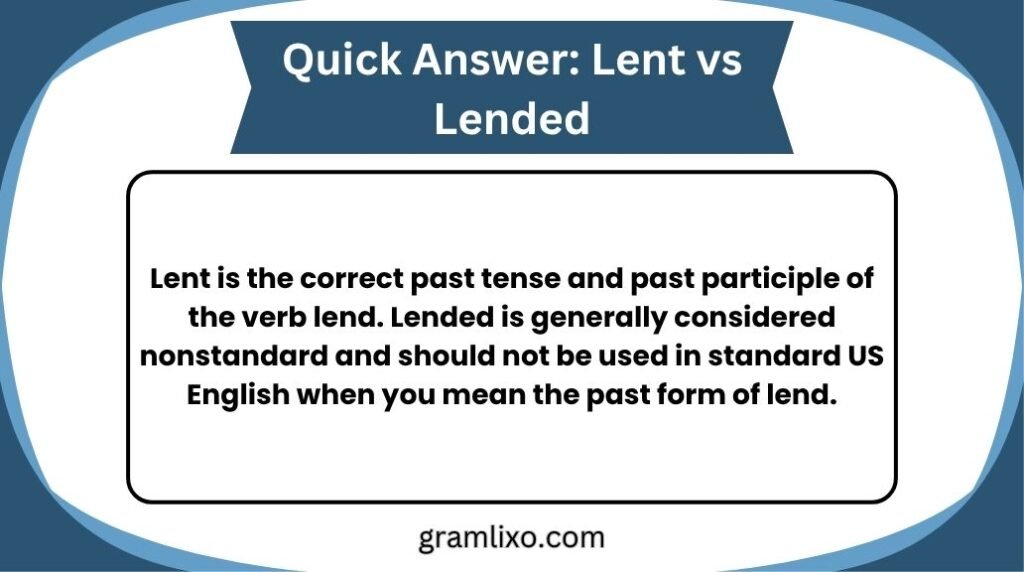
Lent is the correct past tense and past participle of the verb lend. Lended is generally considered nonstandard and should not be used in standard US English when you mean the past form of lend.
- Present: I lend my books to friends.
- Past: I lent my book to Sarah.
- Past participle: I have lent my book to Sarah.
So, when choosing between lent vs lended, use lent.
Understanding the Basics: Lent vs Lended
The main difference is grammatical rather than semantic. Lend is an irregular verb, so it does not form its past tense by simply adding -ed.
| Form | Type | Meaning | Example | Correct/Incorrect |
|---|---|---|---|---|
| lend | Base form | To temporarily give something to someone with the expectation of its return | I lend books to my friends. | ✅ Correct |
| lends | Third-person singular present | Gives something temporarily | She lends me her notes. | ✅ Correct |
| lent | Past tense | Gave something temporarily in the past | I lent him my jacket. | ✅ Correct |
| lent | Past participle | Used with have, has, or had | She has lent me her car. | ✅ Correct |
| lended | Attempted past form | Intended to mean the past of lend | I lended him money. | ❌ Nonstandard |
Why Does “Lend” Become “Lent”?
English contains many irregular verbs that do not follow the simple verb + -ed pattern.
For example:
- go → went
- buy → bought
- teach → taught
- send → sent
- lend → lent
Because lend is irregular, adding -ed to create lended is not the standard way to form its past tense.
The Three Main Forms of “Lend”
Understanding the verb forms makes the rule easier to remember:
Base form: lend
I lend my notes to classmates.
Past tense: lent
I lent my notes to a classmate yesterday.
Past participle: lent
I have lent my notes to several classmates.
Notice that both the past tense and past participle are lent.
Correct Meanings and Uses of “Lent”
1. “Lent” Means Gave Something Temporarily
The most common meaning of lent is that someone gave something to another person temporarily.
For example:
I lent my brother my laptop.
Here is the sentence breakdown:
- I = subject
- lent = past-tense verb
- my brother = person receiving the item
- my laptop = item being temporarily given
The sentence means that I gave my laptop to my brother for temporary use.
Another example:
Maria lent me her umbrella.
This means Maria gave me her umbrella temporarily.
2. “Lent” Can Refer to Money
We commonly use lent when talking about money.
David lent me $100.
This means David gave me $100 with the expectation that I would return it.
More examples:
- My parents lent me money for college.
- She lent her friend $50.
- I lent him enough money to buy lunch.
- They lent us money for the emergency.
- My coworker lent me five dollars.
The important point is that lent describes something that happened in the past.
3. “Lent” Can Refer to Objects
You can also use lent for physical objects.
I lent my car to my cousin.
The speaker temporarily allowed the cousin to use the car.
Other examples include:
- She lent me her favorite book.
- He lent his jacket to his friend.
- We lent our chairs to the neighbors.
- They lent us a camera.
- I lent my calculator to a classmate.
4. “Lent” Can Be Used With “Have,” “Has,” and “Had”
Because lent is also the past participle of lend, it can appear in perfect tenses.
Examples:
I have lent him my book.
She has lent me her notes.
They had lent us their equipment.
In these sentences, lent works with an auxiliary verb.
Compare:
- I lent him my book. → simple past
- I have lent him my book. → present perfect
- I had lent him my book. → past perfect
In all three examples, the correct form remains lent.
Test Tip: Replace “Lend” With Another Irregular Verb
If you are tempted to write lended, pause and remember that lend is irregular.
Think:
send → sent
Then:
lend → lent
This mental connection can help you remember the correct form.
Lent vs Lended in Real-Life Situations
The difference becomes particularly clear when you place the words in realistic situations.
Example 1: Borrowing a Book
Incorrect:
I lended my friend a book yesterday.
Correct:
I lent my friend a book yesterday.
The action happened yesterday, so you need the past-tense form lent.
Example 2: Lending Money
Incorrect:
She lended me $50 last week.
Correct:
She lent me $50 last week.
The phrase “last week” clearly establishes a past action.
Example 3: Using Present Perfect
Incorrect:
He has lended me his car before.
Correct:
He has lent me his car before.
Because has is followed by a past participle, lent is required.
Example 4: Workplace Conversation
Incorrect:
My manager lended me a laptop for the project.
Correct:
My manager lent me a laptop for the project.
The second sentence uses the standard English form.
Case Study: A Workplace Email
Imagine an employee needs a laptop for an important project.
A coworker writes:
“Hi Alex, I lent you my spare laptop yesterday. Please return it to my desk when you finish the presentation.”
This sentence is clear and grammatically correct.
Now imagine the employee writes:
“Thanks for lended me your laptop.”
That sentence contains an incorrect form. A natural correction would be:
“Thanks for lending me your laptop.”
This example also highlights an important distinction: after for, English uses the -ing form, so we say lending, not lent.
Compare These Forms
- I lend you my laptop. → present
- I lent you my laptop. → past
- I am lending you my laptop. → present continuous
- Thanks for lending me your laptop. → gerund after for
- I have lent you my laptop. → present perfect
The correct form depends on the grammatical structure.
Grammar Rules: Why “Lent” Is Correct
According to standard English usage, lend is an irregular verb. Major dictionaries such as Merriam-Webster list lent as the past tense and past participle of lend.
The important pattern is:
lend → lent → lent
Not:
lend → lended → lended
This is similar to other irregular verbs.
| Base Verb | Past Tense | Past Participle |
|---|---|---|
| lend | lent | lent |
| send | sent | sent |
| spend | spent | spent |
| build | built | built |
| keep | kept | kept |
| feel | felt | felt |
You would not normally say:
- “I sended the email.”
- “She builded the house.”
- “He keeped the book.”
Likewise, standard English does not use lended as the normal past form of lend.
What Does “Irregular Verb” Mean?
An irregular verb does not form its past tense using the usual -ed ending.
For regular verbs:
- walk → walked
- play → played
- clean → cleaned
- open → opened
But irregular verbs use different patterns:
- lend → lent
- write → wrote
- take → took
- give → gave
- see → saw
Learning common irregular verbs is therefore an important part of mastering English grammar.
Common Mistakes With “Lent vs Lended”
Mistake 1: Assuming Every Past Verb Ends in “-ed”
This is probably the biggest reason people write lended.
A learner may think:
lend + ed = lended
That logic works with regular verbs such as help → helped, but it does not work with every English verb.
The correct form is:
lend → lent
Mistake 2: Fast Typing
Digital communication often happens quickly. When people type a message without checking it, they may automatically add -ed.
For example:
“I lended him my charger.”
The writer may know the correct form but type the wrong one because the regular -ed pattern feels automatic.
Mistake 3: Autocorrect
Autocorrect can sometimes reinforce an incorrect form or fail to identify a nonstandard form. Depending on the keyboard, dictionary, or software being used, unusual words may not always be flagged.
That is why it is useful to know the rule rather than relying completely on spell-checking software.
Mistake 4: Lack of Familiarity With Irregular Verbs
People who are learning English may naturally apply regular verb rules to irregular verbs.
This is not unusual. English has many irregular forms that must be learned individually.
Similar Grammar Confusions
The lent vs lended issue belongs to a larger group of common English mistakes.
| Common Confusion | Correct Form | Why? |
|---|---|---|
| lend / lended | lend / lent | Lend is irregular |
| send / sended | send / sent | Send is irregular |
| buy / buyed | buy / bought | Buy is irregular |
| go / goed | go / went | Go is irregular |
| its / it’s | its / it’s | Possessive vs contraction |
| your / you’re | your / you’re | Possessive vs contraction |
| their / they’re | their / they’re | Possessive vs contraction |
| affect / effect | depends on usage | Verb vs noun and related meanings |
| then / than | depends on meaning | Time/order vs comparison |
“Its” vs “It’s”
Its shows possession:
The dog wagged its tail.
It’s means it is or it has:
It’s raining outside.
“Your” vs “You’re”
Your shows possession:
Is this your phone?
You’re means you are:
You’re very helpful.
Just as you need to recognize the difference between these pairs, you need to recognize that lent is the established past form of lend.
Lent vs Lended in Different Contexts
Everyday Conversation
In casual speech, you might hear:
“I lent him my charger.”
“She lent me her jacket.”
“Who lent you that book?”
These are natural and correct.
Although conversation is informal, lent remains the standard past form.
Professional Writing
Professional communication requires extra attention to grammar because errors can affect clarity and credibility.
Correct:
“The finance department lent the equipment to our team for the project.”
Incorrect:
“The finance department lended the equipment to our team.”
In business emails, reports, proposals, and workplace documents, use lent.
Creative Writing
Authors can use unusual language intentionally when creating dialogue for a character.
For example, a writer might have a fictional character say:
“I lended him my old truck.”
That could represent the character’s speech pattern or a deliberate portrayal of nonstandard English.
However, this does not make lended the standard past tense of lend. In normal narration and standard writing, lent remains the appropriate form.
Social Media and Texting
Online communication is often informal:
“She lent me her hoodie 😂”
or:
“Who lent you that?”
People sometimes make grammar mistakes in texts because they type quickly. Informal communication does not change the standard grammatical form.
What About “Lending”?
A common source of confusion is that lending is correct.
You may see:
I am lending him my car.
This is not the same as lended.
The verb forms are:
- lend — base form
- lends — third-person singular present
- lent — past tense
- lent — past participle
- lending — present participle/gerund
Examples:
I lend my books to friends.
She lends her notes to classmates.
I lent him my book yesterday.
I have lent him my book before.
I am lending him my book today.
All five forms are grammatically distinct.
“Lend” vs “Borrow”
Another important point is that lend and borrow describe opposite sides of the same transaction.
Lend means to give something temporarily.
I lent John my calculator.
Borrow means to receive something temporarily.
John borrowed my calculator.
Think of it this way:
I lend → You borrow
For example:
Sarah lent me her umbrella.
At the same time:
I borrowed Sarah’s umbrella.
Both sentences describe the same event from different perspectives.
Why This Matters
People sometimes confuse lend and borrow because both involve temporary possession.
But the grammatical roles are different:
| Verb | Meaning | Example |
|---|---|---|
| lend | Give temporarily | I lent him my book. |
| borrow | Receive temporarily | He borrowed my book. |
Why Correct Usage Matters
1. Clarity in Communication
Using the correct verb form makes your meaning immediately clear.
I lent her my notes.
The reader understands that the action happened in the past.
2. Professionalism
Grammar errors can distract readers in emails, applications, reports, and business documents.
Using lent instead of lended helps your writing follow standard English conventions.
3. Writing Accuracy
Correct verb forms demonstrate control of English grammar.
This becomes especially important in:
- academic writing
- job applications
- professional emails
- websites
- reports
- formal messages
4. Digital Communication
People often write quickly online. A small grammar mistake may seem insignificant, but repeated errors can make written communication harder to trust or understand.
A useful reminder is:
Correct grammar makes your meaning easier to follow.
Special Exception: Can “Lended” Ever Appear?
In ordinary modern standard US English, lended is not the standard past tense of lend.
However, you may occasionally encounter unusual forms in historical texts, dialectal speech, quotations, creative writing, or other nonstandard contexts. A word appearing somewhere does not automatically make it the standard form for formal English.
For ordinary writing, the safe and standard pattern is:
lend → lent → lent
If you are writing an essay, email, report, school assignment, website article, or professional document, use lent.
Quick Recap Checklist
Use this checklist whenever you are unsure about lent vs lended.
| Question | If Yes → Use |
|---|---|
| Are you talking about giving something temporarily now? | lend |
| Are you talking about giving something temporarily in the past? | lent |
| Are you using have, has, or had before the verb? | lent |
| Are you describing an ongoing action with am, is, or are? | lending |
| Are you thinking of the past form “lended”? | Use lent instead |
Practice Examples
1. Yesterday, I ___ my friend my headphones.
Answer: lent
Yesterday, I lent my friend my headphones.
2. She has ___ me her notes.
Answer: lent
She has lent me her notes.
3. I am ___ my car to my brother this weekend.
Answer: lending
I am lending my car to my brother this weekend.
Easy Memory Trick
Here is a simple way to remember the rule:
“Lend in the present, lent in the past.”
Think:
Today I lend. Yesterday I lent.
For example:
Today, I lend my friend my bicycle.
Yesterday, I lent my friend my bicycle.
If you remember this pair, you will avoid the most common lent vs lended mistake.
Another useful connection is:
send → sent
Because lend and send have a similar ending and both use -ent in the past:
send → sent
lend → lent
Frequently Asked Questions About Lent vs Lended
Is “lended” a correct word?
Lended is not the standard past tense of lend in modern standard US English. The correct past tense and past participle are lent.
Is it “I lent him money” or “I lended him money”?
The correct sentence is:
I lent him money.
Lend is an irregular verb, so its past tense is lent, not lended.
Is “lent” the past tense of “lend”?
Yes. Lent is both the past tense and past participle of lend.
Examples:
I lent her my book.
I have lent her my book.
Can I say “I have lended”?
No, not in standard English. The correct form is:
I have lent.
For example:
I have lent him my car before.
What is the difference between “lent” and “borrowed”?
Lent means you gave something temporarily, while borrowed means you received something temporarily.
I lent him my laptop.
He borrowed my laptop.
Why do people say “lended”?
People may create lended by applying the regular -ed rule to lend. Fast typing, unfamiliarity with irregular verbs, and assumptions about English verb patterns can contribute to the mistake. In standard English, however, lent is the appropriate form.
Conclusion
The difference between lent vs lended is straightforward once you remember that lend is an irregular verb. The standard forms are lend for the base form, lent for the past tense, and lent for the past participle. Therefore, you should write “I lent him my book,” not “I lended him my book.”
Use lend when describing the base action, lent when describing a completed past action, and lending when the sentence requires the -ing form. The word lended is not the standard past form in modern US English.
When in doubt, remember one simple sentence:
Today I lend; yesterday I lent.
Master that pattern, and you will never need to hesitate over lent vs lended again.

I’m Robert Williams, an English grammar writer at Gramlixo. I focus on breaking down confusing grammar rules into simple explanations and useful examples.


[…] |Lent vs Lended: Which One Is Correct? […]