Have you ever wanted to describe someone who constantly talks about how talented, successful, rich, or impressive they are, but paused between braggart vs bragger? 🤔
These two words look closely related because both come from the verb brag, and both can describe a person who boasts. However, they are not identical in tone or usage.
The main difference is that braggart is the established dictionary word for a person who boasts excessively, while bragger is a straightforward noun formed from the verb brag and can be understood as “someone who brags.”
In modern English, bragger is possible, but braggart is generally the more established and recognizable term when you want to describe a person characterized by boastful behavior.
Cambridge Dictionary defines braggart as someone who proudly talks a lot about themselves, their achievements, or their possessions, and labels the word as old-fashioned and disapproving.
So, if you are wondering which word to choose, the answer depends on your sentence, tone, and intended meaning.
|To Far vs Too Far: Which One Is Correct?
|You Are Correct vs You Are Right: What’s the Difference?
|Better Than vs Better Then: Which One Is Correct?
Quick Answer: Braggart vs Bragger
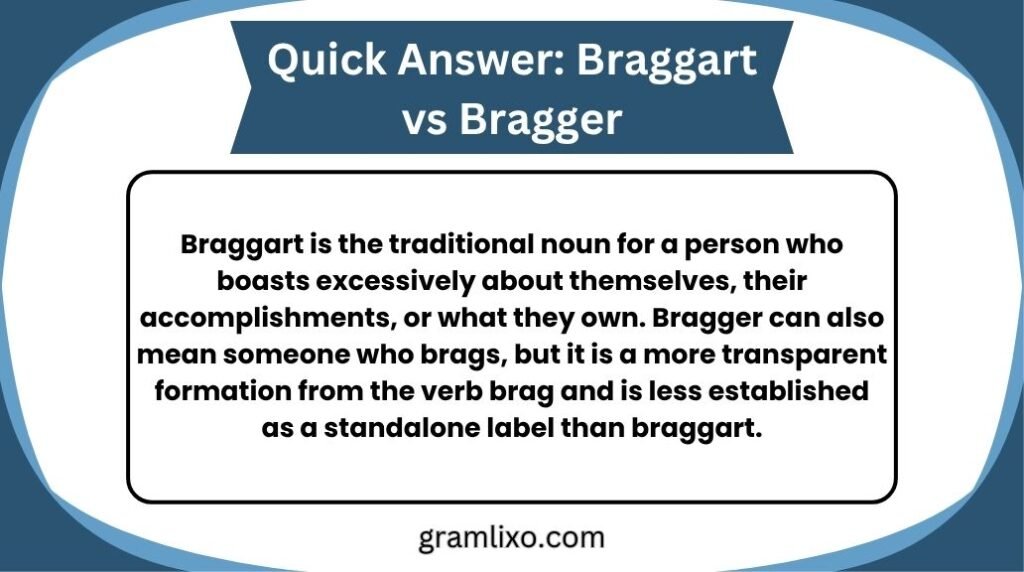
Braggart is the traditional noun for a person who boasts excessively about themselves, their accomplishments, or what they own. Bragger can also mean someone who brags, but it is a more transparent formation from the verb brag and is less established as a standalone label than braggart.
Example:
- Correct and natural: Everyone knew Jake was a braggart.
- Possible but less established: Everyone knew Jake was a bragger.
If you need a conventional English noun for a boastful person, braggart is the safer choice.
Understanding the Basics: Braggart vs Bragger
The easiest way to understand braggart vs bragger is to start with the word brag.
Brag is a verb meaning to talk too proudly about something you have done or something you possess. Cambridge Dictionary gives examples involving people bragging about money, achievements, and other accomplishments.
From that basic idea, English has developed several related words:
- Brag — verb
- Bragging — present participle/gerund
- Braggart — noun for a boastful person
- Bragging rights — the opportunity or privilege to boast about an achievement
- Bragger — a person who brags, formed directly from brag
Here is the comparison:
| Form | Type | Meaning | Example | Correct/Incorrect |
|---|---|---|---|---|
| brag | Verb | To speak too proudly about something | He likes to brag about his success. | ✅ Correct |
| bragging | Verb form/noun | Speaking proudly, often excessively | Her constant bragging annoyed everyone. | ✅ Correct |
| braggart | Noun | A person who boasts excessively | He is a terrible braggart. | ✅ Correct |
| bragger | Noun | Someone who brags | He is always a bragger. | ⚠️ Possible, but less established |
| bragged | Past-tense verb | Spoke boastfully | She bragged about her promotion. | ✅ Correct |
| bragging rights | Noun phrase | The opportunity to boast after an achievement | Our team earned bragging rights. | ✅ Correct |
The important point is that braggart is not simply a spelling variation of bragger. It is a well-established noun with its own history and conventional usage.
What Does Braggart Mean?
A braggart is someone who repeatedly or proudly talks about their own achievements, possessions, abilities, status, or experiences.
For example:
Daniel is such a braggart that every conversation becomes a story about his achievements.
Here, braggart describes Daniel as a person with a characteristic habit of boasting.
Cambridge Dictionary specifically describes braggart as a noun for someone who proudly talks a lot about themselves and their achievements or possessions. It also marks the word as old-fashioned and disapproving.
Example 1: Achievement
Marcus is a braggart who never misses an opportunity to mention his awards.
Breakdown:
- Marcus = subject
- is = linking verb
- a braggart = noun complement
- who never misses… = relative clause describing Marcus
The word braggart identifies Marcus as a person who boasts.
Example 2: Possessions
The braggart kept telling everyone about his expensive car.
Here, braggart is a noun referring to the person who boasts.
Example 3: Workplace
Nobody wanted to sit next to the office braggart during lunch.
Again, the word describes a person known for boastful behavior.
What Does Bragger Mean?
Bragger can be understood as a person who brags.
The construction is straightforward:
brag + -er = bragger
The suffix -er commonly creates nouns referring to people who perform an action:
- teach → teacher
- run → runner
- drive → driver
- sing → singer
- work → worker
- brag → bragger
Therefore, bragger is easy to understand grammatically.
For example:
He is a constant bragger.
The intended meaning is clear: he constantly brags.
However, there is an important usage distinction. Braggart is the more established traditional noun for this concept. It appears as a dictionary headword and has a long history in English. Cambridge specifically lists braggart as a noun.
That does not mean every use of bragger is automatically a grammatical error. Rather, bragger is a less conventional choice when you need a standard noun for a boastful person.
Braggart vs Bragger: The Core Difference
The difference becomes easier when you focus on conventional usage.
Braggart
Braggart is an established noun meaning a boastful person.
It often carries a negative or critical tone.
Example:
The braggart could not stop talking about his accomplishments.
The speaker is clearly criticizing the person’s behavior.
Bragger
Bragger means someone who brags and follows a productive English word-building pattern.
Example:
He is a frequent bragger on social media.
The meaning is understandable, but the word is less conventional than braggart.
Simple Rule
Remember this:
A braggart is a person characterized by boasting; a bragger is simply someone who brags.
In ordinary polished writing, braggart is usually the more established choice when describing a boastful person as a type of person.
Brag, Braggart, and Bragger: How They Connect
Understanding the family of words can eliminate much of the confusion.
Brag = Verb
Use brag when someone performs the action.
Tom likes to brag about his grades.
Here, brag tells us what Tom does.
Bragging = Action
Use bragging to describe the act of boasting.
Tom’s bragging became annoying.
Here, bragging refers to the behavior.
Braggart = Person
Use braggart when you want a noun describing a person known for boastful behavior.
Tom is a braggart.
Here, braggart identifies Tom as a type of person.
Bragger = Person Who Brags
Bragger can similarly identify someone who brags.
Tom is a frequent bragger.
The construction is understandable, but braggart is the more traditional and established noun.
Is Braggart a Negative Word?
Yes. Braggart generally has a negative or disapproving tone.
Cambridge Dictionary labels the word old-fashioned and disapproving.
Compare these sentences:
She confidently described her accomplishments.
This is neutral.
She proudly told everyone about her accomplishments.
This can be neutral or mildly negative depending on context.
She is a braggart.
This is clearly more critical.
Calling someone a braggart suggests that the person boasts too much or behaves in a way that others find irritating or excessive.
That distinction matters in professional communication.
Is Bragger a Correct Word?
Bragger is understandable and can be used as a noun for someone who brags, but it is not the usual traditional choice when describing a boastful person.
This is an important distinction between grammatical formation and established vocabulary.
English regularly creates nouns with -er, so bragger makes sense structurally. However, not every possible verb + -er formation becomes equally established in standard usage.
For example, English speakers naturally recognize:
- teacher
- runner
- swimmer
- writer
- driver
But English vocabulary is not determined entirely by mathematical rules. Historical usage matters too.
Braggart has become the established noun in this semantic area.
So, if you are writing an essay, article, formal document, or polished piece of prose, braggart is usually the more conventional option.
Correct Meanings and Uses
Using Braggart as a Noun
The most common use of braggart is as a countable noun.
He is a braggart.
She married a braggart.
The story’s villain is a boastful braggart.
Because it is a countable noun, you can use:
- a braggart
- the braggart
- several braggarts
- those braggarts
Using Bragger as a Noun
Bragger can be used to identify someone who brags.
He became known as a bragger among his coworkers.
The sentence is understandable, but depending on the context, boaster, braggart, or a direct phrase such as someone who constantly brags may sound more natural.
Using Brag as a Verb
If your sentence focuses on the action, do not force either noun into it.
Instead of:
She is a braggart about her promotion.
Use:
She brags about her promotion.
Or:
She keeps bragging about her promotion.
The verb often produces the most natural sentence.
Test Tip: Use the Action Test
Here is a quick way to decide what form you need.
Ask:
Am I describing what the person does?
If yes, use brag.
He likes to brag.
Am I naming the person as someone characterized by boastful behavior?
If yes, braggart is the established choice.
He is a braggart.
Do I simply want to describe someone who performs the action of bragging?
Bragger may be understandable, but consider whether braggart, boaster, or someone who brags sounds more natural in your context.
Case Study: A Workplace Conversation
Imagine a team meeting at a company.
One employee, Alex, receives praise for completing a difficult project. Instead of briefly accepting the compliment, Alex spends the next 15 minutes talking about how talented he is and reminding everyone about his previous achievements.
A coworker later says:
Alex is such a braggart.
This sentence sounds natural because braggart identifies Alex as someone whose behavior is characterized by excessive boasting.
Another coworker might say:
Alex keeps bragging about the project.
This is also natural because bragging describes the action.
Someone could technically say:
Alex is such a bragger.
The meaning can be understood, but it does not have the same established feel as braggart.
What Should You Use in a Professional Email?
Suppose a manager needs to describe the situation formally.
Instead of:
Alex is a bragger.
A professional writer would usually avoid labeling the employee and describe the observable behavior:
Alex frequently discusses his accomplishments during team meetings.
This is more neutral and specific.
The lesson is important: choosing the right word is not only about grammar. It is also about tone.
Grammar Rules Behind Braggart vs Bragger
The verb brag is completely standard.
Cambridge Dictionary defines brag as a verb meaning to speak too proudly about what you have done or what you own.
English also allows people nouns to be created with the suffix -er. That explains why bragger is understandable.
However, English contains many words that cannot be predicted perfectly from current word-formation rules.
Braggart is one of those established forms.
Its meaning is not simply “a person who happens to brag once.” It commonly describes someone characterized by boastful behavior.
For example:
He bragged about winning one game.
This tells us about one action.
But:
He is a braggart.
This characterizes the person.
That difference helps explain why braggart often sounds stronger.
Braggart vs Boaster
Another useful comparison is braggart vs boaster.
Both are established nouns for people who boast.
Braggart
He is an arrogant braggart.
Boaster
He is an endless boaster.
Both sentences identify a person who boasts.
The word boaster comes directly from the verb boast, while braggart is the established noun associated with brag.
Cambridge lists braggart among vocabulary connected with boasting.
In many contexts, these words can be close synonyms.
Common Mistakes with Braggart vs Bragger
Why do people get this distinction wrong? There are several reasons.
1. The -er Pattern Is Very Strong
English learners quickly learn patterns such as:
- dance → dancer
- teach → teacher
- sing → singer
- write → writer
So it is natural to think:
brag → bragger
That reasoning is understandable.
The problem is that established vocabulary does not always follow the most obvious productive pattern.
2. Fast Typing
When people type quickly, they may create a word that looks logical without checking whether it is conventional.
This is especially common in:
- texts
- comments
- social media
- instant messages
3. Autocorrect
Autocorrect can sometimes encourage unusual word forms or fail to recognize less common vocabulary.
Because bragger looks structurally reasonable, a writer may not notice that braggart is the more established noun.
4. Lack of Vocabulary Knowledge
Someone may know the verb brag without having encountered the noun braggart.
That makes bragger feel like the obvious choice.
5. Confusing Word Formation With Standard Usage
A word can be logically understandable without being the most conventional word in a particular context.
That is the key lesson here.
Similar Grammar Confusions
English has many pairs that cause confusion because the words look or sound similar.
| Confusing Forms | Correct Use | Example |
|---|---|---|
| it’s / its | it’s = it is; its = possessive | It’s cold. / The dog wagged its tail. |
| your / you’re | your = possession; you’re = you are | Your book is here. / You’re late. |
| their / there / they’re | Different grammatical functions | Their house is there. / They’re coming. |
| then / than | then = time; than = comparison | First eat, then leave. / She is taller than me. |
| advice / advise | noun / verb | I need advice. / Please advise me. |
| affect / effect | Usually verb / noun | It affected me. / The effect was clear. |
| brag / braggart | verb / person | He likes to brag. / He is a braggart. |
| braggart / bragger | established noun / less-established agent noun | He is a braggart. |
The best way to avoid these errors is to learn the function of each word rather than relying only on spelling patterns.
Usage in Different Contexts
Everyday Conversation
In casual speech, people may use several expressions:
He’s always bragging.
She’s such a braggart.
He never stops talking about himself.
The first and third options are often more natural in everyday conversation.
Professional Writing
Professional writing should prioritize clarity and appropriate tone.
Instead of labeling someone:
John is a braggart.
A workplace writer might describe the behavior:
John frequently emphasizes his accomplishments during meetings.
This approach is more objective and less confrontational.
If the word is appropriate in a formal discussion or literary context, braggart remains the established noun.
Creative Writing
Creative writing gives you more freedom.
The boastful braggart marched into the tavern, certain that everyone wanted to hear his latest story.
Here, braggart works especially well because it has a strong descriptive and somewhat old-fashioned flavor.
Social Media and Texting
Online communication is flexible.
You might see:
Bro is a bragger 😂
The meaning is immediately understandable.
However, if you are writing polished content, braggart is generally the more established noun.
Why It Matters
Choosing between braggart vs bragger may seem like a tiny vocabulary issue, but word choice can affect clarity and tone.
Clarity
Established vocabulary makes your meaning easier for readers to recognize.
Braggart immediately signals a person who boasts.
Professionalism
In formal writing, conventional vocabulary usually sounds more polished.
Compare:
He is a bragger.
with:
He is a braggart.
The second is the established traditional noun.
Digital Communication
Online writing spreads quickly. A word that is understandable in casual conversation may not be the best choice for an article, report, essay, or professional publication.
Accuracy
As a general writing principle:
Clear words make clear writing.
When a conventional word exists, choosing it can reduce unnecessary ambiguity.
A Short Quote to Remember
“Use the word that communicates your meaning most clearly.”
That principle applies far beyond braggart vs bragger. Good writing is not about using the fanciest word. It is about selecting the clearest and most appropriate word.
Special Exception: Is Bragger Ever Useful?
Yes.
The word bragger can occur because English speakers can form nouns from verbs using -er, and readers can easily understand what it means.
For example:
The website describes him as a chronic bragger.
The meaning is clear.
However, bragger should not automatically replace braggart simply because it follows a familiar word-building pattern.
Also remember that braggart has a somewhat old-fashioned quality in modern English. Cambridge explicitly labels it old-fashioned and disapproving.
In casual modern writing, you may sometimes get a more natural result by using:
- someone who brags
- someone who boasts
- a boastful person
- a show-off
- a boastful coworker
The best choice depends on your audience and tone.
Braggart vs Bragger in Example Sentences
Here are several examples to make the distinction easier.
Braggart Examples
- Everyone avoided the braggart at the party.
- The novel’s main character is a charming but irritating braggart.
- Nobody believed the braggart’s exaggerated stories.
- He sounded like a braggart whenever he discussed his wealth.
- The braggart kept reminding everyone about his achievements.
Bragger Examples
- He is known among his friends as a constant bragger.
- The article describes him as a frequent bragger.
- Nobody enjoys listening to a bragger for hours.
- She joked that her brother was a terrible bragger.
- The term “bragger” is easy to understand because it comes directly from “brag.”
Notice that the sentences with braggart tend to feel more established and conventional.
When Should You Use “Brag”?
Sometimes the simplest solution is not choosing between the two nouns at all.
Use brag when you are describing the action.
Correct
He likes to brag about his new car.
Correct
She bragged about getting the highest score.
Correct
They were bragging about their vacation.
Correct
Stop bragging about your accomplishments.
This is often much more natural than trying to insert a noun into every sentence.
When Should You Use “Boast”?
Boast is another excellent alternative.
He likes to boast about his achievements.
She boasted that she could finish the job in one day.
Cambridge identifies boast as a synonym associated with brag.
In some contexts, boast can sound slightly more formal than brag.
Therefore:
- Casual: He keeps bragging.
- More formal: He keeps boasting.
- Person characterized by boasting: He is a braggart.
Quick Recap Checklist
Use this checklist whenever you are unsure about braggart vs bragger.
| Question | If Yes → Use |
|---|---|
| Are you describing the action of talking proudly? | brag |
| Are you describing the act itself? | bragging |
| Are you naming a person known for boastful behavior? | braggart |
| Do you need the established traditional noun? | braggart |
| Are you forming an understandable noun directly from brag? | bragger may be possible |
| Are you writing formal or polished content? | Prefer braggart over bragger |
| Do you want a neutral description instead of a label? | someone who brags |
Practice Example 1
Incorrect or less conventional:
Michael is a bragger.
Better established choice:
Michael is a braggart.
Practice Example 2
Correct:
Michael likes to brag about his achievements.
Here, brag is the verb.
Practice Example 3
Correct:
Michael’s constant bragging annoyed his coworkers.
Here, bragging names the behavior.
FAQs About Braggart vs Bragger
1. Is “braggart” a correct word?
Yes. Braggart is a standard English noun meaning a person who boasts excessively about themselves, their achievements, or possessions. Cambridge Dictionary lists it as a noun and describes it as old-fashioned and disapproving.
2. Is “bragger” grammatically correct?
Bragger is understandable as a noun meaning someone who brags, and it follows a normal English word-formation pattern. However, braggart is the more established traditional noun for a boastful person.
3. Which is more common: braggart or bragger?
For the specific meaning of a person who boasts, braggart is the established dictionary term. Bragger can be understood, but it is less conventional as the standard label for such a person.
4. What is the difference between brag and braggart?
Brag is a verb, while braggart is a noun.
- He likes to brag.
- He is a braggart.
The first describes an action. The second identifies the person.
5. Can I say “He is a bragger”?
Yes, the meaning is clear, and the word can be formed naturally from brag. However, if you want the established conventional noun, braggart is the better choice.
6. Is “braggart” insulting?
It can be. Braggart normally has a disapproving tone because it suggests that someone boasts too much. Cambridge explicitly marks the word as disapproving.
Final Thoughts on Braggart vs Bragger
The confusion between braggart vs bragger comes from a perfectly understandable English pattern. Since brag is a verb, it may seem natural to create bragger with the familiar -er ending. The word is understandable, but English already has an established noun for a person characterized by boastful behavior: braggart.
Use brag when you are describing the action:
He likes to brag.
Use bragging when referring to the behavior:
His bragging annoyed everyone.
Use braggart when identifying a person known for excessive boasting:
He is a braggart.
Although bragger can be understood and may appear in informal usage, braggart is the more established choice for polished English. Cambridge Dictionary supports this distinction by defining braggart as a noun for someone who proudly talks a lot about themselves and their achievements or possessions.
Remember: brag is the action, braggart is the established person-word. Choose the word that makes your meaning unmistakably clear. ✨

Hi, I’m Lisa Jones, a grammar enthusiast and writer at Gramlixo. I enjoy making English grammar simple, clear, and easy to apply in everyday writing.


[…] |Braggart vs Bragger: Meaning, Difference & Correct Usage […]
[…] |Braggart vs Bragger: Meaning, Difference & Correct Usage […]