Have you ever written a sentence with whatever vs. what ever and suddenly wondered whether those two words should be together or separated? You are not alone. This is a small-looking grammar question that can cause surprisingly big confusion, especially when people type quickly or rely on autocorrect.
In modern American English, whatever is by far the more common form. It can mean “anything that,” “no matter what,” or, in casual speech, “it does not matter.” What ever, written as two words, has a much narrower use and usually appears when ever adds emphasis to the question word what.
Understanding whatever vs. what ever becomes much easier once you look at the role each word plays in a sentence.
In this guide, I’ll explain the difference with simple rules, examples, tables, common mistakes, real-life situations, and quick tests. By the end, you should be able to choose the correct form confidently. ✍️
|Peal vs Peel: What’s the Difference?
|To vs Too vs Two: What’s the Difference? (Meaning, Rules, and Examples)
|Imply vs Infer: What’s the Difference?
Quick Answer: Whatever vs. What Ever
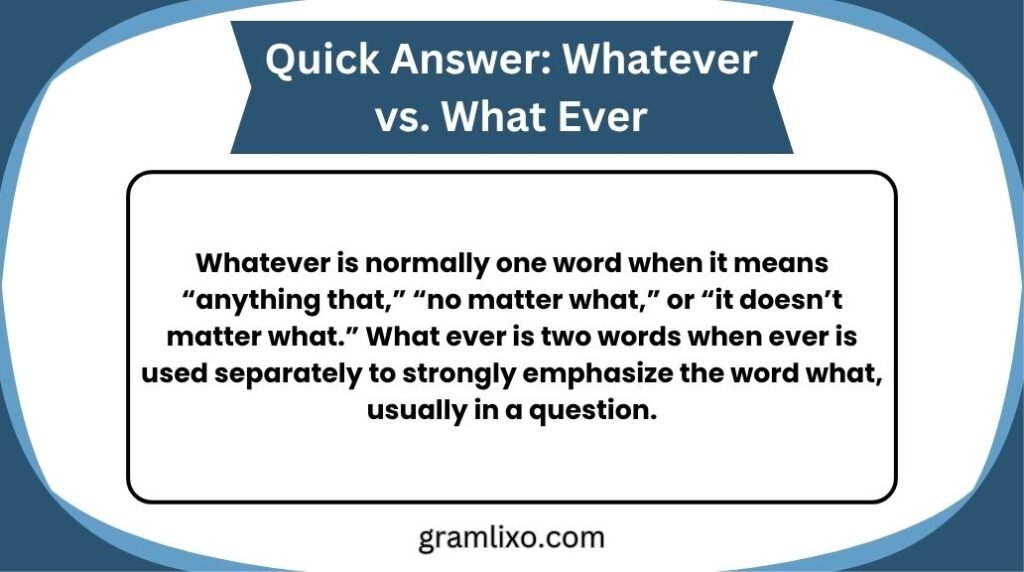
Whatever is normally one word when it means “anything that,” “no matter what,” or “it doesn’t matter what.” What ever is two words when ever is used separately to strongly emphasize the word what, usually in a question.
Quick rule: If you mean “anything/no matter what,” use whatever. If you mean “what, at any time or under any circumstances?” with special emphasis on ever, what ever may be appropriate.
Understanding the Basics: Whatever vs. What Ever
The main difference between whatever and what ever is grammatical function.
Whatever is an established compound word. It commonly works as a pronoun, determiner, or conjunction-like relative word.
For example:
Whatever you choose is fine with me.
Here, whatever means “anything that.”
By contrast, what ever consists of the question word what plus the separate adverb ever.
For example:
What ever could he mean?
Here, ever adds strong emphasis or surprise to what. The sentence has a dramatic or emphatic tone.
Comparison Table
| Form | Type | Meaning | Example | Correct/Incorrect |
|---|---|---|---|---|
| whatever | Pronoun/determiner | Anything that; no matter what | Whatever you decide is fine. | ✅ Correct |
| whatever | Determiner | Any; no matter which | Choose whatever book you want. | ✅ Correct |
| whatever | Conjunction-like relative word | Regardless of what | Whatever happens, stay calm. | ✅ Correct |
| what ever | What + adverb | Strongly emphasizes “what” | What ever could that mean? | ✅ Correct in special contexts |
| what ever | Intended as “anything/no matter what” | Usually incorrect | What ever you choose is fine. | ❌ Usually incorrect |
The key point is that what ever is not simply an alternative spelling of whatever.
What Does “Whatever” Mean?
Whatever is a standard English word with several related meanings.
1. Whatever Means “Anything That”
One of the most common uses is to refer to anything or everything within a particular category.
Take whatever you need.
This means:
Take anything that you need.
Another example:
Whatever you buy should fit your budget.
The sentence means that anything you buy should fit your budget.
2. Whatever Means “No Matter What”
Whatever can also introduce a situation in which the result does not change regardless of the circumstances.
Whatever happens, I’ll support you.
This means:
No matter what happens, I’ll support you.
Another example:
Whatever you decide, I’ll respect your choice.
Here, the speaker is saying that their respect will remain regardless of the decision.
3. Whatever Can Mean “Any One You Choose”
It can also refer to a free choice.
You can choose whatever color you like.
This means:
You can choose any color you like.
Notice that whatever stays together because it functions as one grammatical unit.
4. Whatever in Casual Conversation
In informal American English, whatever can mean that something is unimportant or that the speaker does not want to argue about it.
“You said you were right.”
“Whatever.”
This usage is highly dependent on tone. It can sound dismissive, annoyed, sarcastic, or indifferent.
For example:
“I think my answer is better.”
“Whatever.”
Although grammatically valid, this use may sound rude in professional communication.
What Does “What Ever” Mean?
What ever is not normally used when you simply mean whatever.
Instead, the two words can appear separately when ever has its own emphatic function.
Consider:
What ever could she be thinking?
The speaker is emphasizing what and expressing surprise, disbelief, or confusion.
The construction can sound literary, dramatic, old-fashioned, or deliberately emphatic depending on the sentence.
“What Ever” as an Emphatic Question
Compare these sentences:
What could he possibly mean?
and:
What ever could he possibly mean?
The second version adds stronger emphasis.
The word ever intensifies the question.
Another example:
What ever made you think that?
This can express strong surprise.
It is similar in meaning to:
What on earth made you think that?
The separate form is therefore about emphasis, not about creating an alternative spelling of the common word whatever.
Whatever vs. What Ever: The Core Grammar Rule
Here is the easiest way to understand the distinction:
Use “whatever” when it means:
- anything that
- any thing that
- no matter what
- any choice that
- regardless of what
Examples:
Whatever you need, just ask.
Whatever happens next, stay calm.
Choose whatever you prefer.
I’ll accept whatever decision you make.
Use “what ever” when “ever” separately emphasizes “what”
Examples:
What ever could she mean?
What ever possessed him to do that?
What ever happened to the old building?
However, even in questions, modern writers will often use whatever rather than what ever when the word is functioning as the established pronoun or determiner.
That means context matters.
How to Tell Which Form You Need
When you are unsure about whatever vs. what ever, try replacing the expression with “anything that” or “no matter what.”
If the sentence still makes sense, whatever is probably the correct choice.
Example 1
Whatever you choose is fine.
Replace it:
Anything that you choose is fine.
The meaning works.
✅ Use whatever.
Example 2
Whatever happens, don’t panic.
Replace it:
No matter what happens, don’t panic.
The meaning works.
✅ Use whatever.
Example 3
What ever could that noise be?
Replacing it with:
Anything that could that noise be?
does not work.
The sentence is an emphatic question.
✅ What ever can be used here.
Test Tip 🧠
Use this simple test:
Can you replace the expression with “no matter what” or “anything that”?
- Yes → whatever
- No, because “ever” is emphasizing “what” → what ever
This test will solve most everyday whatever vs. what ever questions.
Whatever as a Pronoun
A pronoun takes the place of a noun or noun phrase.
Whatever can function as a pronoun when it refers to an unspecified thing or choice.
Whatever is left can go in the refrigerator.
Here, whatever refers to an unspecified thing.
Another example:
Whatever you decide is your choice.
The word refers to an unspecified decision.
More Examples
Whatever you want is available.
Whatever happens next will be important.
I’ll eat whatever you cook.
She accepted whatever was offered.
In each case, whatever is functioning as a unified grammatical word.
Whatever as a Determiner
Whatever can come before a noun.
Choose whatever option you prefer.
Here, whatever modifies option.
Another example:
Take whatever book you want.
Here, whatever modifies book.
More examples include:
- whatever reason
- whatever method
- whatever answer
- whatever choice
- whatever amount
- whatever time
For example:
Use whatever method works best.
This means:
Use any method that works best.
Whatever in Conditional and Relative Structures
Whatever is especially common in sentences involving uncertainty or conditions.
Whatever you do, don’t touch that button.
Whatever the result, we’ll learn from it.
Whatever she says, listen carefully.
Whatever happens tomorrow, we’ll be ready.
These structures communicate that the outcome or choice does not change the main situation.
Sentence Breakdown
Consider:
Whatever happens, we’ll continue.
- Whatever = no matter what
- happens = the possible event
- we’ll continue = the main result
The word whatever connects the unknown possibility with the main statement.
What Ever in Emphatic Questions
The separate form what ever can be used when ever intensifies what.
For example:
What ever were you thinking?
The speaker is not simply requesting information. The sentence conveys strong surprise or disbelief.
Similarly:
What ever could have caused this?
The speaker wants to know the cause but is also emphasizing how surprising the situation is.
Tone Matters
What ever can sound:
- dramatic
- surprised
- incredulous
- literary
- old-fashioned
- highly emphatic
In ordinary modern writing, many people would choose a different construction instead:
What could possibly have caused this?
This often sounds more natural than the emphatic what ever.
Real-Life Case Study: Workplace Email 📧
Imagine that a manager sends this message:
Please choose whatever option works best for your team.
This is correct because whatever means any option that.
Now imagine a dramatic conversation about an unexpected mistake:
What ever were you thinking when you approved that?
Here, ever is being used for emphasis.
Why the Difference Matters
If you wrote:
Please choose what ever option works best for your team.
many readers would find the spacing unusual or incorrect because the intended meaning is clearly “any option that.”
The correct professional version is:
Please choose whatever option works best for your team.
This example shows why knowing the function of the word is more useful than simply memorizing spelling.
Grammar Rules and Standard Usage
The standard modern spelling for the common word meaning “anything that,” “no matter what,” or “any choice that” is whatever.
Major dictionaries, including Merriam-Webster, recognize whatever as an established word with meanings related to unrestricted choice, an unspecified thing, or indifference. Standard dictionary treatment therefore supports using whatever as the normal one-word form for these meanings.
The important distinction is that what ever may still appear when what and ever are functioning independently.
This is similar to other English constructions in which a word can be written together when it has developed into a standard compound or written separately when the individual words retain separate grammatical roles.
Why “Whatever” Is Usually One Word
Over time, whatever became established as a single lexical item.
It behaves as a unified word in sentences such as:
Whatever you need, I can help.
The word is not functioning as the ordinary question word what followed by a separate ever. Instead, it expresses an unrestricted or indefinite meaning.
That is why separating it unnecessarily can make a sentence look incorrect or awkward.
Common Mistakes With Whatever vs. What Ever
Why do people confuse these forms? There are several reasons.
1. Fast Typing ⌨️
When people type quickly, they may separate words that normally belong together or combine words that should remain separate.
For example:
I’ll do what ever you want.
A fast typist may not notice that the intended meaning is “anything that you want.”
The better version is:
I’ll do whatever you want.
2. Autocorrect
Autocorrect and predictive typing can sometimes make unusual spacing choices.
Because what and ever are both common words, a keyboard system may not always understand the intended grammatical structure.
Always read the final sentence rather than trusting automatic corrections.
3. Lack of Knowledge
Some writers know that both what and ever are words but do not know when they combine into whatever.
Learning the meaning behind the spelling is more reliable than memorizing isolated examples.
4. Confusion With Other “-ever” Words
English contains several words ending in -ever:
- whoever
- whenever
- wherever
- however
- whichever
- whatever
This pattern can make learners wonder whether what ever and whatever are interchangeable.
They are not always interchangeable.
Similar Grammar Confusions
The whatever vs. what ever issue belongs to a larger group of English word-choice problems.
| Confusion | Correct Form | Meaning |
|---|---|---|
| its / it’s | Depends on meaning | Possessive / it is |
| your / you’re | Depends on meaning | Possessive / you are |
| their / there / they’re | Depends on meaning | Possessive / place / they are |
| then / than | Depends on meaning | Time/result / comparison |
| everyday / every day | Depends on meaning | Ordinary / each day |
| awhile / a while | Depends on sentence | Adverb / noun phrase |
| maybe / may be | Depends on meaning | Perhaps / might be |
| whatever / what ever | Depends on function | Indefinite word / emphatic construction |
The general lesson is simple: English spelling often reflects grammatical function.
Whatever vs. What Ever in Everyday Conversation
In everyday American conversation, whatever is extremely common.
You might hear:
Whatever you want.
Whatever works.
Whatever happens, we’ll figure it out.
Choose whatever you like.
I don’t care whatever you decide.
The last sentence is understandable, but a more natural construction would often be:
I don’t care what you decide.
or:
Whatever you decide is fine with me.
The Casual “Whatever”
Whatever can also be used alone.
“Do you want pizza or burgers?”
“Whatever.”
This usually means:
Either choice is fine.
But depending on tone, it can also mean:
I don’t want to discuss this.
That difference is important in real communication.
Whatever vs. What Ever in Professional Writing
Professional writing requires extra attention to clarity and tone.
Use whatever normally when you mean:
- any
- anything that
- no matter what
- regardless of what
Examples:
Please select whatever option best meets the requirements.
We will proceed with whatever approach the committee approves.
Whatever the final decision, we will communicate it clearly.
Avoid unnecessarily writing what ever when you simply mean whatever.
For example:
❌ Please use what ever information is available.
✅ Please use whatever information is available.
The second sentence is cleaner and standard.
Whatever vs. What Ever in Creative Writing
Creative writing gives authors more freedom.
A writer may intentionally use what ever to create emphasis, surprise, or an unusual voice.
For example:
What ever could be hiding behind that door?
The spacing can contribute to a dramatic rhythm.
In fiction, dialogue, poetry, or historical-style writing, unusual constructions may be deliberate.
However, creative freedom does not mean the two forms have identical meanings.
Whatever vs. What Ever in Social Media and Texting
Social media is less formal, so people often write words in unconventional ways.
You might see:
whatever 😂
or:
what everrrr
The second version may be intentional for humor, sarcasm, or dramatic emphasis.
Texting frequently bends standard grammar because users prioritize speed, emotion, and personality.
Still, if you are writing:
- a blog post
- an academic paper
- a business email
- a resume
- a website
- an application
- professional content
standard usage is the safer choice.
Why This Difference Matters
Grammar is not just about passing a test. It helps readers understand your meaning quickly.
1. Clarity in Communication
Correct word choice reduces ambiguity.
Compare:
Choose whatever you want.
with:
Choose what ever you want.
The first immediately reads as the familiar expression meaning any choice you want.
2. Professionalism
Small grammar errors can affect how polished your writing appears.
A reader may overlook one typo, but repeated spacing and word-choice mistakes can reduce confidence in the writer.
3. Digital Communication
Online writing is often scanned quickly.
Clear wording helps readers understand your message without stopping to interpret what you meant.
4. Better Search-Friendly Content
For SEO and answer-focused writing, precise language matters. Search engines and AI systems need clear context to distinguish a common word such as whatever from a deliberately emphatic construction such as what ever.
“Clear writing makes the right meaning easier to see.”
That principle applies far beyond this one grammar question.
Special Exception: When “What Ever” Is Intentional
There is no need to treat what ever as an automatic spelling error.
It can be appropriate when ever is intentionally functioning as a separate word that adds emphasis to what.
For example:
What ever could you mean?
Here, the writer is emphasizing the question.
Another possible construction is:
What ever happened to that old tradition?
The exact interpretation can depend on context, tone, and style.
A Useful Caution
In many modern sentences, however, whatever may be the expected form.
For example:
Whatever happened to that old tradition?
This is a completely standard use of whatever.
Therefore, simply seeing what + ever in a question does not automatically mean the words should be separated.
Ask yourself what the sentence is actually doing.
A Deeper Look at “Whatever Happened?”
Consider:
Whatever happened to Sarah?
This sentence can look confusing because it is a question.
However, whatever is still one word.
It can express something like:
What happened to Sarah, no matter what the circumstances were?
In everyday use, it is a standard expression asking about the fate or current situation of someone or something.
So remember:
A question does not automatically require “what ever.”
That is one of the most important points in understanding whatever vs. what ever.
Whatever vs. What Ever: More Examples
Correct Uses of “Whatever”
Whatever you choose will be acceptable.
I’ll support you whatever happens.
Take whatever you need.
Whatever answer you give, explain your reasoning.
She can wear whatever she wants.
Use whatever method is easiest.
Whatever the weather, the event will continue.
You can call me whenever you need help with whatever problem you have.
Possible Emphatic Uses of “What Ever”
What ever could that mean?
What ever made him say that?
What ever were they thinking?
These examples have an intentionally emphatic quality.
Incorrect or Awkward Uses
If you mean anything that, avoid separating the word.
❌ I’ll accept what ever you decide.
✅ I’ll accept whatever you decide.
If you mean any option, use the compound word.
❌ Pick what ever option you like.
✅ Pick whatever option you like.
If you mean no matter what, use whatever.
❌ What ever happens, stay calm.
✅ Whatever happens, stay calm.
The corrected versions are more natural and standard for modern American English.
Quick Recap Checklist
| Question | If Yes → Use |
|---|---|
| Do you mean “anything that”? | whatever |
| Do you mean “no matter what”? | whatever |
| Do you mean “any choice that”? | whatever |
| Does the word modify a noun? | whatever |
| Is “ever” separately emphasizing “what”? | what ever may be appropriate |
| Are you simply trying to spell the common word? | whatever |
Practice Example 1
______ you decide, I’ll support you.
Answer: whatever
Whatever you decide, I’ll support you.
Why? It means no matter what you decide.
Practice Example 2
Choose ______ movie you want.
Answer: whatever
Choose whatever movie you want.
Why? It means any movie you want.
Practice Example 3
______ could have caused that?
If the writer wants a strongly emphatic, surprised tone, what ever may be possible:
What ever could have caused that?
But the more ordinary modern phrasing would often be:
Whatever could have caused that?
or:
What could possibly have caused that?
The intended tone should guide the choice.
FAQs About Whatever vs. What Ever
1. Is “whatever” one word or two?
Whatever is normally one word. Use it when you mean “anything that,” “no matter what,” or “any choice that.”
Example:
Choose whatever you like.
2. Is “what ever” grammatically correct?
What ever can be grammatically correct in specific emphatic constructions. In such cases, what and ever are functioning separately, with ever adding emphasis.
Example:
What ever could she mean?
However, it should not normally replace whatever.
3. What is the difference between whatever and what ever?
Whatever is an established word meaning “anything that,” “no matter what,” or a similar indefinite idea. What ever uses what and ever as separate words, generally for emphasis.
4. Should I write “whatever you want” or “what ever you want”?
Write:
Whatever you want.
Here, whatever means anything that.
The standard sentence is:
You can choose whatever you want.
5. Is “whatever” formal or informal?
Whatever is grammatically appropriate in both formal and informal writing. However, its standalone use—such as saying “Whatever.”—can sound dismissive or rude, so it should be used carefully in professional situations.
6. How can I remember whatever vs. what ever?
Remember this simple rule:
“Anything/no matter what” = whatever.
If ever is being used separately to add strong emphasis to what, what ever may be possible.
Final Conclusion
The difference between whatever vs. what ever is mainly a matter of grammar, meaning, and emphasis. In modern American English, whatever is the standard one-word form when you mean “anything that,” “no matter what,” “any choice that,” or “regardless of what.” For example, “Choose whatever you like” and “Whatever happens, stay calm” are both standard uses.
What ever, on the other hand, can appear when ever is deliberately used as a separate word to emphasize what, especially in a surprised, dramatic, or strongly questioning sentence. It is not simply an alternative spelling of whatever.
When you are unsure, use the substitution test: if “anything that” or “no matter what” fits the meaning, choose whatever. That simple habit will prevent most mistakes.
Remember: when “whatever” means “anything” or “no matter what,” keep it together—one word, one clear meaning. ✅

I’m Sarah Martinez, a writer and English language enthusiast at Gramlixo. I love explaining grammar concepts in a clear and practical way that anyone can understand.