Have you ever wondered about the difference between to vs too vs two while writing an email, text message, or school assignment? These three commonly confused English words sound exactly alike, but they have completely different meanings and grammatical functions.
Understanding to vs too vs two is essential for writing clear, accurate, and professional English. For example, you might write, “I want to go too,” or “I need two tickets.”
Although these words sound similar when spoken, each one has a specific purpose in a sentence. I often see this confusion among English learners, students, and even experienced writers. The good news is that learning the difference is easier than you might think.
In this guide, I will explain the meanings, grammar rules, common mistakes, and practical examples of to, too, and two. By the end, you will know exactly when to use each word and how to avoid these common spelling mistakes in everyday writing.
|Stationary vs Stationery: Meaning, Difference, Rules, and Examples
|To Far vs Too Far: Which One Is Correct?
|Knowledgable vs Knowledgeable: Which Spelling Is Correct?
Quick Answer: To vs Too vs Two
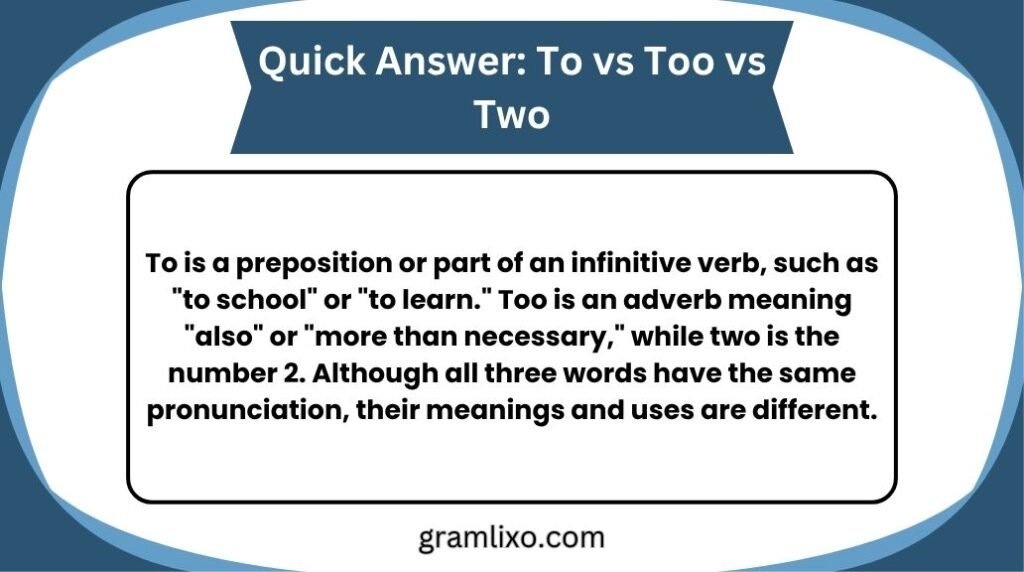
To is a preposition or part of an infinitive verb, such as “to school” or “to learn.” Too is an adverb meaning “also” or “more than necessary,” while two is the number 2. Although all three words have the same pronunciation, their meanings and uses are different.
Quick examples:
- I want to learn English.
- I want to learn English too.
- I have two English books.
Understanding the Basics of To vs Too vs Two
The easiest way to understand to vs too vs two is to remember the job each word performs in a sentence.
These words are homophones. Homophones are words that sound alike but have different meanings, spellings, or grammatical uses.
For example:
- To: I am going to the office.
- Too: She is coming too.
- Two: They have two children.
All three words sound the same when spoken. However, replacing one with another can change the meaning of a sentence or create a grammatical error.
Comparison Table: To vs Too vs Two
| Form | Type | Meaning | Example | Correct/Incorrect |
|---|---|---|---|---|
| To | Preposition | Direction, destination, or relationship | I am going to school. | Correct |
| To | Infinitive marker | Used before a base verb | I want to sleep. | Correct |
| Too | Adverb | Also or in addition | I want to come too. | Correct |
| Too | Adverb | Excessively or more than necessary | It is too cold. | Correct |
| Two | Number | The numerical value 2 | I bought two pens. | Correct |
| Too | Adverb | Used instead of the number 2 | I have too cats. | Incorrect |
| To | Preposition | Used instead of the number 2 | I have to cats. | Incorrect |
The Simplest Way to Remember
- To = Direction or action
- Too = Also or excessively
- Two = Number 2
If you remember these three basic meanings, you can avoid most mistakes involving these commonly confused words.
Correct Meanings and Uses of To, Too, and Two
Let’s explore each word separately to understand its grammatical role and how to use it correctly.
1. What Does To Mean?
The word to is one of the most frequently used words in English. It commonly functions as a preposition or an infinitive marker.
It can describe movement, direction, destination, purpose, relationships, and the connection between different things.
A. To as a Preposition
A preposition connects a noun or pronoun to another part of a sentence.
When used as a preposition, “to” often indicates movement toward a destination or person.
Examples:
- I am going to school.
- She walked to the supermarket.
- He sent a message to his friend.
- We traveled to California.
- Please give this letter to Sarah.
Sentence breakdown:
Example: “I am going to school.”
- I = Subject
- Am going = Verb phrase
- To = Preposition
- School = Object of the preposition
Here, “to” explains the destination of the movement.
B. To Before an Infinitive Verb
Another common use of “to” is before the base form of a verb.
This construction is called a to-infinitive.
Examples:
- I want to learn English.
- She needs to finish her homework.
- They decided to travel abroad.
- He hopes to become a doctor.
- We plan to start a business.
Sentence breakdown:
Example: “She wants to become a teacher.”
- She = Subject
- Wants = Main verb
- To become = Infinitive
- A teacher = Complement
The word “to” introduces the verb “become.”
C. To Express Purpose
We also use “to” when explaining why someone does something.
Examples:
- I went outside to get some fresh air.
- She studies hard to pass her examination.
- He called me to ask a question.
- They saved money to buy a house.
In these examples, “to” introduces the purpose of an action.
D. To Express Time
The word “to” can also describe the time remaining before a particular hour.
Examples:
- It is ten minutes to five.
- The meeting starts at a quarter to nine.
- We arrived at five minutes to midnight.
Here, “to” means the time leading up to the next hour.
E. To Show Relationships or Connections
“To” can describe relationships between people, things, or ideas.
Examples:
- She is married to a businessman.
- This solution is important to our team.
- The answer to the question is simple.
- He is kind to everyone.
Test Tip: If you can replace “to” with a directional expression such as “toward” or identify it as introducing a verb, you may need “to.” Always check the actual sentence meaning because “to” has several grammatical uses.
2. What Does Too Mean?
The word too is an adverb with two major meanings:
- Also or in addition.
- Excessively or more than necessary.
It helps add information or describe an excessive amount, degree, or intensity.
A. Too Means Also
When “too” means “also,” it indicates that something applies to another person or situation.
Examples:
- I want to come too.
- She likes chocolate too.
- He is joining us too.
- My brother plays football too.
- I enjoyed the movie too.
Sentence breakdown:
Example: “I want to come too.”
- I = Subject
- Want = Main verb
- To come = Infinitive phrase
- Too = Also
The final “too” tells us that the speaker also wants to come.
B. Too Means Excessively
The second meaning of “too” describes something beyond an acceptable or desired level.
Examples:
- This coffee is too hot.
- The bag is too heavy.
- She speaks too quickly.
- The movie was too long.
- The price is too high.
Sentence breakdown:
Example: “The coffee is too hot.”
- The coffee = Subject
- Is = Linking verb
- Too = Degree adverb
- Hot = Adjective
The word “too” emphasizes that the coffee is hotter than desired.
C. Too Before Adjectives
“Too” frequently appears before adjectives to express an excessive degree.
Examples:
- Too expensive
- Too difficult
- Too beautiful
- Too small
- Too complicated
Example sentences:
- This phone is too expensive for me.
- The question is too difficult for beginners.
- The room is too small for five people.
D. Too Before Adverbs
“Too” can also modify another adverb.
Examples:
- He drives too quickly.
- She speaks too softly.
- They arrived too late.
- You are walking too slowly.
In these sentences, “too” explains that the action is happening beyond the expected or acceptable degree.
E. Too Much and Too Many
These two expressions are especially important.
- Too much is generally used with uncountable nouns.
- Too many is used with plural countable nouns.
Examples of too much:
- There is too much sugar in my tea.
- You spend too much money.
- We have too much work today.
Examples of too many:
- There are too many people here.
- She bought too many dresses.
- I made too many mistakes.
Test Tip: Try replacing “too” with “also” or “excessively.” If the sentence keeps its intended meaning, “too” is probably correct.
3. What Does Two Mean?
The word two is a number. It represents the numerical value 2.
Unlike “to” and “too,” which perform grammatical functions, “two” identifies a quantity or position in a numerical sequence.
A. Two for Counting
We use “two” when referring to exactly two people, objects, animals, or things.
Examples:
- I have two brothers.
- She bought two dresses.
- We need two chairs.
- There are two dogs outside.
- He ordered two pizzas.
Sentence breakdown:
Example: “I bought two books.”
- I = Subject
- Bought = Verb
- Two = Number or determiner
- Books = Plural noun
The word “two” tells us exactly how many books were purchased.
B. Two for Age
“Two” can describe someone’s age.
Examples:
- My daughter is two years old.
- The baby is almost two.
- He started reading when he was two.
C. Two for Time
We also use “two” to identify an hour or a numerical time.
Examples:
- The meeting begins at two.
- I will call you at two o’clock.
- The train leaves at two fifteen.
D. Two for Measurements
“Two” can describe measurements, quantities, and distances.
Examples:
- The table is two feet long.
- We walked two miles.
- She needs two liters of water.
- The package weighs two pounds.
E. Two in Ordinal and Number Expressions
“Two” is a cardinal number. Its ordinal form is “second.”
Examples:
- I have two assignments.
- She finished in second place.
- This is my second attempt.
Remember that “two” and “second” are related, but they are not interchangeable.
Test Tip: If you can replace the word with the numerical digit 2 without changing the intended meaning, use “two.”
To vs Too vs Two: Side-by-Side Examples
Sometimes the easiest way to understand these words is to compare them in similar sentences.
| To | Too | Two |
|---|---|---|
| I want to travel. | I want to travel too. | I have two tickets. |
| She went to school. | She is coming too. | She has two schools nearby. |
| He needs to study. | He studies too much. | He has two exams. |
| Give it to me. | Give me one too. | Give me two. |
| I walked to the park. | It was too far. | We saw two birds. |
Notice how changing one word changes the sentence’s meaning.
Can To, Too, and Two Appear in the Same Sentence?
Yes! All three words can appear in one sentence.
Example:
“I want to buy two books too.”
Let’s break it down:
- To = Introduces the verb “buy.”
- Two = Describes the number of books.
- Too = Means also.
Another example:
“She needs to bring two notebooks too.”
This sentence is grammatically correct because every word performs a different function.
Real-Life Case Study: To vs Too vs Two in an Email
Imagine that an employee named Daniel is writing an email to his manager about an upcoming workplace meeting.
He wants to confirm that he will attend and mention that he needs two copies of a report.
Incorrect Email
EmailMeeting Confirmation
Meeting Confirmation
Hi Sarah,
I am planning too come to the meeting tomorrow. I will also bring to copies of the report. My colleague wants to attend to.
Best regards,
Daniel
There are three mistakes:
- “Too come” should be “to come.”
- “To copies” should be “two copies.”
- “Attend to” should be “attend too.”
Correct Email
EmailMeeting Confirmation
Meeting Confirmation
Hi Sarah,
I am planning to come to the meeting tomorrow. I will also bring two copies of the report. My colleague wants to attend too.
Best regards,
Daniel
Why Is the Second Email Correct?
- To come: “To” introduces the infinitive verb “come.”
- Two copies: “Two” identifies the exact number of reports.
- Attend too: “Too” means that the colleague also wants to attend.
This example shows why choosing the correct word matters in professional communication.
Grammar Rules Explanation: Why Are To, Too, and Two Different?
Although these words sound alike, English grammar assigns each one a different role.
Understanding their grammatical classifications helps prevent confusion.
Rule 1: Use To for Prepositions and Infinitives
Use “to” when indicating direction, destination, relationships, or an infinitive verb.
Examples:
- She went to the library.
- I need to work.
- He gave the gift to his mother.
- We decided to leave early.
Rule 2: Use Too for Addition or Excess
Use “too” when you mean “also” or “more than necessary.”
Examples:
- I want some too.
- The room is too dark.
- He talks too much.
- She arrived too early.
Rule 3: Use Two for the Number 2
Use “two” when referring to a quantity of exactly two.
Examples:
- I have two phones.
- She bought two tickets.
- They have two children.
- We need two volunteers.
What Do Standard Grammar References Say?
Major English dictionaries, including Merriam-Webster and Cambridge Dictionary, distinguish these words by their meanings and grammatical functions.
Their dictionary definitions establish the following distinctions:
- To functions as a preposition and an infinitive marker.
- Too functions as an adverb meaning also or excessively.
- Two is the word representing the number 2.
These distinctions are based on standard English usage rather than personal preference.
You can consult their dictionaries for additional definitions and examples:
- Merriam-Webster: To
- Merriam-Webster: Too
- Merriam-Webster: Two
- Cambridge Dictionary
Common Mistakes When Using To, Too, and Two
Even experienced English speakers sometimes confuse these words.
The main reason is that all three have identical pronunciations in standard American English.
Let’s examine the mistakes people commonly make.
Common Incorrect Sentences and Their Corrections
| Incorrect Sentence | Correct Sentence | Explanation |
|---|---|---|
| I want too go home. | I want to go home. | “To” introduces the verb. |
| She has to cats. | She has two cats. | “Two” indicates quantity. |
| I am coming to. | I am coming too. | “Too” means also. |
| It is to expensive. | It is too expensive. | “Too” means excessively. |
| We need too chairs. | We need two chairs. | “Two” identifies the number. |
| He wants two sleep. | He wants to sleep. | “To” introduces the infinitive. |
| I like pizza to. | I like pizza too. | “Too” means also. |
Why Do These Mistakes Happen?
There are several reasons people use the wrong word.
1. Fast Typing
People often type quickly without checking their sentences.
Because to, too, and two sound identical, writers may accidentally select the wrong spelling.
For example:
Incorrect: “I want two see you.”
Correct: “I want to see you.”
2. Autocorrect
Autocorrect sometimes changes a correctly intended word into an incorrect one.
For example, you might type “I want to go” but accidentally send “I want two go.”
Technology does not always understand the meaning of the entire sentence.
3. Lack of Grammar Knowledge
Some learners memorize pronunciation without learning grammatical functions.
As a result, they understand how the words sound but cannot always identify when to use each spelling.
4. Speech-to-Text Errors
Voice typing can also create confusion because all three words sound alike.
For example:
- Intended: “I need two tickets.”
- Transcribed: “I need to tickets.”
Always review automatically generated text before sending it.
Similar Grammar Confusions
To, too, and two are not the only commonly confused English words.
Here are some other examples worth learning.
| Confusing Words | Difference | Example |
|---|---|---|
| Your vs. You’re | Possession vs. you are | Your book is here. You’re welcome. |
| Its vs. It’s | Possession vs. it is | The dog wagged its tail. It’s raining. |
| There vs. Their vs. They’re | Place vs. possession vs. they are | They’re visiting their house over there. |
| Then vs. Than | Time or sequence vs. comparison | We ate, then left. She is taller than me. |
| Here vs. Hear | Location vs. listening | Come here and hear me. |
| Weather vs. Whether | Atmospheric conditions vs. alternatives | I don’t know whether the weather will improve. |
| Affect vs. Effect | Usually verb vs. usually noun | Sleep affects health. The effect was noticeable. |
Learning these differences will improve your spelling, grammar, and overall writing accuracy.
Usage of To vs Too vs Two in Different Contexts
These three words appear in almost every type of English communication.
However, their correct use remains the same regardless of the writing situation.
1. Everyday Conversation
In everyday conversations, people use these words naturally.
Examples:
- I am going to the store.
- Can I come too?
- Please buy two bottles of water.
- It is too cold outside.
- I need to call my mother.
Even when speaking casually, understanding the difference helps you communicate accurately.
2. Professional Writing
Professional writing requires correct spelling and grammar.
Using the wrong word in an email, report, or business proposal can make your message unclear.
Examples:
- I would like to speak to the manager.
- Please send two copies of the document.
- The current price is too high.
- I would like to attend the meeting too.
Before sending professional documents, proofread your writing carefully.
3. Creative Writing
Writers use these words in stories, poems, dialogue, and descriptions.
Examples:
- She ran to the old house.
- The night was too quiet.
- Two strangers entered the room.
- I wanted to tell him the truth too.
Correct spelling helps readers focus on the story rather than grammar mistakes.
4. Social Media and Texting
Social media users frequently type quickly, which increases the possibility of spelling errors.
Examples:
- I want to go too!
- We need two more people.
- I have to leave now.
- That movie was too funny!
Informal communication may allow abbreviations and slang, but the meanings of these three words do not change.
Why Does the Difference Between To, Too, and Two Matter?
Understanding to vs too vs two may seem like a small grammar lesson, but it has practical benefits.
Let’s look at why using these words correctly matters.
1. Clarity in Communication
The correct word helps readers understand your intended message.
Consider these examples:
- I want to eat.
- I want too eat.
- I want two eat.
The first sentence is correct. The other two do not communicate the intended meaning.
Using the right word prevents confusion.
2. Professionalism
Correct grammar creates a more polished impression in professional communication.
Whether you are writing a resume, business email, report, or application, spelling accuracy helps present your ideas clearly.
3. Writing Accuracy
Correct word selection is an important part of effective writing.
When you understand the difference between these homophones, you can produce more accurate sentences and avoid unnecessary editing mistakes.
4. Digital Communication
Emails, instant messages, online articles, and social media posts are part of everyday communication.
A small spelling mistake can change the meaning of your message.
Developing good proofreading habits helps reduce these errors.
A Simple Quote to Remember
“Clear writing begins with choosing the right words.”
This short reminder highlights an important writing principle: accurate word choice makes communication easier to understand.
Special Exceptions and Interesting Facts About To, Too, and Two
Although these words have different grammatical functions, there are a few interesting details worth knowing.
1. The Word To Can Be Part of Different Expressions
“To” appears in many common English expressions.
Examples include:
- According to
- Due to
- In addition to
- Look forward to
- Used to
- Next to
One important point is that “to” does not always introduce an infinitive.
For example:
“I look forward to meeting you.”
Here, “to” is a preposition, so it is followed by the gerund “meeting,” not the base verb “meet.”
2. Too Can Appear at the End of a Sentence
When “too” means “also,” it frequently appears at the end of a sentence.
Examples:
- I am hungry too.
- She wants to participate too.
- We enjoyed the event too.
However, it can also appear in other positions.
Example:
“Too many people attended the event.”
3. Two Has an Ordinal Form
The cardinal number “two” has the ordinal form “second.”
Examples:
- Two students participated.
- The second student arrived late.
“Two” identifies quantity, while “second” identifies position or order.
4. Two Can Be Written as a Numeral
In everyday writing, you can represent the number two using the digit 2.
For example:
- I bought two books.
- I bought 2 books.
Both can be correct, depending on the writing style and context.
Formal publications may follow specific number-style rules.
5. All Three Words Are Homophones
To, too, and two belong to a group of words known as homophones.
Other examples include:
- Sea and see
- Right and write
- One and won
- Pair and pear
- Flower and flour
Homophones are common in English because pronunciation does not always reveal spelling or meaning.
Quick Recap Checklist: How to Choose the Correct Word
If you still find these words confusing, use the following checklist before completing your sentence.
| Question | If Yes → Use |
|---|---|
| Are you describing direction or destination? | To |
| Are you introducing a base verb? | To |
| Do you mean also or in addition? | Too |
| Do you mean excessively or more than necessary? | Too |
| Are you referring to the number 2? | Two |
| Are you counting two people or objects? | Two |
Easy Memory Trick
Remember these simple associations:
- To: Think of going to a place or doing something.
- Too: Think of an extra “o” for also or excess.
- Two: Think of the number 2.
These associations make the correct spelling easier to remember.
Practice Examples
Test your understanding with these three sentences.
Example 1:
I want ___ learn English.
Correct answer: To
Explanation: “To” introduces the infinitive verb “learn.”
Example 2:
She wants to come ___.
Correct answer: Too
Explanation: “Too” means also.
Example 3:
I bought ___ new shoes.
Correct answer: Two
Explanation: “Two” identifies the number of shoes.
Test Your Knowledge: To vs Too vs Two Quiz
Now that you understand the grammar rules, try this short quiz to check your knowledge.
Grammar practice
0 of 6 answered
1. I need ___ finish my homework.ToTooTwo
2. This box is ___ heavy to lift.ToTooTwo
3. She has ___ brothers.ToTooTwo
4. Can I come with you ___?ToTooTwo
5. We are traveling ___ New York tomorrow.ToTooTwo
6. There are ___ mistakes in this paragraph.ToTooTwoCheck My Answers
Frequently Asked Questions (FAQs)
Here are answers to some of the most common questions about to vs too vs two.
1. What Is the Main Difference Between To, Too, and Two?
The main difference is their meaning and grammatical function. “To” indicates direction or introduces an infinitive verb. “Too” means also or excessively. “Two” represents the number 2.
2. Is It To or Too?
It depends on the sentence. Use “to” for direction, destination, or an infinitive verb. Use “too” when you mean also or excessively.
Examples:
- I want to sleep.
- I want to sleep too.
- It is too late.
3. Is It Two or Too?
Use “two” when referring to the number 2. Use “too” when expressing addition or excess.
Examples:
- I have two sisters.
- I have two sisters too.
4. Can To, Too, and Two Be Used in the Same Sentence?
Yes. All three words can appear in one grammatically correct sentence.
Example: “I want to buy two tickets too.”
Here, “to” introduces the verb “buy,” “two” indicates quantity, and “too” means also.
5. Why Are To, Too, and Two Pronounced the Same?
They are homophones. Homophones share the same pronunciation but have different meanings and spellings. This is why context is important when deciding which word to use.
6. What Is an Easy Way to Remember To, Too, and Two?
Remember these three simple rules:
- To = Direction or action.
- Too = Also or excessively.
- Two = Number 2.
You can also check whether the word can be replaced with “also,” “excessively,” or the digit 2.
Conclusion: Mastering To vs Too vs Two
Understanding the difference between to vs too vs two is an important part of improving your English grammar. Although these three words sound exactly alike, they have different meanings and grammatical functions. Use to when expressing direction, destination, or an infinitive verb. Use too when you mean also or excessively. Use two when referring to the number 2. The easiest way to remember these rules is to connect each word with its purpose. Practice using them in everyday conversations, emails, assignments, and social media posts. Always take a moment to proofread your sentences before sharing them. With regular practice, choosing the correct word will become natural and effortless. Remember, good writing is not about using complicated words; it is about using simple words correctly. Master these three little words, and make every sentence count!

I’m Michael Williams, an English writer and grammar enthusiast at Gramlixo. I’m passionate about making grammar easier to learn and helping readers write with greater confidence.
[…] |To vs Too vs Two: What’s the Difference? (Meaning, Rules, and Examples) […]
[…] |To vs Too vs Two: What’s the Difference? (Meaning, Rules, and Examples) […]
[…] |To vs Too vs Two: What’s the Difference? (Meaning, Rules, and Examples) […]