Have you ever written “per usual” and then wondered whether “as per usual” is the correct version? The question of per usual vs as per usual is surprisingly common because both expressions appear in everyday conversations, emails, social media posts, and informal writing.
They are closely related and can communicate the idea of something happening in the normal or expected way, but they differ slightly in tone and usage. “As per usual” is the longer, traditional expression, while “per usual” is a shorter and more informal form commonly used in modern English. If you are unsure which one to choose, there is also an even simpler option: “as usual.”
In this guide, I’ll break down per usual vs as per usual, explain what each phrase means, show you when to use each one, and provide clear examples so you can choose the right expression confidently.
Whether you are writing a professional email, chatting with friends, or creating content online, understanding this small difference can make your English more natural and precise.
|Braggart vs Bragger: Meaning, Difference & Correct Usage
|Elude vs Allude: Meaning, Differences, Examples, and Correct Usage
Quick Answer: Per Usual vs As Per Usual
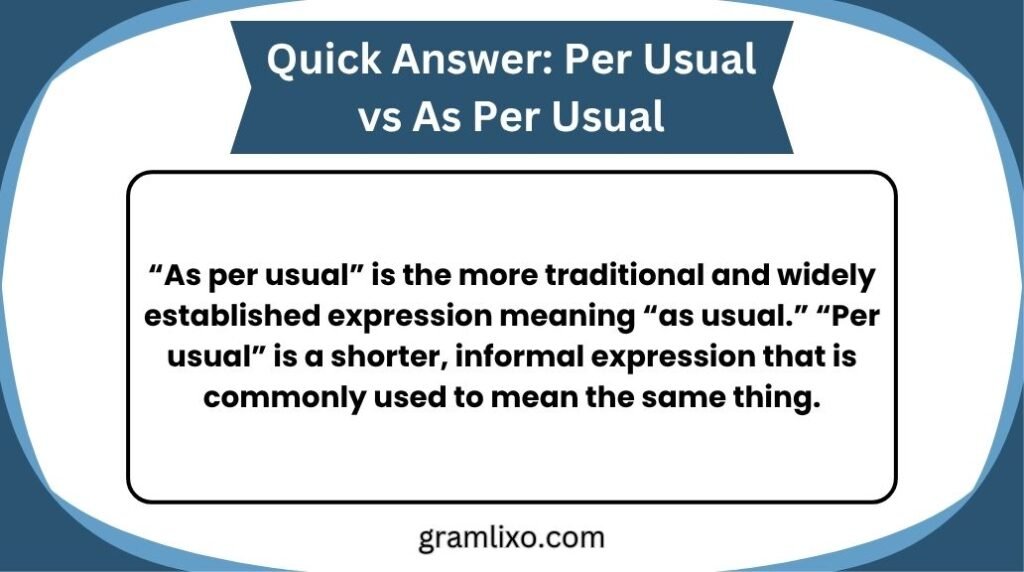
“As per usual” is the more traditional and widely established expression meaning “as usual.” “Per usual” is a shorter, informal expression that is commonly used to mean the same thing.
For formal or professional writing, “as usual” is usually the clearest choice. In casual conversation, texting, and informal writing, “per usual” can sound natural.
Understanding the Basics of Per Usual vs As Per Usual
The easiest way to understand per usual vs as per usual is to start with the meaning they share.
Both expressions can communicate the idea of something happening in the normal or expected way.
- As per usual = as is usual; as normally happens
- Per usual = as usual; in the usual way
- As usual = the simplest and most universally accepted alternative
For example:
As per usual, Jake arrived late.
This means Jake arrived late, just as he normally does.
You could also say:
Per usual, Jake arrived late.
The meaning is essentially the same, but the second sentence has a more casual feel.
Comparison Table
| Form | Type | Meaning | Example | Correct/Incorrect |
|---|---|---|---|---|
| as per usual | Idiomatic phrase | As normally happens | As per usual, she was early. | Correct |
| per usual | Informal idiomatic phrase | As usual | Per usual, he forgot his keys. | Correct in informal use |
| as usual | Standard idiom | In the normal way | As usual, they ordered pizza. | Correct |
| as per | Prepositional phrase | According to | As per the schedule, the meeting starts at 9. | Correct |
| per usual in very formal writing | Informal usage | As usual | Per usual, the report was delayed. | Better replaced with “as usual” |
The important point is that “per usual” is not simply a spelling error or automatically incorrect grammar. It is a shortened expression that has gained established informal use.
What Does “As Per Usual” Mean?
“As per usual” means “as is usual” or “as normally happens.”
It is generally used when something occurs in the same way it normally does.
Example 1
As per usual, Maria brought enough snacks for everyone.
Breakdown:
- As introduces the comparison or manner.
- per usual refers to what normally happens.
- The complete expression means “as normally happens.”
Maria regularly brings snacks, and she did so again.
Example 2
As per usual, the traffic was terrible this morning.
The speaker is saying that the traffic was bad, just as it commonly is.
Example 3
As per usual, my brother forgot where he parked.
This suggests that forgetting where he parked is something the brother often does.
Is “As Per Usual” Formal?
It is grammatical and established, but it is not necessarily the best choice for highly formal writing.
In professional documents, academic writing, or official communication, “as usual” is often more concise and natural.
Compare:
As per usual, the meeting started at 9:00 a.m.
with:
As usual, the meeting started at 9:00 a.m.
The second version is cleaner.
What Does “Per Usual” Mean?
“Per usual” is an informal expression meaning “as usual.”
It is especially common in casual American English.
For example:
Per usual, Tom was the last person to arrive.
The sentence means:
Tom was the last person to arrive, as usual.
Another example:
Per usual, the kids were making noise before breakfast.
The writer is pointing out that the behavior is normal or expected.
Why Does “Per Usual” Sound Strange to Some People?
The phrase can sound unusual because “per” traditionally means “for each,” “by,” or “according to,” depending on context.
For example:
- $5 per person
- 60 miles per hour
- per the instructions
So some readers expect “per” to introduce a specific relationship rather than function as part of an idiom.
However, “per usual” has developed as an informal expression meaning “as usual.”
This is why you may see people disagree about whether it is correct. The issue is often about register and traditional usage, not simply whether the phrase can occur in English.
Per Usual vs As Per Usual: The Main Difference
The practical difference is mostly style and register.
“As Per Usual”
This is the longer and more traditional expression.
Example:
As per usual, Sarah completed the assignment early.
It sounds slightly more deliberate.
“Per Usual”
This is the shorter, more conversational version.
Example:
Per usual, Sarah completed the assignment early.
It can sound relaxed, humorous, or conversational.
“As Usual”
This is the safest and simplest option.
Example:
As usual, Sarah completed the assignment early.
If you are unsure which expression to choose, “as usual” is the safest answer.
When Should You Use “Per Usual”?
Use “per usual” when the context is informal and conversational.
Good situations include:
- Text messages
- Social media
- Casual emails
- Personal blogs
- Friendly conversations
- Informal storytelling
- Humorous comments
Examples
Per usual, I forgot my coffee at home. ☕
Per usual, the dog stole my seat.
Per usual, we ended up ordering too much food.
Per usual, my phone died at the worst possible moment.
These sentences sound natural in casual communication.
When Should You Use “As Per Usual”?
Use “as per usual” when you want the traditional expression or want to emphasize that something happened in its normal way.
Examples:
As per usual, the store was crowded on Saturday.
As per usual, she handled the situation calmly.
As per usual, the children were excited about the trip.
That said, “as usual” will often sound more polished.
When Should You Use “As Usual”?
If your goal is clarity, simplicity, and professional readability, “as usual” is usually the best choice.
For example:
As usual, the manager arrived early.
This is shorter than:
As per usual, the manager arrived early.
And more universally accepted than:
Per usual, the manager arrived early.
Why “As Usual” Works So Well
The phrase is:
- Short
- Clear
- Familiar
- Grammatically straightforward
- Suitable for formal and informal contexts
It also avoids any debate about whether “per usual” sounds too casual.
A Useful Test Tip 📝
Here is an easy test:
Replace the phrase with “as usual.”
If the sentence still makes sense, “per usual” or “as per usual” may work in an informal context.
For example:
Per usual, Mike was late.
Replace it:
As usual, Mike was late.
The meaning stays the same.
Another example:
As per usual, the restaurant was busy.
Replace it:
As usual, the restaurant was busy.
Again, the meaning remains clear.
Test Tip
Ask yourself:
“Am I simply saying that something happened normally or repeatedly?”
If yes, “as usual” is almost always a safe choice.
Per Usual vs As Per Usual in a Real-Life Workplace
Imagine that a team has a weekly meeting every Monday.
The meeting usually starts at 9:00 a.m., and everyone knows this.
An employee sends a casual message:
Per usual, our Monday meeting started right at 9.
The sentence is understandable and conversational.
Now imagine a formal report:
As usual, the Monday meeting began at 9:00 a.m.
This sounds more professional and concise.
You could also write:
As per usual, the Monday meeting began at 9:00 a.m.
This is grammatical, but the simpler “as usual” version is generally preferable.
What This Case Study Shows
The choice is not always about right versus wrong.
It is often about:
Correctness + context + tone.
A casual message can tolerate informal expressions. A formal report usually benefits from the simplest standard wording.
Grammar Rules: Why Are These Expressions Different?
To understand per usual vs as per usual, it helps to separate the phrase “per usual” from another construction: “as per.”
“As Per” Has a Different Use
“As per” generally means “according to” or “in accordance with.”
For example:
As per the contract, payment is due within 30 days.
Here, “as per” means “according to.”
Another example:
As per your request, I attached the document.
This means:
According to your request, I attached the document.
This is different from:
As per usual, I attached the document.
In “as per usual,” the complete expression means “as usual.”
Do Not Automatically Treat “As Per Usual” as “According to Usual”
That interpretation does not capture the idiomatic meaning.
Instead, think of:
as per usual = as usual
That simple substitution will help you understand most examples.
Is “Per Usual” Grammatically Correct?
In modern informal English, “per usual” is an established usage and is widely understood.
However, it is more informal than “as usual.”
This distinction matters because grammar is not always a simple list of words that are either “correct” or “incorrect.” English changes over time, and expressions can become accepted in particular registers.
Standard dictionaries such as Merriam-Webster document many contemporary English usages and idiomatic expressions. When deciding what to use in polished writing, however, the safest approach is to consider both grammatical acceptability and audience expectations.
For maximum clarity:
Use “as usual” in formal or neutral writing.
For casual writing:
“Per usual” can be appropriate.
Common Mistakes With Per Usual vs As Per Usual
People often make mistakes with these expressions because English contains many similar-looking phrases.
Mistake 1: Treating “Per Usual” as Always Wrong
Some writers assume:
❌ Per usual is never correct.
That is too absolute.
The expression is used in contemporary informal English and is generally understood to mean “as usual.”
The better advice is:
“Per usual” is informal, while “as usual” is the safer standard choice.
Mistake 2: Using “As Per” When You Mean “As Usual”
Consider:
As per, John forgot his wallet.
This is incorrect because “as per” normally needs something to refer to, such as a request, rule, schedule, or document.
Better:
As usual, John forgot his wallet.
Or:
As per the schedule, John arrived at 8:00.
Mistake 3: Confusing “As Per Usual” With “As Per”
These are different constructions.
As per usual:
As per usual, the bus was late.
Meaning:
The bus was late as usual.
As per the schedule:
As per the schedule, the bus leaves at 8:00.
Meaning:
According to the schedule, the bus leaves at 8:00.
Similar Grammar Confusions
The per usual vs as per usual question is part of a much larger pattern in English. Small differences can change meaning, tone, or grammatical function.
| Confusion | Correct Forms | Main Difference |
|---|---|---|
| it’s vs its | It’s / its | “It’s” = it is; “its” = possessive |
| your vs you’re | Your / you’re | “Your” = possessive; “you’re” = you are |
| their vs there vs they’re | Their / there / they’re | Possession, place, and “they are” |
| then vs than | Then / than | Time/result vs comparison |
| affect vs effect | Affect / effect | Usually verb vs noun |
| to vs too vs two | To / too / two | Preposition/infinitive, also, number |
| advice vs advise | Advice / advise | Noun vs verb |
| everyday vs every day | Everyday / every day | Adjective vs frequency phrase |
| as usual vs as per usual | As usual / as per usual | Standard concise form vs longer expression |
Why Do These Mistakes Happen?
Several factors contribute.
Fast Typing ⌨️
When people type quickly, they often choose the first familiar phrase that comes to mind.
Autocorrect 📱
Autocorrect may change words or phrases without the writer noticing.
Lack of Knowledge
Some expressions are rarely taught directly. People learn them by hearing and reading them.
Regional and Social Usage
English varies across communities. A phrase that sounds perfectly natural in casual American conversation may seem unusual in formal writing.
Per Usual vs As Per Usual in Different Contexts
Everyday Conversation
In everyday speech, “per usual” can sound relaxed and natural.
Per usual, she was running five minutes late.
You could also say:
As usual, she was running five minutes late.
Both communicate the same basic idea.
Professional Writing
In professional writing, choose:
As usual
Example:
As usual, the team completed the review ahead of schedule.
This is clean and direct.
If you use “as per usual,” it is still understandable, but it can sound slightly wordier.
Creative Writing
Creative writing gives you more flexibility.
A character might naturally say:
Per usual, you showed up without a plan.
The informal phrase can help establish personality and voice.
A narrator might prefer:
As usual, the street was quiet after midnight.
The best choice depends on the desired tone.
Social Media and Texting
“Per usual” works especially well in informal digital communication.
Examples:
Per usual, Monday is already exhausting. 😩
Per usual, my cat thinks the entire house belongs to him. 😂
Per usual, I forgot why I walked into the room.
Social media often favors shorter, conversational language, so the abbreviated expression fits naturally.
Why This Difference Matters
Choosing between per usual vs as per usual may seem like a tiny detail, but small wording choices can affect how your writing is received.
1. Clarity
The phrase “as usual” is immediately understood by virtually every English reader.
2. Professionalism
Formal writing usually benefits from simple, established wording.
3. Digital Communication
Texting and social media are more flexible. Informal expressions such as “per usual” can make writing feel natural and conversational.
4. Audience Expectations
A casual message to a friend has different expectations from a business report.
Short quote: “Choose the wording that fits your audience.”
The goal is not to make every sentence sound formal. The goal is to make every sentence appropriate, clear, and intentional.
Special Exception: “As Per” in Formal or Business Language
There is an important edge case involving “as per.”
Unlike “as per usual,” the phrase “as per” is commonly used before a noun phrase.
Examples:
As per your email, we updated the order.
As per company policy, employees must submit the form.
As per the agreement, payment is required by Friday.
Here, “as per” means “according to” or “in accordance with.”
Do not confuse this construction with the idiom:
As per usual, the office was quiet.
The word “usual” changes the construction into an idiomatic expression meaning “as usual.”
Is “As Per Usual” Better Than “Per Usual”?
Not necessarily.
If you are choosing between only these two:
- As per usual = more traditional and established
- Per usual = shorter and more informal
But if you can use a third option:
- As usual = usually the clearest and most versatile
For most general writing, I would rank them this way:
| Situation | Best Choice |
|---|---|
| Formal writing | As usual |
| Academic writing | As usual |
| Business writing | As usual |
| Neutral writing | As usual |
| Casual conversation | As usual / per usual |
| Texting | Per usual / as usual |
| Social media | Per usual / as usual |
| Deliberately traditional phrasing | As per usual |
Quick Recap Checklist
Use this checklist whenever you are unsure.
| Question | If Yes → Use |
|---|---|
| Do you mean “as normally happens”? | As usual |
| Are you writing something formal? | As usual |
| Are you writing casually? | Per usual can work |
| Do you want the longer traditional expression? | As per usual |
| Do you mean “according to”? | As per + noun |
| Are you unsure about the phrase? | As usual |
Practice Examples
1. ___, James forgot his umbrella.
Best answer:
As usual, James forgot his umbrella.
2. ___, my computer decided to update at the worst time.
Casual version:
Per usual, my computer decided to update at the worst time.
3. ___ the company policy, all visitors must sign in.
Correct:
As per the company policy, all visitors must sign in.
Notice that the third sentence does not use “as per usual.” It uses “as per” in the sense of “according to.”
Frequently Asked Questions
Is “per usual” grammatically correct?
Yes, “per usual” is used in contemporary informal English to mean “as usual.” However, it is less formal than “as usual,” so the standard phrase is generally preferable in professional or academic writing.
Is “as per usual” correct?
Yes. “As per usual” is a well-established expression meaning “as usual” or “as normally happens.” It is grammatically acceptable, although “as usual” is often shorter and more natural.
Which is better: “per usual” or “as per usual”?
It depends on the context. “Per usual” is more informal, while “as per usual” is the longer traditional form. For formal and neutral writing, “as usual” is usually the best option.
Can I use “per usual” in an email?
Yes, if the email is casual. For example:
Per usual, I’ll send the files this afternoon.
For a formal business email, “as usual” would generally be a better choice.
Does “as per usual” mean “according to usual”?
No. “As per usual” is an idiomatic expression meaning “as usual.” By contrast, “as per the schedule” means “according to the schedule.”
Is “as usual” always correct?
“As usual” is the safest and most versatile option when you mean that something happened in the normal or expected way. It works in casual, professional, and academic contexts.
Per Usual vs As Per Usual: Final Verdict
The confusion between per usual vs as per usual is understandable because both expressions can mean essentially the same thing. The main distinction is one of style, tone, and usage preference.
“As per usual” is an established expression meaning “as usual.” “Per usual” is a shorter, informal expression that is also used to convey the same idea, particularly in casual modern English.
If you are writing a text, social media post, or relaxed message, “per usual” can fit naturally. If you want a more traditional version, “as per usual” works.
But when you need the clearest, simplest, and most broadly appropriate wording, choose “as usual.”
Also remember that “as per” by itself has a different function. It usually means “according to,” as in “as per the instructions.”
So, when in doubt, keep it simple:
As usual = the safest choice.
The best grammar is not always the longest grammar—it is the wording that makes your meaning clear, natural, and appropriate for your reader. ✨

Hi, I’m Lisa Jones, a grammar enthusiast and writer at Gramlixo. I enjoy making English grammar simple, clear, and easy to apply in everyday writing.


[…] |Per Usual vs As Per Usual: Which Is Correct? […]
[…] |Per Usual vs As Per Usual: Which Is Correct? […]