Have you ever written a sentence and stopped because you were unsure whether to use propose vs purpose? You are not alone. These two words look and sound somewhat similar, and both can relate to ideas, plans, intentions, or goals. However, they do very different jobs in a sentence.
Propose is primarily a verb meaning to suggest, put forward, plan, or offer something for consideration. Purpose is most commonly a noun meaning the reason, goal, or intention behind an action. Although purpose can also function as a verb, that use is much less common.
Understanding the difference between propose and purpose can make your writing more accurate and your meaning much clearer. Whether you are writing a business email, preparing an academic paper, chatting with friends, or creating content online, choosing the right word matters.
In this guide, we will explore propose vs purpose, their meanings, grammar rules, common mistakes, examples, and easy ways to remember which word belongs in your sentence. 😊
|Introduction to vs. Introduction of: What’s the Difference?
|In the Street vs On the Street: Which Is Correct?
|Its-Self vs. Itself: Which Is Correct? A Complete Grammar Guide
Quick Answer: Propose vs Purpose
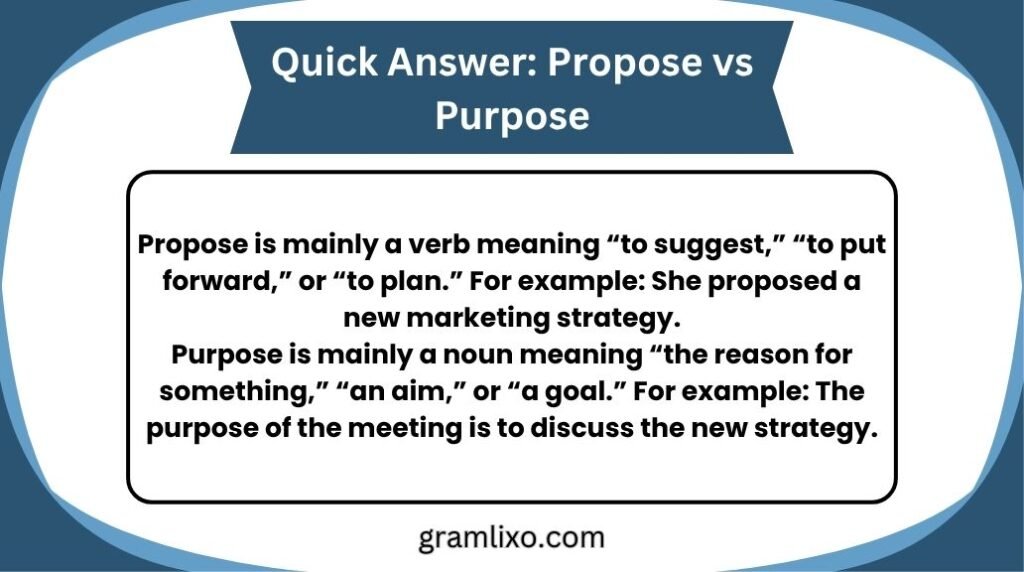
Propose is mainly a verb meaning “to suggest,” “to put forward,” or “to plan.” For example: She proposed a new marketing strategy.
Purpose is mainly a noun meaning “the reason for something,” “an aim,” or “a goal.” For example: The purpose of the meeting is to discuss the new strategy.
In simple terms:
Propose = suggest or put forward an idea.
Purpose = the reason or goal behind something.
Merriam-Webster defines propose as a verb that can mean to put forward a plan or intention, while purpose commonly refers to the reason something is done or used, or to a person’s aim or goal.
Understanding the Basics: Propose vs Purpose
The easiest way to understand these words is to focus on their grammatical roles.
What Does “Propose” Mean?
Propose is a verb. It describes an action.
When you propose something, you suggest it, present it for consideration, or put forward a plan.
Examples:
- The manager proposed a new schedule.
- They proposed several solutions.
- I propose that we start earlier.
- She proposed moving the meeting online.
- He proposed to his girlfriend during dinner.
Merriam-Webster lists several meanings for propose, including putting forward a plan or intention, presenting something for acceptance or rejection, recommending someone for a position, offering a toast, and making an offer of marriage.
What Does “Purpose” Mean?
Purpose is most commonly a noun. It refers to the reason something exists, the reason an action is performed, or the goal someone wants to achieve.
Examples:
- The purpose of this meeting is to review the budget.
- What is the purpose of this tool?
- Her purpose was to help new students.
- The main purpose of exercise is to improve health and fitness.
- He lives with a strong sense of purpose.
Merriam-Webster defines purpose as the reason something is done or used and also as a person’s aim or goal.
Comparison Table
| Form | Type | Meaning | Example | Correct/Incorrect |
|---|---|---|---|---|
| propose | Verb | To suggest or put forward | She proposed a new plan. | ✅ Correct |
| purpose | Noun | Reason, aim, or goal | The purpose is to save time. | ✅ Correct |
| propose | Verb | To plan or intend | They propose to expand the business. | ✅ Correct |
| purpose | Noun | Intended reason | What is the purpose of this rule? | ✅ Correct |
| purpose | Verb | To set something as an aim | He purposed to complete the task. | ✅ Grammatically possible, but uncommon |
| purpose | Noun | Used instead of propose | She purposed a new idea. | ❌ Incorrect |
| propose | Verb | Used to mean “reason” | The propose of the meeting is… | ❌ Incorrect |
The key distinction is simple:
You propose an idea, but you explain the purpose of the idea.
Correct Meanings and Uses of “Propose”
1. Propose Means “To Suggest”
One of the most common uses of propose is to suggest an idea or plan.
Example
The director proposed a new training program.
Sentence breakdown
- The director = subject
- proposed = verb
- a new training program = object
The director is actively suggesting something.
More examples:
- The committee proposed a new policy.
- Maria proposed a different approach.
- The scientist proposed a new explanation.
- The teacher proposed an interesting experiment.
If someone is putting an idea on the table for other people to consider, propose is usually the correct word.
2. Propose Means “To Plan or Intend”
Propose can also mean to intend or plan to do something.
This structure is commonly followed by to + verb.
Examples
We propose to launch the product next month.
The company proposes to expand into new markets.
They propose to build a larger office.
Here, propose does not simply mean “suggest.” It communicates an intended course of action.
Merriam-Webster includes this meaning in its examples, such as propose to buy a new house.
A useful pattern
propose + to + verb
Examples:
- propose to change
- propose to invest
- propose to improve
- propose to expand
- propose to introduce
You can also use:
propose + -ing
For example:
She proposed changing the schedule.
Both patterns can be grammatical, although the exact construction can depend on the context and intended meaning.
3. Propose Means “To Put Forward for Consideration”
In formal writing, propose often means to present something for discussion, approval, acceptance, or rejection.
Examples:
- The government proposed new legislation.
- The board proposed several changes.
- The researchers proposed a new theory.
- The team proposed three possible solutions.
This use is particularly common in:
- business writing
- academic writing
- government documents
- research
- professional presentations
Test Tip 📝
Ask yourself:
Am I putting an idea, plan, solution, or suggestion forward?
If yes, propose is probably the word you need.
4. Propose Can Mean “Ask Someone to Marry You”
Another very familiar meaning of propose relates to marriage.
Examples:
- He proposed to Sarah.
- She proposed to him.
- They got engaged after he proposed.
- He proposed during their vacation.
Here, propose to someone means to ask someone to marry you.
Notice the construction:
He proposed to her.
This is different from:
He proposed a plan.
In the first sentence, propose refers to marriage. In the second, it refers to an idea.
Merriam-Webster specifically lists “to make an offer of marriage” as one of the meanings of propose.
Correct Meanings and Uses of “Purpose”
1. Purpose Means “Reason”
The most common meaning of purpose is the reason something is done or exists.
Example:
The purpose of this meeting is to discuss the budget.
The question behind the sentence is:
Why is the meeting happening?
The answer is:
To discuss the budget.
Therefore, “to discuss the budget” is the meeting’s purpose.
More examples:
- The purpose of the rule is to protect customers.
- The purpose of this machine is to reduce waste.
- The purpose of the survey is to collect feedback.
- The purpose of the lesson is to teach basic grammar.
2. Purpose Means “Goal”
Purpose can also describe an aim or goal.
Examples:
Her purpose is to become a successful writer.
The team’s purpose is to improve customer service.
He worked with a clear sense of purpose.
In these examples, purpose refers to what someone wants to achieve.
Remember
Purpose answers “Why?”
Goal answers “What do you want to achieve?”
The two concepts overlap, which is why purpose can sometimes be translated as an aim or objective.
3. Purpose Can Mean “Intention”
Purpose can describe what someone intends to accomplish.
Examples:
- He came here with a clear purpose.
- She spoke with the purpose of explaining the situation.
- The document serves a specific purpose.
- They acted with good purpose.
Merriam-Webster lists intention, aim, goal, and objective among the related meanings and synonyms associated with purpose.
4. “Purpose” Can Function as a Verb
This is an important advanced point.
Purpose can be a verb, although this use is relatively uncommon in modern everyday English.
Merriam-Webster lists the verb purpose as meaning “to propose as an aim to oneself.”
For example:
He purposed to complete the work before Friday.
This means that he intended or planned to complete the work.
However, this construction can sound formal, literary, or old-fashioned to many modern readers.
For ordinary communication, intend, plan, or aim will often sound more natural.
Instead of:
I purpose to finish the report tomorrow.
You would usually write:
I plan to finish the report tomorrow.
or:
I intend to finish the report tomorrow.
Propose vs Purpose in Real Sentences
Seeing the words side by side makes the difference much easier to understand.
Example 1
The manager proposed a new schedule.
The manager suggested the schedule.
Example 2
The purpose of the new schedule is to reduce delays.
The sentence explains why the schedule exists.
Example 3
The team proposed a new marketing campaign.
The team presented an idea.
Example 4
The purpose of the campaign is to attract younger customers.
The sentence explains the campaign’s goal.
Example 5
She proposed changing the deadline.
She suggested a change.
Example 6
The purpose of the deadline is to keep the project on track.
The sentence explains the reason for the deadline.
This gives you a powerful memory trick:
Propose creates or presents the idea. Purpose explains why the idea exists.
Propose vs Purpose: Case Study
Imagine that a marketing team is preparing for a quarterly meeting.
During the meeting, Alex says:
“I propose that we create a new social media campaign.”
Alex is proposing an idea.
Then the manager asks:
“What is the purpose of the campaign?”
Alex responds:
“The purpose is to increase brand awareness among younger customers.”
Notice how naturally the two words work together.
Step 1: Propose
Someone suggests an idea.
Alex proposed a social media campaign.
Step 2: Purpose
Someone explains why the idea is being suggested.
The purpose of the campaign is to increase brand awareness.
Step 3: Decision
The team discusses whether the proposal is useful.
This distinction is valuable in workplace communication because proposals and purposes often appear together.
Propose vs Purpose in Professional Writing
Professional writing requires precision.
Consider these two sentences:
❌ The purpose a new advertising strategy.
This is incomplete and grammatically incorrect.
✅ The company proposed a new advertising strategy.
Here, proposed is the action.
Now compare:
❌ The company proposed of the advertising strategy is to increase sales.
This incorrectly combines the structures.
✅ The purpose of the advertising strategy is to increase sales.
Here, purpose identifies the reason.
Common professional patterns
We propose…
We propose a revised payment schedule.
The purpose of…
The purpose of this report is to summarize the findings.
The purpose of the proposal is…
The purpose of the proposal is to reduce operating costs.
These structures appear frequently in business communication.
Grammar Rules: Why Propose and Purpose Are Different
The difference begins with their grammatical roles.
Propose Is Primarily a Verb
A verb expresses an action, state, or occurrence.
In:
The committee proposed a new policy.
Proposed is the verb.
It tells us what the committee did.
Purpose Is Primarily a Noun
A noun identifies a person, place, thing, idea, quality, or concept.
In:
The purpose of the policy is to protect employees.
Purpose is the noun.
It identifies the reason behind the policy.
Merriam-Webster categorizes propose as a verb and gives purpose as both a noun and a verb, with the noun being the familiar everyday use.
The easiest grammar rule
If you need an action, consider propose.
If you need a reason, aim, or goal, consider purpose.
Propose vs Purpose: Common Mistakes
Why do people confuse these words?
There are several reasons.
1. They Look Similar
The words share several letters:
- propose
- purpose
When someone is typing quickly, visual similarity can cause a mistake.
2. They Sound Somewhat Similar
Although their pronunciation is different, inexperienced English learners may hear them as similar.
Propose: /prə-ˈpōz/
Purpose: /ˈpər-pəs/
The final sounds are especially different: propose ends with a /z/ sound, while purpose ends with an /s/ sound.
3. Fast Typing
When people type quickly, they may select the wrong word without noticing.
4. Autocorrect
Autocorrect and predictive text can sometimes replace one word with another.
5. Lack of Vocabulary Knowledge
Learners may understand that both words relate to ideas or intentions but may not know their grammatical differences.
Similar Grammar Confusions
The English language contains many word pairs that create similar problems.
| Confusing Pair | Correct Difference | Example |
|---|---|---|
| propose / purpose | suggest vs. reason/goal | She proposed a plan. |
| its / it’s | possessive vs. it is | The dog wagged its tail. |
| your / you’re | possessive vs. you are | You’re using your phone. |
| their / they’re | possessive vs. they are | They’re in their office. |
| affect / effect | usually verb vs. usually noun | The change affected the result. |
| advice / advise | noun vs. verb | She gave me advice. |
| accept / except | receive vs. excluding | Everyone came except John. |
| principal / principle | person/main vs. rule | The principal explained the principle. |
| then / than | time/order vs. comparison | First this, then that. |
| lose / loose | misplace/fail vs. not tight | Don’t lose the loose paper. |
The best solution is not simply memorizing spelling. Learn what each word does in a sentence.
Usage in Different Contexts
Propose vs Purpose in Everyday Conversation
In everyday speech, both words are useful.
Propose
I propose we order pizza.
This means:
I suggest we order pizza.
Purpose
What’s the purpose of this button?
This means:
Why does this button exist?
The distinction is straightforward when you focus on meaning.
Propose vs Purpose in Professional Writing
Professional writing often uses both words.
Examples:
We propose a new approach to customer support.
The purpose of this approach is to improve response times.
Another example:
The committee proposed several changes.
The purpose of the changes is to improve efficiency.
In formal documents, using the correct word improves clarity and credibility.
Propose vs Purpose in Academic Writing
Academic writers frequently propose theories, explanations, models, methods, and solutions.
Examples:
The researchers proposed a new model.
The study proposes a possible explanation for the findings.
Meanwhile, purpose is often used to describe the objective of a study.
Example:
The purpose of this study is to examine how students learn vocabulary.
A common academic structure is:
The purpose of this study is to…
For example:
The purpose of this study is to investigate the effects of online learning.
Propose vs Purpose in Creative Writing
Creative writing can use both words in more expressive ways.
Propose
He proposed a journey into the mountains.
Purpose
She had finally discovered her purpose.
Purpose can carry an emotional or philosophical meaning in stories.
Examples:
- a sense of purpose
- a higher purpose
- a life’s purpose
- a personal purpose
Propose, by contrast, often describes an intentional action:
She proposed a daring plan.
Propose vs Purpose in Social Media and Texting
Social media and texting are informal, so people often shorten sentences.
You might see:
I propose pizza tonight 😂
or:
What’s the purpose of this challenge? 😂
In casual communication, people may make spelling mistakes without much consequence. However, the distinction becomes important when you are writing:
- LinkedIn posts
- professional emails
- resumes
- business proposals
- school assignments
- blog posts
- website content
Why the Difference Matters
Understanding propose vs purpose may seem like a small grammar detail, but accurate word choice has a large effect on communication.
1. Clarity
Compare:
We propose a new strategy.
with:
The purpose of the new strategy is to increase sales.
These sentences communicate different information.
The first tells us what someone suggests.
The second tells us why the strategy exists.
2. Professionalism
Correct word choice makes professional writing sound more polished.
A sentence such as:
The purpose of this report is to explain the findings.
sounds precise and professional.
Using propose incorrectly could confuse the reader.
3. Digital Communication
Today, people write constantly:
- emails
- texts
- comments
- captions
- reports
- websites
- social posts
Because written communication happens so quickly, small vocabulary mistakes can spread easily.
4. Reader Trust
Accurate grammar shows that the writer understands the language and cares about the message.
A useful principle is:
Clear words create clear meaning.
That is especially important when your writing represents you professionally.
Special Exception: “Purpose” as a Verb
There is one interesting exception worth remembering.
Although purpose is primarily used as a noun, it can function as a verb.
Merriam-Webster defines the verb purpose as “to propose as an aim to oneself.”
Example:
He purposed to complete the project.
This means:
He intended to complete the project.
However, this use is uncommon in ordinary modern American English.
For most situations, use:
- intend
- plan
- aim
instead.
Also note “purpose” in fixed expressions
Some expressions use purpose in ways that are easy to recognize:
- on purpose = intentionally
- for the purpose of = with the intention of
- for practical purposes = in practical terms
- sense of purpose = feeling that one’s life or work has meaning
- purpose-built = designed specifically for a particular function
Examples:
She did it on purpose.
The tool was designed for the purpose of measuring temperature.
The building is purpose-built for research.
These are normal and established uses of purpose.
Propose vs Purpose: Easy Memory Tricks
If you often confuse these words, use one of these memory tricks.
Memory Trick #1: Propose = Present an Idea
Think:
Propose = put forward.
If you are presenting an idea for consideration, propose is likely correct.
She proposed a solution.
Memory Trick #2: Purpose = Why
Think:
Purpose = why.
If you can replace the word with reason, aim, or goal, use purpose.
What is the purpose of this meeting?
= What is the reason for this meeting?
Memory Trick #3: Pairs
Remember this simple pair:
Propose a plan.
Purpose of the plan.
This is one of the easiest ways to remember the distinction.
Quick Recap Checklist
Use this checklist whenever you are unsure.
| Question | If Yes → Use |
|---|---|
| Am I suggesting an idea? | propose |
| Am I putting forward a plan? | propose |
| Am I recommending something? | propose |
| Am I asking someone to marry me? | propose |
| Am I explaining why something exists? | purpose |
| Am I describing an aim or goal? | purpose |
| Can I replace the word with “reason”? | purpose |
| Can I replace the word with “suggest”? | propose |
Practice Example 1
The manager ______ a new policy.
Answer: proposed
Why? The manager suggested or put forward a policy.
Practice Example 2
The ______ of the policy is to improve safety.
Answer: purpose
Why? The sentence explains the reason for the policy.
Practice Example 3
The committee ______ several solutions.
Answer: proposed
Why? The committee presented several solutions for consideration.
Propose vs Purpose: Sentence Transformation Practice
One excellent way to master these words is to transform sentences.
Starting sentence
The team proposed a new training program.
You can transform it into:
The purpose of the new training program is to improve employee skills.
The first sentence focuses on the suggestion.
The second focuses on the reason.
Another pair:
The city proposed a new transportation plan.
becomes:
The purpose of the transportation plan is to reduce traffic congestion.
Again:
proposed = suggested
purpose = reason or goal
This relationship appears in countless real-world situations.
Propose vs Purpose in Questions
Questions can also help you recognize the difference.
Questions using “propose”
What did the committee propose?
What solution did she propose?
What changes are they proposing?
These questions ask about an idea or suggestion.
Questions using “purpose”
What is the purpose of this rule?
What is the purpose of the meeting?
What is the purpose of this device?
These questions ask about a reason or function.
Therefore:
What did they propose? → What did they suggest?
What is its purpose? → Why does it exist or happen?
Frequently Asked Questions About Propose vs Purpose
1. What is the main difference between propose and purpose?
Propose is primarily a verb meaning to suggest, put forward, recommend, or plan something. Purpose is primarily a noun meaning the reason, aim, or goal behind something.
Example:
She proposed a new plan.
The purpose of the plan is to save money.
2. Is “propose” a verb or a noun?
Propose is a verb.
It describes an action, such as suggesting an idea or asking someone to marry you.
Example:
The researchers proposed a new theory.
The related noun is proposal.
The researchers submitted a proposal.
3. Is “purpose” a verb or a noun?
Purpose is most commonly a noun, but it can also be a verb.
As a noun:
The purpose of the meeting is to discuss the budget.
As a verb:
He purposed to finish the work.
The verb use is much less common in modern everyday English.
4. Can propose and purpose be used in the same sentence?
Yes. In fact, they often work naturally together.
Example:
The committee proposed a new policy, whose purpose is to improve workplace safety.
Here, proposed describes the act of suggesting the policy, while purpose describes the policy’s goal.
5. Is “purpose” the same as “reason”?
Often, yes.
When purpose refers to the reason something is done or used, it can often be replaced by reason.
Example:
The purpose of the meeting is to discuss the budget.
Similar:
The reason for the meeting is to discuss the budget.
The two words are not always perfect substitutes, but they overlap strongly in this context.
6. Is “propose” the same as “suggest”?
Often, yes.
Both words can mean putting an idea forward for consideration.
Example:
She proposed a new solution.
She suggested a new solution.
However, propose can have additional meanings, including planning or making an offer of marriage. Merriam-Webster lists suggest among the synonyms associated with propose.
7. Which is correct: “purpose a plan” or “propose a plan”?
The correct standard expression is:
propose a plan
Example:
The team proposed a new plan.
You generally should not use purpose in place of propose in this sentence.
8. Which is correct: “the propose of” or “the purpose of”?
The correct expression is:
the purpose of
Example:
The purpose of this article is to explain the difference between two commonly confused words.
“The propose of” is incorrect.
Propose vs Purpose: Final Comparison
Let’s bring everything together.
| Propose | Purpose |
|---|---|
| Usually a verb | Usually a noun |
| Means suggest | Means reason |
| Means put forward | Means aim |
| Can mean plan or intend | Can mean goal |
| Can refer to a marriage proposal | Can describe the function of something |
| Example: She proposed a solution. | Example: The purpose is to solve the problem. |
| Answers “What did someone suggest?” | Answers “Why?” |
The words may look similar, but they perform different grammatical jobs.
Conclusion
The difference between propose vs purpose becomes easy once you focus on their core meanings. Propose is primarily a verb used when someone suggests, presents, recommends, or plans something. Purpose is primarily a noun used to describe the reason, aim, intention, or goal behind something. For example, you might propose a new project, while the purpose of the project is to solve a particular problem. Although purpose can also be used as a verb, that construction is relatively uncommon in modern everyday American English. When in doubt, remember this simple rule: you propose an idea, but you explain its purpose. Learning this distinction will help you write more clearly in emails, essays, reports, conversations, and online content. Once you connect propose with suggest and purpose with reason or goal, the confusion largely disappears. ✨
Propose the idea. Explain the purpose. Write with confidence.

I’m Robert Williams, an English grammar writer at Gramlixo. I focus on breaking down confusing grammar rules into simple explanations and useful examples.
[…] |Propose vs Purpose: What’s the Difference? Meaning, Usage, and Examples […]
[…] |Propose vs Purpose: What’s the Difference? Meaning, Usage, and Examples […]
[…] |Propose vs Purpose: What’s the Difference? Meaning, Usage, and Examples […]