Have you ever started typing a question such as “Who else should I invite?” and suddenly wondered whether it should be “Whom else should I invite?” 🤔 You are not alone. The confusion between who else vs whom else comes from the difference between who and whom, two pronouns that can sound similar but serve different grammatical roles.
The word else makes the question look more complicated, but it actually does not change the basic rule. The important question is whether the pronoun is functioning as the subject or the object of the sentence. In everyday American English, who else is by far the more common expression, while whom else is possible in formal grammatical structures when whom functions as an object.
For example, “Who else is coming?” asks who is performing the action of coming. But “Whom else did you invite?” places the person being asked about in the object position.
Understanding this small difference can make your writing more accurate without making your English sound unnecessarily formal.
|Attain vs Obtain: What Is the Difference and When Should You Use Each?
|Die vs Dice: What’s the Difference and When Should You Use Each?
|Appal vs Appall: What’s the Difference and Which Spelling Is Correct?
Quick Answer: Who Else vs Whom Else
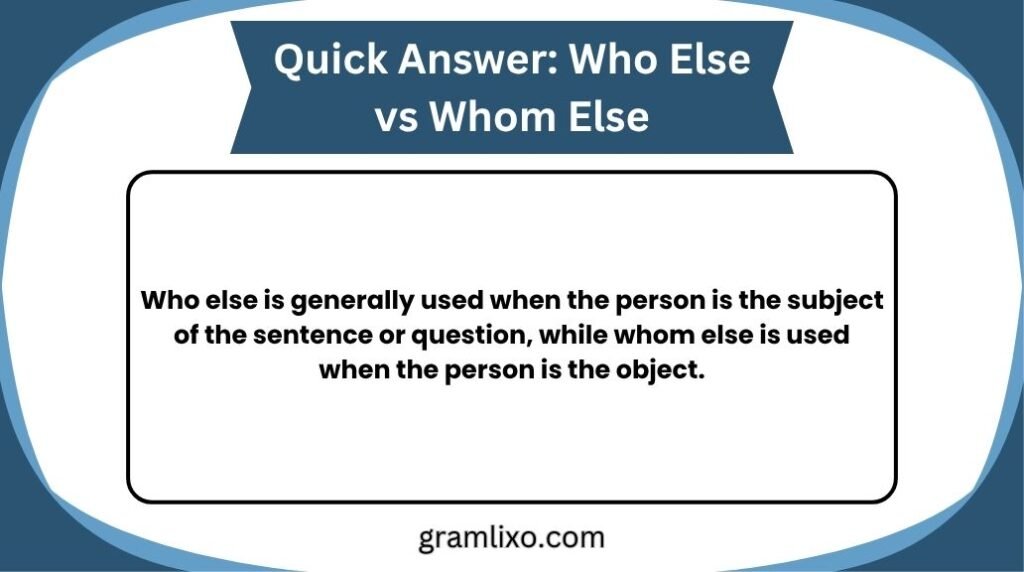
Who else is generally used when the person is the subject of the sentence or question, while whom else is used when the person is the object.
- Who else is coming? ✅
- Whom else did you invite? ✅ Formal
- Who else did you invite? ✅ Natural and common in modern American English
A simple test is to replace the pronoun with he/she or him/her. If he/she works, use who. If him/her works, whom is traditionally correct. Cambridge Grammar explains that whom is the object form of who and is especially associated with formal writing.
Understanding the Basics of Who Else vs Whom Else
The easiest way to understand who else vs whom else is to first understand the difference between who and whom.
What Does “Who” Mean?
Who is a pronoun used to ask about or identify a person or people. It commonly functions as the subject of a clause.
Examples:
- Who called you?
- Who else wants coffee?
- Who else is joining us?
- Who else knows the answer?
In these sentences, who represents the person performing the action.
For example:
Who else called you?
The hidden structure is:
Someone else called you.
The person represented by who is doing the calling. Therefore, who is the natural choice.
What Does “Whom” Mean?
Whom is traditionally the object form of who.
Examples:
- Whom did you invite?
- Whom did she call?
- To whom did you speak?
Here, the person represented by whom receives or is affected by the action.
Cambridge Grammar describes whom as the object form of who and notes that it is more common in formal writing than in everyday speech.
What Does “Else” Do?
The word else means “in addition to the person or thing already mentioned or considered.”
Compare:
- Who is coming?
- Who else is coming?
The first question asks for any person. The second asks for an additional person.
Likewise:
- Whom did you invite?
- Whom else did you invite?
The word else does not change whether the pronoun is a subject or object.
Comparison Table
| Form | Type | Meaning | Example | Correct/Incorrect |
|---|---|---|---|---|
| Who else | Subject pronoun phrase | What additional person? | Who else is coming? | ✅ Correct |
| Whom else | Object pronoun phrase | What additional person as an object? | Whom else did you invite? | ✅ Formal |
| Who else | Informal/common object use | What additional person? | Who else did you invite? | ✅ Common |
| Whom else | Object pronoun phrase | Additional person receiving the action | Whom else did she contact? | ✅ Formal |
| Who else is coming? | Subject question | Who is performing the action? | Who else is coming? | ✅ Correct |
| Whom else is coming? | Incorrect object form | — | Whom else is coming? | ❌ Incorrect |
Who Else: Meaning and Correct Uses
“Who Else” as a Subject
The most straightforward use of who else occurs when the phrase is the subject of the sentence.
Consider:
Who else wants to participate?
The verb is wants.
Ask:
Who wants to participate?
The answer could be:
Maria wants to participate.
Maria is doing the wanting, so the pronoun is functioning as a subject.
Therefore:
Who else wants to participate? ✅
Not:
Whom else wants to participate? ❌
Who Else Is Coming?
This is one of the most common examples.
Who else is coming to the meeting?
The person represented by who is the subject of is coming.
The sentence means:
Which other people are coming to the meeting?
Examples:
- Who else is attending the conference?
- Who else is going to the party?
- Who else is working tonight?
- Who else knows about this?
All of these use who else naturally.
Who Else Can Help?
Consider:
Who else can help us?
The person represented by who performs the action of helping.
Therefore:
Who else can help us? ✅
The answer might be:
James can help us.
James is the subject.
Who Else Wants It?
Another common structure is:
Who else wants a slice of pizza?
The phrase who else is the subject of wants.
This pattern appears frequently in everyday conversation.
Examples:
- Who else wants dessert?
- Who else needs a ride?
- Who else wants to join?
- Who else needs help?
Whom Else: Meaning and Correct Uses
“Whom Else” as an Object
Whom else is traditionally correct when the person is the object of the verb.
For example:
Whom else did you invite?
The structure is:
You invited someone else.
The subject is you.
The verb is invited.
The person being invited is the object.
Therefore, in formal traditional grammar:
Whom else did you invite? ✅
However, there is an important modern-English point: Who else did you invite? is also extremely common and natural, especially in speech and informal writing.
Cambridge notes that who is widely used even where traditional grammar might expect whom, while whom is especially associated with formal styles and writing.
Whom Else Did You Contact?
Consider:
Whom else did you contact?
The subject is you.
The verb is contacted.
The person contacted is the object.
Therefore, formal grammar permits:
Whom else did you contact?
But in ordinary American conversation, most speakers would naturally say:
Who else did you contact?
Both can communicate the same meaning, but the second sounds less formal.
To Whom Else?
The phrase becomes especially clear after a preposition.
For example:
To whom else should I send this letter?
Here, whom follows the preposition to.
This is a strongly formal construction.
In everyday English, you would usually say:
Who else should I send this letter to?
Cambridge notes that whom commonly appears with prepositions in formal styles, such as “with whom” or “to whom.”
The Fastest Way to Choose Between Who Else and Whom Else
If you are unsure, use the he/him test.
Step 1: Remove “else”
Take:
Who else did you invite?
Temporarily remove else:
Who did you invite?
Step 2: Answer the question
Imagine the answer:
I invited him.
Not:
I invited he.
Because him works, traditional grammar would choose whom:
Whom else did you invite?
However, modern English commonly uses who here, particularly in conversation.
Now consider:
Who else is coming?
The answer is:
He is coming.
Not:
Him is coming.
Because he works, use who:
Who else is coming?
The Simple Memory Trick
Remember:
Who = he/she
Whom = him/her
For example:
- Who else called? → She called.
- Whom else did you call? → You called her.
This is a useful traditional grammar test.
Correct Meanings and Uses
Asking About Additional People
The most common use of who else is asking about additional people.
Examples:
Who else knows the secret?
Who else is attending the event?
Who else wants to come?
Here, who else usually asks:
Which additional person or people?
Asking About Additional People as Objects
When the person is the object, whom else may appear in formal writing.
Example:
Whom else did the manager interview?
The meaning is:
Which other person did the manager interview?
But modern American English commonly favors:
Who else did the manager interview?
This is important because grammar rules and actual usage do not always move at exactly the same speed.
Asking About an Additional Person After a Preposition
Formal writing may use:
To whom else should I address the complaint?
or:
With whom else did you discuss the matter?
These forms are grammatically traditional and formal.
In conversational English, you are much more likely to hear:
Who else did you discuss it with?
The formal version is not necessarily “better.” It simply has a more formal tone.
Test Tip
Test Tip: Replace the phrase with he/she or him/her.
- He is coming. → Who else is coming?
- I invited her. → Whom else did I invite? (formal)
- She called. → Who else called?
- I spoke with him. → With whom else did you speak? (formal)
If the sentence sounds stiff with whom, modern conversational English may favor who.
Case Study: A Workplace Email
Imagine a manager writing an email about an upcoming presentation.
Informal workplace version
Who else should we invite to the presentation?
This is completely natural.
The manager is asking which additional people should receive an invitation.
Formal version
A highly formal writer might say:
Whom else should we invite to the presentation?
Traditionally, whom is justified because the implied structure is:
We should invite whom?
The company could use either version, but the first is generally more natural in modern American business communication.
Another Example
Imagine an employee asks:
Who else did you speak with about the project?
This sounds natural and professional.
A more formal version is:
Whom else did you speak with about the project?
An even more formal construction is:
With whom else did you speak about the project?
The three versions differ mainly in tone and grammatical formality.
Grammar Rules: Why Who and Whom Differ
The fundamental distinction is based on grammatical case.
Who as a Subject
A subject performs an action or occupies the subject position.
Examples:
Who called?
Who wants coffee?
Who else is attending?
In each sentence, who represents the subject.
Whom as an Object
An object receives the action or follows a preposition.
Examples:
Whom did you call?
Whom did she invite?
To whom did you speak?
Traditional grammar therefore treats who as the subject form and whom as the object form.
Cambridge Grammar explicitly identifies whom as the object form of who. It also notes that whom is more common in formal writing than in speech.
Why “Who Else Did You Invite?” Is So Common
This is where real-world English becomes interesting.
Traditional grammar gives us:
Whom else did you invite?
But modern English frequently uses:
Who else did you invite?
Why?
Because whom is disappearing from ordinary conversation. Many speakers naturally use who in object positions.
This does not mean that whom is meaningless or incorrect. It remains useful in formal constructions.
Cambridge similarly notes that who can be used in questions even where whom might traditionally be expected, while whom is associated more strongly with formal styles.
Who Else vs Whom Else in American English
For American English learners, context matters.
Casual Conversation
Use:
Who else did you invite?
This sounds natural.
Professional Email
Use:
Who else should we include in the meeting?
This is professional and clear.
You do not need to force whom simply because the message is professional.
Very Formal Writing
You may encounter:
Whom else should we consult before making a decision?
This is grammatically traditional and formal.
Formal Prepositional Construction
You may also see:
With whom else did you discuss the proposal?
This is correct but noticeably formal.
Common Mistakes With Who Else vs Whom Else
Mistake 1: Assuming “Else” Determines the Pronoun
Some writers think else requires a particular form.
It does not.
Compare:
Who is coming?
Who else is coming?
The addition of else does not change the grammatical role of who.
Likewise:
Whom did you invite?
Whom else did you invite?
The word else simply adds the meaning of “another” or “in addition.”
Mistake 2: Using “Whom” Everywhere
Some learners memorize:
“Whom sounds more grammatical.”
Then they write:
Whom else is coming?
That is incorrect because the person is the subject of is coming.
Correct:
Who else is coming?
Mistake 3: Avoiding Whom Completely
The opposite problem also occurs.
A writer may never use whom, even in a highly formal phrase such as:
To whom else should this letter be addressed?
Although “Who else should this letter be addressed to?” is common and understandable, the to whom construction remains a standard formal option.
Mistake 4: Confusing Formality With Correctness
Whom is not automatically “more correct.”
The choice depends on grammatical role and context.
Modern English often uses who where traditional grammar recommends whom, especially in speech.
Similar Grammar Confusions
Many English learners struggle with pairs that look or sound similar.
| Confusion | Correct Form | Main Difference |
|---|---|---|
| who / whom | Who called? / Whom did you call? | Subject vs. object |
| it’s / its | It’s cold. / Its color is blue. | Contraction vs. possessive |
| your / you’re | Your car / You’re late | Possessive vs. contraction |
| their / they’re | Their house / They’re home | Possessive vs. contraction |
| affect / effect | It affected me / The effect was strong | Verb vs. noun in common uses |
| then / than | Then we left / Taller than me | Time vs. comparison |
| accept / except | Accept the offer / Everyone except John | Receive vs. exclusion |
Why Do These Mistakes Happen?
Fast Typing
When people type quickly, they often choose the first familiar word.
Autocorrect
Autocorrect may encourage a familiar form and fail to recognize the intended grammatical role.
Lack of Knowledge
Some people simply never learned the traditional distinction between subject and object pronouns.
Changes in Modern English
Language changes over time. The difference between who and whom is less strongly maintained in everyday speech than it once was.
Usage in Different Contexts
Everyday Conversation
In conversation, who else is overwhelmingly natural.
Examples:
- Who else is coming?
- Who else wants pizza?
- Who else knows about this?
- Who else did you ask?
You rarely need to force whom into casual conversation.
Professional Writing
In professional writing, clarity usually matters more than sounding excessively formal.
Good:
Who else should we include in the meeting?
Also possible in a more formal style:
Whom else should we consult?
Choose based on the tone of your organization and audience.
Creative Writing
Creative writers can choose either form depending on the character’s voice.
A character who speaks naturally might say:
Who else would do something like that?
A highly formal character might say:
Whom else could I possibly trust?
The choice can even communicate personality.
Social Media and Texting
Social media usually favors who else.
Examples:
Who else loves Friday nights? 😄
Who else is watching this?
Who else wants one?
Using whom in these casual situations can sound humorous or intentionally formal.
Why Who Else vs Whom Else Matters
Grammar is not only about passing a test. It is about making communication easier.
Clarity
Choosing the appropriate form can make sentence structure easier to understand.
Compare:
Who else is responsible?
This immediately identifies the person being asked about as the subject.
Professionalism
Correct grammar can make business communication appear more polished.
However, professionalism does not mean using the most formal word possible. A sentence that is unnecessarily formal can sound unnatural.
Digital Communication
Online communication moves quickly. Emails, messages, social media posts, and workplace chats all require fast decisions.
Knowing when to use who else and when whom else helps you write confidently without stopping every few seconds to question your grammar.
A Useful Reminder
Good grammar should make your meaning clearer, not make your writing harder to read.
Special Exception: Modern English and the Decline of “Whom”
There is no special brand-name exception that changes the basic grammar of who else vs whom else.
The more important edge case is modern usage.
Traditional grammar distinguishes:
- who = subject
- whom = object
But contemporary English increasingly uses who in both roles.
For example:
Who did you invite?
Traditional grammar may prefer:
Whom did you invite?
But the first sentence is extremely common in modern English.
Cambridge notes that whom is mainly used in formal styles or writing and is not commonly used in ordinary speech.
A Practical Rule for Modern American English
If you are writing normal American English, who else will usually be the safest and most natural choice.
Use whom else when:
- The person is clearly the object.
- The context is formal.
- The construction sounds appropriate for the audience.
- You are intentionally following traditional formal grammar.
Quick Recap Checklist
| Question | If Yes → Use |
|---|---|
| Is the person doing the action? | Who else |
| Does the phrase function as the subject? | Who else |
| Is the person receiving the action? | Whom else in formal/traditional grammar |
| Does a preposition directly come before the pronoun? | Whom else in formal writing |
| Is the sentence casual conversation? | Usually who else |
| Is the writing deliberately formal? | Whom else may be appropriate |
| Are you unsure in everyday American English? | Usually who else |
Practice Example 1
___ else is coming to dinner?
Answer:
Who else is coming to dinner? ✅
Why? The person represented by who is the subject of is coming.
Practice Example 2
___ else did you invite?
Formal traditional answer:
Whom else did you invite? ✅
Natural modern answer:
Who else did you invite? ✅
Practice Example 3
With ___ else did you discuss the problem?
Formal answer:
With whom else did you discuss the problem? ✅
Casual alternative:
Who else did you discuss the problem with? ✅
Who Else vs Whom Else: A Simple Formula
You can remember the entire lesson with three questions.
Question 1: Is the person doing the action?
Use:
Who else
Example:
Who else called?
Question 2: Is the person receiving the action?
Traditional formal grammar:
Whom else
Example:
Whom else did you call?
Question 3: Is the situation casual?
Use:
Who else
Example:
Who else did you call?
This reflects modern everyday English.
FAQs About Who Else vs Whom Else
1. Is “who else” grammatically correct?
Yes. Who else is grammatically correct when the phrase functions as the subject, and it is also extremely common when who functions as an object in modern English.
Examples include “Who else is coming?” and “Who else did you invite?”
2. Is “whom else” correct?
Yes, whom else is grammatically correct when whom functions as an object, particularly in formal or traditional English.
For example:
Whom else did you invite?
However, modern speakers commonly say:
Who else did you invite?
3. Should I say “who else” or “whom else”?
In most everyday American English, who else is the safest and most natural choice.
Use whom else when you are writing in a formal style and the pronoun clearly functions as an object.
4. Is “whom else is coming?” correct?
No. The traditional form is:
Who else is coming?
The person represented by the pronoun is the subject of is coming, so who is appropriate.
5. Is “who else did you invite?” correct?
Yes. It is completely natural in modern American English.
Traditional formal grammar may prefer:
Whom else did you invite?
But who else did you invite? is much more common in everyday communication.
6. What is the easiest way to remember who vs. whom?
Use the he/him test:
- If he/she fits, choose who.
- If him/her fits, traditional grammar chooses whom.
For example:
Who else is coming? → She is coming.
But:
Whom else did you invite? → I invited her.
Conclusion
The difference between who else vs whom else becomes much easier once you understand the basic distinction between who and whom. Who traditionally functions as a subject, while whom traditionally functions as an object. The word else does not change this grammatical relationship; it simply means “another” or “in addition.”
So, use who else when the person is doing the action:
Who else is coming?
When the person is the object, whom else can be used in formal or traditional grammar:
Whom else did you invite?
However, modern American English commonly uses who even in object positions, especially in conversation and informal writing. That means Who else did you invite? is natural, clear, and widely accepted in everyday communication.
The best rule is simple: use grammar to serve clarity and context. Remember the subject/object distinction, recognize when whom is appropriate, and do not be afraid of natural modern English.
When in doubt, remember: who does the action; whom receives it. 🎯

I’m Christopher Garcia, an English writer and grammar enthusiast at Gramlixo. I enjoy making grammar easy to understand through clear explanations and practical examples.
[…] |Who Else vs Whom Else: Which One Is Correct? […]
[…] |Who Else vs Whom Else: Which One Is Correct? […]