Have you ever typed “soo” when you really meant “so”? You are not alone. The confusion between soo vs so is surprisingly common, especially in texting, social media, and casual online conversations. The two spellings look almost identical, and when people stretch the pronunciation of “so,” it can sound as though there are two vowel sounds at the end. That makes “soo” feel natural to some writers.
However, in standard American English, so is the normal and correct spelling when you mean “to such a degree,” “therefore,” “in this way,” or several other established meanings. Merriam-Webster lists so as an adverb, conjunction, adjective, pronoun, noun, and abbreviation, with uses that have been part of English for centuries.
So, is soo always wrong? Not exactly. Soo can appear as a proper name or in certain specialized, dialectal, or nonstandard contexts. It can also be used informally online as an exaggerated spelling of “so.” But those uses are different from the standard English word so.
Let’s explore soo vs so carefully so you can choose the right form every time. 😊
|Unregister vs Deregister: What’s the Difference and Which One Is Correct?
|Its-Self vs. Itself: Which Is Correct? A Complete Grammar Guide
|Imbed vs Embed: What’s the Difference and Which One Should You Use?
Quick Answer: Soo vs So
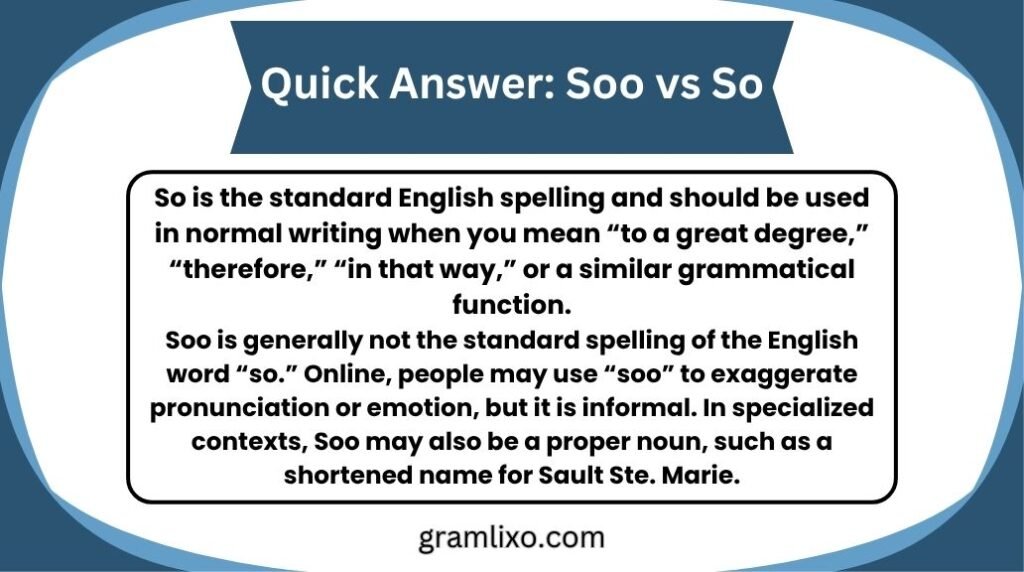
So is the standard English spelling and should be used in normal writing when you mean “to a great degree,” “therefore,” “in that way,” or a similar grammatical function.
Soo is generally not the standard spelling of the English word “so.” Online, people may use “soo” to exaggerate pronunciation or emotion, but it is informal. In specialized contexts, Soo may also be a proper noun, such as a shortened name for Sault Ste. Marie.
Simple rule:
👉 If you mean the ordinary English word so, spell it so.
Understanding the Basics of Soo vs So
The easiest way to understand soo vs so is to separate standard grammar from informal spelling.
So is a real, established English word with many grammatical functions. It can describe degree, introduce a result, express agreement, replace a previously mentioned idea, and perform other roles. Merriam-Webster identifies it as an adverb, conjunction, adjective, pronoun, noun, and abbreviation.
By contrast, soo is not normally used as the standard spelling of this everyday English word.
Online, however, you may see:
- “I’m soo tired!”
- “That was soo funny!”
- “I love this soo much!”
- “She is soo cute!”
In these examples, soo is usually an intentional informal spelling. The writer is visually stretching so to make the emotion stronger.
Soo vs So Comparison Table
| Form | Type | Meaning | Example | Correct/Incorrect |
|---|---|---|---|---|
| so | Adverb | To a high degree | She is so happy. | ✅ Correct |
| so | Conjunction | Therefore/result | It was raining, so we stayed home. | ✅ Correct |
| so | Adverb | In the same way | I think so, too. | ✅ Correct |
| soo | Informal spelling | Emphasized “so” | That is soo cute! | ⚠️ Informal |
| Soo | Proper noun/name | A shortened place name | We drove through the Soo. | ✅ In the proper context |
| soo | Dialectal/rare use | A variant with specialized meaning | Found in some dialectal usage | ⚠️ Specialized |
The key point is that so belongs to standard English grammar, while soo usually belongs to informal, specialized, or nonstandard usage.
What Does “So” Mean?
The word so has several meanings, which is one reason it appears so frequently in English.
Merriam-Webster gives multiple definitions for so, including uses as an adverb and conjunction.
Let’s examine the most common ones.
“So” Meaning “To a Great Degree”
One of the most familiar uses of so is to emphasize an adjective or adverb.
Examples:
- I am so tired.
- She is so kind.
- That movie was so interesting.
- He runs so quickly.
- This cake is so delicious.
Here, so tells us about the degree or intensity of something.
Sentence Breakdown
Consider:
She is so excited.
- She = subject
- is = linking verb
- so = degree adverb
- excited = adjective
The word so intensifies the adjective excited.
You could say:
She is very excited.
But:
She is so excited!
often sounds more emotionally expressive.
“So” Meaning “Therefore”
So can also introduce a result.
For example:
It was raining, so we stayed inside.
The sentence contains two ideas:
- It was raining.
- We stayed inside.
The second idea happened because of the first.
Therefore:
raining → stayed inside
Other examples include:
- I was tired, so I went to bed.
- She studied hard, so she passed the exam.
- The store was closed, so we came back later.
- He missed the bus, so he called a taxi.
Merriam-Webster recognizes this conjunction use of so as standard English.
“So” Meaning “In That Way”
Another important use occurs when so refers to an idea, action, or manner already mentioned.
For example:
“Do you think she will come?”
“I think so.”
Here, so essentially means:
I think that she will come.
Instead of repeating the entire idea, English allows us to use so.
More examples:
- I hope so.
- I believe so.
- I suppose so.
- I think so.
- I don’t think so.
- I said so.
This makes communication shorter and more natural.
“So” Meaning “Also” or “In the Same Way”
You can also use so to show that something is true in the same way for another person.
For example:
I love coffee, and so does my brother.
This means:
I love coffee, and my brother loves coffee too.
Another example:
She works hard, and so does her sister.
The word so replaces the repeated idea.
Merriam-Webster includes this “same manner or way” meaning among the standard uses of the word.
Why Do People Write “Soo”?
If so is correct, why does soo appear so often online?
The answer is simple: people sometimes stretch spelling to imitate speech or emotion.
Imagine someone saying:
“That is SO cute!”
If they want to represent an exaggerated pronunciation in writing, they might type:
“That is sooo cute!”
Or:
“That is soo cute!”
The additional letters communicate emphasis.
This is similar to informal spellings such as:
- sooo
- nooo
- yesss
- pleeease
- whaaat
These spellings are usually not intended to follow formal grammar rules. Instead, they imitate the way people stretch sounds during emotional speech.
Example
Standard:
I am so happy!
Informal:
I am soo happy!
More exaggerated:
I am sooo happy!!!
The second and third versions can work in casual texting, but they are not appropriate replacements for so in formal writing.
Is “Soo” a Word?
This question deserves a careful answer.
Soo can be a word or name in specific contexts, but it is not the standard spelling of the everyday English word “so.”
For example, Collins Dictionary lists Soo in American English as an alteration of Sault, referring to the region around Sault Ste. Marie in northern Michigan and southern Ontario.
There are also dialectal and specialized uses recorded in dictionaries and linguistic references.
Therefore, saying “soo is never a word” would be too broad.
A better rule is:
Soo is not the standard spelling when you simply mean the common English word “so.”
That distinction is important.
Soo vs So in Everyday Conversation
In ordinary speech, you do not have to worry about the spelling difference because people pronounce the standard word so.
For example:
I’m so hungry.
When spoken naturally, so receives emphasis depending on the speaker’s tone.
Someone might say:
I’m SO hungry!
The pronunciation may be longer or stronger, but the written word remains so.
Common Conversational Examples
- That was so funny!
- I’m so tired.
- Why are you so quiet?
- I’m so glad you came.
- It was so much fun.
- I’m so sorry.
- That’s so sweet of you.
In standard writing, all of these use so, not soo.
Soo vs So in Professional Writing
Professional writing requires greater consistency and accuracy.
You should use so in:
- Business emails
- Reports
- Resumes
- Cover letters
- Academic papers
- Workplace documents
- Formal presentations
- Professional websites
- News articles
- Official correspondence
For example:
❌ We were soo impressed with the results.
✅ We were so impressed with the results.
The first sentence looks informal and potentially careless. The second is standard.
Professional Example
The deadline was moved forward, so our team adjusted the project schedule.
Here, so clearly introduces a result.
Another example:
The new process is so efficient that we completed the task in half the usual time.
Again, so is the correct standard spelling.
Soo vs So in Texting and Social Media
This is where things become more flexible.
Social media and texting often allow creative spelling.
You might see:
That dress is soo pretty! 😍
Or:
I’m sooo excited!!! 🎉
These expressions are understandable and common in casual digital communication.
However, there is an important distinction between acceptable informality and standard grammar.
Casual texting
You are soo sweet 🥹❤️
This can work because the writer intentionally exaggerates the word.
Formal email
Thank you soo much for your help.
This is not recommended.
Instead:
Thank you so much for your help.
The second version is appropriate for professional communication.
Soo vs So in Creative Writing
Creative writing gives authors more freedom.
A novelist writing dialogue might deliberately use soo or sooo to reproduce a character’s speech pattern.
For example:
“You are sooo annoying!” Maya laughed.
Here, the spelling is a stylistic choice.
The writer is not necessarily making a grammatical mistake. They are trying to show exaggerated pronunciation.
Creative writing can use nonstandard spelling when it serves a purpose.
However, the same technique should not be confused with standard spelling.
Think of It This Way
Grammar:
She is so excited.
Character dialogue:
“I’m sooo excited!”
The second version communicates personality and emotion.
A Real-Life Case Study: Email vs Text Message
Imagine that a coworker sends you a message after completing an important project.
Text Message
We finished the project soo early! 🎉
In a casual group chat, this is understandable. The writer is stretching so for excitement.
Now imagine the same person writing to a client.
Professional Email
We completed the project so early that we were able to begin the next phase ahead of schedule.
The second version is much better for professional communication.
Why?
Because professional writing should prioritize:
- Standard spelling
- Clear grammar
- Consistent style
- Easy readability
- Professional credibility
The difference is not about whether people can understand soo. Most readers can.
The difference is about register.
Grammar Rules: Why “So” Is the Standard Form
The main grammar rule is straightforward:
Use “so” when you are using the standard English word with its established grammatical meanings.
Merriam-Webster lists so as a standard English word with numerous functions, including adverbial and conjunction uses. Its dictionary entry includes meanings involving degree, manner, consequence, and other grammatical relationships.
For example:
The weather was so cold.
Here, so modifies the adjective cold.
Another example:
The weather was cold, so we stayed home.
Here, so connects the cause and result.
Another:
I think so.
Here, so stands in for a previously mentioned idea.
These are all standard uses.
By contrast, adding an extra o does not create a standard grammatical form for these meanings.
The Basic Rule
If you can replace the word with:
- very
- therefore
- in that way
- to that degree
- also
depending on the sentence, you probably need so.
A Simple Test for “Soo vs So”
When you are unsure, ask yourself:
Test 1: Am I writing formal or standard English?
If yes, use so.
Test 2: Does the word mean “very” or “to a great degree”?
Use so.
She is so talented.
Test 3: Does it introduce a result?
Use so.
It was late, so we left.
Test 4: Am I intentionally stretching the word for emotion?
If you’re texting casually, soo may be used stylistically.
That puppy is soo cute! 🥹
But remember: this is informal.
Test Tip
If you would expect to find the spelling in a formal essay, report, or business email, choose so.
Common Mistakes With Soo and So
The confusion usually comes from informal digital communication.
People see soo frequently online and may assume that it is an alternative standard spelling.
It is not.
Mistake 1: Treating “Soo” as a Formal Variant
❌ I am soo pleased with the results.
✅ I am so pleased with the results.
Mistake 2: Using “Soo” in Academic Writing
❌ The experiment was soo successful.
✅ The experiment was so successful.
Mistake 3: Assuming Pronunciation Controls Spelling
A speaker might stretch the sound:
“I’m sooo tired.”
But standard spelling does not change simply because pronunciation is exaggerated.
Why Do These Mistakes Happen?
Several factors contribute to the popularity of soo.
Fast Typing
When people type quickly, they often prioritize speed over formal correctness.
Texting is especially relaxed.
Autocorrect and Predictive Text
Modern keyboards may learn informal language patterns. If you frequently type slang or exaggerated expressions, your keyboard may become more tolerant of them.
Social Media Habits
Online communities create their own writing styles.
People intentionally modify words to express:
- Excitement
- Sarcasm
- Humor
- Frustration
- Affection
- Surprise
Lack of Grammar Knowledge
Some writers may genuinely believe that soo is an accepted spelling of so.
That is why learning the standard form matters.
Similar Grammar Confusions
The soo vs so problem belongs to a larger category of commonly confused forms.
| Confusion | Correct Form | Common Issue |
|---|---|---|
| its / it’s | Depends on meaning | Possessive vs contraction |
| your / you’re | Depends on meaning | Possessive vs “you are” |
| their / there / they’re | Depends on meaning | Different grammatical functions |
| to / too / two | Depends on meaning | Sound-alike words |
| then / than | Depends on meaning | Time vs comparison |
| affect / effect | Depends on context | Verb vs noun usage |
| loose / lose | Depends on meaning | Different words |
| definitely / defiantly | Spelling confusion | Similar appearance |
| soo / so | so in standard English | Informal spelling vs standard form |
Understanding these distinctions improves both grammar and digital communication.
How “So” Works With “That”
One of the most useful patterns is:
so + adjective/adverb + that
Examples:
- She was so tired that she fell asleep immediately.
- The movie was so interesting that I watched it twice.
- He ran so quickly that nobody could catch him.
- The box was so heavy that we needed help.
Merriam-Webster also recognizes so that as a conjunction used to express purpose or result.
For example:
I whispered so that nobody would hear me.
This is standard English.
“So” vs “Very”
Another common question is whether so and very are interchangeable.
Sometimes they are close in meaning, but they can create different tones.
Compare:
She is very happy.
and:
She is so happy!
Very often sounds more neutral.
So can sound more emotionally expressive, especially in conversation.
For example:
That cake is very good.
versus:
That cake is so good!
Both can be grammatically correct, but the second may sound more enthusiastic.
“So” in Professional Communication
In professional writing, so is perfectly acceptable.
Some writers mistakenly think formal writing requires avoiding simple words like so.
That is not true.
Consider:
The data was incomplete, so the team requested additional information.
This is clear and professional.
You could write:
The data was incomplete; therefore, the team requested additional information.
That version is also correct, but it is not automatically better.
Good professional writing is usually about clarity, not unnecessarily complicated vocabulary.
Why the Difference Matters
At first glance, soo vs so may seem like a tiny spelling issue.
But small details can influence how readers perceive your writing.
Clarity
Standard spelling makes your meaning immediately recognizable.
Professionalism
Correct spelling helps your writing appear polished and intentional.
Digital Communication
Online writing is often read quickly. Standard forms reduce unnecessary confusion.
Credibility
Whether you are writing an email, article, application, or report, consistent grammar can make your message more trustworthy.
A useful principle is:
Write for the reader, not just for the keyboard.
Informal spelling has its place, but standard spelling is the safer choice whenever accuracy matters.
When “Soo” Is Actually Appropriate
There are a few situations where Soo can be legitimate.
Sault Ste. Marie
Soo can be used as a shortened form referring to Sault Ste. Marie, a place associated with the St. Marys Falls area around northern Michigan and southern Ontario. Collins Dictionary records this geographical usage.
For example:
We spent the weekend in the Soo.
Here, Soo is not an informal spelling of the adverb so. It is functioning as a place name.
Dialectal Uses
Some dictionaries and linguistic references record soo in dialectal contexts, including a UK dialectal variant of sow.
This is a specialized usage and should not be confused with standard American English so.
Informal Online Spelling
Finally, soo can appear as an intentionally elongated version of so:
That is soo adorable!
This is understandable in casual writing, but it remains informal.
Is “Sooo” Better Than “Soo”?
Neither is the standard spelling of the ordinary word so.
Both soo and sooo can be used informally to exaggerate pronunciation.
Compare:
That is so cute.
Standard.
That is soo cute!
Informal.
That is sooo cute!!!
Highly informal and expressive.
The more extra letters you add, the more casual and emotional the writing tends to become.
In a professional context, simply write:
That is so cute.
Or, depending on the context:
That is extremely cute.
Soo vs So: What Should Students Use?
Students should almost always use so unless they are deliberately discussing informal language.
For school assignments:
❌ The story was soo interesting.
✅ The story was so interesting.
For exams:
❌ The question was soo difficult.
✅ The question was so difficult.
For essays:
❌ The results were soo surprising.
✅ The results were so surprising.
Using so helps maintain standard English conventions.
Soo vs So in Search and Digital Content
For websites, blogs, articles, product descriptions, and professional digital content, so should be used when it is the intended English word.
Search engines can generally understand informal variations, but writers should not deliberately replace standard spelling with nonstandard forms simply because people sometimes type them online.
Good SEO writing still needs to be:
- Natural
- Accurate
- Helpful
- Readable
- Grammatically correct
- Written for humans
For example:
This guide explains the difference between soo vs so and shows you when to use each form.
This is a natural way to address the search query while maintaining standard grammar throughout the article.
Quick Recap Checklist
Use this checklist whenever you’re unsure about soo vs so.
| Question | If Yes → Use |
|---|---|
| Do you mean “very” or “to a great degree”? | so |
| Do you mean “therefore”? | so |
| Do you mean “in that way”? | so |
| Are you writing an academic paper? | so |
| Are you writing a professional email? | so |
| Are you intentionally stretching the word in a text? | soo can be informal |
| Are you referring to Sault Ste. Marie? | Soo |
| Are you using a specialized dialectal form? | soo, if that context requires it |
Practice Examples
1. The movie was ___ funny that everyone laughed.
Answer: so
The movie was so funny that everyone laughed.
2. Your puppy is ___ cute! 🥹
Answer in standard writing: so
Your puppy is so cute!
Informal texting could use:
Your puppy is soo cute!
3. We visited the ___ during our trip.
Answer depends on context. If referring to the regional nickname for Sault Ste. Marie, Soo may be correct.
FAQs About Soo vs So
1. Is “soo” grammatically correct?
Usually, no—not when you mean the standard English word so. In casual texting, soo can be an intentional spelling used to exaggerate pronunciation, but so is the standard form.
2. Should I use “so” or “soo” in formal writing?
Use so. Academic papers, professional emails, reports, resumes, and other formal documents should use the standard spelling.
3. Why do people write “soo”?
People often write soo to make a word appear longer or more emotional. It can imitate the way someone stretches a sound while speaking.
For example:
I’m soo excited!
This is an informal stylistic choice.
4. Is “soo” a real English word?
It can be, depending on the context. Soo appears in specialized uses, including as a shortened geographical name associated with Sault Ste. Marie. Some dialectal uses are also recorded.
However, soo is not the standard spelling of everyday so.
5. Is “sooo” correct in texting?
It can be acceptable as an informal stylistic spelling.
For example:
I’m sooo happy!
The extra letters communicate emphasis. However, use so in formal or professional writing.
6. What is the easiest way to remember “soo vs so”?
Remember this:
Standard English = so.
Extra “o” = usually informal emphasis or a specialized name/word.
If you are unsure, choose so.
Conclusion
The difference between soo vs so becomes simple once you separate standard English from informal spelling. So is the standard English form and has many established grammatical functions. It can express degree, introduce a result, indicate a manner, replace a previously mentioned idea, and perform several other roles. Merriam-Webster confirms its broad grammatical use.
Soo, on the other hand, is generally not the standard spelling when you mean so. It may appear in casual texting as an exaggerated spelling, or it may have a specialized meaning, such as the geographical use associated with Sault Ste. Marie.
So when you’re writing an essay, email, article, application, or professional message, choose so. When you’re texting a friend and deliberately want to stretch the sound for emotion, soo or sooo can work as an informal stylistic choice.
The easiest rule to remember is:
When in doubt, use “so.” One extra letter can change standard grammar into informal style.

I’m Sarah Martinez, a writer and English language enthusiast at Gramlixo. I love explaining grammar concepts in a clear and practical way that anyone can understand.

[…] |Soo vs So: What’s the Difference and Which One Is Correct? […]
[…] |Soo vs So: What’s the Difference and Which One Is Correct? […]
[…] |Soo vs So: What’s the Difference and Which One Is Correct? […]