If you have ever wondered about “introduction to vs introduction of,” you are not alone. These two phrases look almost identical, but the preposition changes the meaning of the sentence.
I know it can be confusing when you are writing an essay, email, course description, or professional document and have to decide whether “to” or “of” is the better choice.
In general, “introduction to” is used when someone is becoming familiar with a subject, person, activity, or idea, while “introduction of” usually refers to bringing, presenting, launching, or implementing something.
For example, “This course is an introduction to economics” means the course teaches the basics of economics. On the other hand, “The introduction of a new policy caused concern” means the policy was brought into use.
Understanding this simple difference can make your writing more accurate, natural, and professional. 😊
|In the Street vs On the Street: Which Is Correct?
|Emasculate vs Demasculate: Which Word Is Correct?
|Time Slot vs Timeslot: Which Spelling Is Correct?
Quick Answer: Introduction to vs. Introduction of
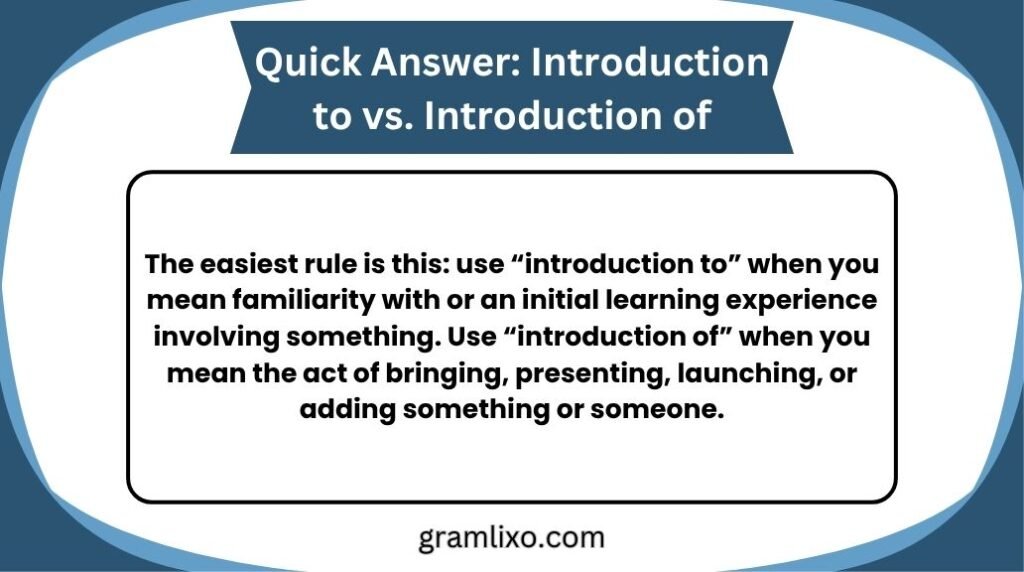
The easiest rule is this: use “introduction to” when you mean familiarity with or an initial learning experience involving something. Use “introduction of” when you mean the act of bringing, presenting, launching, or adding something or someone.
- Introduction to = an entry point into a subject, activity, person, or idea.
- Introduction of = the act of bringing something or someone into a situation, system, group, or public awareness.
Examples:
- “This is an introduction to American history.” ✅
- “The introduction of the new software improved productivity.” ✅
- “She received an introduction to the team.” ✅
- “The introduction of a new team member was brief.” ✅
Merriam-Webster defines introduction as both something that introduces and the act or process of introducing, which helps explain why both prepositions can be correct in different contexts.
Understanding the Basics of Introduction to vs. Introduction of
The words “to” and “of” create different relationships between introduction and the noun that follows it.
Think of the difference this way:
Introduction to = getting acquainted with something.
Introduction of = bringing something into existence, use, attention, or a particular setting.
The distinction becomes especially clear when you compare the following sentences:
“The book is an introduction to biology.”
Here, the book helps readers become familiar with biology.
“The introduction of a new biology textbook changed the course.”
Here, the textbook itself was newly brought into use.
Comparison Table
| Form | Type | Meaning | Example | Correct/Incorrect |
|---|---|---|---|---|
| introduction to | Noun + preposition | Familiarity with a subject, person, activity, or idea | “This is an introduction to psychology.” | ✅ Correct |
| introduction of | Noun + preposition | Act of bringing, presenting, launching, or adding something | “The introduction of the policy was controversial.” | ✅ Correct |
| introduction to | Learning/exposure | First basic experience with something | “She took an introduction to coding course.” | ✅ Correct |
| introduction of | Implementation/arrival | Bringing something into a system or situation | “The introduction of automation increased efficiency.” | ✅ Correct |
| introduction of for a learning subject | Usually wrong for this meaning | Does not naturally express learning about a subject | “This class is an introduction of chemistry.” | ❌ Usually incorrect |
| introduction to for a newly launched product | Usually wrong if emphasizing the launch | Focuses on becoming familiar with it rather than launching it | “The introduction to the new policy occurred Monday.” | ⚠️ Usually not the intended meaning |
The important point is that neither “to” nor “of” is universally correct. Your intended meaning determines the appropriate construction.
What Does “Introduction to” Mean?
“Introduction to” is normally used when someone is being introduced to a subject, concept, activity, person, field, or area of knowledge.
It often suggests a beginner-level encounter.
Examples
- “The workshop provides an introduction to digital marketing.”
- “This book is an introduction to philosophy.”
- “The teacher gave us an introduction to Shakespeare.”
- “The class offers an introduction to photography.”
- “The meeting was my first introduction to the new manager.”
In each sentence, the emphasis is on becoming acquainted with something or someone.
Merriam-Webster’s definition of introduce includes the sense of bringing someone to a knowledge of something, as in introducing people to new ideas.
“Introduction to” a Subject
This is one of the most common uses.
For example:
“This course is an introduction to economics.”
Sentence breakdown
- This course = subject
- is = linking verb
- an introduction = noun phrase
- to economics = prepositional phrase identifying the subject
The sentence means:
The course gives students their first basic exposure to economics.
Other examples include:
- Introduction to chemistry
- Introduction to accounting
- Introduction to psychology
- Introduction to programming
- Introduction to American literature
- Introduction to creative writing
These phrases are particularly common in course titles, textbooks, training programs, and educational materials.
What Does “Introduction of” Mean?
“Introduction of” generally refers to the act of bringing, presenting, adding, launching, or implementing something or someone.
Here, the noun after of is often the thing being introduced.
Examples
- “The introduction of the new law sparked debate.”
- “The introduction of electric vehicles changed the market.”
- “The introduction of new technology improved production.”
- “The introduction of the guest speaker took place at noon.”
- “The introduction of a new payment system made transactions easier.”
Merriam-Webster gives examples such as “the introduction of telephone service” and “the introduction of a new topic,” illustrating this use of of for something being brought into a situation or introduced.
“Introduction of” a New Product
Consider:
“The introduction of the new smartphone attracted considerable attention.”
This means the smartphone was launched, presented, or brought into the market.
It does not mean people were merely learning about smartphones.
Compare:
- “The company announced the introduction of a new smartphone.” → The phone is being launched.
- “The article provides an introduction to the new smartphone.” → The article helps readers understand it.
That one preposition changes the relationship between the noun and the word introduction.
Introduction to vs. Introduction of in Education
Education provides some of the clearest examples of this distinction.
Use “introduction to” for learning
- “Introduction to Biology”
- “Introduction to Statistics”
- “Introduction to Computer Science”
- “Introduction to Business”
- “Introduction to Creative Writing”
These titles suggest that learners are becoming familiar with a field.
For example:
“The professor teaches an introduction to sociology.”
The course introduces students to sociology.
Use “introduction of” for something being brought into education
Now consider:
“The introduction of tablets changed the classroom.”
The tablets are the new element being brought into the classroom.
Another example:
“The introduction of online testing changed how students completed exams.”
The focus is not on learning about online testing. The focus is on implementing it.
Simple rule
If you can replace the phrase with:
“learning about”
then introduction to is often appropriate.
If you can replace it with:
“bringing in” or “implementing”
then introduction of is often appropriate.
Introduction to vs. Introduction of People
The distinction can become slightly more interesting when people are involved.
“Introduction to a person”
“My introduction to Sarah happened at a conference.”
This means that the speaker first became acquainted with Sarah.
Another example:
“The internship was my introduction to the company’s CEO.”
The speaker’s first experience of meeting or becoming acquainted with the CEO is being described.
“Introduction of a person”
“The host gave an introduction of the keynote speaker.”
Here, the host is presenting the speaker to the audience.
However, natural English often uses:
“The host introduced the keynote speaker.”
This direct verb construction is frequently simpler and more natural.
Merriam-Webster defines introduce as including the act of causing people to become acquainted and formally presenting or announcing someone.
Compare
Introduction to John
= becoming acquainted with John.
Introduction of John
= presenting John, usually to an audience or group.
That is a useful distinction to remember.
Introduction to vs. Introduction of Ideas
The same pattern works with abstract concepts.
Introduction to an idea
“The lecture provided an introduction to the theory of evolution.”
The audience is learning about the theory.
Introduction of an idea
“The introduction of the new theory changed the debate.”
The theory was brought into the discussion.
Notice the different focus:
- to → the audience’s relationship with the idea
- of → the idea’s arrival or introduction into the discussion
This distinction is useful in academic and professional writing.
Introduction to vs. Introduction of Technology
Technology creates many opportunities to see the difference.
Introduction to technology
“The workshop provides an introduction to artificial intelligence.”
The workshop teaches participants about AI.
Introduction of technology
“The introduction of artificial intelligence changed the company’s workflow.”
AI was brought into the company’s workflow.
Another comparison
Introduction to computers
= learning the basics of computers.
Introduction of computers
= computers being brought into a particular environment.
For example:
“The introduction of computers into classrooms transformed education.”
Here, of is correct because computers were introduced into classrooms.
A Useful Test Tip 🧠
When you’re unsure whether to use to or of, ask yourself one question:
“Who or what is being introduced?”
If the sentence focuses on the person learning, experiencing, or becoming familiar with something, use to.
“She received an introduction to graphic design.”
If the sentence focuses on the thing being brought, launched, presented, or implemented, use of.
“The introduction of graphic design software changed the workflow.”
The “learning vs. bringing” test
- Learning / becoming familiar → to
- Bringing / launching / implementing → of
This is not an absolute rule for every possible sentence, but it is an excellent practical guide.
Case Study: A Workplace Email
Imagine a company has just hired a new employee and introduced a new software system.
A manager writes:
“Today, I’d like to give everyone an introduction to our new project-management software.”
This means employees will learn how to use or understand the software.
Later, the manager writes:
“The introduction of the new software will begin next Monday.”
Now the focus is on the implementation of the software.
Both sentences are grammatically correct.
Why?
The first sentence focuses on people becoming familiar with the software.
The second focuses on the software being brought into the workplace.
Another workplace example
“The training session was an introduction to our new accounting system.”
The employees are learning about the system.
“The introduction of the new accounting system reduced paperwork.”
The system was implemented.
This distinction can make workplace communication considerably clearer.
Grammar Rules Behind “Introduction to” and “Introduction of”
The noun introduction can describe different kinds of relationships.
Merriam-Webster defines introduction as something that introduces, the act or process of introducing, and something introduced.
That range of meanings explains why different prepositions can follow it.
Rule 1: “To” can identify the subject of familiarity
When introduction means an initial exposure or beginning study of something, to commonly identifies the subject.
“An introduction to economics”
Here, economics is the subject being explored.
Other examples:
- an introduction to literature
- an introduction to programming
- an introduction to photography
- an introduction to statistics
- an introduction to public speaking
Rule 2: “Of” can identify what is being introduced
When introduction means the act of bringing something into use, attention, discussion, or existence, of can identify the thing being introduced.
“The introduction of a new policy”
The policy is what has been introduced.
Other examples:
- the introduction of a new product
- the introduction of new regulations
- the introduction of a new employee
- the introduction of new technology
- the introduction of a new procedure
Rule 3: Meaning matters more than memorization
Do not memorize:
“Introduction always takes to.”
It does not.
Likewise, do not memorize:
“Introduction always takes of.”
It does not.
Instead, understand the relationship between the two nouns.
Common Mistakes With Introduction to vs. Introduction of
Why do people confuse these expressions?
There are several reasons.
1. Fast typing
When people type quickly, they often choose the first preposition that comes to mind.
For example:
“This is an introduction of marketing.”
A writer may know exactly what they mean but choose of automatically.
If the intended meaning is a beginner’s explanation of marketing, introduction to marketing is more natural.
2. Autocorrect
Autocorrect and predictive text can sometimes encourage a writer to accept a phrase without checking whether the preposition matches the intended meaning.
3. Lack of knowledge
Many English learners learn vocabulary as individual words rather than as combinations.
Learning introduction is not always enough. It is useful to learn common patterns such as:
- introduction to a subject
- introduction to a person
- introduction of a policy
- introduction of a product
- introduction of new technology
4. Similar meanings
Both expressions contain the same noun, introduction, and both involve the concept of something being “introduced.”
That makes the distinction easy to overlook.
Similar Grammar Confusions
The introduction to vs. introduction of problem belongs to a much larger family of English word-choice and grammar issues.
| Confusion | Correct distinction |
|---|---|
| its / it’s | its = possessive; it’s = it is/it has |
| your / you’re | your = possessive; you’re = you are |
| their / there / they’re | different grammatical functions |
| affect / effect | usually affect = verb; effect = noun |
| advice / advise | advice = noun; advise = verb |
| fewer / less | fewer = countable; less = generally uncountable |
| to / too / two | different meanings and functions |
| then / than | then = time/result; than = comparison |
| who / whom | different grammatical roles |
| introduction to / introduction of | familiarity/exposure vs. bringing/presenting |
The larger lesson is simple: small words can carry major meaning.
Usage in Different Contexts
Everyday Conversation
In everyday speech, introduction to is common when talking about a first experience.
“That trip was my introduction to skiing.”
This means skiing was something the speaker experienced for the first time.
Another example:
“College was my introduction to independent living.”
The person first experienced independent living in college.
Introduction of is more likely when discussing something being brought into a situation:
“The introduction of self-checkout changed the store.”
Professional Writing
Professional writing often requires careful distinctions.
Use “introduction to” when discussing:
- training
- education
- orientation
- beginner courses
- background knowledge
- first exposure
Examples:
“The workshop offers an introduction to project management.”
“The report provides an introduction to the proposed framework.”
Use “introduction of” when discussing:
- policies
- products
- services
- technology
- procedures
- regulations
- organizational changes
Examples:
“The introduction of the new policy begins in January.”
“The introduction of automated reporting reduced administrative work.”
Creative Writing
Creative writing allows more flexibility because the writer may focus on emotional experience.
“Her introduction to the city was unforgettable.”
This emphasizes her first experience of the city.
Compare:
“The introduction of the stranger into the story changed everything.”
Here, the stranger is a new character brought into the narrative.
The distinction can therefore help writers control perspective.
Social Media and Texting
In casual digital communication, people often shorten words or use informal phrasing.
You might see:
“My intro to hiking was terrible 😂.”
Here, intro is simply a casual shortening of introduction. Merriam-Webster lists intro as a noun meaning introduction.
In formal writing, however, use the complete form when appropriate:
“My introduction to hiking was challenging.”
For social media, clarity still matters, especially when a post is intended for a broad audience.
Why “Introduction to” vs. “Introduction of” Matters
At first glance, this may seem like a tiny grammar issue. But precise preposition choice improves communication.
1. Clarity
Compare:
“The introduction to the new policy”
and
“The introduction of the new policy”
These can point to different situations.
The first can mean an explanation or orientation concerning the policy.
The second can mean the policy itself was brought into effect.
2. Professionalism
Correct word combinations make business emails, reports, essays, and presentations sound more polished.
3. Digital communication
Online writing is often read quickly. Clear grammar helps readers understand your intended meaning without stopping to interpret the sentence.
4. Academic accuracy
In academic writing, the difference can affect whether you are describing learning about a topic or the arrival of a concept, method, or development.
“An introduction to linguistics”
is a course or overview.
“The introduction of a new linguistic theory”
describes the theory being brought into scholarly discussion.
A short reminder
Choose the preposition that matches the relationship, not the one that merely sounds familiar.
Special Exceptions and Edge Cases
There is no major exception that makes “introduction to” or “introduction of” universally interchangeable. However, context can make either expression natural.
For example:
“The introduction of John was brief.”
This may refer to someone formally presenting John.
But:
“My introduction to John was brief.”
means the speaker’s first interaction or acquaintance with John was brief.
Similarly:
“The introduction of the book was well received.”
can mean the book’s launch or presentation.
But:
“The introduction to the book was well written.”
usually refers to the introductory section at the beginning of the book.
This is an especially important distinction.
Introduction to a book
Usually means the introductory material about the book’s subject or content.
“The introduction to the book explains the historical background.”
Introduction of a book
Can mean the act of presenting or launching the book.
“The introduction of the book at the conference attracted attention.”
Context determines the intended meaning.
“Introduction to” vs. “Introduction of” in Book Writing
Books provide another useful comparison.
“Introduction to”
“The book is an introduction to modern architecture.”
The book teaches readers about modern architecture.
“Introduction of”
“The introduction of the book took place at the annual conference.”
The book was formally presented or launched.
There is another construction worth noticing:
“The introduction of the book discusses the author’s research.”
This sentence can sound awkward because introduction might mean the opening section of the book. In that situation, writers often simply say:
“The introduction to the book discusses the author’s research.”
The preposition to clearly connects the introductory section with the book.
Can “Introduction to” and “Introduction of” Ever Be Interchangeable?
Sometimes the broader context may make the meaning seem similar, but they are not generally interchangeable.
Consider:
“The introduction to the new system was difficult.”
This could mean learning or becoming familiar with the system was difficult.
Now:
“The introduction of the new system was difficult.”
This more strongly suggests that implementing or launching the system was difficult.
Both are grammatical.
But the perspective changes.
“To” focuses on the relationship or destination
The introduction leads someone to the subject.
“Of” focuses on the thing being introduced
The introduction concerns the thing that was introduced.
That is why replacing one with the other can subtly change your meaning.
Quick Recap Checklist
Use this checklist whenever you are uncertain.
| Question | If Yes → Use |
|---|---|
| Does the phrase mean learning about a subject? | introduction to |
| Does it describe first exposure to something? | introduction to |
| Does it describe becoming acquainted with a person? | introduction to |
| Does it mean bringing a product into the market? | introduction of |
| Does it mean implementing a policy? | introduction of |
| Does it mean bringing technology into use? | introduction of |
| Does it mean formally presenting someone? | introduction of can be appropriate |
| Is the focus on the thing being brought into a situation? | introduction of |
Practice Examples
Example 1
“This course is an ________ accounting.”
The meaning is learning the basics of accounting.
Answer: introduction to ✅
Example 2
“The ________ new regulations caused confusion.”
The regulations were brought into effect.
Answer: introduction of ✅
Example 3
“The internship was my first ________ professional journalism.”
The meaning is first exposure to the field.
Answer: introduction to ✅
FAQs About Introduction to vs. Introduction of
1. Is “introduction to” grammatically correct?
Yes. “Introduction to” is grammatically correct when referring to becoming familiar with or learning about a subject, person, activity, or idea.
Example:
“This textbook is an introduction to chemistry.”
2. Is “introduction of” grammatically correct?
Yes. “Introduction of” is correct when introduction means bringing, presenting, launching, adding, or implementing something.
Example:
“The introduction of the new policy created several questions.”
3. Should I say “an introduction to English” or “an introduction of English”?
Usually, say “an introduction to English” when you mean a beginner-level course or explanation about English.
Example:
“She enrolled in an introduction to English course.”
4. Should I say “the introduction to the new policy” or “the introduction of the new policy”?
It depends on your meaning.
- Introduction to the new policy = an explanation or orientation that helps people understand the policy.
- Introduction of the new policy = the act of bringing or implementing the policy.
Both can be correct.
5. Is “introduction of a person” correct?
Yes, depending on the context. “Introduction of a person” can describe formally presenting that person to an audience or group.
However, “introduction to a person” usually emphasizes becoming acquainted with that person.
Compare:
- “My introduction to David was unexpected.”
- “The host’s introduction of David was brief.”
6. Is “introduction to vs. introduction of” a grammar or vocabulary issue?
It is mainly a grammar and usage issue involving prepositions and meaning. The noun introduction can be followed by different prepositions depending on the relationship being expressed.
A useful shortcut is:
Introduction to = becoming familiar with something.
Introduction of = bringing or presenting something.
Conclusion
Understanding introduction to vs. introduction of becomes much easier once you stop treating the two expressions as interchangeable. “Introduction to” generally describes becoming familiar with a subject, person, activity, or idea. “Introduction of” generally describes the act of bringing, presenting, launching, or implementing something or someone. For example, “an introduction to economics” is a beginner-level exploration of economics, while “the introduction of a new policy” refers to bringing that policy into use. Merriam-Webster’s definitions of introduction and introduce support these different senses, including both becoming acquainted with something and bringing something into a situation.
When you’re unsure, ask yourself: Am I talking about becoming familiar with something, or am I talking about bringing something in? If it is familiarity, choose to. If it is bringing, launching, presenting, or implementing, choose of. Master that simple distinction, and this common preposition problem becomes far less confusing. ✨
Remember: “to” points toward what you’re learning; “of” points to what is being introduced.

I’m Michael Williams, an English writer and grammar enthusiast at Gramlixo. I’m passionate about making grammar easier to learn and helping readers write with greater confidence.



[…] |Introduction to vs. Introduction of: What’s the Difference? […]