Day off vs off day is a common English phrase confusion, especially when talking about work schedules, free time, or personal performance. Although these expressions contain the same two words, their meanings are different.
A day off means a day when you do not have to work or perform your usual duties, while an off day usually describes a day when you are not performing as well as normal or when things are not going smoothly.
Understanding day off vs off day can help you communicate more clearly in everyday conversations, professional emails, workplace messages, and social media posts.
In this guide, you will learn the key differences, correct meanings, grammar rules, examples, common mistakes, and simple tips for choosing the right expression.
|Aging vs Ageing: What Is the Difference?
|Die vs Dice: What’s the Difference and When Should You Use Each?
|Loot vs Lute: What’s the Difference? Meaning, Usage, and Examples
Quick Answer: Day Off vs Off Day
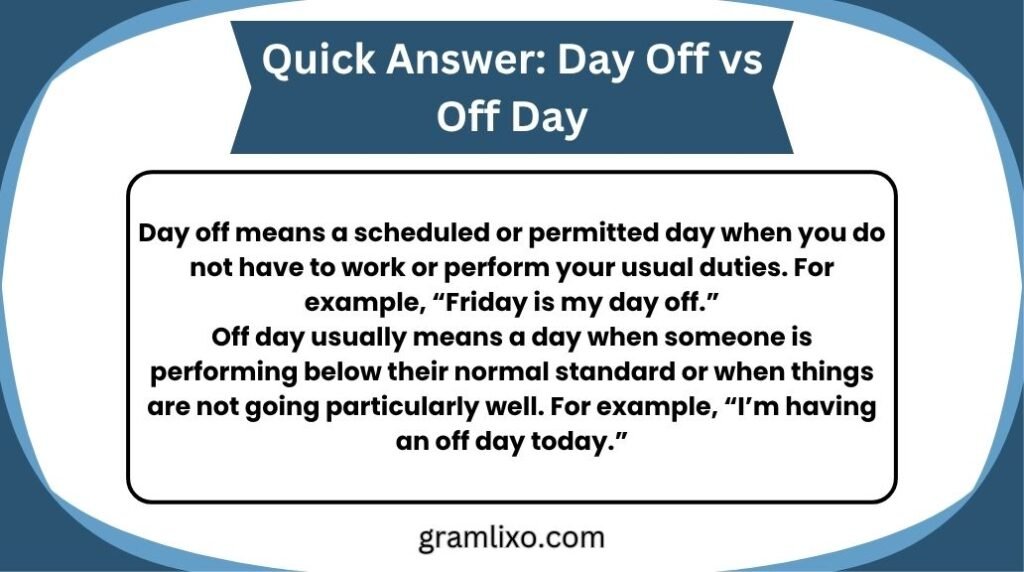
Day off means a scheduled or permitted day when you do not have to work or perform your usual duties. For example, “Friday is my day off.”
Off day usually means a day when someone is performing below their normal standard or when things are not going particularly well. For example, “I’m having an off day today.”
So, remember:
Day off = no regular work or duties.
Off day = a less-than-usual day or poor performance.
Merriam-Webster defines the idiom “take a/the day off” as deciding not to work on a particular day.
Understanding the Basics of Day Off vs Off Day
The easiest way to understand day off vs off day is to look at what each expression focuses on.
A day off focuses on your schedule. You are normally expected to work, study, or perform a regular duty, but you are free from that obligation for the day.
An off day focuses more on performance, condition, mood, or circumstances. You might still be working on an off day. In fact, you could be at work while having an off day.
For example:
- “Tomorrow is my day off.” → You do not have to work tomorrow.
- “I’m having an off day.” → You are not feeling or performing normally today.
Comparison Table
| Form | Type | Meaning | Example | Correct/Incorrect |
|---|---|---|---|---|
| day off | Noun phrase | A day away from regular work or duties | “Saturday is my day off.” | ✅ Correct |
| off day | Noun phrase | A day when performance or circumstances are below normal | “The pitcher had an off day.” | ✅ Correct |
| take a day off | Verb phrase/idiom | Decide not to work for a day | “I’m going to take a day off.” | ✅ Correct |
| have a day off | Verb + noun phrase | Have a scheduled or permitted non-working day | “I have a day off tomorrow.” | ✅ Correct |
| have an off day | Verb + noun phrase | Experience a poor or unusual day | “I’m having an off day.” | ✅ Correct |
| take an off day | Context-dependent | Can mean taking a rest day, especially in informal or specialized contexts | “I took an off day from training.” | ⚠️ Context-dependent |
| dayoff | Incorrect standard spelling | Not normally written as one word | “Friday is my dayoff.” | ❌ Incorrect |
| offday | Incorrect standard spelling | Not normally written as one word | “I’m having an offday.” | ❌ Incorrect |
The important point is that both “day off” and “off day” are legitimate expressions. The issue is not that one is correct and the other is wrong. The issue is meaning and context.
Merriam-Webster’s entry for off includes senses related to being away from regular work and being “spent off duty,” while its idiom entry specifically defines “take a/the day off” as deciding not to work on a particular day.
What Does “Day Off” Mean?
A day off is a day when you are not required to work or perform your normal responsibilities.
It may be:
- regularly scheduled
- requested and approved
- given by an employer
- taken as vacation
- used for rest
- part of a rotating work schedule
Example 1: Work Schedule
“Monday is my day off.”
This means the speaker does not have to work on Monday.
Example 2: Requesting Leave
“Can I take Friday off?”
The speaker wants permission to avoid work on Friday.
Example 3: Enjoying Free Time
“I’m going to relax on my day off.”
The speaker is talking about a non-working day.
Example 4: Regular Schedule
“My days off are Saturday and Sunday.”
Here, days off refers to the days when the person does not normally work.
A day off does not necessarily mean that the person spends the day doing nothing. Someone might clean the house, travel, exercise, study, go shopping, or spend time with family.
The important idea is simply that the person is free from their normal work or duty.
What Does “Off Day” Mean?
An off day generally describes a day when someone is not performing as well as usual or when something feels less successful than normal.
For example:
“I’m having an off day today.”
This could mean the speaker feels tired, distracted, stressed, unmotivated, or simply not like themselves.
Oxford Learner’s Dictionaries defines off day as a day when someone does not do things as well as usual.
Example 1: Poor Performance
“The team had an off day.”
The team performed below its usual level.
Example 2: Feeling Unwell or Unfocused
“I’m sorry about the mistake. I’m having an off day.”
The speaker is saying that their performance today is not normal.
Example 3: Sports
“The basketball player had an off day.”
The player probably performed worse than expected.
Example 4: Work
“Even experienced employees can have an off day.”
This means that experienced employees can occasionally make more mistakes or perform below their normal standard.
Notice that the person can still be working on an off day.
That is one of the easiest ways to distinguish the two expressions.
Day Off vs Off Day: The Core Difference
The simplest rule is:
Day off = absence from normal work
“I have a day off tomorrow.”
You are not working.
Off day = below-normal performance or an unusual day
“I had an off day at work.”
You are working, but things are not going as well as usual.
Think of it this way:
DAY OFF → schedule
OFF DAY → performance/condition
This distinction solves most usage questions.
Day Off: Common Uses and Examples
1. A Scheduled Non-Working Day
“Wednesday is my day off.”
This is one of the most common uses.
The speaker is simply describing their schedule.
2. A Day Away From Work
“I need a day off after this busy week.”
The speaker wants time away from work.
3. An Approved Leave Day
“My manager gave me a day off.”
The employee received permission not to work.
4. A Rest Day
“I’m taking a day off from the gym.”
Here, the phrase can mean a break from a regular activity rather than formal employment.
5. Multiple Days
The plural form is:
“days off”
For example:
“I have three days off next week.”
Not:
“I have three day offs.”
The noun day changes to plural:
one day off → two days off
Off Day: Common Uses and Examples
1. Poor Performance
“The quarterback had an off day.”
The quarterback did not perform at the usual level.
2. A Bad or Difficult Day
“Today has been an off day for me.”
The speaker feels that the day has not gone normally or well.
3. Lack of Focus
“I can’t concentrate today. I’m having an off day.”
The phrase describes the speaker’s condition.
4. A Temporary Dip in Performance
“Everyone has an off day sometimes.”
This is a useful expression because it emphasizes that poor performance can happen occasionally.
5. Sports and Competition
“Off day” is especially common when discussing athletes.
“The tennis player had an off day.”
This does not normally mean that the tennis player had a vacation day.
Instead, it means the athlete performed below expectations.
The Important Difference Between “My Day Off” and “My Off Day”
Consider these two sentences:
“Today is my day off.”
“Today is my off day.”
They may look almost identical, but the intended meaning can be very different.
“Today is my day off.”
This normally means:
I am not scheduled to work today.
“Today is my off day.”
This may mean:
Today is a day when I am not performing well or do not feel normal.
However, in some informal contexts, especially fitness, sports, shift work, or non-American varieties of English, off day can sometimes be used to mean a scheduled rest day.
That is why context matters.
For standard American English, if you mean “I don’t have to work today,” the clearest choice is:
Today is my day off.
Test Tip: How to Choose the Correct Phrase
Here is a quick test.
Ask yourself:
“Am I talking about my schedule?”
If yes, use day off.
“Friday is my day off.”
“Am I talking about poor performance or an unusual condition?”
If yes, use off day.
“I’m having an off day.”
This simple test works in most everyday situations.
Another useful question is:
Am I working today?
If you are not working, you probably mean day off.
If you are working but performing poorly, you probably mean off day.
Case Study: A Workplace Conversation
Imagine Sarah works at a hospital.
Her normal schedule gives her Tuesday off.
On Wednesday, she returns to work but makes several small mistakes because she is tired.
Here is how the two expressions work:
Tuesday:
Sarah: “Tuesday is my day off, so I’m going to rest.”
This is about her work schedule.
Wednesday:
Sarah: “I’m sorry about those mistakes. I’m having an off day.”
This is about her performance.
The same person can have both a day off and an off day, but the meanings are different.
Workplace Email Example
“I will be out of the office on Friday because it is my scheduled day off.”
This is professional and clear.
But if an employee writes:
“Friday is my off day.”
The sentence may be understood, but day off is usually clearer when the intended meaning is a scheduled non-working day.
Day Off in Professional Writing
In professional American English, day off is the safest choice when discussing work schedules.
Use it in:
- emails
- HR communication
- schedules
- leave requests
- workplace notices
- employee messages
- formal conversations
Examples
“I would like to request a day off next Friday.”
“I will be unavailable because Friday is my scheduled day off.”
“She has two days off next week.”
“Could I take Monday off?”
These sentences are clear and natural.
What About “Off Day”?
Use off day when you genuinely mean a day of poor performance or an unusual condition.
“The sales team had an off day yesterday.”
“The athlete admitted that he had an off day.”
“I’m having an off day, so I may need extra time.”
Day Off in Everyday Conversation
Day off is extremely natural in casual speech.
You might hear:
“What are you doing on your day off?”
“I finally have a day off!”
“I’m working tomorrow, but I have Friday off.”
“Let’s go out on my day off.”
These expressions sound natural in American English.
People often use have, get, take, or get a with day off.
Common Patterns
have a day off
“I have a day off tomorrow.”
take a day off
“I’m going to take a day off.”
get a day off
“We finally get a day off.”
have Friday off
“I have Friday off.”
All of these are common constructions.
Merriam-Webster specifically records take a/the day off as an idiom meaning to decide not to work on a particular day.
Off Day in Everyday Conversation
Off day is also common in informal conversation, particularly when someone feels that things are not going well.
“I’m having an off day.”
“We all have off days.”
“It was just an off day.”
“The team had an off day.”
The expression can soften criticism because it suggests that poor performance is temporary rather than a permanent problem.
For example:
“He isn’t a bad player. He just had an off day.”
This means his poor performance was unusual.
Day Off vs Off Day in Sports
Sports provide one of the clearest examples of the difference.
Day Off
A player might say:
“The team has a day off tomorrow.”
This means the team does not have a scheduled practice or game.
Off Day
A sports commentator might say:
“The star player had an off day.”
This means the player performed below expectations.
Therefore:
The team had a day off.
means no regular activity.
But:
The team had an off day.
usually means poor performance.
This distinction is especially important in sports journalism because the two phrases can lead to very different interpretations.
Day Off vs Off Day in Creative Writing
Creative writing gives authors more freedom.
A writer might say:
“After three exhausting weeks, she finally had a day off.”
This creates a sense of relief.
Another sentence might say:
“It was an off day, and nothing seemed to go right.”
Here, off day creates a mood of frustration or unusual difficulty.
Writers can use the expressions to show different experiences:
- day off → freedom, rest, leisure, break
- off day → frustration, poor performance, fatigue, unusual circumstances
The surrounding context usually makes the intended meaning clear.
Day Off vs Off Day in Texting and Social Media
Informal digital communication often uses both expressions.
For example:
“Finally got a day off 😌”
This means the person is free from work.
Another person might post:
“Having an off day today 😩”
This suggests that the person feels tired, distracted, stressed, or unsuccessful.
Social Media Examples
Day off:
“Day off = coffee, movies, and absolutely no emails. ☕🎬”
Off day:
“Definitely having an off day today. Nothing is going right. 😩”
Both are natural, but they communicate different ideas.
Why Do People Confuse Day Off and Off Day?
The confusion is understandable because English often changes meaning when word order changes.
Compare:
- day off
- off day
The same two words appear in reverse order, but the phrase changes meaning.
English contains many similar examples:
- a houseboat vs a boat house
- a blackboard vs a board that is black
- a workday vs a day of work
- a rest day vs a day of rest
Word order matters.
In day off, off modifies the idea of the day being away from normal work or duty.
In off day, off describes the day as unusual, below normal, or unsuccessful.
Grammar Rules: Why the Word Order Matters
There is no universal grammar rule saying that day off is correct while off day is incorrect.
Both are established English expressions.
The difference comes from lexical meaning and conventional usage, not simply from grammar.
Merriam-Webster’s entry for off includes meanings associated with suspension or absence from regular work, such as “off duty,” and its dictionary also recognizes “take a/the day off” as an idiom.
At the same time, off can function as an adjective meaning below the usual standard or poor. Merriam-Webster lists senses of off connected with being incorrect or below normal.
This helps explain expressions such as:
“He is off his game.”
and:
“She had an off day.”
In both cases, off suggests that performance is not at its normal level.
Is “Off Day” Grammatically Correct?
Yes.
Off day is grammatically acceptable and widely used.
For example:
“Everyone has an off day.”
This is completely natural.
However, if you are talking specifically about a scheduled non-working day, day off is usually the better choice in American English.
So don’t think:
“Off day is wrong.”
Instead, think:
Off day has a different meaning.
Is “Day Off” Grammatically Correct?
Yes.
Day off is standard and extremely common.
Examples:
“I have a day off tomorrow.”
“She took a day off.”
“Monday is my day off.”
“We have two days off.”
These are all correct.
Common Mistakes With Day Off vs Off Day
Mistake 1: Using “off day” for a work holiday
Incorrect or unclear:
“Tomorrow is my off day.”
Better when referring to a scheduled non-working day:
“Tomorrow is my day off.”
Mistake 2: Assuming “day off” means poor performance
Incorrect meaning:
“The team had a day off during the game.”
If you mean the team performed poorly, say:
“The team had an off day.”
Mistake 3: Writing the phrase as one word
Avoid:
“I have a dayoff.”
Use:
“I have a day off.”
Also avoid:
“I had an offday.”
Use:
“I had an off day.”
Mistake 4: Incorrect pluralization
Don’t write:
“I have two day offs.”
Use:
“I have two days off.”
The plural belongs to day.
Why These Mistakes Happen
Several factors can cause confusion.
Fast Typing
When people type quickly, they may reverse the words or combine them.
Autocorrect
Phone keyboards sometimes change phrases automatically or fail to recognize less common constructions.
Lack of Knowledge
English learners may see both forms and assume they are interchangeable.
Regional Usage
English varies across regions. Some expressions may be more common in particular varieties of English or specialized settings.
Context
The same person can use both phrases in the same week, but with different meanings.
The best solution is not to memorize a complicated grammar rule. Instead, remember the meaning of each expression.
Similar Grammar Confusions
| Confusing Forms | Correct Meaning |
|---|---|
| day off / off day | Non-working day / below-normal day |
| it’s / its | It is / possessive form |
| your / you’re | Possessive / you are |
| their / they’re | Possessive / they are |
| then / than | Time or sequence / comparison |
| affect / effect | Usually verb / usually noun |
| advice / advise | Noun / verb |
| practice / practise | American English uses “practice” for both noun and verb |
| everyday / every day | Adjective / each day |
| sometime / some time | At an unspecified time / a period of time |
These pairs demonstrate an important feature of English: small differences can change meaning or grammatical function.
A Simple Memory Trick 🧠
Use this:
DAY OFF = OFF WORK
If you are away from work:
“I have a day off.”
OFF DAY = OFF YOUR USUAL PERFORMANCE
If your performance or mood is below normal:
“I’m having an off day.”
Another shortcut:
Day off = schedule 📅
Off day = performance 🎯
This two-word memory trick can help you choose correctly without thinking too much.
Day Off vs Off Day: Professional Examples
Employee Email
“I would like to request a day off next Thursday for a personal appointment.”
Correct because the employee is requesting time away from work.
Manager Message
“You are scheduled to have Friday off.”
Correct because Friday is a non-working day.
Performance Review
“The employee appeared to have an off day during the presentation.”
Correct because the phrase describes performance.
Sports Report
“The pitcher had an off day and struggled throughout the game.”
Correct because the pitcher performed poorly.
Customer Service
“I apologize for the mistake. I’m having an off day.”
Correct because the speaker is describing their condition.
Can “Off Day” Ever Mean a Day Off?
Yes, but this is where context and regional or specialized usage matter.
In some contexts, particularly informal speech, sports, fitness, or shift-based work, people may use off day to mean a day away from a normal activity.
For example:
“Monday is my off day from training.”
Here, the speaker means Monday is the day they do not train.
This usage can be understood because from training provides the missing context.
However, if your goal is maximum clarity in standard American English, especially in professional writing, prefer:
“Monday is my day off from training.”
or:
“Monday is my rest day.”
This avoids ambiguity.
Oxford specifically records off day with the meaning of a day when someone does not perform as well as usual, which reinforces the performance-related sense.
Special Exception: Fitness and Training Language
Fitness culture sometimes uses off day differently.
A trainer might say:
“Take an off day between intense workouts.”
In this context, off day can mean a day without regular training.
You may also hear:
“Today is my off day from the gym.”
This does not necessarily mean the speaker is performing poorly. It means they are taking a break from training.
For maximum clarity, however, rest day is often even clearer:
“Today is my rest day.”
So context determines whether off day means a poor-performance day or a break from an activity.
Day Off vs Off Day: Which One Should You Use?
Use day off when you mean:
- a non-working day
- approved leave
- scheduled free time
- a break from regular duties
- time away from work
- a day without a normal activity
Use off day when you mean:
- poor performance
- an unusual day
- feeling unlike yourself
- a day when things go badly
- below-normal results
Quick Decision
Do you mean “I don’t have to work”?
→ day off
Do you mean “I am not performing normally”?
→ off day
Do you mean “I am taking a break from training”?
→ rest day or, depending on context, off day
Why the Difference Matters
The distinction between day off vs off day may seem small, but choosing the right expression makes communication clearer.
1. Clarity
Compare:
“I have an off day tomorrow.”
with:
“I have a day off tomorrow.”
The second sentence immediately tells the reader that the speaker is not working.
2. Professionalism
Clear workplace language reduces misunderstandings.
When discussing schedules, leave, shifts, or availability, day off is usually the clearest choice.
3. Digital Communication
Messages and emails often lack additional context.
A short sentence such as:
“I’m off Friday.”
can mean several things.
But:
“Friday is my day off.”
is clearer.
4. Better Writing
Knowing the difference helps you communicate more precisely without using unnecessary words.
A useful rule is:
Choose the phrase based on what you want to describe: your schedule or your performance.
A Short Quote to Remember
“Your day off is about when you work; your off day is about how the day goes.”
That is not a formal dictionary definition, but it is a useful memory device.
Quick Recap Checklist
| Question | If Yes → Use |
|---|---|
| Are you not scheduled to work? | day off |
| Did your employer give you leave? | day off |
| Are you taking a break from normal duties? | day off |
| Are you performing worse than usual? | off day |
| Are you having an unusually difficult day? | off day |
| Are you discussing poor sports performance? | off day |
| Are you talking about a gym rest day? | rest day or context-dependent off day |
Practice Examples
1. “Saturday is my ___.”
Answer: day off
2. “The player had an ___ during the championship.”
Answer: off day
3. “I’m exhausted, so I’m going to take a ___.”
Answer: day off
Try creating your own sentences using both expressions. If you can explain whether you are describing a schedule or performance, you probably have the distinction right.
Frequently Asked Questions
1. Is “day off” or “off day” correct?
Both are correct, but they have different meanings. A day off is a day when you are free from your normal work or duties. An off day usually describes a day when you perform below your normal level or when things do not go well.
2. What is the difference between “day off” and “off day”?
A day off refers to your schedule, while an off day generally refers to your performance, condition, or circumstances. For example, “Friday is my day off” means you do not work Friday. “I’m having an off day” means you are not feeling or performing normally.
3. Is “off day” grammatically correct?
Yes. Off day is a correct and established expression. It is commonly used to describe a day when someone does not perform as well as usual. Oxford Learner’s Dictionaries gives this meaning for off day.
4. Is “day off” one word or two words?
Day off is written as two words. The plural is days off, not “dayoffs” or “day offs.”
Correct:
“I have two days off.”
5. Can I say “I have an off day tomorrow” to mean I don’t work tomorrow?
It may be understood in some contexts, but “I have a day off tomorrow” is clearer when you mean you are not scheduled to work. In standard American English, use day off for a non-working day.
6. Can “off day” mean a rest day?
Yes, in some informal or specialized contexts, especially fitness or shift-based work, off day can mean a day away from a particular activity. However, rest day or day off may be clearer depending on what you mean.
Conclusion
Understanding day off vs off day is much easier once you focus on meaning rather than word order. A day off is a day when you are free from your normal work, responsibilities, or activities. An off day usually describes a day when your performance, mood, or circumstances are below your normal level.
For example, “Friday is my day off” means you do not have to work Friday. “I’m having an off day” means you are not feeling or performing at your best. In some specialized contexts, off day can also refer to a rest day, so context remains important.
Merriam-Webster’s treatment of off and its idiom “take a/the day off” supports the non-working-day sense, while Oxford’s entry for off day highlights the below-usual-performance meaning.
The easiest rule to remember is simple: a day off is about your schedule; an off day is usually about how things are going. Once you remember that distinction, you can use both expressions confidently and accurately.
Remember: Your “day off” tells people when you are free; your “off day” tells them when you are not at your best.

I’m Michael Williams, an English writer and grammar enthusiast at Gramlixo. I’m passionate about making grammar easier to learn and helping readers write with greater confidence.

[…] |Day Off vs Off Day: What’s the Difference? […]
[…] |Day Off vs Off Day: What’s the Difference? […]
[…] |Day Off vs Off Day: What’s the Difference? […]