Have you ever typed a word that sounded right in your head, only to wonder whether you spelled it correctly? Loot vs lute is one of those confusing word pairs.
The two words look almost identical, and they are pronounced similarly, but they have completely different meanings. One is connected to stolen goods or valuable things taken by force, while the other refers to a traditional musical instrument. 🎵
I know this kind of spelling confusion can be frustrating, especially when you are writing quickly, texting, studying English, or trying to make your professional writing sound polished. The good news is that the difference between loot and lute is actually easy to remember once you connect each word with its meaning.
In this guide, we will explore loot vs lute, including their definitions, pronunciation, grammatical roles, common uses, examples, mistakes, and practical ways to remember which word to choose. By the end, you will never have to guess between these two words again.
|Tortuous vs Torturous: What’s the Difference? Easy Guide With Examples
|Company-Wide vs Companywide: Which Is Correct?
|Continuous vs Contious: Which Spelling Is Correct?
Quick Answer: Loot vs Lute
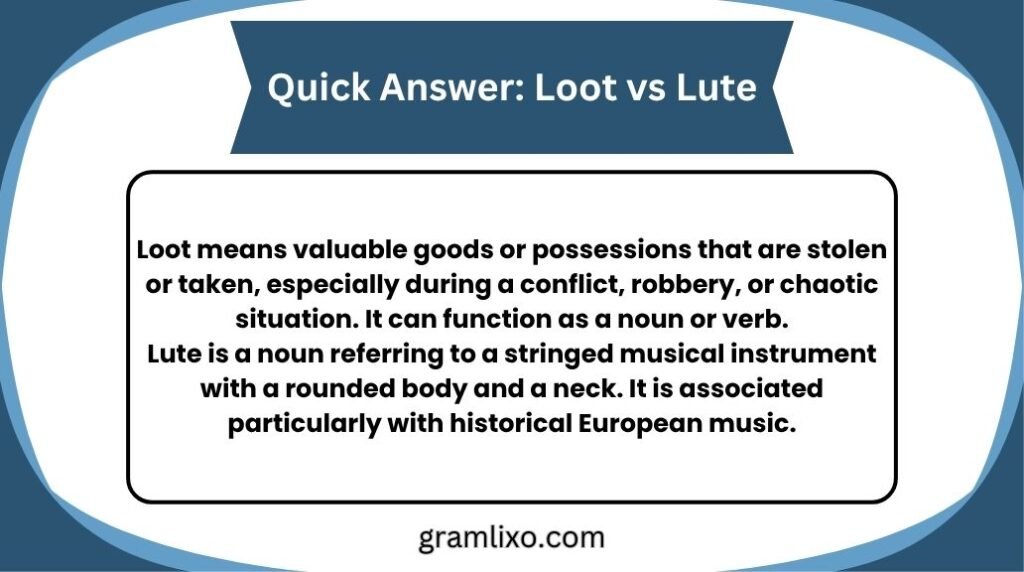
Loot means valuable goods or possessions that are stolen or taken, especially during a conflict, robbery, or chaotic situation. It can function as a noun or verb.
Lute is a noun referring to a stringed musical instrument with a rounded body and a neck. It is associated particularly with historical European music.
Easy memory trick:
👉 Loot = things taken or stolen.
👉 Lute = a musical instrument. 🎶
Understanding the Basics: Loot vs Lute
The main difference between loot and lute is meaning, not grammar alone.
Although the words differ by only one vowel, they describe entirely unrelated things. Loot is associated with stealing, valuable possessions, or taking goods. Lute, on the other hand, is associated with music.
| Word | Form | Type | Meaning | Example | Correct/Incorrect |
|---|---|---|---|---|---|
| loot | Noun/Verb | Common English word | Stolen or illegally taken goods; to steal or take valuable goods | The thieves escaped with the loot. | ✅ Correct |
| lute | Noun | Musical term | A stringed musical instrument | She played a beautiful melody on the lute. | ✅ Correct |
| lute | Noun | Musical term | A historical stringed instrument with a rounded body | The musician studied the lute. | ✅ Correct |
| loot | Noun | Possessions/goods | Valuable items taken during theft or conflict | The police recovered the stolen loot. | ✅ Correct |
| lute | Used for stolen goods | — | Does not mean stolen property | The thieves took the lute. | ❌ Wrong if you mean stolen goods |
| loot | Used for instrument | — | Does not mean a musical instrument | He played the loot. | ❌ Wrong if you mean the instrument |
The key is simple: loot concerns possessions; lute concerns music.
What Does “Loot” Mean?
Loot has two major grammatical uses: it can be a noun and a verb.
Loot as a Noun
As a noun, loot refers to valuable things that have been stolen or taken, particularly during a robbery, war, riot, or other disorderly situation.
Examples
- The robbers divided the loot among themselves.
- Police recovered the stolen loot.
- The pirates hid their loot on a remote island.
- The thieves escaped with thousands of dollars in loot.
In each sentence, loot refers to the goods or valuables that were taken.
Sentence Breakdown
Consider:
The thieves hid the loot.
- The thieves = subject
- hid = verb
- the loot = object
Here, loot is a noun because it names the stolen valuables.
Loot as a Verb
Loot can also function as a verb meaning to steal valuable things, especially from a place during disorder or conflict.
Examples:
- The attackers looted several stores.
- Criminals looted the abandoned building.
- Several shops were looted overnight.
- The soldiers were accused of looting villages.
Notice how the form changes:
- loot
- looted
- looting
A Useful Pattern
If you can replace the word with steal, stolen goods, or valuable things taken illegally, you probably need loot.
Example:
The criminals took the valuable goods.
You could say:
The criminals took the loot.
What Does “Lute” Mean?
A lute is a musical instrument.
It is a stringed instrument with a rounded or pear-shaped body and a neck. Lutes have been used in various forms across different cultures and periods, and the European lute became especially important in medieval and Renaissance music. 🎵
Examples
- The musician played a beautiful lute melody.
- She is learning to play the lute.
- The museum displayed an ancient lute.
- Renaissance musicians often performed with the lute.
- He carefully tuned the strings of his lute.
In all these examples, lute refers to the instrument.
Sentence Breakdown
Consider:
The musician played the lute.
- The musician = subject
- played = verb
- the lute = object
The word lute is a noun because it names a musical instrument.
Loot vs Lute Pronunciation
Another reason this pair can be confusing is that the words sound very similar.
In standard American English, they are generally pronounced differently because of their vowel sounds:
- loot → /luːt/
- lute → /luːt/
Interestingly, in standard pronunciation, loot and lute are typically homophones. That means they sound alike but have different spellings and meanings.
This makes context especially important.
For example:
He played the lute.
and
He found the loot.
The pronunciation alone does not tell you which word is intended. The surrounding words do.
Merriam-Webster’s pronunciation guidance explains that English spelling does not always provide a simple one-to-one relationship between letters and sounds, which is one reason words that sound alike can have different spellings.
Loot vs Lute: The Core Difference
The easiest way to understand the distinction is to associate each word with a specific concept.
Loot = Stolen or Taken Goods 💰
Think about:
- robbery
- theft
- pirates
- valuable possessions
- stolen money
- goods taken during conflict
Example:
The pirates buried their loot.
Lute = Musical Instrument 🎶
Think about:
- strings
- music
- musicians
- Renaissance
- historical instruments
- melodies
Example:
The musician carefully tuned her lute.
The One-Line Rule
If you are talking about stolen valuables, use “loot.” If you are talking about a stringed musical instrument, use “lute.”
Correct Meanings and Uses of “Loot”
Let’s look more closely at how loot works in everyday English.
Loot as Stolen Property
The most common noun use describes things that have been stolen.
The police recovered the loot from the warehouse.
Here, loot refers to stolen property.
More examples
- The burglars divided the loot.
- The stolen loot was eventually recovered.
- Investigators discovered the loot in an abandoned car.
- The thieves hid their loot in the basement.
Loot as a Verb
As a verb, loot means to steal valuable items, often from a place.
Criminals looted several businesses.
Here, looted describes the action.
More examples
- The store was looted during the unrest.
- Thieves looted the abandoned house.
- The group was accused of looting valuable artifacts.
Test Tip 🧠
Replace loot with steal.
If the sentence still makes sense, loot may be correct.
They looted the store.
→ They stole things from the store.
That meaning works.
Correct Meanings and Uses of “Lute”
The word lute is much more specialized.
It normally refers to a stringed instrument.
Lute as a Musical Instrument
Examples:
The performer played the lute beautifully.
The museum has an impressive collection of historic lutes.
She studied Renaissance music and learned the lute.
The word can also appear in discussions about:
- classical music
- Renaissance music
- medieval music
- music history
- traditional instruments
- instrument construction
Test Tip 🧠
Ask:
“Am I talking about music or an instrument?”
If yes, lute is probably the word you need.
Loot vs Lute in Real-Life Conversation
Imagine two friends are visiting a historical museum.
Friend A says:
Look at that beautiful lute!
Friend B replies:
Yes, it’s a fascinating musical instrument.
Now imagine a completely different situation:
The police found the stolen loot.
These situations make the difference obvious.
A lute belongs in a music-related context.
Loot belongs in a theft or valuable-property context.
Case Study: A Workplace Email
Imagine an employee writing an email about an office event involving historical music.
An employee writes:
We will display a Renaissance lute during Friday’s presentation.
That is correct because the email refers to a musical instrument.
Now imagine a security report:
The investigation team recovered the stolen loot from the storage room.
Again, the word is correct because the sentence refers to stolen property.
Why Context Matters
Both words may sound identical when spoken, so spelling becomes particularly important in written communication.
A sentence such as:
We found the loot in the music room.
means something completely different from:
We found the lute in the music room.
The first sentence suggests stolen valuables.
The second sentence refers to a musical instrument.
One letter changes the meaning completely.
Grammar Rules: Why Loot and Lute Are Both Correct
There is an important point here: neither “loot” nor “lute” is inherently incorrect.
They are both legitimate English words.
The mistake occurs when you use the wrong word for the intended meaning.
Loot
Loot can be:
- a noun
- a verb
Examples:
The thieves stole the loot.
The criminals looted the store.
Lute
Lute is primarily a noun.
Example:
She played the lute.
Because the two words have different meanings, grammar alone cannot determine which spelling you need. Meaning and context determine the correct choice.
Standard dictionaries such as Merriam-Webster distinguish words by spelling, pronunciation, grammatical category, and meaning. This is especially useful with homophones and near-identical spellings.
Why Do People Confuse Loot and Lute?
The biggest reason is simple: they sound the same in standard American English.
When someone hears:
loot
or
lute
there is no obvious sound difference to tell them which spelling is intended.
Several factors can make the confusion worse.
1. Fast Typing ⌨️
When typing quickly, people often choose the first spelling that comes to mind.
2. Autocorrect
Autocorrect can sometimes select a familiar word without understanding the intended meaning.
3. Lack of Vocabulary Knowledge
Someone who has never encountered a lute may naturally assume that the word they heard was spelled loot.
4. Sound-Based Spelling
English contains many homophones, so spelling a word solely according to its sound can lead to mistakes.
Common Word Confusions Similar to Loot vs Lute
Loot vs lute belongs to a larger group of English words that sound alike or look similar.
| Confusing Pair | Correct Distinction |
|---|---|
| its / it’s | Possessive / it is |
| your / you’re | Possessive / you are |
| there / their / they’re | Place / possession / they are |
| to / too / two | Direction or infinitive / also / number |
| hear / here | Perceive sound / location |
| right / write | Correct or direction / produce words |
| weather / whether | Atmospheric conditions / choice or possibility |
| principal / principle | Person or main item / rule or belief |
| stationary / stationery | Not moving / writing materials |
| loot / lute | Stolen goods / musical instrument |
These mistakes are normal, but proofreading is important when accuracy matters.
Loot vs Lute in Different Contexts
Everyday Conversation
In casual conversation, loot may appear when discussing theft, games, pirates, or fictional adventures.
Examples:
The pirates discovered a chest full of loot.
The game gives players new loot after each battle.
Lute appears in conversations about music.
My brother plays the lute.
I’ve never heard a lute played live.
Professional Writing
In professional writing, context makes the difference especially important.
A security report might say:
Officers recovered the stolen loot.
A museum report might say:
The collection includes a sixteenth-century lute.
Using the wrong spelling could make an otherwise polished document look careless.
Creative Writing
Writers may use both words in very different scenes.
Fantasy scene:
The pirate captain guarded his treasure and refused to reveal where he had hidden the loot.
Historical scene:
A musician sat beside the fireplace, gently playing a lute.
The surrounding imagery helps establish the meaning.
Social Media and Texting
Informal writing often contains spelling mistakes because people type quickly.
You might see:
“That musician is playing a loot.”
If the writer means the instrument, lute is correct.
Likewise:
“The pirates found a chest of lute.”
would be incorrect if the writer means stolen treasure.
The correct version is:
“The pirates found a chest of loot.”
Even in casual communication, choosing the right word makes your meaning clearer.
Why Loot vs Lute Matters
At first glance, confusing two words that sound alike may seem like a tiny problem. But word choice affects communication.
1. Clarity
The reader needs to understand exactly what you mean.
Compare:
The musician played the loot.
with:
The musician played the lute.
The second sentence immediately communicates the intended meaning.
2. Professionalism
Spelling mistakes can affect how readers perceive your writing.
A correctly spelled word shows attention to detail.
3. Digital Communication
Emails, websites, reports, social media posts, and messages are often read quickly. A single incorrect word can interrupt comprehension.
4. Search and SEO Accuracy
For online writing, correct spelling is especially important because users search for specific terms. If your article discusses the historical instrument, consistently writing loot instead of lute can confuse readers and weaken topical clarity.
“The right word makes the right meaning.”
That simple principle is worth remembering whenever you write.
Special Exception: Loot and Lute in Names or Titles
There is no general grammatical exception that makes loot mean a musical instrument or lute mean stolen property.
However, either spelling could appear as part of:
- a fictional character’s name
- a business name
- a product name
- a game title
- a username
- a creative work
- a brand or proper noun
In those situations, capitalization and context may determine whether the word is being used as a standard English vocabulary item or as a name.
For ordinary English writing, however, keep the distinction straightforward:
Loot = stolen or taken valuables.
Lute = stringed musical instrument.
Loot vs Lute: Easy Memory Tricks
Here are several ways to remember the difference.
Memory Trick 1: Loot = Loss
Think:
Loot → stolen property → loss
Someone loses something because another person takes it.
Memory Trick 2: Lute = Lyrics
Both lute and lyrics relate to music.
Lute → music 🎵
Memory Trick 3: Lute Has “U”
Picture a musician holding a lute.
You can associate the unusual spelling with the unusual historical instrument.
Memory Trick 4: Ask the Context
Before typing the word, ask:
Am I talking about stolen things?
→ loot
Am I talking about an instrument?
→ lute
This is probably the fastest test.
Quick Recap Checklist
Use this checklist whenever you are unsure.
| Question | If Yes → Use |
|---|---|
| Am I talking about stolen valuables? | loot |
| Am I talking about goods taken during a robbery or conflict? | loot |
| Am I describing the act of stealing goods? | loot |
| Am I talking about a stringed musical instrument? | lute |
| Am I discussing Renaissance or historical music? | lute |
| Am I describing someone playing a traditional stringed instrument? | lute |
Practice Examples
1. The pirates divided their treasure and ______.
Answer: loot
2. The musician carefully tuned her ______ before the performance.
Answer: lute
3. The thieves were arrested after they ______ the store.
Answer: looted
Loot vs Lute: More Example Sentences
Seeing the words in different sentences can help reinforce the distinction.
Examples with “Loot”
- The robbers escaped with the loot.
- Police recovered the stolen loot.
- The pirates buried their loot.
- The thieves tried to hide the loot.
- Several businesses were looted.
- The criminals had been accused of looting stores.
- The treasure hunter imagined finding pirate loot.
Examples with “Lute”
- The musician played the lute.
- The museum displayed an old lute.
- She learned to play the lute.
- The performer tuned the lute before the concert.
- The historical performance featured a lute.
- He researched the development of the lute.
- The soft sound of the lute filled the room.
Notice how the surrounding vocabulary makes the intended meaning easy to identify.
Frequently Asked Questions About Loot vs Lute
1. What is the difference between loot and lute?
Loot refers to stolen or illegally taken goods, and it can also be a verb meaning to steal valuable items. Lute is a noun referring to a stringed musical instrument.
Example:
“The thieves took the loot.”
“She played the lute.”
2. Are loot and lute pronounced the same?
Yes. In standard American English, loot and lute are generally pronounced alike: /luːt/. They are therefore homophones, even though they have different spellings and meanings.
3. Is loot a noun or a verb?
Loot can be both a noun and a verb.
As a noun:
The thieves divided the loot.
As a verb:
The criminals looted the store.
4. Is lute a noun or a verb?
Lute is primarily a noun when referring to the musical instrument.
Example:
She played the lute beautifully.
The word identifies a type of stringed instrument.
5. How can I remember loot vs lute?
Use this simple association:
Loot = stolen valuables 💰
Lute = musical instrument 🎵
If you are talking about theft, choose loot. If you are talking about music, choose lute.
6. Can “loot” and “lute” be used interchangeably?
No. They have completely different meanings. Loot refers to stolen or taken goods or the act of stealing them, while lute refers to a musical instrument.
Although they may sound the same, substituting one for the other changes the meaning of the sentence.
Conclusion: Loot vs Lute
The difference between loot vs lute is simple once you connect each spelling to its meaning. Loot refers to valuable goods that have been stolen or taken, and it can also function as a verb meaning to steal valuable things. Lute, by contrast, is a stringed musical instrument associated especially with historical and traditional music.
Because these words are pronounced the same in standard American English, it is easy to confuse them when writing. The best solution is to focus on context rather than sound.
Remember the rule:
Loot = stolen goods or stealing. 💰
Lute = musical instrument. 🎵
When you see a sentence involving robbery, treasure, or stolen property, reach for loot. When the sentence involves strings, musicians, or historical music, choose lute.
Different spelling, different meaning—let context choose the word.

I’m Robert Williams, an English grammar writer at Gramlixo. I focus on breaking down confusing grammar rules into simple explanations and useful examples.


[…] |Loot vs Lute: What’s the Difference? Meaning, Usage, and Examples […]
[…] |Loot vs Lute: What’s the Difference? Meaning, Usage, and Examples […]