Faze vs phase is a common English confusion because both words sound exactly the same but have completely different meanings and uses. If you are unsure whether to write “That didn’t faze me” or “That didn’t phase me,” you are not alone.
Faze is a verb meaning to bother, disturb, or unsettle someone, while phase usually refers to a stage, period, or part of a process. Phase can also work as a verb when something is introduced or carried out gradually.
Learning the difference between faze vs phase can help you avoid spelling mistakes in emails, essays, workplace documents, social media posts, and everyday writing.
The good news is that the rule is easy to remember: faze = disturb or bother, while phase = stage or period. Once you connect each spelling with its meaning, you will be able to choose the correct word confidently.
|Better Than vs Better Then: Which One Is Correct?
|Marquee vs Marquis: Meaning, Difference, and Correct Usage
|Bespeckled vs Bespectacled: Meaning, Difference, and Correct Usage
Quick Answer: Faze vs Phase
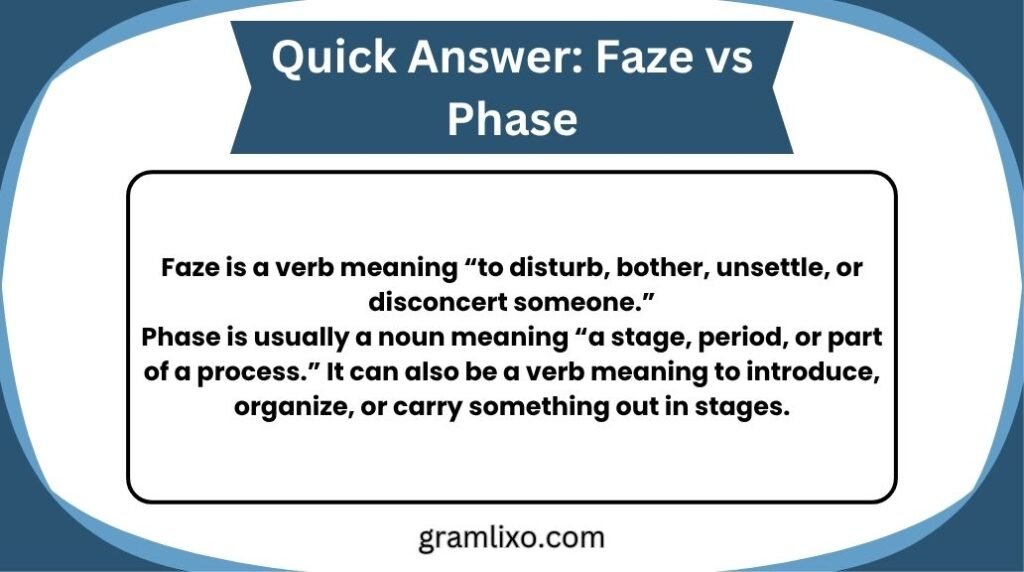
Faze is a verb meaning “to disturb, bother, unsettle, or disconcert someone.”
Phase is usually a noun meaning “a stage, period, or part of a process.” It can also be a verb meaning to introduce, organize, or carry something out in stages.
Quick rule: If you mean bother or unsettle, use faze. If you mean stage or period, use phase.
- The criticism didn’t faze her. ✅
- The project is entering its second phase. ✅
- The criticism didn’t phase her. ❌
- The project is entering its second faze. ❌
Merriam-Webster identifies faze as a verb meaning to disturb someone’s composure, while phase commonly refers to a stage or part of a process and can also function as a verb.
Understanding the Basics of Faze vs Phase
The easiest way to understand faze vs phase is to focus on what each word does in a sentence.
Faze
Faze is a verb.
It describes the effect something has on a person’s emotional state or composure. If something fazes you, it makes you feel worried, confused, nervous, embarrassed, or unsettled.
For example:
The difficult interview questions didn’t faze Maria.
This means the difficult questions did not make Maria nervous or uncomfortable.
Phase
Phase is most commonly a noun.
It describes a stage or period in a process, development, activity, or cycle.
For example:
The construction project has entered its final phase.
Here, phase means a stage of the construction project.
Phase can also function as a verb:
The company will phase in the new software next year.
In this sentence, phase in means to introduce the software gradually or in stages. Merriam-Webster specifically notes that phase can be used as a verb meaning to conduct something in planned phases or introduce it in stages.
Faze vs Phase Comparison Table
| Form | Type | Meaning | Example | Correct/Incorrect |
|---|---|---|---|---|
| faze | Verb | To disturb or unsettle | The pressure didn’t faze him. | ✅ Correct |
| fazed | Verb | Past tense of faze | She wasn’t fazed by the criticism. | ✅ Correct |
| fazing | Verb | Present participle of faze | The noise isn’t fazing me. | ✅ Correct |
| phase | Noun | A stage or period | This is the final phase of the project. | ✅ Correct |
| phase | Verb | To introduce or carry out in stages | We will phase in the changes. | ✅ Correct |
| faze | Noun | A stage or period | The project entered a new faze. | ❌ Incorrect |
| phase | Verb meaning disturb | The criticism didn’t phase her. | ❌ Incorrect | |
| fazed | Stage or period | The project reached a new fazed. | ❌ Incorrect |
The key difference is simple:
Faze = disturb someone.
Phase = stage or period.
What Does Faze Mean?
Faze is a verb that means to disturb someone’s composure.
If something fazes you, it affects your confidence, calmness, or emotional control.
Some useful synonyms include:
- bother
- disturb
- unsettle
- worry
- rattle
- disconcert
- embarrass
- discourage
- upset
Merriam-Webster defines faze as a verb meaning to disturb someone’s composure or disconcert them.
Example 1: Criticism
The negative comments didn’t faze the writer.
Sentence breakdown:
- The negative comments = subject
- didn’t faze = verb phrase
- the writer = object
The sentence means the writer remained calm despite the negative comments.
Example 2: Difficult Situation
The unexpected problem didn’t faze the experienced manager.
The manager stayed calm and continued working.
Example 3: Fear
The dark didn’t faze the children.
This means the children were not frightened or disturbed by the darkness.
Example 4: Pressure
The pressure of the competition didn’t faze the athlete.
The athlete remained confident despite the pressure.
Example 5: Surprise
The sudden question didn’t faze her.
She was not confused or unsettled by the question.
Why Is Faze Often Used in Negative Sentences?
One interesting feature of faze is that it frequently appears in negative constructions.
You will often see phrases such as:
- didn’t faze me
- wasn’t fazed
- nothing fazes him
- never fazed her
- hardly fazed them
- not easily fazed
For example:
Nothing seems to faze him.
This means nothing seems to disturb or upset him.
Merriam-Webster notes that faze often appears in negative expressions such as “it didn’t faze her” and “nothing fazes him.”
However, faze is not limited to negative sentences.
You can also say:
The announcement fazed him.
This means the announcement disturbed or unsettled him.
Another example is:
She was fazed by the sudden change.
So remember that negative constructions are common, but they are not required.
What Does Phase Mean?
Phase has several meanings, but the most common everyday meaning is a stage or period in a process.
For example:
The project is now in its testing phase.
Here, the testing phase is a particular stage of the project.
Phase as a Noun
As a noun, phase can describe:
- a stage of development
- a period of time
- part of a process
- part of a cycle
- a temporary condition
- a particular stage of life
Example 1: Project
We have completed the first phase of the project.
The project is divided into different stages, and the first stage is finished.
Example 2: Life
He is going through a difficult phase in his life.
Here, phase means a period of time.
Example 3: Development
The company has entered a new phase of growth.
The company has reached a new stage in its development.
Example 4: Childhood
Many children go through a curious phase.
The word phase refers to a temporary period or stage.
Example 5: Science
The moon goes through different phases.
In this context, phase refers to a recurring stage or appearance in a cycle.
Merriam-Webster lists recurring cycles, developmental stages, and distinguishable parts of a process among the meanings of phase.
Phase as a Verb
Although phase is most commonly a noun, it can also be a verb.
As a verb, phase often means to introduce or carry something out gradually.
You will frequently see it in expressions such as:
- phase in
- phase out
- phase into
Phase In
Phase in means to introduce something gradually.
The company will phase in the new policy over six months.
This means the company will introduce the new policy step by step.
Phase Out
Phase out means to gradually stop using or producing something.
The manufacturer plans to phase out the old model.
This means the old model will gradually be discontinued.
Phase Into
Phase into can describe a gradual transition from one condition or stage to another.
The team phased into the new system over several weeks.
The exact construction depends on the sentence, but the central idea remains gradual transition.
Merriam-Webster lists phase in as a common verbal construction meaning to introduce something in stages.
Faze vs Phase: The Main Difference
The most important distinction is this:
Faze is about a person’s emotional reaction. Phase is about a stage or process.
Compare these sentences:
The criticism didn’t faze me.
This means the criticism did not bother or unsettle me.
The project is entering a new phase.
This means the project is entering a new stage.
The two words sound identical, but their meanings are unrelated.
A Simple Memory Trick
Think:
Faze = Feelings
Phase = Process
The letter F in faze can remind you of feelings.
The word phase can remind you of phases of the moon, stages, or steps.
So:
Feelings → Faze
Stages → Phase
This simple association can prevent many spelling mistakes.
Correct Meanings and Uses
Using Faze Correctly
Use faze when someone remains calm, confident, or composed despite something that might normally disturb them.
Correct:
The loud crowd didn’t faze the speaker.
Incorrect:
The loud crowd didn’t phase the speaker.
Why is the second sentence incorrect?
Because the writer means “disturb” or “unsettle,” not “stage.”
More Examples
The criticism didn’t faze the actor.
Nothing seems to faze my brother.
She wasn’t fazed by the difficult exam.
The unexpected delay didn’t faze the team.
The intense competition never fazed him.
Each sentence describes an emotional response.
Using Phase Correctly
Use phase when talking about a stage, period, or part of a process.
Correct:
The project is in its final phase.
Incorrect:
The project is in its final faze.
The incorrect version changes the spelling of a word that should mean “stage.”
More Examples
The company is entering a new phase.
The moon is in a different phase tonight.
The project has three major phases.
She is going through a challenging phase.
The final phase of development begins next month.
Test Tip: Replace the Word
Here is a fast test you can use.
If you can replace the word with bother, disturb, or unsettle, use faze.
The criticism didn’t ___ her.
Try:
The criticism didn’t bother her.
It works.
Therefore:
The criticism didn’t faze her. ✅
Now try a different sentence:
The project entered its final ___.
Replace the blank with stage.
The project entered its final stage.
That works.
Therefore:
The project entered its final phase. ✅
The Golden Test
Bother → faze
Stage → phase
This test works in many everyday situations.
Faze vs Phase in Real-Life Communication
Understanding a grammar rule is useful, but seeing it in context makes the difference much easier to remember.
Workplace Example
Imagine a manager sends this email:
We are entering the final phase of the product launch. Please review your assignments before Friday.
Here, phase means a stage of the product launch.
Now imagine an employee receives a difficult customer complaint:
The customer’s criticism didn’t faze the employee, and she calmly solved the problem.
Here, faze means disturb or unsettle.
The two words can even appear in the same conversation:
Although the team had entered a stressful phase of the project, the tight deadline didn’t faze them.
In this sentence:
- phase = stage of the project
- faze = disturb or unsettle
That is an excellent example of why spelling matters.
Case Study: A Workplace Email
Consider this workplace situation.
A software company is replacing an old computer system with a new one. The transition will happen gradually.
A manager writes:
Subject: Final Phase of the System Upgrade
We are entering the final phase of our system upgrade. The new software will be phased in over the next four weeks. Although some technical issues may occur, the support team is prepared to handle them.
Here, phase is correct because the email discusses stages and gradual implementation.
Now imagine a different sentence:
The unexpected technical problems didn’t faze our support team.
Here, faze is correct because the sentence describes the team’s emotional response.
Why This Example Matters
Professional writing often requires both words.
The manager may discuss a phase of a project while describing employees who are not fazed by challenges.
Understanding the difference helps prevent confusing or embarrassing errors in workplace communication.
Grammar Rules for Faze vs Phase
The grammar rule is straightforward.
Rule 1: Faze Is a Verb
Faze functions as a verb.
Examples:
The criticism fazed him.
The criticism is fazing him.
Nothing fazes her.
The situation didn’t faze them.
Its forms include:
- faze
- fazes
- fazed
- fazing
Merriam-Webster classifies faze as a verb meaning to disturb someone’s composure.
Rule 2: Phase Is Usually a Noun
Phase commonly functions as a noun.
Examples:
This is an important phase of the project.
We are entering a new phase.
The first phase is complete.
Rule 3: Phase Can Also Be a Verb
Phase can function as a verb when it means to introduce or carry something out in stages.
Examples:
We will phase in the new system.
The company will phase out the old product.
The changes will be phased in gradually.
Merriam-Webster recognizes both the noun and verb uses of phase.
Why Are Faze and Phase So Easy to Confuse?
The biggest reason is pronunciation.
Faze and phase are homophones.
A homophone is a word that sounds the same as another word but has a different spelling and meaning.
For example:
- faze / phase
- its / it’s
- your / you’re
- they’re / their / there
- to / too / two
- hear / here
When people speak, they cannot see the spelling.
That means the confusion usually happens when someone is writing.
The Problem With Sound-Based Spelling
If you have heard the phrase:
“It didn’t faze me.”
You may not immediately know whether faze is spelled with an F or phase is spelled with PH.
This becomes especially difficult because phase is a much more familiar word to many readers.
Common Mistakes With Faze vs Phase
Mistake 1: Using Phase to Mean Bother
Incorrect:
The criticism didn’t phase me.
Correct:
The criticism didn’t faze me.
The intended meaning is “The criticism didn’t bother me.”
Mistake 2: Using Faze for a Stage
Incorrect:
We are entering the final faze of construction.
Correct:
We are entering the final phase of construction.
Here, “stage” could replace phase, so phase is correct.
Mistake 3: Confusing “Fazed” With “Phased”
These words are especially easy to mix up.
Fazed
Means disturbed or unsettled.
She wasn’t fazed by the difficult question.
Phased
Usually means arranged or introduced in stages.
The new system was phased in over several months.
These words are not interchangeable.
Why Do These Mistakes Happen?
Several factors can lead to confusion.
Fast Typing
When people type quickly, they often write the word that sounds right without checking the spelling.
Autocorrect
Autocorrect can sometimes reinforce an incorrect spelling, especially when the surrounding sentence does not make the intended meaning obvious.
Lack of Knowledge
Some writers simply have never learned that faze and phase have different meanings.
Familiarity With “Phase”
Because phase is common in everyday and technical language, writers may automatically choose it when they hear the sound /feɪz/.
Speaking vs. Writing
When we speak, the distinction disappears because both words are pronounced the same way.
Similar Grammar Confusions
The English language contains many pairs and groups of words that sound similar but have different meanings.
| Confusing Words | Correct Use |
|---|---|
| faze / phase | disturb / stage |
| it’s / its | it is / possessive |
| your / you’re | possessive / you are |
| they’re / their / there | they are / possessive / location |
| to / too / two | direction or infinitive / also / number |
| accept / except | receive / excluding |
| affect / effect | usually influence / result |
| principal / principle | person or main / rule or belief |
| complement / compliment | completes / praise |
| stationary / stationery | still / writing materials |
The best way to avoid these mistakes is to learn the meaning of each word instead of relying only on pronunciation.
Faze vs Phase in Different Contexts
Everyday Conversation
In casual conversation, faze is commonly used when discussing someone’s reaction to stress or difficulty.
Don’t worry. That kind of criticism won’t faze her.
Phase is commonly used to describe a temporary period.
He’s going through a strange phase.
Both words are natural in everyday American English.
Professional Writing
Professional writing requires careful word choice.
Use faze when describing someone’s reaction:
The unexpected delay did not faze the project manager.
Use phase when describing project stages:
The project has entered the implementation phase.
In reports, emails, proposals, and business documents, confusing these words can make a sentence look careless.
Creative Writing
Writers can use faze to describe emotional resilience.
The storm raged outside, but it didn’t faze her.
They can use phase to describe periods of life or development.
It was only a phase, but it changed him forever.
Both words can add precision to descriptive writing.
Social Media and Texting
Social media users often type quickly, so faze vs phase mistakes are common.
For example:
“Nothing can faze me today.”
Here, faze is correct because the person means nothing can disturb them.
Meanwhile:
“I’m going through a weird phase.”
Here, phase is correct because the person means a temporary period.
Even in informal writing, choosing the correct word makes your message clearer.
Why Faze vs Phase Matters
At first glance, confusing two homophones may seem like a small issue. After all, both words sound exactly alike.
But writing is different from speaking.
Clarity in Communication
The spelling of a word helps readers understand its intended meaning.
The situation didn’t faze him.
The reader immediately understands that he remained calm.
The situation didn’t phase him.
Many readers may understand the intended meaning from context, but the spelling is still incorrect when faze is intended.
Professionalism
Spelling errors can affect how readers perceive your writing.
A single typo may not matter in a casual text, but repeated errors in a report, application, article, or business email can reduce credibility.
Digital Communication
Today, people communicate through:
- emails
- websites
- social media
- online applications
- business messages
- reports
- blogs
- presentations
Because so much communication is written, knowing commonly confused words matters more than ever.
A Simple Reminder
Choose the spelling that matches the meaning, not merely the sound.
That rule applies to faze vs phase and many other homophones.
Special Exceptions and Edge Cases
There is no standard grammatical situation in ordinary modern US English where faze and phase become interchangeable simply because they sound alike.
However, phase has an important additional use as a verb.
For example:
The company will phase out the outdated equipment.
Here, phase is not a noun. It is a verb meaning to remove or discontinue something gradually.
Similarly:
The company will phase in the new equipment.
This means the company will introduce the equipment gradually.
So don’t assume that phase is always a noun.
Likewise, faze is primarily used as a verb.
Merriam-Webster notes that the two words are homophones but have very different meanings and histories. Faze means to disturb or disconcert, while phase is associated with stages, cycles, and planned stages of activity.
A Note About Rare Spellings
Older or dialectal forms such as feaze or feeze exist in historical English, but they are not the standard spellings you should use for ordinary modern American writing. Merriam-Webster treats these as separate historical or dialectal forms.
For modern standard English, stick with:
faze = disturb
phase = stage
Faze vs Phase: Quick Recap Checklist
Use this checklist whenever you are unsure.
| Question | If Yes → Use |
|---|---|
| Does the word mean “bother”? | faze |
| Does it mean “disturb”? | faze |
| Does it describe someone’s composure? | faze |
| Does it mean “stage”? | phase |
| Does it mean “period”? | phase |
| Does it describe part of a process? | phase |
| Does it mean introduce gradually? | phase |
| Does it appear in “phase in”? | phase |
| Does it appear in “phase out”? | phase |
| Does it mean unsettle someone? | faze |
Practice Example 1
The difficult interview didn’t ___ her.
Ask: Did the interview disturb her?
Yes.
Answer: faze
The difficult interview didn’t faze her. ✅
Practice Example 2
The company has entered a new ___ of development.
Ask: Does the word mean “stage”?
Yes.
Answer: phase
The company has entered a new phase of development. ✅
Practice Example 3
The new rules will be ___ in over the next few months.
Ask: Does the word mean “introduced gradually”?
Yes.
Answer: phased
The new rules will be phased in over the next few months. ✅
Easy Ways to Remember Faze vs Phase
If you still mix these words up, use one of these memory tricks.
Memory Trick 1: Faze = Feelings
The F in faze can remind you of feelings.
Faze → Feelings → disturb someone.
Memory Trick 2: Phase = Stage
Think about the phases of the moon.
A phase is a particular stage or appearance in a cycle.
Phase → Stage.
Memory Trick 3: Ask “Can I Say Stage?”
If you can replace the word with stage, choose phase.
The project is in its final stage.
Therefore:
The project is in its final phase.
If you can replace the word with bother, choose faze.
The criticism didn’t bother her.
Therefore:
The criticism didn’t faze her.
Faze vs Phase in Questions
Here are some common questions people ask when deciding between the two words.
“It doesn’t faze me” or “It doesn’t phase me”?
The correct phrase is:
It doesn’t faze me.
Here, faze means “bother” or “disturb.”
“A phase of life” or “a faze of life”?
The correct expression is:
A phase of life.
A phase is a period or stage.
“I wasn’t fazed” or “I wasn’t phased”?
If you mean “I wasn’t bothered or unsettled,” use:
I wasn’t fazed.
“Phased out” or “fazed out”?
The correct expression is:
Phased out.
It means gradually discontinued or removed.
“Phased in” or “fazed in”?
The correct expression is:
Phased in.
It means introduced gradually.
FAQs About Faze vs Phase
1. What is the difference between faze and phase?
Faze is a verb meaning to disturb, bother, or unsettle someone. Phase is usually a noun meaning a stage or period in a process, although it can also be a verb meaning to introduce or carry something out gradually.
2. Is it “doesn’t faze me” or “doesn’t phase me”?
The correct phrase is “doesn’t faze me.” The verb faze means to disturb or bother someone.
Example:
The criticism doesn’t faze me.
3. Is “fazed” or “phased” correct?
Both are correct words, but they have different meanings.
Fazed means disturbed or unsettled.
She wasn’t fazed by the criticism.
Phased means arranged or introduced in stages.
The new policy was phased in gradually.
4. Is phase a verb or a noun?
Phase can be both a noun and a verb. As a noun, it usually means a stage or period. As a verb, it can mean to introduce or carry something out in stages.
Examples:
We are entering a new phase.
We will phase in the new system.
5. Is faze always a verb?
In standard modern English, faze is primarily used as a verb.
Examples include:
Nothing fazes him.
She was fazed by the sudden change.
The word refers to disturbing or unsettling someone.
6. Why do faze and phase sound the same?
Faze and phase are homophones. They have the same pronunciation but different spellings, meanings, and histories. This is why they are easy to confuse when writing. Merriam-Webster specifically identifies them as homophones with different meanings.
Conclusion: Faze vs Phase
The difference between faze vs phase is simple once you focus on meaning rather than pronunciation. Faze is a verb that means to disturb, bother, unsettle, or disconcert someone. Phase usually refers to a stage, period, or part of a process, and it can also function as a verb when something is introduced or carried out gradually. When you are unsure, use the substitution test: if you mean bother, choose faze; if you mean stage, choose phase. Remember the simple formula: faze = disturb, phase = stage. This distinction is especially useful in professional writing, academic work, digital communication, and everyday English. Once you connect each spelling with its meaning, this common homophone confusion becomes much easier to avoid.
When the words sound the same, let the meaning choose the spelling.

I’m Sarah Martinez, a writer and English language enthusiast at Gramlixo. I love explaining grammar concepts in a clear and practical way that anyone can understand.
[…] |Faze vs Phase: What’s the Difference? […]