Have you ever seen the words marquee and marquis and wondered whether they are simply two spellings of the same word? You are not alone. The confusion is understandable because marquee vs marquis involves two words that look and sound remarkably similar, yet they have completely different meanings and origins.
In modern English, marquee is commonly connected with a large outdoor tent, an event tent, or a sign above the entrance of a theater or business. It can also describe something that is especially prominent or important, such as a “marquee player” or “marquee event.”
Marquis, on the other hand, is a title of nobility. A marquis is historically a European nobleman ranked below a duke and above an earl or count, depending on the country’s system of titles.
So, while marquee vs marquis may look like a simple spelling problem, it is actually a vocabulary and meaning issue. Choosing the correct word depends entirely on what you are trying to say.
Let’s break down these two confusing words so you can recognize, spell, pronounce, and use each one correctly. 😊
|Worn vs Warn: What’s the Difference?
|Tear vs Tare: Meaning, Differences, Uses, and Examples
|Loot vs Lute: What’s the Difference? Meaning, Usage, and Examples
Quick Answer: Marquee vs Marquis
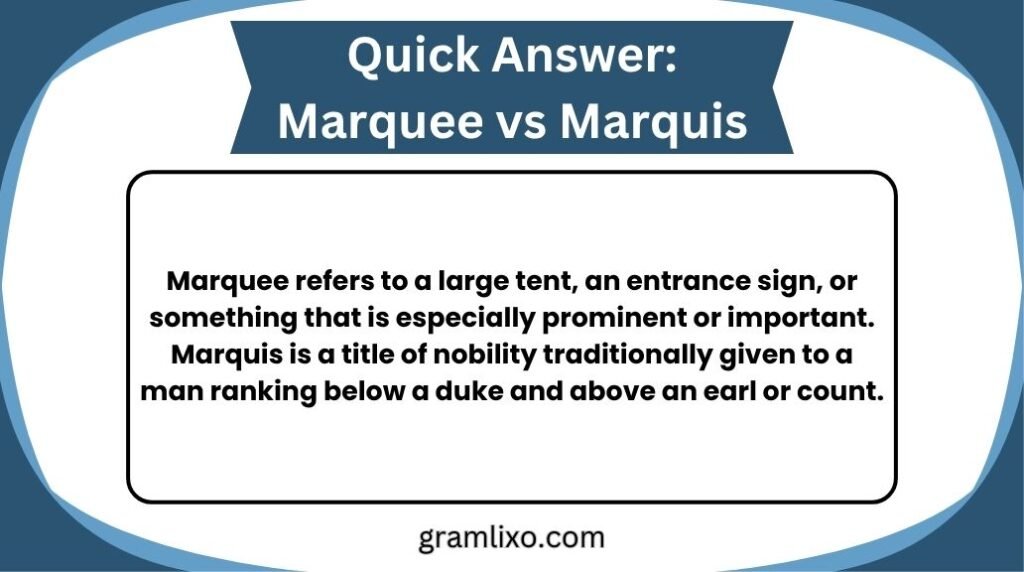
Marquee refers to a large tent, an entrance sign, or something that is especially prominent or important.
Marquis is a title of nobility traditionally given to a man ranking below a duke and above an earl or count.
The easiest way to remember the difference
- Marquee = tent, theater sign, or prominent attraction
- Marquis = noble title
For example:
The wedding reception was held under a large marquee.
But:
The Marquis attended the royal ceremony.
These words are not interchangeable. If you are talking about an event tent or a prominent feature, use marquee. If you are referring to a noble title, use marquis.
Understanding the Basics of Marquee vs Marquis
The first thing to understand is that marquee and marquis belong to different vocabulary categories and developed from different historical uses.
Marquee
Marquee is a noun with several modern meanings.
It can refer to:
- A large tent used for an event.
- A canopy or shelter.
- A sign over the entrance of a theater, hotel, or other establishment.
- Something considered especially prominent, prestigious, or important.
Examples:
- We rented a marquee for the outdoor wedding.
- The theater’s marquee displayed the name of the new movie.
- The team signed a marquee player during the offseason.
Marquis
Marquis is a noun referring to a noble title.
Traditionally, a marquis was a European nobleman whose rank was generally below that of a duke and above that of an earl or count. The exact ranking and terminology varied between countries and historical periods.
Examples:
- The marquis owned a large estate.
- The novel’s main character was the son of a marquis.
- The Marquis of [place] was a hereditary title.
Comparison Table
| Form | Type | Meaning | Example | Correct/Incorrect |
|---|---|---|---|---|
| marquee | Noun | Large tent or canopy | The guests gathered under the marquee. | ✅ Correct |
| marquee | Noun | Theater or building sign | The movie title appeared on the marquee. | ✅ Correct |
| marquee | Adjective | Prominent or highly important | She was the marquee speaker. | ✅ Correct |
| marquis | Noun | Noble title | The marquis arrived at the estate. | ✅ Correct |
| marquis | Noun | A man holding that title | The marquis hosted the dinner. | ✅ Correct |
| marquis | Noun | Outdoor event tent | We rented a marquis for the wedding. | ❌ Incorrect |
| marquee | Noun | A noble title | He was a marquee of the kingdom. | ❌ Incorrect |
The key point is simple: marquee and marquis have different meanings, even though their spellings are similar.
What Does “Marquee” Mean?
The word marquee has several meanings in contemporary English.
1. Marquee as an Event Tent
One of the most common meanings of marquee is a large tent or temporary structure used for gatherings.
For example:
The wedding guests enjoyed dinner inside a beautifully decorated marquee.
Here, marquee refers to the physical structure where people are gathered.
Other examples include:
- The company organized a reception inside a large marquee.
- We need to reserve a marquee for the outdoor festival.
- The rain forced the organizers to move everyone into the marquee.
2. Marquee as a Theater Sign
Marquee can also mean a sign or canopy above the entrance of a theater or similar establishment.
For example:
The actor’s name was displayed prominently on the theater marquee.
In this sentence, the word does not refer to a tent. It refers to the sign associated with the theater entrance.
You may see a marquee displaying:
- A movie title
- A theater production
- A performer’s name
- A special event
- Business information
3. Marquee as “Prominent” or “Important”
In modern American English, marquee can also function as an adjective meaning especially prominent, prestigious, or important.
For example:
The university invited a marquee speaker for its annual conference.
Here, marquee does not mean a tent or sign. It means that the speaker is a major or highly notable attraction.
More examples:
- The team acquired a marquee player.
- The festival announced several marquee performers.
- This is the company’s marquee product.
- The championship was the marquee event of the season.
This modern figurative use is especially common in sports, entertainment, business, and marketing.
What Does “Marquis” Mean?
Marquis is a completely different word.
It refers to a noble title traditionally used in parts of Europe.
A person holding this title is called a marquis.
Marquis as a Noble Title
Historically, the title was associated with territories or regions that had particular strategic importance, especially border areas.
For example:
The marquis ruled over a large territory.
In historical writing, you might encounter expressions such as:
- The Marquis of Westminster
- The Marquis of Cornwall
- The Marquis arrived at court.
- The young marquis inherited the estate.
The word is therefore strongly associated with aristocracy, nobility, historical fiction, and formal titles.
Marquis in Modern Writing
You are most likely to encounter marquis in:
- Historical books
- Biographies
- British or European history
- Historical fiction
- Genealogical writing
- Formal titles
- Discussions of aristocracy
It is much less common in ordinary everyday conversation than marquee.
Marquee vs Marquis: Pronunciation Difference
The pronunciation can also contribute to the confusion.
In standard English, the two words are generally pronounced differently.
Marquee is commonly pronounced approximately:
mar-KEE
Marquis is commonly pronounced approximately:
MAR-kwis
The difference becomes clearer when you say the words slowly.
Try:
mar-KEE → marquee
Then:
MAR-kwis → marquis
Because English spelling and pronunciation do not always match perfectly, listening alone is not always enough to identify the spelling. Merriam-Webster notes more broadly that English contains many cases where spelling and pronunciation do not correspond in an obvious way.
Correct Meanings and Uses
When to Use “Marquee”
Use marquee when you mean a tent, theater sign, or prominent attraction.
Example 1: Event Tent
The guests waited inside the marquee while the rain continued outside.
Sentence breakdown:
- The guests = subject
- waited = verb
- inside the marquee = location
Here, marquee is a noun describing the temporary structure.
Example 2: Theater Sign
The theater marquee advertised tonight’s performance.
Here, marquee refers to the sign outside the theater.
Example 3: Prominent Attraction
The singer was the marquee performer at the festival.
Here, marquee is used figuratively to mean the main or most prominent performer.
When to Use “Marquis”
Use marquis when you are referring to a nobleman or a noble title.
Example 1
The marquis welcomed his guests to the estate.
The word identifies a person holding the noble title.
Example 2
The young marquis inherited the family property.
Again, the word describes a nobleman.
Example 3
The novel follows the adventures of a mysterious marquis.
This is common in historical fiction and romance novels.
Test Tip: How to Choose the Right Word
If you are unsure whether to use marquee or marquis, ask yourself one simple question:
“Am I talking about a tent, sign, or prominent attraction?”
If the answer is yes, use:
marquee
If you are talking about a noble title or nobleman, use:
marquis
Memory trick
Think:
Marquee = movie screen, event tent, major attraction
Marquis = man of nobility
A simple association can help:
Marquee = “main attraction”
Marquis = “nobleman”
Once you connect each word with its meaning, the spelling becomes much easier to remember.
Marquee vs Marquis in Real-Life Communication
Understanding the difference is useful because both words can appear in very different situations.
Imagine you are writing an email to an event planner.
Incorrect:
We need to reserve a large marquis for the wedding.
Correct:
We need to reserve a large marquee for the wedding.
Why?
Because the writer is talking about a large event tent.
Now imagine you are writing historical fiction.
Incorrect:
The marquee entered the royal chamber.
Correct:
The marquis entered the royal chamber.
Why?
Because the character is a nobleman.
The meaning determines the spelling.
Case Study: A Workplace Example
Imagine a marketing team is preparing for a major company event.
The manager sends an email:
“We have booked a large marquee for the product launch. Please make sure the company logo is visible near the entrance.”
Here, marquee is correct because the company has booked a large temporary structure for an event.
Now imagine a history department preparing a presentation:
“The presentation will examine the political influence of the Marquis of Salisbury.”
Here, marquis is correct because the word is part of a noble title.
What This Case Study Shows
The two words are not alternatives.
You cannot simply choose one based on spelling preference.
Instead, determine the meaning first.
- Event structure → marquee
- Theater sign → marquee
- Main attraction → marquee
- Noble title → marquis
Grammar Rules Behind Marquee vs Marquis
There is no special grammatical rule that says one of these words is always correct. Both are legitimate English words.
The important rule is semantic accuracy.
In other words, the grammar of the sentence may be perfectly correct while the vocabulary is wrong.
Consider:
The guests gathered beneath the marquis.
The sentence structure is grammatically sound. However, if the writer means an event tent, marquis is the wrong word.
The correct sentence is:
The guests gathered beneath the marquee.
Likewise:
The marquis arrived at the palace.
This is grammatically correct if the writer means a nobleman.
You should not replace marquis with marquee simply because the two words look similar.
Dictionary Authority
Standard dictionaries distinguish these words as separate entries with different meanings and histories. Merriam-Webster is one appropriate reference for checking their definitions, spelling, pronunciation, and usage. Its pronunciation guidance also illustrates why visually similar English words can have different pronunciations and why spelling should not be assumed from sound alone.
For formal writing, checking a reliable dictionary is better than relying on autocorrect or memory.
Common Mistakes With Marquee and Marquis
Why do people confuse marquee and marquis?
There are several reasons.
1. Similar Spelling
The words share several letters:
- marq-
- similar overall appearance
- both begin with “mar”
- both contain “r” and “q”
This makes them visually confusing.
2. Fast Typing
When people type quickly, they may remember the general shape of a word without remembering the exact spelling.
For example:
marquis
may accidentally be typed when the writer means:
marquee
3. Autocorrect
Autocorrect can sometimes reinforce an incorrect spelling if the writer does not notice the suggested replacement.
4. Lack of Knowledge
Many people rarely encounter marquis in everyday life. Others may know marquee only from movie theaters or event planning.
If someone has never learned the historical meaning of marquis, the two words can easily become confused.
5. Similar Pronunciation Patterns
Although the standard pronunciations differ, someone who has only encountered one word in writing may not know how either word is pronounced.
Similar Grammar and Word Confusions
The marquee vs marquis confusion belongs to a larger group of English word problems.
| Confusing Words | Correct Distinction |
|---|---|
| its / it’s | its = possessive; it’s = it is/it has |
| your / you’re | your = possessive; you’re = you are |
| their / there / they’re | Possession / place / they are |
| affect / effect | Usually verb / usually noun |
| then / than | Time or sequence / comparison |
| accept / except | Receive or agree / excluding |
| advice / advise | Noun / verb |
| principal / principle | Person or main / rule or belief |
| marquee / marquis | Tent/sign/prominent / noble title |
The solution is the same in nearly every case: focus on meaning rather than appearance.
Usage in Different Contexts
1. Everyday Conversation
In everyday conversation, marquee is much more likely to appear when discussing events, theaters, or prominent attractions.
Example:
“The reception will be under a huge marquee.”
Marquis is less common unless you are discussing history, royalty, or literature.
Example:
“The book’s main character is a wealthy marquis.”
2. Professional Writing
Both words can appear in professional writing, but they belong to different contexts.
Professional use of marquee
The company will host the conference in a temporary marquee.
The campaign features several marquee events.
Professional use of marquis
The historical report examines the political role of the marquis.
In business writing, using the wrong word can make your writing appear careless.
3. Creative Writing
Creative writers may use both words frequently.
A historical romance might say:
The marquis stepped through the grand doorway.
A contemporary novel might say:
The crowd gathered beneath the festival marquee.
Because fiction often relies on precise imagery, selecting the correct word is especially important.
4. Social Media and Texting
Social media posts are usually informal, but spelling still matters.
Consider:
“Our wedding marquee looks amazing!”
This clearly refers to the event structure.
Using marquis instead would change the word into a reference to nobility and make the sentence confusing.
In a historical post, however:
“The marquis played an important role in eighteenth-century politics.”
Here, marquis is appropriate.
Why the Difference Matters
You might wonder whether confusing two words like these really matters.
It does.
1. Clarity
Correct word choice helps readers immediately understand your meaning.
Compare:
The guests gathered under the marquee.
with:
The guests gathered under the marquis.
The second sentence creates confusion because a nobleman is not an event tent.
2. Professionalism
Spelling the correct word demonstrates attention to detail.
This is particularly important in:
- Business emails
- Reports
- Marketing materials
- Academic papers
- Website content
- Event invitations
3. Accuracy in Digital Communication
Online writing spreads quickly. A spelling mistake can be copied, shared, or published before anyone notices it.
A useful principle is:
“Choose words for meaning, not just for appearance.”
That idea is especially valuable when dealing with commonly confused words.
Special Exceptions and Edge Cases
There is an important point to remember: marquee has developed beyond its original physical meanings.
In modern usage, especially in American sports, entertainment, and marketing, marquee can describe something that is highly prominent.
For example:
The team signed a marquee quarterback.
Here, the quarterback is not standing under a tent, and there is no theater sign involved. Instead, marquee means that the player is a major or highly notable attraction.
Similarly:
The festival’s marquee event begins Saturday.
This means the festival’s principal or most anticipated event.
What About Proper Names?
You may occasionally encounter Marquis as a personal name or surname.
For example, someone might legally be named Marquis.
In that case, the spelling is a proper name and should not be “corrected” to marquee.
Likewise, a business, building, product, or fictional character may use either spelling as part of a proper name.
Therefore, always consider the context.
Is “Marquis” Ever Used for a Tent?
In standard modern English, marquis is not the normal word for an event tent.
If you mean a large temporary structure used for an outdoor event, the standard choice is:
marquee
For example:
The wedding guests ate dinner inside the marquee.
Do not write:
The wedding guests ate dinner inside the marquis.
Unless Marquis is part of a specific proper name, that spelling is incorrect for the tent meaning.
Is “Marquee” Ever Used for a Nobleman?
No, not in the ordinary sense of the word.
A nobleman with the relevant historical title is a:
marquis
Not a:
marquee
The words are not interchangeable.
Marquee vs Marquis: A Simple Memory Trick
If you often forget which spelling belongs to which meaning, use this trick.
Think of the “ee” ending in marquee
Imagine:
Marquee = event + entertainment
A marquee can be associated with:
- Events
- Movie theaters
- Major performers
- Major players
- Major attractions
Think of “marquis” as a title
Marquis belongs with historical words such as:
- Duke
- Earl
- Count
- Baron
- Nobleman
- Aristocrat
So remember:
Marquee = attraction
Marquis = aristocracy
This simple association can prevent most spelling mistakes.
Quick Recap Checklist
Use this table whenever you need to choose between marquee and marquis.
| Question | If Yes → Use |
|---|---|
| Am I talking about a large event tent? | marquee |
| Am I talking about a theater sign? | marquee |
| Am I describing a major attraction or prominent person? | marquee |
| Am I discussing a noble title? | marquis |
| Am I describing a historical nobleman? | marquis |
| Am I writing about European aristocracy? | marquis |
| Is the word part of someone’s personal name? | Use the person’s actual spelling |
| Is it part of a brand or proper name? | Preserve the official spelling |
Practice Examples
1. The guests waited inside the large ______ during the storm.
Answer: marquee
2. The novel’s mysterious ______ owned a magnificent estate.
Answer: marquis
3. The theater’s ______ displayed the title of the new film.
Answer: marquee
Quick Self-Test
Ask:
“Could I replace this word with ‘nobleman’?”
If yes, use marquis.
Ask:
“Could I replace this word with ‘tent,’ ‘theater sign,’ or ‘main attraction’?”
If yes, use marquee.
Marquee vs Marquis in Example Sentences
Here are several examples to reinforce the distinction.
Marquee Examples
- The wedding planner ordered a large marquee for the reception.
- The movie’s title appeared on the theater marquee.
- The singer was the marquee performer at the festival.
- The company hired a marquee speaker for the conference.
- The football team signed a marquee player.
- Guests gathered beneath the decorated marquee.
- The marquee provided shelter from the rain.
- The theater replaced its old marquee with a digital display.
Marquis Examples
- The marquis hosted a formal dinner at his estate.
- The young marquis inherited the family title.
- The novel centers on a mysterious marquis.
- The historian wrote about the influence of the marquis.
- The marquis arrived at the royal court.
- The title was passed down through generations of the family.
- The fictional marquis lived in an enormous country estate.
- The documentary explored the life of a famous marquis.
Notice how the contexts are completely different.
Frequently Asked Questions About Marquee vs Marquis
1. What is the difference between marquee and marquis?
Marquee usually means a large tent, a theater sign, or something especially prominent. Marquis is a historical title of nobility for a man ranked below a duke and above an earl or count in systems where the title is used.
2. Is a wedding tent called a marquee or marquis?
A wedding tent is called a marquee.
Correct:
We rented a large marquee for the wedding.
Marquis is incorrect when you mean an event tent.
3. Is a marquis a nobleman?
Yes. A marquis is traditionally a male noble holding the title of marquis. The exact rank and historical significance varied across European countries and periods.
4. What does marquee mean in entertainment?
In entertainment, marquee can refer to a theater sign or, figuratively, to a major attraction, performer, event, or player.
For example:
She is the festival’s marquee performer.
Here, marquee means the performer is one of the main attractions.
5. How do you pronounce marquee and marquis?
Marquee is commonly pronounced approximately mar-KEE.
Marquis is commonly pronounced approximately MAR-kwis.
Because pronunciation can vary somewhat by accent, a dictionary is a useful reference when you are uncertain.
6. Can marquee and marquis be used interchangeably?
No. They have different meanings and should not normally be substituted for one another.
Use marquee for a tent, theater sign, or prominent attraction.
Use marquis for the noble title or a person holding that title.
Final Comparison: Marquee vs Marquis
The difference becomes very easy once you connect each spelling to its meaning.
| Word | Main Meaning | Example |
|---|---|---|
| marquee | Large tent | The reception was held in a marquee. |
| marquee | Theater sign | The movie title appeared on the marquee. |
| marquee | Major attraction | He is the team’s marquee player. |
| marquis | Noble title | The marquis entered the palace. |
| marquis | Nobleman | The marquis owned a large estate. |
The biggest mistake is treating these words as spelling variants.
They are not.
They are two distinct words with different meanings.
Conclusion
Understanding marquee vs marquis becomes simple once you focus on meaning instead of spelling. Marquee is the word to use for a large event tent, a theater sign, or something especially prominent, such as a marquee player or marquee event. Marquis, by contrast, refers to a traditional noble title or the man who holds that title.
If you are writing about a wedding tent, choose marquee. If you are discussing a historical nobleman, choose marquis. That single distinction will help you avoid nearly every common mistake involving these two words.
When in doubt, ask yourself what you are describing. Is it an event structure, theater sign, or major attraction? Choose marquee. Is it a nobleman or aristocratic title? Choose marquis.
Remember the simplest rule:
Marquee is for tents, signs, and major attractions; marquis is for nobility.
Once you connect each word with its meaning, marquee vs marquis is no longer a confusing spelling problem—it becomes an easy vocabulary distinction.

I’m Michael Williams, an English writer and grammar enthusiast at Gramlixo. I’m passionate about making grammar easier to learn and helping readers write with greater confidence.
[…] |Marquee vs Marquis: Meaning, Difference, and Correct Usage […]