Have you ever paused while writing a sentence because you were unsure whether to use “shall” or “will”? You are not alone. The words shall vs will have a long history in English grammar, and their traditional rules can make the choice seem more complicated than it really is.
In modern American English, will is far more common when talking about future events, decisions, promises, and predictions. Shall, however, has not disappeared.
It still appears in questions, formal writing, legal documents, rules, and certain polite expressions.Understanding shall vs will becomes much easier when you focus on context instead of memorizing old-fashioned rules.
In this guide, I’ll explain the difference in simple US English, show you real examples, compare their grammatical functions, and point out the mistakes writers commonly make.
Whether you are writing an email, having a conversation, preparing a formal document, or simply trying to improve your grammar, this article will help you choose the right word confidently. ✍️
|Faze vs Phase: What’s the Difference?
|Worn vs Warn: What’s the Difference?
|Brite vs Bright: What’s the Difference and Which One Is Correct?
Quick Answer: Shall vs Will
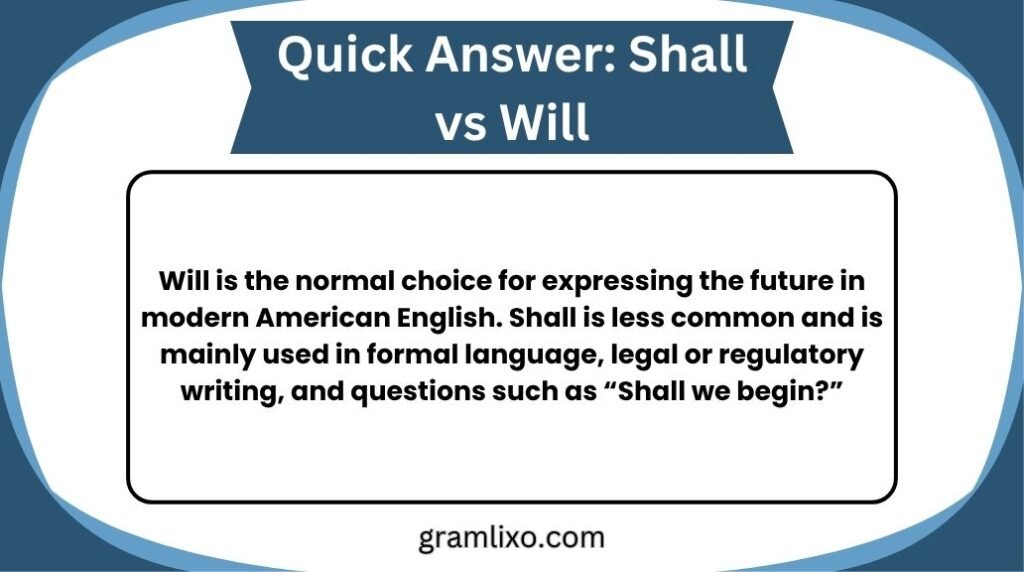
Will is the normal choice for expressing the future in modern American English. Shall is less common and is mainly used in formal language, legal or regulatory writing, and questions such as “Shall we begin?”
Quick rule: Use will for most future statements. Use shall when the context is formal or when making a suggestion, offer, or proposal with I or we.
Understanding the Basics of Shall vs Will
The easiest way to understand shall vs will is to look at how English speakers actually use these words today.
Both shall and will can function as modal auxiliary verbs. They can help express future actions, intentions, expectations, obligations, or proposals. However, their modern usage is not equal.
In American English:
- Will is the standard future auxiliary in most situations.
- Shall is relatively uncommon in ordinary future statements.
- Shall is useful for suggestions and offers, especially with I and we.
- Shall is common in legal, contractual, and regulatory language.
- Will can express predictions, decisions, promises, and willingness.
Basic Comparison Table
| Form | Type | Meaning | Example | Correct/Incorrect |
|---|---|---|---|---|
| Will | Modal auxiliary | Future action | I will call you tomorrow. | ✅ Correct |
| Shall | Modal auxiliary | Formal future, suggestion, offer, or obligation | Shall we start the meeting? | ✅ Correct |
| Will | Modal auxiliary | Prediction | She will arrive soon. | ✅ Correct |
| Shall | Modal auxiliary | Suggestion | Shall we order dinner? | ✅ Correct |
| Will | Modal auxiliary | Promise | I will help you. | ✅ Correct |
| Shall | Formal/legal modal | Requirement or obligation | The tenant shall pay the fee. | ✅ Correct in formal/legal context |
| Shall | Ordinary future statement | General future | He shall go to school tomorrow. | ⚠️ Unnatural in modern US English |
| Will | Future auxiliary | General future | He will go to school tomorrow. | ✅ Natural |
The key point is that will has a much broader role in contemporary American English.
What Does “Will” Mean?
Will is the most common word used to express future time.
It can describe something that is expected to happen, something someone decides to do, or something someone promises to do.
1. Will for Future Actions
Use will when an action is expected to happen in the future.
Examples:
- I will finish the report tomorrow.
- She will visit us next week.
- They will arrive at 8 p.m.
- The store will open at nine.
In each sentence, will connects the subject to a future action.
2. Will for Predictions
We commonly use will when making predictions.
- It will probably rain tonight.
- Technology will continue to change.
- The team will win the game.
- Prices will increase next year.
Here, the speaker is predicting what may happen.
3. Will for Promises
Will is also common when making promises.
- I will always support you.
- I will call you later.
- I will never forget your kindness.
- I will help you solve the problem.
The word can communicate determination and willingness.
4. Will for Decisions Made at the Moment
Suppose someone asks:
“Who will answer the phone?”
You might immediately say:
“I will.”
The decision happens at the moment of speaking.
Another example:
“We need someone to carry these boxes.”
“I will help.”
This use of will is extremely common in everyday English.
What Does “Shall” Mean?
Shall has several uses, but it is much less common than will in everyday American English.
Its meaning depends heavily on context.
1. Shall for Suggestions
One of the most natural modern uses of shall is to make a suggestion involving I or we.
Examples:
- Shall we go?
- Shall we start?
- Shall we have lunch?
- Shall we meet tomorrow?
- Shall I open the window?
These questions often mean:
- Do you want to go?
- Should we start?
- Would you like me to open the window?
Why Is “Shall We?” So Common?
Shall we…? is a conventional English expression used to suggest an action.
For example:
Shall we begin the meeting?
This does not simply ask about the future. It asks whether the people involved agree to begin.
That is why “Shall we?” sounds natural even though shall is relatively uncommon elsewhere.
2. Shall for Offers
Shall can also be used when offering to do something.
Examples:
- Shall I carry that for you?
- Shall I make some coffee?
- Shall I call the manager?
- Shall I help you with your bags?
The speaker is offering an action and asking whether the other person wants it.
Compare:
Shall I open the door?
This means:
Would you like me to open the door?
3. Shall in Formal or Legal Language
You will often encounter shall in contracts, regulations, policies, and legal documents.
For example:
The applicant shall provide all required documents.
Here, shall can indicate a requirement or obligation.
Another example:
The employee shall comply with all applicable safety regulations.
In this context, shall has a formal force that goes beyond simply describing the future.
However, legal drafting can be complicated because different organizations and jurisdictions may prefer different wording. Modern legal writers sometimes use must when they want to make an obligation especially clear.
Shall vs Will in Modern American English
Traditional grammar books sometimes taught a rule like this:
- I/we shall for simple future.
- You/he/she/they will for simple future.
- Reverse the words to express determination or insistence.
For example, older grammar traditions might have taught:
I shall go.
and:
You will go.
However, this rule does not accurately describe normal modern American English.
Today, Americans generally use will with all subjects:
- I will go.
- We will go.
- You will go.
- He will go.
- She will go.
- They will go.
This is much more natural.
Modern Pattern
| Subject | Common Modern Form |
|---|---|
| I | I will |
| We | We will |
| You | You will |
| He | He will |
| She | She will |
| It | It will |
| They | They will |
So if you are writing ordinary American English, will is usually your safest choice.
When Should You Use “Shall”?
Use shall mainly in a few specific situations.
Shall We…?
Use shall to make a suggestion.
- Shall we leave now?
- Shall we continue?
- Shall we order pizza?
- Shall we discuss this tomorrow?
Shall I…?
Use shall to make an offer or ask for instructions.
- Shall I help you?
- Shall I send the email?
- Shall I close the door?
- Shall I call her?
Formal Rules and Contracts
Use shall when the style or established wording of a formal document requires it.
- The buyer shall provide proof of payment.
- The contractor shall complete the work by Friday.
- Each participant shall sign the agreement.
But remember: in many situations, must may communicate an obligation more directly.
Shall vs Will: Sentence-by-Sentence Comparison
Let’s compare some common examples.
Example 1
I will call you tonight. ✅
This is the normal modern American English form.
I shall call you tonight. ⚠️
Grammatically possible, but it sounds formal, old-fashioned, or deliberately British in many American contexts.
Example 2
Shall we go now? ✅
This is a natural suggestion.
Will we go now? ✅
This is grammatically correct, but it usually asks about whether something will happen rather than proposing that it happen.
The meanings are different.
Example 3
Shall I open the window? ✅
This is an offer or request for permission.
Will I open the window? ⚠️
This normally sounds like you are asking whether you are going to open the window, rather than offering to do it.
Example 4
The company will announce the results tomorrow. ✅
This is a normal future statement.
The company shall announce the results tomorrow. ⚠️
This can sound formal, contractual, or regulatory.
Correct Meanings and Uses
Will for Predictions
Use will when you believe something is likely to happen.
The package will arrive tomorrow.
Breakdown:
- The package = subject
- will = future auxiliary
- arrive = base verb
- tomorrow = future time reference
The structure is:
Subject + will + base verb
Examples:
- She will win.
- They will arrive.
- We will know soon.
- It will work.
Will for Promises
Will often expresses a promise.
I will take care of everything.
The speaker is not merely predicting an event. The speaker is committing to an action.
Other examples:
- I will keep your secret.
- We will support you.
- I will never give up.
- She will help you.
Will for Willingness
Will can communicate willingness.
I will help you.
This means the speaker is willing to help.
Negative forms can express unwillingness:
He won’t listen.
Here, won’t can mean that he refuses to listen.
Shall for Suggestions
A common pattern is:
Shall + I/we + base verb?
Examples:
- Shall I begin?
- Shall I explain?
- Shall we leave?
- Shall we wait?
- Shall we try again?
This structure is especially useful in polite conversation.
Test Tip: How Can You Choose Between Shall and Will?
Try this simple test:
Ask yourself: “Am I talking about the future?”
If yes, will is usually the correct choice.
I will visit Chicago next month.
Ask yourself: “Am I suggesting something?”
If yes, shall may be appropriate.
Shall we visit Chicago next month?
Ask yourself: “Am I offering to do something?”
If yes, shall I may work well.
Shall I book the tickets?
Ask yourself: “Is this a formal rule or contractual requirement?”
If yes, shall may appear, depending on the drafting style.
The supplier shall provide the materials.
Shall vs Will in a Real-Life Workplace Example
Imagine that a manager is speaking with an employee about an upcoming presentation.
The manager says:
“The presentation will begin at 10 a.m.”
This is a simple statement about a future event.
Then the manager asks:
“Shall we review the slides first?”
This is a suggestion.
The employee responds:
“Sure. I will check the introduction.”
Here, will expresses the employee’s future action or decision.
Finally, the manager asks:
“Shall I contact the client?”
This is an offer.
Notice how naturally the words work together:
- will → future action
- shall we → suggestion
- shall I → offer
This distinction is far more useful than memorizing traditional subject-based rules.
Grammar Rules Behind Shall vs Will
Both words are modal auxiliary verbs, so they are followed by the base form of a verb.
Correct:
I will go.
Correct:
Shall we go?
Incorrect:
I will goes.
Incorrect:
Shall we going?
The basic structure is:
Subject + modal + base verb
Examples:
- She will arrive.
- They will leave.
- We shall discuss it.
- Shall we begin?
Negative Forms
The negative of will is will not, commonly contracted to won’t.
- I will not go.
- I won’t go.
The negative of shall is shall not, often written as shan’t in some varieties of English.
However, shan’t is uncommon in modern American English.
According to standard English usage resources such as Merriam-Webster, shall has a range of meanings and uses beyond a simple future marker, including uses involving determination, obligation, and suggestion.
The important practical point for US writers is that will is the ordinary future form, while shall has more specialized uses.
Common Mistakes With Shall vs Will
Why do people confuse these words?
Several factors contribute to the problem.
1. Old Grammar Rules
Many learners encounter traditional rules that say shall belongs with I/we and will belongs with other subjects.
That rule can be useful when studying historical English grammar, but it does not represent ordinary modern American usage.
2. Fast Typing
When people type quickly, they may choose whichever future word comes to mind first.
For example:
Shall we meet tomorrow?
may accidentally become:
Will we meet tomorrow?
The second sentence is grammatical, but the intended meaning may change.
3. Autocorrect
Autocorrect can sometimes replace a word with another familiar word.
This is especially problematic when both words are grammatically possible but have different meanings.
4. Lack of Knowledge
Some writers simply have not learned the difference between a future statement and a suggestion or offer.
Understanding the purpose of the sentence usually solves the problem.
Similar Grammar Confusions
| Confusing Forms | Correct Difference |
|---|---|
| it’s / its | It’s = it is; its = possessive |
| your / you’re | Your = possessive; you’re = you are |
| their / there / they’re | Possession, location, and they are |
| then / than | Time/order vs. comparison |
| affect / effect | Usually verb vs. noun, depending on context |
| who / whom | Subject vs. object in formal usage |
| shall / will | Future, suggestion, offer, or formal obligation |
These pairs cause problems because the words may sound similar, appear in similar contexts, or have overlapping grammatical functions.
Shall vs Will in Different Contexts
Everyday Conversation
In everyday American conversation, will is much more common.
Natural:
I’ll call you later.
We’ll see you tomorrow.
She’ll be here soon.
Shall is mostly used in expressions such as:
Shall we go?
Shall I help?
Outside these patterns, frequent use of shall can sound unusually formal.
Professional Writing
In professional writing, will is usually preferred for ordinary future statements.
The team will submit the report Friday.
We will contact you once the review is complete.
Shall may appear in policies, agreements, or formal procedures.
Employees shall follow all safety procedures.
However, writers should use formal language consistently. Do not insert shall simply because it sounds more professional.
Creative Writing
Authors can use shall deliberately to create a particular tone.
For example:
We shall meet again.
This may sound dramatic, formal, historical, poetic, or ceremonial.
Compare:
We will meet again.
This is more neutral and conversational.
Therefore, creative writers can use shall as a stylistic choice.
Social Media and Texting
In texting and social media, will is overwhelmingly more natural for future statements.
I’ll be there soon.
I’ll text you later.
We’ll talk tomorrow.
But shall we…? can still sound perfectly natural:
Shall we get pizza? 🍕
The expression is short, friendly, and conversational.
Why Shall vs Will Matters
Choosing the right word is not simply about passing a grammar test. It can change the meaning and tone of your sentence.
Clarity
Compare:
Shall we leave?
with:
Will we leave?
The first is a suggestion. The second asks whether leaving is expected to happen.
One word changes the communicative purpose.
Professionalism
In formal writing, using the appropriate modal can make your meaning more precise.
For example:
The employee shall submit the form.
has a formal, rule-like tone.
But:
The employee will submit the form.
usually sounds more like a statement about what is expected or scheduled to happen.
Digital Communication
Emails, messages, workplace chats, and online content often need to communicate meaning quickly.
Using will for ordinary future statements and reserving shall for its specific functions makes your writing easier to understand.
“Clear writing respects the reader’s time.”
That principle is especially important in digital communication.
Special Exceptions and Edge Cases
There is no major brand-name exception that changes the grammar of shall vs will, but there are several special contexts worth remembering.
Legal Language
Legal documents frequently use shall to express obligations or requirements.
For example:
The tenant shall maintain the property.
However, legal drafting practices vary. Some modern legal-writing guides recommend must for obligations because it can be more direct and less ambiguous.
Ceremonial Language
You may also encounter shall in formal or ceremonial expressions:
We shall overcome.
We shall remember this day.
Such sentences can sound elevated or rhetorical.
British English
Shall remains somewhat more noticeable in British English than in everyday American English, particularly in suggestions and formal expressions.
Still, even in British English, will is widely used for ordinary future statements.
Quick Recap Checklist
Use this table whenever you are unsure.
| Question | If Yes → Use |
|---|---|
| Am I making a normal statement about the future? | Will |
| Am I making a prediction? | Will |
| Am I making a promise? | Will |
| Am I expressing willingness? | Will |
| Am I suggesting something with “we”? | Shall |
| Am I offering to do something with “I”? | Shall |
| Am I writing a formal rule or legal provision? | Shall may be appropriate |
| Am I trying to sound ceremonial or deliberately formal? | Shall may work |
Practice Examples
1. _____ we order dinner?
Answer: Shall
Shall we order dinner?
2. I _____ call you tomorrow.
Answer: will
I will call you tomorrow.
3. _____ I send the document now?
Answer: Shall
Shall I send the document now?
Shall vs Will: Easy Memory Trick
Here is a simple way to remember the difference:
Think “future” → WILL
I will go.
She will arrive.
They will win.
Think “suggestion” → SHALL WE
Shall we go?
Shall we start?
Shall we eat?
Think “offer” → SHALL I
Shall I help?
Shall I call?
Shall I open the door?
This three-part pattern covers most situations you will encounter in modern American English.
Frequently Asked Questions
Is “shall” still used in American English?
Yes. Shall is still used in American English, especially in questions such as “Shall we…?” and “Shall I…?”, as well as in formal, legal, regulatory, and ceremonial language.
Is “will” more common than “shall”?
Yes. Will is much more common for ordinary future statements in modern American English.
For example:
I will see you tomorrow.
is much more natural in everyday US English than:
I shall see you tomorrow.
Should I say “shall we” or “will we”?
It depends on your meaning.
Use “Shall we…?” when making a suggestion:
Shall we leave now?
Use “Will we…?” when asking whether something is expected to happen:
Will we leave before noon?
Is “I shall” grammatically correct?
Yes. I shall is grammatically correct, but it often sounds formal, old-fashioned, literary, or British in ordinary American conversation.
For normal US English, I will is usually more natural.
Can “shall” mean “must”?
Yes, especially in formal or legal language.
For example:
The applicant shall provide identification.
In such contexts, shall can express a requirement or obligation. However, must is often used in modern drafting when an obligation needs to be unmistakably clear.
Which is better: “shall” or “will”?
Neither word is universally “better.” The correct choice depends on the meaning and context.
For ordinary future statements, choose will. For suggestions and offers, especially shall we…? and shall I…?, choose shall. In formal or legal writing, shall may express an obligation or requirement.
Conclusion
The difference between shall vs will becomes much easier once you stop relying on old-fashioned subject-based rules. In modern American English, will is the standard choice for most future statements, predictions, promises, decisions, and expressions of willingness. Shall has a more specialized role. It works naturally in suggestions such as “Shall we begin?”, offers such as “Shall I help?”, and certain formal, legal, regulatory, or ceremonial contexts.
If you are unsure, remember the simplest rule: use “will” for ordinary future statements, “shall we” for suggestions, and “shall I” for offers. This approach will cover most everyday situations and help your writing sound natural and confident.
When in doubt, choose the word that makes your intended meaning unmistakably clear.

I’m Christopher Garcia, an English writer and grammar enthusiast at Gramlixo. I enjoy making grammar easy to understand through clear explanations and practical examples.
[…] |Shall vs Will: What’s the Difference and When Should You Use Each? […]