When writing about age, many people get confused about year old vs years old and wonder which form is grammatically correct. Should you write “She is five years old” or “She is a five-year-old girl”? Both forms are correct, but they are used in different grammatical situations.
The difference depends mainly on where the age expression appears in the sentence. “Years old” is generally used when you state someone’s age after a verb, while “year-old” is used as a compound adjective before a noun.
For example, you would write, “My son is six years old,” but “My six-year-old son loves soccer.” Once you understand this simple distinction, choosing between year old vs years old becomes much easier.
In this guide, we’ll explain the grammar rules, common mistakes, examples, and practical usage so you can use both forms confidently in everyday and professional English.
|Hanged vs Hung: What’s the Difference?
|Better Than vs Better Then: Which One Is Correct?
|Reorder vs Re-Order: Which Spelling Is Correct?
Quick Answer: Year Old vs Years Old
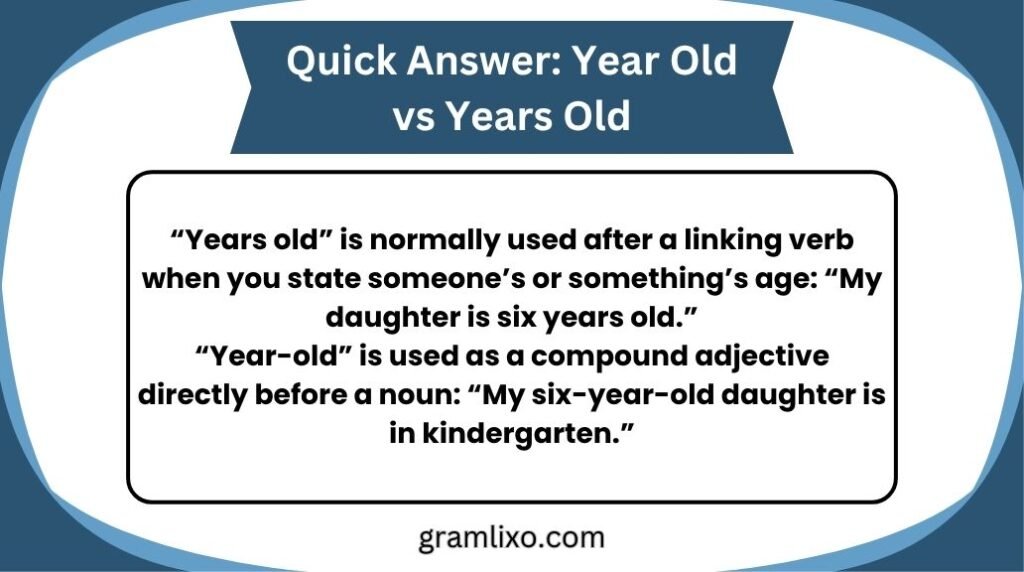
“Years old” is normally used after a linking verb when you state someone’s or something’s age: “My daughter is six years old.”
“Year-old” is used as a compound adjective directly before a noun: “My six-year-old daughter is in kindergarten.”
The key rule is simple:
- After a verb: six years old
- Before a noun: six-year-old
Notice that the compound adjective uses year, not years, even when the number is greater than one.
Understanding the Basics of Year Old vs Years Old
The easiest way to understand year old vs years old is to look at the grammatical position of the age expression.
When the age comes after the person or thing being described, use years old.
She is ten years old.
When the age comes before a noun and describes that noun, use a hyphenated compound adjective.
She is a ten-year-old student.
Both sentences communicate the same basic age, but their structures are different.
Comparison Table
| Form | Type | Meaning | Example | Correct/Incorrect |
|---|---|---|---|---|
| years old | Age expression | States age | He is eight years old. | ✅ Correct |
| year old | Compound adjective without hyphens | Describes a noun when properly hyphenated | an eight-year-old boy | ✅ Correct |
| year-old | Compound adjective | Describes a noun | an eight-year-old boy | ✅ Correct |
| years-old | Incorrect compound form | Usually uses plural “years” inside the compound | an eight-years-old boy | ❌ Incorrect |
| year old | Predicative phrase | Usually incorrect when stating age by itself | He is eight year old. | ❌ Incorrect |
| years old | Compound adjective before noun | Incorrect because “years” should be singular in the compound | an eight-years-old boy | ❌ Incorrect |
The Core Rule
Remember this pattern:
Subject + linking verb + number + years old
Maria is seven years old.
But:
Number + year-old + noun
Maria is a seven-year-old child.
The number changes the meaning of the grammatical structure, but it does not make year plural inside a compound adjective.
Why Is It “Years Old” After a Verb?
When you directly state someone’s age, years functions as a plural noun.
For example:
David is twelve years old.
The expression means that David has an age of twelve years.
Because the number is greater than one, years is plural.
Compare:
- He is one year old.
- He is two years old.
- She is five years old.
- They are twenty years old.
This follows the normal singular/plural rule.
One Year Old
Use one year old when the age is exactly one.
The baby is one year old.
Here, year is singular because the number is one.
More Than One Year Old
Use years old with numbers greater than one.
The child is three years old.
My car is five years old.
The building is fifty years old.
This distinction is straightforward when the age expression follows a verb.
Why Is It “Year-Old” Before a Noun?
Things become slightly different when an age expression appears directly before a noun.
In this position, the entire phrase acts as a compound adjective.
For example:
a five-year-old child
The phrase five-year-old describes the noun child.
When multiple words work together as one adjective before a noun, English commonly uses hyphens to show that the words belong together.
Notice something important:
a five-year-old child
Not:
a five-years-old child
Even though the child is five years old, the compound adjective uses the singular year.
Why Does “Year” Stay Singular?
The singular form appears because the age expression is functioning as one compound modifier.
Think of five-year-old as a single descriptive unit.
Examples include:
- a two-year-old dog
- a three-year-old car
- a seven-year-old student
- a ten-year-old building
- a twenty-year-old tradition
The number tells you how many years, but year remains singular inside the compound.
Correct Meanings and Uses
1. Using “Years Old” to State Age
Use years old when the expression follows a linking verb such as is, are, was, or were.
Examples:
My son is four years old.
Sarah is twenty years old.
The house is more than one hundred years old.
Those trees are fifty years old.
The phrase directly tells the reader the age of the subject.
Sentence Breakdown
Consider:
James is fifteen years old.
- James = subject
- is = linking verb
- fifteen years old = description of James’s age
Because the age appears after the verb, years old is the appropriate form.
2. Using “Year-Old” Before a Noun
Use year-old as part of a compound adjective when it comes directly before a noun.
Examples:
I met a six-year-old girl.
He owns a fifteen-year-old car.
They adopted a two-year-old dog.
She teaches a group of eight-year-old students.
In each example, year-old describes the noun that follows.
Sentence Breakdown
Consider:
We adopted a three-year-old dog.
- three-year-old = compound adjective
- dog = noun
- The compound adjective tells us the dog’s age.
The expression works as one descriptive unit.
3. Using “Year Old” After a Number
Writers sometimes leave out the hyphens when an age expression appears before a noun.
For example:
a five year old boy
This is commonly understood, especially in informal writing, but standard edited English generally prefers:
a five-year-old boy
The hyphens make the relationship between the words clear.
Test Tip: The Easy Way to Choose
Here is a quick test you can use whenever you are unsure.
Ask: “Does the age come before a noun?”
If yes, use the singular year and hyphenate the compound:
a seven-year-old child
If no, and you are simply stating someone’s age after a verb, use:
seven years old
The Simple Test
Before a noun → year-old
After a verb → years old
For example:
She is nine years old.
But:
She is a nine-year-old girl.
This simple test solves most year old vs years old questions.
Year Old vs Years Old in Real-Life Situations
Age expressions appear everywhere in everyday communication.
You might use them when talking about children, pets, cars, buildings, businesses, traditions, or historical objects.
Talking About Children
My daughter is six years old.
I have a six-year-old daughter.
Both sentences are correct.
The first tells us her age.
The second uses her age as an adjective describing daughter.
Talking About Pets
Our cat is three years old.
We have a three-year-old cat.
Again, both forms are grammatically correct.
Talking About Objects
My laptop is four years old.
I have a four-year-old laptop.
The same rule applies even though we are not talking about a person.
Talking About Buildings
The building is seventy years old.
It is a seventy-year-old building.
The structure remains exactly the same.
Case Study: A Workplace Email
Imagine that an employee is writing an email about a family event.
Incorrect:
I will be absent tomorrow because my six years old daughter has a doctor’s appointment.
The problem is that six years old is being used directly before the noun daughter.
A better version is:
I will be absent tomorrow because my six-year-old daughter has a doctor’s appointment.
Now imagine the employee writes:
My daughter is six years old, so I need to take her to an appointment.
This is correct because six years old follows the verb is.
What This Example Teaches
The two structures can appear in the same paragraph:
My daughter is six years old. I need to take my six-year-old daughter to an appointment.
The age has not changed. Only its grammatical function has changed.
Grammar Rules Explained
The distinction between year old vs years old is based on standard English grammar and the way compound modifiers work.
Rule 1: Use Plural “Years” When Stating an Age
When a number greater than one describes an age after a linking verb, use years.
He is twenty years old.
She was fourteen years old.
The company is thirty years old.
This follows ordinary number agreement.
Rule 2: Use Singular “Year” in a Compound Modifier
When the age comes immediately before a noun as a compound adjective, use singular year.
a twenty-year-old man
a fourteen-year-old student
a thirty-year-old company
Even though the number is plural in meaning, year remains singular within the compound expression.
Rule 3: Use Hyphens Before a Noun
When the age expression acts as a compound adjective before a noun, hyphens improve clarity.
a ten-year-old child
a five-year-old car
a hundred-year-old house
The hyphens show that ten-year-old works together to modify child.
What Do Major Dictionaries Say?
Major English dictionaries and style references, including Merriam-Webster, recognize age expressions such as year-old as compound modifiers. Standard usage distinguishes the hyphenated modifier from the ordinary plural phrase used to state age.
This is not simply a matter of style preference. The grammatical position of the phrase determines its form.
Common Mistakes With Year Old vs Years Old
Age expressions are frequently written incorrectly because the two structures sound almost identical when spoken.
Mistake 1: “He Is Five Year Old”
❌ Incorrect:
He is five year old.
✅ Correct:
He is five years old.
Because the age follows the verb is, use plural years.
Mistake 2: “A Five Years Old Boy”
❌ Incorrect:
She has a five years old boy.
✅ Correct:
She has a five-year-old boy.
The age expression appears before boy, so it functions as a compound adjective.
Mistake 3: Forgetting the Hyphens
Common:
a ten year old student
Standard edited form:
a ten-year-old student
The hyphens connect the words into a single compound modifier.
Mistake 4: Using “Years” Inside the Compound
❌ Incorrect:
a ten-years-old student
✅ Correct:
a ten-year-old student
The compound modifier uses singular year.
Why Do These Mistakes Happen?
Several everyday factors contribute to confusion.
Fast Typing
People often type quickly and focus on meaning rather than grammar. Since year old and years old sound similar, the wrong form can slip through.
Autocorrect
Autocorrect and predictive text may not understand the grammatical role of an age expression. It may suggest or retain a form that sounds acceptable but does not fit the sentence structure.
Lack of Grammar Knowledge
Many native and non-native English speakers learn these expressions through conversation rather than formal grammar lessons. As a result, they may know what sounds familiar without knowing why one structure is correct.
Speech Hides the Difference
When people speak quickly, the distinction between year and years can be difficult to notice. Writing makes the grammatical difference more visible.
Similar Grammar Confusions
The confusion between year old vs years old is part of a larger group of English grammar problems.
| Confusion | Correct Form | Why |
|---|---|---|
| it’s / its | It’s raining. / The dog wagged its tail. | Contraction vs. possessive |
| your / you’re | Your car is here. / You’re late. | Possessive vs. contraction |
| their / they’re | Their house is large. / They’re home. | Possessive vs. contraction |
| there / their | The book is there. / Their book is new. | Place vs. possession |
| then / than | First this, then that. / Taller than me. | Time vs. comparison |
| affect / effect | It affected me. / The effect was strong. | Verb vs. noun |
| fewer / less | Fewer people. / Less water. | Countable vs. uncountable |
| year / years | one year old / five years old | Singular vs. plural age |
Learning the grammatical function behind a word often makes these pairs much easier to remember.
Year Old vs Years Old in Different Contexts
Everyday Conversation
In conversation, years old is very common.
How old is your son?
He is eight years old.
You may also hear:
She’s a three-year-old.
This is a shortened noun phrase where three-year-old describes an understood noun, such as child or girl.
Professional Writing
Professional writing benefits from clear and standard formatting.
Instead of:
We hired a twenty five year old employee.
Use:
We hired a twenty-five-year-old employee.
However, be careful with unnecessary references to age in professional contexts. Include age only when it is relevant to the subject.
Creative Writing
Writers can use both forms naturally.
The old house was nearly two hundred years old.
Or:
She entered a two-hundred-year-old house.
Creative writing often benefits from varied sentence structures, but the grammatical rule remains the same.
Social Media and Texting
Informal writing may omit hyphens:
My daughter is 5 years old!
That’s perfectly understandable and grammatically fine.
A caption might also say:
My 5-year-old just learned to ride a bike! 🚲
Here, the hyphenated form is appropriate because 5-year-old describes the child.
Numbers and Hyphens in Age Expressions
When writing an age before a noun, hyphenate the entire compound adjective.
Examples:
- a one-year-old baby
- a two-year-old dog
- a five-year-old child
- a ten-year-old student
- a twenty-year-old building
- a fifty-year-old tradition
Notice that year remains singular in every example.
What About Large Numbers?
The same principle applies:
a hundred-year-old house
a two-hundred-year-old tradition
a thousand-year-old manuscript
When the age expression comes after a verb:
The house is a hundred years old.
The tradition is two hundred years old.
The grammatical structure changes, but the meaning remains the same.
What About “One-Year-Old”?
This form is especially easy to understand.
Before a noun:
a one-year-old child
After a verb:
The child is one year old.
Both use singular year because the number is one.
Compare this with:
a two-year-old child
The child is two years old.
The compound adjective always uses singular year, regardless of whether the number is one, two, ten, or one hundred.
Special Exception: When “Year-Old” Becomes a Noun
There is an interesting usage where year-old can function as part of a noun phrase.
For example:
The two-year-old was playing outside.
Here, two-year-old refers to an understood child.
This is common in everyday English.
However, in more formal writing, you may choose to identify the noun:
The two-year-old child was playing outside.
Both can be grammatical, depending on context.
Another example:
The five-year-old won the race.
The phrase the five-year-old means “the five-year-old child.”
The noun is understood from context.
Is “Year Old” Ever Correct Without Hyphens?
Yes, but the grammatical position matters.
For example:
The child is five years old.
There is no hyphen because the phrase follows the verb.
You can also write:
She is five years old today.
However, when the expression directly modifies a noun, standard edited English generally uses hyphens:
a five-year-old child
Not:
a five year old child
And not:
a five-years-old child
The hyphenated version makes the compound adjective clear.
Why the Hyphen Matters
Hyphens are useful because they prevent ambiguity.
Consider:
I bought a twenty-year-old house.
The hyphens show that twenty-year-old functions together as one adjective describing house.
Without the hyphens:
I bought a twenty year old house.
The meaning can still be understood, but the punctuation is less precise in formal writing.
Hyphens are especially useful in professional, academic, and edited content.
Why It Matters
You may wonder whether this small distinction really matters. In casual conversation, listeners will usually understand you even if you make a mistake.
However, correct grammar has several advantages.
Clarity in Communication
Correct structures make your meaning immediately clear.
He is seven years old.
is instantly recognizable as an age statement.
Professionalism
Correct grammar matters in:
- resumes
- emails
- reports
- websites
- school assignments
- business documents
- publications
Small grammatical details can influence how polished your writing appears.
Digital Communication
Online writing is read quickly. Clear punctuation and structure help readers understand information without stopping to interpret it.
A Simple Reminder
“Good grammar makes the right meaning easier to see.”
The goal is not to make every sentence complicated. The goal is to make your meaning clear.
Quick Recap Checklist
Use this checklist whenever you are unsure about year old vs years old.
| Question | If Yes → Use |
|---|---|
| Am I stating someone’s age after “is,” “was,” “are,” or “were”? | years old |
| Does the age come directly before a noun? | year-old |
| Is the number greater than one and the phrase follows a verb? | years old |
| Is the age functioning as a compound adjective? | year-old |
| Am I describing a person as “a five-year-old”? | year-old |
| Am I saying “She is five…”? | five years old |
Practice Examples
1. My brother is twelve ___ old.
Answer: years
My brother is twelve years old.
2. She has a twelve-___-old brother.
Answer: year
She has a twelve-year-old brother.
3. We live in a fifty-___-old house.
Answer: year
We live in a fifty-year-old house.
Quick Formula to Remember
If you want one formula that works in most situations, remember:
After a Verb
Subject + is/was/are/were + number + years old
The dog is four years old.
Before a Noun
number + year-old + noun
The four-year-old dog is sleeping.
That’s the entire rule in its simplest form.
Frequently Asked Questions
Is it “5 year old” or “5 years old”?
Use 5 years old when stating someone’s age after a verb.
My son is 5 years old.
Use 5-year-old when the expression comes directly before a noun.
My 5-year-old son is at school.
Is “years old” always correct?
No. Years old is correct when you are stating an age, usually after a linking verb.
She is ten years old.
But before a noun, use the singular compound form:
a ten-year-old girl
Why is “five-year-old” singular?
Because five-year-old is a compound adjective. In English, the measurement unit in this type of compound modifier normally remains singular.
a five-year-old child
But when stating the age normally:
The child is five years old.
Should “year old” have a hyphen?
It depends on its position.
When it appears before a noun as a compound adjective, use hyphens:
a six-year-old boy
When it follows a verb, do not hyphenate it:
The boy is six years old.
Is “five-years-old” correct?
No, not when it is used as a compound adjective before a noun.
Incorrect:
a five-years-old child
Correct:
a five-year-old child
The word year stays singular in the compound adjective.
Can “year-old” be used without a noun?
Yes. In informal and ordinary English, the noun can sometimes be understood.
The five-year-old is sleeping.
Here, five-year-old refers to an understood child.
However, if clarity is important, you can include the noun:
The five-year-old child is sleeping.
Conclusion
Understanding year old vs years old is much easier when you focus on the position of the age expression. When you are simply stating someone’s age after a verb, use years old: “She is eight years old.” When the age comes directly before a noun and acts as a compound adjective, use the singular, hyphenated form year-old: “She is an eight-year-old girl.” Remember that year stays singular inside the compound adjective, even when the number is greater than one. So, “a ten-year-old student” is correct, while “a ten-years-old student” is not. Once you learn the simple pattern—after a verb = years old; before a noun = year-old—you can use these expressions confidently in conversations, professional writing, school assignments, and online content. When in doubt, check what the age is doing in the sentence, and the correct form will usually become obvious.

I’m Robert Williams, an English grammar writer at Gramlixo. I focus on breaking down confusing grammar rules into simple explanations and useful examples.

[…] |Year Old vs Years Old: What’s the Difference? […]