Have you ever typed knowledgable vs knowledgeable and stopped because one version suddenly looked wrong? You are not alone. These two spellings are extremely easy to confuse because both look natural, sound almost identical, and are built from the same word, knowledge.
The extra “e” in knowledgeable can be easy to overlook, especially when typing quickly.
The good news is that the difference is simple once you know the standard form. Knowledgeable is the spelling you should generally choose in modern US English. It is an adjective meaning “knowing a lot” or “well-informed.” Merriam-Webster also recognizes knowledgable as a variant spelling, so it is not merely a random typo.
Still, if you are writing an email, article, résumé, academic paper, website, or business document, knowledgeable is the clearest and safest choice.
This guide explains knowledgable vs knowledgeable, their meanings, spelling differences, grammar, real-world usage, common mistakes, and the best form to use in different situations.
Experience In vs Experience On: Which One Is Correct?
|Hanged vs Hung: What’s the Difference?
|Pajamas vs Pyjamas: Which Spelling Is Correct?
Quick Answer: Knowledgable vs Knowledgeable
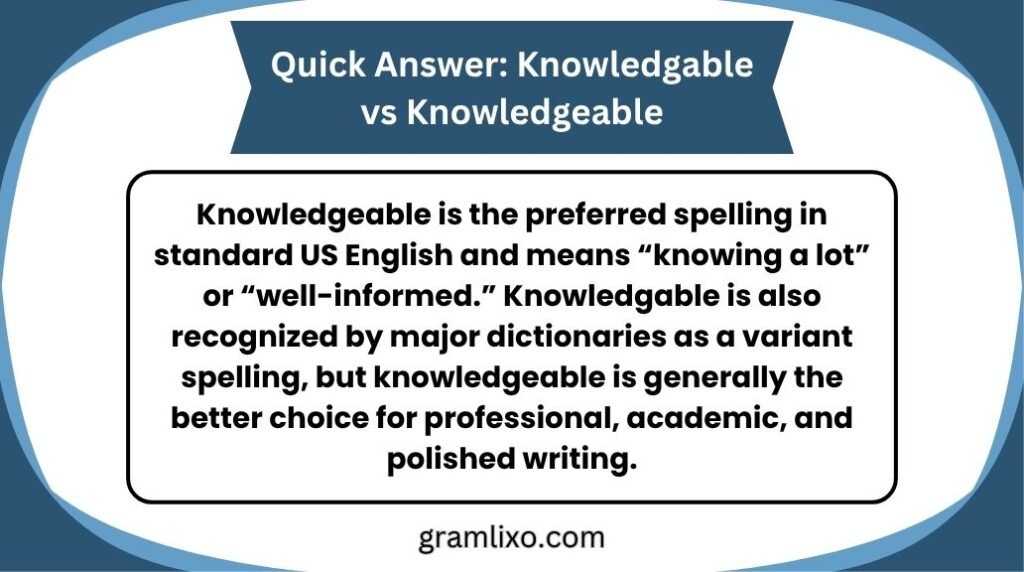
Knowledgeable is the preferred spelling in standard US English and means “knowing a lot” or “well-informed.” Knowledgable is also recognized by major dictionaries as a variant spelling, but knowledgeable is generally the better choice for professional, academic, and polished writing.
Best choice:
✅ knowledgeable
Recognized variant:
⚠️ knowledgable
For example:
- She is knowledgeable about modern technology.
- Our teacher is very knowledgeable about American history.
- The salesperson was knowledgeable and helpful.
If you need one spelling to remember, choose knowledgeable.
Understanding the Basics of Knowledgable vs Knowledgeable
The confusion comes from the spelling of the base word knowledge.
The standard adjective is formed as:
knowledge + able = knowledgeable
That gives us:
knowledgeable
The word describes someone who has a lot of knowledge about a subject or who is well-informed.
For example:
Maria is knowledgeable about computer programming.
Here, knowledgeable describes Maria’s level of knowledge.
Comparison Table
| Form | Type | Meaning | Example | Correct/Incorrect |
|---|---|---|---|---|
| knowledgeable | Adjective | Knowing a lot; well-informed | He is knowledgeable about finance. | ✅ Preferred |
| knowledgable | Adjective | Same basic meaning | She is knowledgable about art. | ⚠️ Variant spelling |
| knowledge | Noun | Information or understanding | He has extensive knowledge of finance. | ✅ Correct |
| know | Verb | To have information or understanding | I know the answer. | ✅ Correct |
The important point is that knowledgable and knowledgeable do not represent two different meanings. They are spelling variants of the same adjective.
Cambridge defines knowledgeable as an adjective meaning “knowing a lot” and also lists knowledgable as an alternative form.
What Does “Knowledgeable” Mean?
Knowledgeable means having a lot of information, understanding, or experience about a particular subject.
It is an adjective, so it normally describes a person, group, source, guide, employee, student, writer, or another noun.
Example 1: Describing a Person
Sarah is knowledgeable about digital marketing.
Sarah = the person being described
is = linking verb
knowledgeable = adjective
about digital marketing = subject area
The sentence tells us that Sarah knows a lot about digital marketing.
Example 2: Describing an Employee
The technician was knowledgeable and professional.
Here, knowledgeable describes the technician.
It tells the reader that the technician understood the subject well.
Example 3: Describing a Guide
We had a knowledgeable tour guide.
The adjective tells us that the guide had substantial information about the place being discussed.
Merriam-Webster provides examples of knowledgeable used for people such as guides, staff members, fans, and professionals.
What Does “Knowledgable” Mean?
Knowledgable has essentially the same meaning as knowledgeable.
It is recognized as a variant spelling by Merriam-Webster.
For example:
He is knowledgable about computers.
The sentence is understandable, and dictionaries recognize the spelling.
However, there is an important practical distinction between dictionary recognition and preferred usage.
If your goal is polished modern US English, it is usually better to write:
He is knowledgeable about computers.
rather than:
He is knowledgable about computers.
Why? Knowledgeable is the spelling most readers are accustomed to seeing in professional and educational writing.
So, although knowledgable should not automatically be treated as meaningless or nonexistent, knowledgeable remains the safest default.
Why Is “Knowledgeable” Spelled With an Extra “e”?
This is where many spelling mistakes begin.
The noun is:
knowledge
When the adjective is formed, the word retains the spelling of knowledge and adds -able:
knowledge + able → knowledgeable
The result contains:
knowledg + e + able
This produces:
knowledgeable
The spelling can look unusual because the letters around the middle of the word are visually crowded.
Compare these:
- knowledge
- knowledgeable
- knowledgable
The second one preserves the full spelling of knowledge before adding the adjective ending.
A Simple Memory Trick
Think:
Knowledge first, then able.
Break it mentally into:
knowledge + able
That gives you:
knowledgeable
You can also remember:
If you can spell knowledge, you are already most of the way to spelling knowledgeable correctly.
Correct Meanings and Uses of “Knowledgeable”
1. Knowledgeable About a Subject
One of the most common patterns is:
knowledgeable about + subject
Examples:
- She is knowledgeable about nutrition.
- He is knowledgeable about American history.
- The consultant is knowledgeable about cybersecurity.
- They are knowledgeable about real estate.
- Our instructor is knowledgeable about grammar.
This construction clearly identifies the area in which someone has expertise or substantial knowledge.
Cambridge specifically gives the pattern “knowledgeable about” and provides examples such as being knowledgeable about German literature.
2. Knowledgeable Person
You can use knowledgeable directly before a noun.
Examples:
She is a knowledgeable teacher.
We hired a knowledgeable consultant.
He became a knowledgeable researcher.
The company has knowledgeable employees.
In each sentence, the adjective tells us that the person possesses substantial knowledge.
3. Knowledgeable Staff
This phrase is common in business and customer-service writing.
For example:
The store has knowledgeable staff who can answer technical questions.
Here, knowledgeable communicates competence and familiarity with the products or services.
Merriam-Webster’s usage examples include references to knowledgeable staff and knowledgeable guides.
4. More Knowledgeable
The adjective can also be compared.
Examples:
Emma is more knowledgeable about photography than I am.
This guide is more knowledgeable about local history.
Experienced employees are often more knowledgeable about the company’s internal systems.
5. Most Knowledgeable
For the highest degree of comparison, use:
most knowledgeable
Examples:
She is the most knowledgeable person on the team.
He is one of the most knowledgeable experts in the field.
This form is particularly common in professional descriptions.
Test Tip: How Can You Check the Spelling?
When you are unsure about knowledgable vs knowledgeable, use this simple test:
Step 1: Find the base noun
The noun is:
knowledge
Step 2: Add “-able”
Think:
knowledge + able
Step 3: Keep the “e”
That gives:
knowledgeable
A second useful test is to ask:
“Which spelling looks more familiar in formal writing?”
For most readers, knowledgeable will be the familiar standard form.
Test Yourself
Which sentence looks better?
A. She is a knowledgable employee.
B. She is a knowledgeable employee.
Answer: B — knowledgeable.
Remember that knowledgable is recognized as a variant spelling, but knowledgeable is the stronger default for polished writing.
Case Study: A Workplace Email
Imagine a manager needs someone to lead a training session.
A team member writes:
John is very knowledgable about our software and can help train the new employees.
The meaning is clear, but the spelling may look unusual to many professional readers.
A polished version would be:
John is very knowledgeable about our software and can help train the new employees.
This version is more familiar and is the better choice for professional communication.
Why Does This Matter?
In workplace writing, small spelling differences can affect how polished your message appears.
If you are writing:
- a résumé,
- a cover letter,
- a business proposal,
- a client email,
- a company website,
- a professional report,
using knowledgeable is the safest option.
The goal is not merely to be understood. Good professional writing should also look consistent and carefully edited.
Grammar Rules: Is “Knowledgeable” an Adjective?
Yes.
Knowledgeable is an adjective.
It describes someone or something characterized by a high level of knowledge.
Examples:
She is knowledgeable.
He is a knowledgeable engineer.
We need a knowledgeable advisor.
The article was written by a knowledgeable researcher.
The adjective can appear after a linking verb:
The teacher is knowledgeable.
Or before a noun:
The knowledgeable teacher answered every question.
“Knowledgeable” Does Not Mean “Knowable”
This distinction is important.
Knowledgeable means:
knowing a lot or being well-informed.
Knowable means:
capable of being known, determined, or understood.
Merriam-Webster distinguishes knowable as an adjective meaning capable of being known.
Compare:
She is knowledgeable about astronomy.
This means she knows a lot about astronomy.
But:
The answer is knowable.
This means the answer can be known or determined.
These words look related, but they describe different concepts.
What Do Major Dictionaries Say?
Dictionary evidence is especially useful because the spelling question is more nuanced than simply saying one form is “wrong.”
Merriam-Webster
Merriam-Webster has an entry for knowledgable and identifies it as a variant spelling of knowledgeable.
That means the shorter spelling is not simply a meaningless typo in every context.
However, when you need a standard, familiar spelling for US English, knowledgeable is the practical choice.
Cambridge Dictionary
Cambridge defines knowledgeable as an adjective meaning “knowing a lot” and lists knowledgable as another form.
Cambridge also provides examples of knowledgeable in contexts involving teachers, experts, employees, writers, and other informed people.
What Should Writers Do?
The safest rule is:
Use “knowledgeable” in standard professional and general-purpose writing.
This avoids unnecessary spelling uncertainty and matches the form most readers expect.
Common Mistakes With “Knowledgable vs Knowledgeable”
Why do people write knowledgable?
There are several reasons.
1. Fast Typing
When people type quickly, they often remove letters that seem unnecessary.
The word:
knowledgeable
is relatively long.
It is easy for the writer to mentally simplify it into:
knowledgable
This is especially common when typing messages quickly.
2. The Pronunciation Can Be Misleading
English spelling does not always perfectly match pronunciation.
When people say knowledgeable, the middle sounds can make the spelling difficult to reconstruct.
Because the extra “e” is not strongly noticeable in pronunciation, writers may leave it out.
3. Visual Familiarity
The incorrect-looking form may actually look natural to some readers:
knowledgable
The structure seems logical because English contains many words ending in -able.
A writer may therefore think:
knowledge + able = knowledgable
But the conventional spelling retains the “e”:
knowledge + able = knowledgeable
4. Autocorrect
Autocorrect does not always catch every spelling variant.
A word may remain unchanged if the software recognizes it as a possible dictionary form.
Because knowledgable is recognized by major dictionaries as a variant, automated spell-checking may not always treat it as a straightforward error.
5. Lack of Knowledge
Sometimes the simplest explanation is that the writer has never learned the preferred spelling.
English contains thousands of words whose spelling must be learned through exposure and practice.
Similar Grammar and Spelling Confusions
The knowledgable vs knowledgeable problem belongs to a larger group of commonly confused English forms.
| Confusion | Correct/Preferred Form | Main Difference |
|---|---|---|
| it’s vs its | Both | Contraction vs possessive |
| your vs you’re | Both | Possessive vs contraction |
| their vs there | Both | Possession vs place/existence |
| affect vs effect | Both | Different grammatical functions |
| than vs then | Both | Comparison vs sequence |
| loose vs lose | Both | Different meanings |
| advice vs advise | Both | Noun vs verb |
| knowledgeable vs knowledgable | Knowledgeable preferred | Spelling variant |
These pairs are confusing because the words may look or sound similar even though their grammatical functions or conventional spellings differ.
Usage in Different Contexts
The best spelling choice can depend on the situation.
Everyday Conversation
In casual conversation, either spelling may be understood.
For example:
She’s really knowledgeable about movies.
This sounds completely natural.
People are generally more focused on meaning than spelling during speech.
Professional Writing
Use:
knowledgeable
Professional writing benefits from familiar, conventional spelling.
Examples include:
Our knowledgeable team can help you choose the right solution.
We are looking for a knowledgeable candidate with experience in sales.
The consultant provided knowledgeable advice.
Academic Writing
Again, choose:
knowledgeable
Academic writing requires consistency and careful language.
Example:
Students should become knowledgeable about the historical context of the text.
The standard spelling makes the sentence look polished and professional.
Creative Writing
In creative writing, spelling choices can occasionally be influenced by characterization or style.
A fictional character’s unusual spelling might be intentionally reproduced in dialogue.
For normal narration, however, knowledgeable remains the safer form.
Social Media and Texting
Informal online communication is much more flexible.
Someone might write:
He’s so knowledgable about cars!
Readers will probably understand the intended meaning.
However, if your post represents a business, professional brand, educational organization, or expert service, knowledgeable is preferable.
Why This Spelling Difference Matters
At first glance, knowledgable vs knowledgeable may seem like a tiny issue.
But spelling contributes to how readers perceive writing.
1. Clarity
Correct and familiar spelling reduces distractions.
When readers encounter an unusual form, they may briefly wonder whether it is a typo.
2. Professionalism
A polished spelling choice helps professional content appear carefully edited.
This matters in:
- résumés
- business websites
- emails
- reports
- academic assignments
- marketing materials
- job applications
3. Digital Communication
Online writing is often judged quickly.
Readers may form an opinion about the quality of an article, business, or website based on small language details.
4. Search and SEO
For SEO content, using the familiar spelling knowledgeable is generally the sensible choice.
Search engines are sophisticated enough to understand spelling variations and related forms, but writers should still prioritize natural language and the spelling readers expect.
A Useful Reminder
Clear writing makes your knowledge easier to trust.
A small spelling choice can support the overall impression of accuracy.
Special Exception: Is “Knowledgable” Ever Acceptable?
Yes.
This is the important exception that should not be ignored.
Knowledgable is recognized as a variant spelling by Merriam-Webster. Cambridge likewise lists knowledgable as an alternative form.
Therefore, calling it absolutely “wrong” in every possible context would be too strong.
Instead, think of the forms this way:
Preferred general form
knowledgeable
Recognized variant
knowledgable
If you are writing for a general American audience and want the most familiar spelling, use knowledgeable.
If you encounter knowledgable in a dictionary, historical text, quotation, or another source, it does not necessarily mean the writer invented the word.
This distinction is especially useful for editors and teachers because dictionary status can be more complicated than a simple right-versus-wrong rule.
Knowledgeable vs Knowledgable: Which One Should You Use?
If you need a practical answer, use this rule:
Choose “knowledgeable” unless you have a specific reason to preserve the variant “knowledgable.”
For example:
Professional email
Thank you for connecting me with such a knowledgeable specialist.
Résumé
Knowledgeable in customer service, project management, and digital marketing.
Website
Our knowledgeable team is ready to answer your questions.
School assignment
The author provides a knowledgeable discussion of the historical period.
Blog article
A knowledgeable reader will notice the difference.
In each case, knowledgeable is the safest and most polished choice.
Knowledgeable vs Knowledge: Do Not Confuse Them
Another common issue is confusing the adjective with the noun.
Knowledge
Knowledge is a noun.
She has extensive knowledge of biology.
Knowledgeable
Knowledgeable is an adjective.
She is knowledgeable about biology.
Compare:
He has extensive knowledge of finance.
and:
He is knowledgeable about finance.
Both sentences communicate a similar idea, but the grammatical roles are different.
Easy Rule
Ask:
Am I naming the information itself?
Use knowledge.
Ask:
Am I describing someone who knows a lot?
Use knowledgeable.
Knowledgeable vs Informed
These words are related but not always identical.
Knowledgeable usually emphasizes having substantial knowledge about a subject.
Informed can emphasize having received or possessing relevant information.
For example:
She is knowledgeable about architecture.
This suggests substantial understanding.
She is well-informed about the latest architecture regulations.
This emphasizes awareness of current information.
Both can be useful depending on the context.
Knowledgeable vs Expert
These words are also related but should not automatically be treated as synonyms.
A person can be knowledgeable without being an expert.
For example:
Mark is knowledgeable about photography.
This tells us that Mark knows a lot about photography.
It does not necessarily mean he has professional-level expertise.
By contrast:
Mark is a photography expert.
This makes a stronger claim.
Therefore, knowledgeable can be a useful word when you want to describe strong knowledge without claiming formal expertise.
How to Remember “Knowledgeable” Permanently
Try these memory strategies.
Strategy 1: Remember “Knowledge”
Start with:
knowledge
Then attach:
able
Result:
knowledgeable
Strategy 2: Think “Knowledge + Able”
The word can be visually remembered as:
knowledge + able
Even though the spelling joins together, keeping the base word in your mind helps.
Strategy 3: Write It Three Times
If you repeatedly make this spelling mistake, write:
knowledgeable
knowledgeable
knowledgeable
Then use it in a sentence:
She is knowledgeable about science.
Active repetition can make the spelling easier to recall.
Strategy 4: Use the Familiar Form
When unsure, choose:
knowledgeable
That simple habit will prevent most problems.
Quick Recap Checklist
Use the following checklist whenever you are unsure about knowledgable vs knowledgeable.
| Question | If Yes → Use |
|---|---|
| Do you mean “knowing a lot”? | knowledgeable |
| Are you writing a professional document? | knowledgeable |
| Are you writing academic content? | knowledgeable |
| Are you creating SEO content for a general audience? | knowledgeable |
| Are you describing a well-informed person? | knowledgeable |
| Did you encounter “knowledgable” in a dictionary or source? | It may be a recognized variant |
| Do you need the safest standard spelling? | knowledgeable |
Practice Example 1
Choose the better form:
The scientist is very ______ about climate research.
Answer: knowledgeable
Correct sentence:
The scientist is very knowledgeable about climate research.
Practice Example 2
Choose the better form:
We need a ______ employee to manage this project.
Answer: knowledgeable
Correct sentence:
We need a knowledgeable employee to manage this project.
Practice Example 3
Choose the better form:
She is extremely ______ about American literature.
Answer: knowledgeable
Correct sentence:
She is extremely knowledgeable about American literature.
FAQs About Knowledgable vs Knowledgeable
1. Is “knowledgable” correct?
Knowledgable is a recognized variant spelling of knowledgeable. Merriam-Webster lists it as a variant, and Cambridge also recognizes it. However, knowledgeable is the better default choice for standard professional and general-purpose US English.
2. Which is correct: knowledgable or knowledgeable?
Knowledgeable is the preferred spelling for most writing. It means knowing a lot or being well-informed. Knowledgable is recognized as a variant spelling, so it should not automatically be described as meaningless or nonexistent.
3. How do you spell knowledgeable?
The preferred spelling is:
knowledgeable
A useful memory trick is to think of the word as:
knowledge + able
This helps you remember the “e” in the middle.
4. What does knowledgeable mean?
Knowledgeable means having a lot of knowledge or being well-informed about a subject.
Example:
She is knowledgeable about computer science.
Cambridge defines the word as meaning “knowing a lot.”
5. Is knowledgeable an adjective?
Yes. Knowledgeable is an adjective.
It can describe a person, group, employee, guide, teacher, writer, or another noun.
Examples:
a knowledgeable teacher
a knowledgeable guide
a knowledgeable employee
The teacher is knowledgeable.
6. Is knowledgeable better than knowledgable?
For most modern professional and general writing, yes, knowledgeable is the safer and more familiar choice. However, knowledgable is recognized as a variant spelling by major dictionaries, so the difference is more accurately described as preferred form versus recognized variant rather than simply correct versus incorrect.
Final Conclusion
The knowledgable vs knowledgeable question is easy to solve once you understand the spelling and dictionary evidence. Knowledgeable is the preferred form for standard US English, professional writing, academic work, websites, and everyday polished communication. It means “knowing a lot” or “well-informed” and functions as an adjective.
At the same time, knowledgable deserves a little more nuance. Major dictionaries recognize it as a variant spelling, so it is not accurate to claim that the form is completely invalid.
Still, if you are choosing a spelling yourself, there is little reason to take the less familiar route. Remember the simple formula:
knowledge + able = knowledgeable
Use knowledgeable when you want the clearest and safest choice.
In short, knowledgable vs knowledgeable is not a battle between two completely different words. It is primarily a question of preferred spelling. When in doubt, keep the “e” and write knowledgeable.

I’m Michael Williams, an English writer and grammar enthusiast at Gramlixo. I’m passionate about making grammar easier to learn and helping readers write with greater confidence.
[…] |Knowledgable vs Knowledgeable: Which Spelling Is Correct? […]