Starting high school or college can be exciting, confusing, and full of new vocabulary. One of the most common word-choice questions students encounter is freshman vs freshmen. These two words look almost identical, sound very similar, and refer to students who are new to a school or program. However, they are not interchangeable.
The basic difference is simple: freshman is the singular form, while freshmen is the plural form. You use freshman when talking about one first-year student, and you use freshmen when talking about two or more first-year students. Merriam-Webster defines a freshman as a student in the first year of high school or college, and it also recognizes the word as meaning a beginner or newcomer.
For example, you would say, “Maria is a freshman,” but “Maria and James are freshmen.” Once you understand this singular-versus-plural distinction, the freshman vs freshmen question becomes much easier.
Still, there are a few details worth learning, especially when these words appear before another noun, such as freshman year, freshman class, or freshman orientation. Let’s break everything down in simple terms. 👇
|Knowledgable vs Knowledgeable: Which Spelling Is Correct?
|Attain vs Obtain: What Is the Difference and When Should You Use Each?
|Die vs Dice: What’s the Difference and When Should You Use Each?
Quick Answer: Freshman vs Freshmen
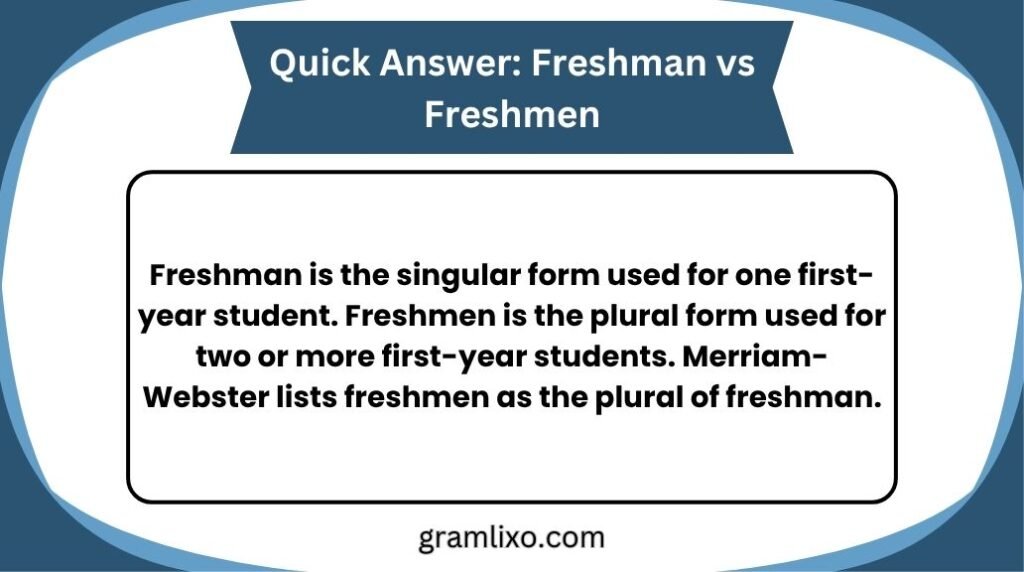
Freshman is the singular form used for one first-year student. Freshmen is the plural form used for two or more first-year students. Merriam-Webster lists freshmen as the plural of freshman.
- One student: freshman
- Two or more students: freshmen
- One freshman: Correct
- Several freshmen: Correct
- Two freshmans: Incorrect
Example:
Daniel is a freshman.
Daniel and Michael are freshmen.
The easiest way to remember it is:
One = freshman → More than one = freshmen.
Understanding the Basics of Freshman vs Freshmen
The main difference between freshman vs freshmen is grammatical number.
Freshman refers to one person who is in the first year of high school, college, or another relevant program. Freshmen refers to multiple people in their first year.
Merriam-Webster gives freshman two especially useful meanings: a first-year student and a beginner or newcomer.
Comparison Table
| Form | Type | Meaning | Example | Correct/Incorrect |
|---|---|---|---|---|
| freshman | Singular noun | One first-year student | She is a freshman. | ✅ Correct |
| freshmen | Plural noun | Two or more first-year students | They are freshmen. | ✅ Correct |
| freshman | Singular modifier | Related to one first-year group or experience | freshman year | ✅ Correct |
| freshmen | Plural noun | Multiple first-year students | The freshmen arrived. | ✅ Correct |
| freshmans | Incorrect plural | Intended to mean multiple first-year students | The freshmans arrived. | ❌ Incorrect |
| freshmen | Plural noun | Used with plural subjects | The freshmen are studying. | ✅ Correct |
The important point is that freshman and freshmen are not different meanings. They are different grammatical forms of the same noun.
Think of It Like “Man” and “Men”
One helpful memory trick is to compare these words:
- one man → two men
- one woman → two women
- one freshman → two freshmen
The ending changes because freshman has an irregular plural form.
So, never write:
❌ Three freshmans attended the meeting.
Instead, write:
✅ Three freshmen attended the meeting.
What Does “Freshman” Mean?
Freshman is a singular noun referring to a person in their first year of high school or college. It can also describe someone who is new to a particular field, activity, organization, or position.
For example:
Olivia is a freshman at the university.
Here, Olivia is one person, so freshman is correct.
The word can also function as an adjective:
Olivia joined the freshman class.
In this sentence, freshman describes the class. It does not mean that the class contains only one student.
Merriam-Webster also lists broader uses such as a beginner, newcomer, or someone who is new to an activity.
For example:
He is still a freshman in the world of professional journalism.
Here, freshman means someone with relatively little experience.
Sentence Breakdown
Consider:
Jake is a freshman.
- Jake = subject
- is = singular verb
- a = singular article
- freshman = singular noun
Because Jake is one person, freshman is appropriate.
What Does “Freshmen” Mean?
Freshmen is the plural form of freshman. It refers to two or more first-year students.
For example:
The freshmen attended orientation on Monday.
The sentence refers to a group of first-year students, so freshmen is correct.
Notice another important clue: freshmen normally works with plural verbs.
The freshmen are excited.
Not:
❌ The freshmen is excited.
More Examples
Five freshmen joined the club.
The freshmen received their schedules.
Several freshmen live in the residence hall.
The university welcomed hundreds of freshmen.
In each sentence, the word refers to more than one student.
Freshman Year vs Freshmen Year
This is one of the most confusing parts of the freshman vs freshmen question.
The standard expression is:
✅ freshman year
Not:
❌ freshmen year
Why?
Because freshman is functioning as a modifier describing the type of year. It is not being used as a plural noun.
For example:
My freshman year was unforgettable.
Here, freshman modifies year. The phrase means the year when someone was a freshman.
The same pattern appears in:
- freshman year
- freshman class
- freshman orientation
- freshman dorm
- freshman experience
- freshman schedule
- freshman seminar
For example:
I met my best friend during my freshman year.
The freshman class attended orientation.
She signed up for a freshman seminar.
In these examples, freshman remains singular because it is functioning as a noun modifier.
Freshman Class vs Freshmen
Both freshman class and freshmen can be correct, but they perform different grammatical jobs.
Freshman Class
The freshman class elected a new president.
Here, freshman describes the class. It acts as a modifier.
Freshmen
The freshmen elected a new president.
Here, freshmen is the plural noun referring directly to the students.
This distinction is extremely useful in academic writing.
Compare:
The freshmen attended the meeting.
and:
The freshman meeting was held at noon.
In the first sentence, freshmen refers to the students.
In the second sentence, freshman describes the type of meeting.
Freshman Student vs Freshmen Students
You may also encounter phrases such as freshman student and freshmen students.
The more natural options are usually:
a freshman student
or:
freshman students
However, when the context is already clear, simply using freshman or freshmen is often cleaner.
For example:
Sarah is a freshman.
is more concise than:
Sarah is a freshman student.
Likewise:
The freshmen attended orientation.
is usually better than:
The freshmen students attended orientation.
In formal writing, first-year student or first-year students can also be useful alternatives. Merriam-Webster lists first-year as a term for a student in the first year of high school or college.
Correct Meanings and Uses
1. Use “Freshman” for One Person
Use freshman when referring to one individual.
Examples:
My brother is a freshman.
Emily became a freshman this fall.
He is the youngest freshman on the team.
I remember being a nervous freshman.
The singular form works with expressions such as:
- a freshman
- one freshman
- each freshman
- every freshman
- this freshman
- that freshman
For example:
Every freshman must attend orientation.
Because every refers to individual members one at a time, the singular freshman is used.
2. Use “Freshmen” for Multiple People
Use freshmen when referring to more than one person.
Examples:
The freshmen arrived early.
Two freshmen joined the debate club.
Several freshmen asked questions.
The school welcomed its new freshmen.
Words that commonly signal the plural include:
- two
- three
- several
- many
- numerous
- all
- these
- those
For example:
Several freshmen attended the workshop.
Because several refers to more than one person, freshmen is required.
3. Use “Freshman” as a Modifier
A particularly important rule is that freshman often remains singular when it modifies another noun.
Examples include:
freshman year
freshman class
freshman orientation
freshman housing
freshman dorm
freshman seminar
freshman schedule
freshman experience
This is a common English pattern. A noun used attributively to modify another noun often appears in a singular form.
For example:
student handbook
not:
❌ students handbook
Similarly:
freshman class
not:
❌ freshmen class
The noun class is the main noun, while freshman describes it.
Test Tip: The One-or-Many Test
Here is a simple test you can use whenever you are unsure about freshman vs freshmen.
Step 1: Ask “How many people?”
If the answer is one, use:
freshman
If the answer is two or more, use:
freshmen
Examples
One student is a ______.
Answer: freshman
Four students are ______.
Answer: freshmen
Step 2: Check Whether the Word Modifies Another Noun
If freshman appears before another noun, it will often remain singular.
freshman year
freshman class
freshman orientation
This quick test solves most usage questions.
Case Study: A College Orientation Email
Imagine a university sends this email:
Subject: Freshman Orientation Information
Welcome to your freshman year! All freshmen are invited to attend orientation on Monday morning. Each freshman will receive a campus map and student ID information.
Notice that both forms appear in the same short message.
“Freshman Orientation”
Here, freshman modifies orientation. It describes the type of orientation.
“Your Freshman Year”
Again, freshman modifies year.
“All Freshmen”
Here, the word refers directly to multiple students. Therefore, freshmen is correct.
“Each Freshman”
The word each refers to students individually, so the singular freshman is used.
This example demonstrates why the words cannot simply be swapped.
Grammar Rules Behind Freshman vs Freshmen
The difference comes down to singular and plural noun forms.
Freshman is singular.
Freshmen is plural.
Merriam-Webster explicitly identifies freshmen as the plural of freshman.
Oxford also lists freshmen as the plural form and defines a freshman as a first-year student at a university, college, high school, or junior high school in North American English.
The plural is irregular because English does not always form plurals simply by adding -s.
Consider:
- man → men
- woman → women
- child → children
- person → people
- freshman → freshmen
Therefore, freshmans is not the standard plural form.
Why “Freshmans” Is Incorrect
It may seem logical to add -s:
freshman + s = freshmans
But English already has an established irregular plural:
freshman → freshmen
So:
❌ The freshmen students were excited.
Actually, this sentence can be grammatically awkward or redundant depending on context, but freshmen itself is correct.
And:
❌ The freshmans arrived.
is incorrect.
The correct version is:
✅ The freshmen arrived.
Common Mistakes With Freshman and Freshmen
Mistake 1: Using “Freshmans”
Incorrect:
❌ Three freshmans joined the club.
Correct:
✅ Three freshmen joined the club.
The plural form is freshmen, not freshmans.
Mistake 2: Writing “Freshmen Year”
Incorrect:
❌ My freshmen year was difficult.
Correct:
✅ My freshman year was difficult.
Here, freshman modifies year.
Mistake 3: Using “Freshman” for a Group
Incorrect:
❌ The freshman are waiting outside.
Correct:
✅ The freshmen are waiting outside.
If the word refers directly to multiple students, use freshmen.
Mistake 4: Using “Freshmen” for One Person
Incorrect:
❌ She is a freshmen.
Correct:
✅ She is a freshman.
The article a is a strong clue that a singular noun is needed.
Mistake 5: Subject-Verb Agreement
Incorrect:
❌ The freshmen is attending orientation.
Correct:
✅ The freshmen are attending orientation.
Because freshmen is plural, it normally takes a plural verb.
Compare:
The freshman is attending orientation.
The freshmen are attending orientation.
Why Do People Confuse These Words?
There are several reasons.
Fast Typing
When people type quickly, they may focus on the sound rather than the grammatical form. Since freshman and freshmen sound very similar, mistakes are easy to make.
Autocorrect
Autocorrect can sometimes make a word-choice mistake harder to notice. A writer may type one form and fail to review the final sentence.
Lack of Knowledge
Some writers simply have not learned that freshmen is an irregular plural.
Similar Appearance
The two words differ by only a few letters:
freshman
freshmen
That small visual difference makes them easy to confuse.
Pronunciation
Both forms are commonly pronounced very similarly in American English. This means you cannot always depend on pronunciation to tell which spelling you need.
The spelling must match the grammatical role.
Similar Grammar Confusions
The freshman vs freshmen confusion is part of a much larger group of commonly confused English forms.
| Confusing Pair | Correct Difference |
|---|---|
| freshman / freshmen | singular / plural |
| man / men | singular / plural |
| woman / women | singular / plural |
| child / children | singular / plural |
| person / people | singular / plural |
| it’s / its | contraction / possessive |
| your / you’re | possessive / contraction |
| their / they’re | possessive / contraction |
| then / than | time or sequence / comparison |
| affect / effect | usually verb / usually noun |
| advice / advise | noun / verb |
| fewer / less | countable / generally uncountable |
Learning to identify the grammatical role of a word is often more useful than memorizing isolated spelling rules.
Usage in Different Contexts
Everyday Conversation
In everyday American English, both forms are common.
My sister is a freshman.
Her friends are freshmen.
I met several freshmen at the event.
The distinction is usually easy to understand from context.
Professional Writing
In professional and academic writing, accuracy matters more.
For example:
The university will host a freshman orientation session.
Here, freshman modifies orientation.
But:
All freshmen must complete the registration process.
Here, freshmen refers to the students.
Academic emails, university websites, reports, and announcements should preserve this distinction.
Creative Writing
Creative writers can use either form depending on the situation.
For example:
As a freshman, Maya felt completely lost on her first day.
Or:
The freshmen gathered beneath the old oak tree.
The choice depends on whether the writer is referring to one character or a group.
Social Media and Texting
Informal communication often contains spelling shortcuts and grammatical mistakes, but the standard forms remain:
Freshman year already feels crazy 😂
These freshmen are having the time of their lives!
Even on social media, using the correct form makes your writing easier to understand.
Freshman in Other Contexts
The word freshman is not limited to schools.
It can also describe someone new to another organization, profession, or activity.
Merriam-Webster notes that the word can mean a beginner or newcomer and gives examples involving people who are new to professional or political roles.
For example:
He is a freshman lawmaker.
This does not necessarily mean he is a first-year student. It can mean he is new to the legislative role.
Similarly:
She is a freshman member of the committee.
The idea is newness or limited experience.
The plural would be:
They are freshmen members of the committee.
However, many modern writers may prefer new members or first-year members, depending on the context.
Why “Freshman” Is Often Used Before a Noun
English frequently uses nouns as modifiers.
Consider:
- school bus
- college student
- student handbook
- office building
- freshman class
In freshman class, the main noun is class. The word freshman tells us what kind of class it is.
This is why:
freshman class
is standard.
You do not normally make freshman plural just because the class contains many students.
The same principle explains:
freshman year
Even though the year may belong to thousands of freshmen, the modifier remains freshman.
Why It Matters
Correct word choice matters because small grammatical differences can affect clarity.
1. Clarity in Communication
Compare:
The freshman are outside.
and:
The freshmen are outside.
The second sentence clearly identifies the students as a plural group.
2. Professionalism
Academic applications, university emails, workplace documents, and professional communication benefit from accurate grammar.
A small error such as freshmans can make otherwise strong writing look less polished.
3. Digital Communication
Online communication moves quickly. Emails, social posts, forms, messages, and school announcements are often written under time pressure.
That makes quick grammar checks valuable.
4. Better Understanding
Knowing the difference also helps you recognize related grammatical patterns.
Once you understand:
freshman → freshmen
you may find other irregular plurals easier to recognize.
“Clear writing makes communication easier.”
The goal is not to make every sentence complicated. The goal is to make every sentence clear.
Special Exception and Modern Alternatives
There is no standard grammatical exception in which freshmans becomes the normal plural of freshman. The established plural is freshmen. Merriam-Webster explicitly lists freshmen as the plural form.
However, there is an important modern usage consideration.
Some schools and organizations increasingly prefer first-year student or first-year students instead of freshman or freshmen. Merriam-Webster recognizes first-year as a term for a student in the first year of high school or college.
For example:
First-year students must attend orientation.
This wording is clear and avoids the singular/plural distinction altogether.
You may also see:
first-year class
first-year orientation
first-year students
The best choice depends on the style of the institution and the audience.
Freshman vs Freshmen: Quick Recap Checklist
Use this checklist whenever you are unsure.
| Question | If Yes → Use |
|---|---|
| Am I talking about one first-year student? | freshman |
| Am I talking about two or more first-year students? | freshmen |
| Does the word directly refer to multiple students? | freshmen |
| Does the word refer to one student? | freshman |
| Is “freshman” describing another noun, such as “year” or “class”? | freshman |
| Am I tempted to write “freshmans”? | freshmen |
| Does the sentence begin with “a freshman”? | freshman |
| Does the sentence use “several,” “many,” or “two”? | Usually freshmen |
Practice Example 1
Emma is a ______ at the university.
Answer:
freshman
Why? Emma is one student.
Practice Example 2
Emma and Noah are ______ at the university.
Answer:
freshmen
Why? Emma and Noah are two students.
Practice Example 3
My ______ year was challenging.
Answer:
freshman
Why? Freshman modifies year.
Easy Memory Trick
If you want one rule to remember, use this:
👤 One = Freshman
One freshman
👥 Many = Freshmen
Many freshmen
And remember:
📚 Before another noun = Usually Freshman
freshman year
freshman class
freshman orientation
Think of the phrase:
“One freshman, many freshmen, freshman year.”
That one pattern will help you avoid most mistakes.
Freshman vs Freshmen in Example Sentences
Here are several examples for quick reference.
Singular: Freshman
I am a freshman.
She is a freshman at UCLA.
He became a freshman this fall.
Each freshman received a welcome packet.
Every freshman must complete the form.
Plural: Freshmen
We are freshmen.
The freshmen attended orientation.
Several freshmen joined the club.
Many freshmen live on campus.
The freshmen are preparing for their first exams.
Modifier: Freshman
My freshman year was unforgettable.
The freshman class gathered in the auditorium.
Freshman orientation begins tomorrow.
The freshman dorm is across from the library.
She joined a freshman seminar.
These examples demonstrate the difference more clearly than memorizing definitions alone.
Frequently Asked Questions
1. Is “freshman” singular or plural?
Freshman is singular. It refers to one first-year student. For example, “She is a freshman.”
2. Is “freshmen” singular or plural?
Freshmen is plural. It refers to two or more first-year students. For example, “The freshmen attended orientation.”
3. Is “freshmans” a correct word?
No. Freshmans is not the standard plural form. The correct plural of freshman is freshmen.
4. Should I say “freshman year” or “freshmen year”?
The standard expression is freshman year. Here, freshman functions as a modifier of year, so it remains singular.
5. Should I write “freshman class” or “freshmen class”?
Use freshman class when referring to a class made up of first-year students. For example, “The freshman class attended orientation.”
6. What is the difference between “freshman” and “freshmen”?
Freshman refers to one first-year student, while freshmen refers to more than one. The difference is grammatical number: singular versus plural.
Conclusion
The difference between freshman vs freshmen is simple once you focus on number. Freshman is the singular form for one first-year student, while freshmen is the plural form for two or more first-year students. Merriam-Webster confirms that freshmen is the plural of freshman.
Remember these three examples:
One student: She is a freshman.
Multiple students: They are freshmen.
Modifier: My freshman year was exciting.
Also avoid the common mistake freshmans, because it is not the standard plural form. When you see words such as several, many, or two, think freshmen. When you see a, one, each, or every, think freshman.
Finally, remember that freshman often stays singular when it describes another noun, as in freshman year or freshman class.
The easiest rule to remember is: one freshman, many freshmen—and always “freshman year.”

I’m Robert Williams, an English grammar writer at Gramlixo. I focus on breaking down confusing grammar rules into simple explanations and useful examples.