Have you ever wondered whether experience in vs. experience on is the correct phrase to use? This common grammar confusion can make even a simple sentence feel uncertain, especially in resumes, cover letters, emails, and professional writing.
Both expressions can be grammatically correct, but they are used in different situations.
Experience in is generally used when talking about a field, profession, industry, subject, skill, or area of expertise, such as “experience in marketing” or “experience in teaching.”
Experience on is more limited and is usually connected to a specific project, assignment, campaign, committee, or production, such as “experience on a research project.”
In this guide, I’ll explain the difference between experience in vs. experience on, show you clear examples, and give you simple rules to help you choose the right preposition every time.
|Limited to vs Limited Too: Which One Is Correct?
|Alright vs All-Right: Which One Is Correct?
|Company-Wide vs Companywide: Which Is Correct?
Quick Answer: Experience In vs. Experience On
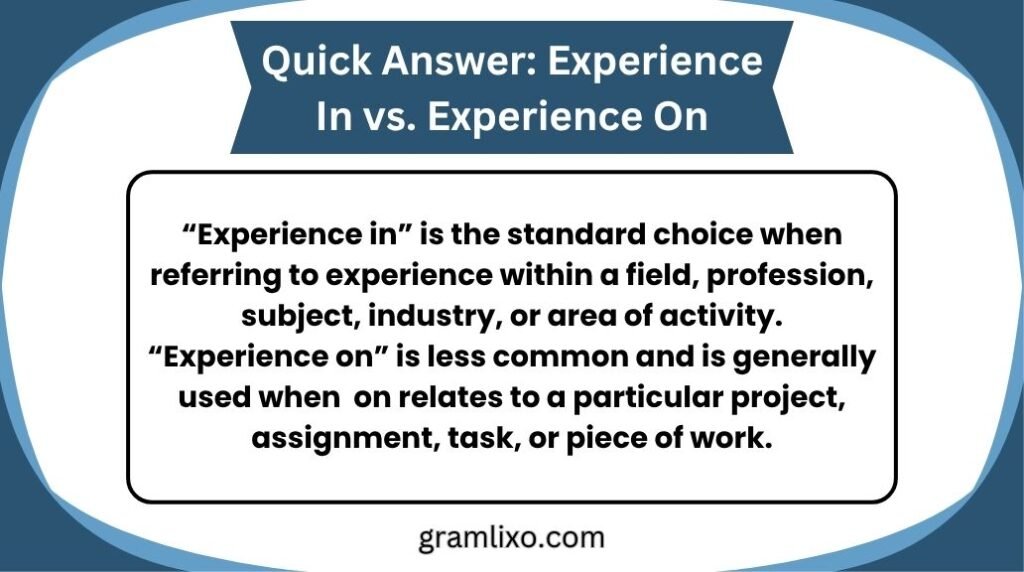
“Experience in” is the standard choice when referring to experience within a field, profession, subject, industry, or area of activity.
- Correct: She has five years of experience in marketing.
- Correct: He has extensive experience in software development.
“Experience on” is less common and is generally used when on relates to a particular project, assignment, task, or piece of work.
- Correct: She has experience on several research projects.
- Correct: He gained experience on the construction site.
So, as a simple rule:
Use “experience in” for fields and areas of expertise; use “experience on” when “on” describes involvement with a specific project, task, or work setting.
Understanding the Basics of Experience In vs. Experience On
The word experience can be followed by different prepositions depending on the relationship between the experience and the thing being described.
The most important distinction is this:
- Experience in → a field, subject, profession, industry, skill, or activity
- Experience on → a particular project, assignment, task, production, or work involving something specific
Comparison Table
| Form | Type | Meaning | Example | Correct/Incorrect |
|---|---|---|---|---|
| Experience in marketing | Prepositional phrase | Experience within a professional field | She has experience in marketing. | ✅ Correct |
| Experience in teaching | Prepositional phrase | Experience in an activity or profession | He has experience in teaching. | ✅ Correct |
| Experience in finance | Prepositional phrase | Experience within an industry | She has experience in finance. | ✅ Correct |
| Experience in programming | Prepositional phrase | Experience with a technical field | He has experience in programming. | ✅ Correct |
| Experience on a project | Prepositional phrase | Experience gained while working on a specific project | I have experience on similar projects. | ✅ Correct |
| Experience on a committee | Prepositional phrase | Experience gained through committee work | She has experience on several committees. | ✅ Correct |
| Experience on a campaign | Prepositional phrase | Experience gained while participating in a campaign | He has experience on political campaigns. | ✅ Correct |
| Experience on marketing | Unnatural usage in most contexts | Intended meaning is usually experience within marketing | She has experience on marketing. | ❌ Usually incorrect |
The key is not simply memorizing one preposition. You need to identify the relationship between the person and the subject being discussed.
Correct Meanings and Uses
When to Use “Experience In”
Experience in is the most common construction when you are describing someone’s knowledge, skills, training, or professional background in a particular area.
It commonly appears before:
- Industries
- Professions
- Academic subjects
- Skills
- Activities
- Fields of expertise
- Areas of work
- Types of business
Examples
She has extensive experience in finance.
Here, finance is a professional field. Therefore, in is appropriate.
I have three years of experience in customer service.
Customer service is an area of professional work, so in works naturally.
He has experience in web development.
Web development is a field or area of expertise.
Sentence Breakdown
Consider this sentence:
Maria has experience in graphic design.
- Maria = subject
- has = verb
- experience = noun
- in graphic design = prepositional phrase
- graphic design = field of expertise
The preposition in creates the idea that Maria’s experience exists within the field of graphic design.
Experience In + Professional Fields
One of the most common uses of experience in appears on resumes, cover letters, LinkedIn profiles, job applications, and professional biographies.
Examples include:
- experience in accounting
- experience in sales
- experience in management
- experience in education
- experience in healthcare
- experience in engineering
- experience in marketing
- experience in journalism
- experience in programming
- experience in customer support
Example Sentences
I have five years of experience in digital marketing.
She has considerable experience in project management.
The candidate has experience in financial analysis.
Our team has extensive experience in software engineering.
These sentences sound natural because the noun following in represents a field or area of expertise.
Experience In + Activities
Experience in can also describe experience with an activity.
For example:
He has experience in teaching children.
She has experience in managing large teams.
I have experience in working with international clients.
They have experience in organizing large events.
Here, the phrase after in describes an activity or type of work.
A Useful Pattern
A common structure is:
experience + in + noun/activity
For example:
experience in teaching
experience in writing
experience in editing
experience in negotiating
experience in managing teams
This construction is particularly useful in professional writing.
When to Use “Experience On”
Experience on is not necessarily wrong. However, its meaning is more specific, and it is less common than experience in.
You can use experience on when on has its normal meaning of involvement with or work upon a particular project, assignment, production, committee, or similar entity.
Examples
She has experience on several research projects.
He worked on the team and gained experience on major construction projects.
I have experience on similar assignments.
She has experience on nonprofit boards.
In these examples, on connects the person to a specific project, assignment, or organizational activity.
Experience On + Projects
This is one of the clearest situations where experience on can be appropriate.
Compare:
I have experience in software development.
This refers to a general field.
But:
I have experience on software development projects.
This refers to specific projects.
The difference is subtle but important.
Compare These Sentences
Experience in:
Daniel has ten years of experience in construction.
This describes Daniel’s overall professional background.
Experience on:
Daniel has experience on several commercial construction projects.
This focuses on specific projects Daniel worked on.
Both sentences can be correct because they communicate different relationships.
Experience In vs. Experience On in Professional Writing
Professional writing is where this distinction matters most.
A resume or cover letter often describes someone’s skills and professional background. In such contexts, experience in is usually the safer and more natural choice.
Resume Examples
Experienced professional with eight years of experience in project management.
Five years of experience in customer service.
Extensive experience in data analysis and reporting.
Strong experience in software development.
However, if you are discussing individual projects, on can work:
Worked on five major infrastructure projects.
Gained valuable experience on international development projects.
Notice that professional writers often avoid forcing experience on into every sentence. Instead, they may simply use worked on, participated in, or contributed to.
Experience In vs. Experience On: A Simple Test
When you are unsure which preposition to choose, ask yourself:
Test Tip 💡
Am I talking about a field or area of expertise?
If yes, use in.
experience in medicine
experience in marketing
experience in teaching
experience in programming
Am I talking about a particular project, assignment, committee, or work effort?
If yes, on may be appropriate.
experience on a research project
experience on a construction project
experience on a committee
This simple test solves most experience in vs. experience on questions.
Case Study: A Workplace Example
Imagine that Sarah is applying for a marketing position.
She has worked in marketing for seven years and has contributed to several advertising campaigns.
She could write:
I have seven years of experience in marketing and have worked on several national advertising campaigns.
This sentence is excellent because each preposition has a different job.
Why “in” Works
Experience in marketing describes Sarah’s general professional field.
Why “on” Works
Worked on advertising campaigns describes specific projects.
Now imagine that Sarah writes:
I have seven years of experience on marketing.
This sounds unnatural because marketing is a professional field, not a particular project.
A better version is:
I have seven years of experience in marketing.
Grammar Rules Behind Experience In vs. Experience On
The difference comes from the meanings of the prepositions.
The Meaning of “In”
The preposition in often indicates inclusion within an area, field, activity, or subject.
For example:
She works in education.
He specializes in medicine.
They have experience in engineering.
The idea is that the person operates within that field.
This explains why experience in is so common.
The Meaning of “On”
The preposition on often indicates contact, involvement, or activity involving a particular object, task, project, or surface.
For example:
She worked on a project.
He worked on a report.
They worked on a campaign.
Therefore, experience on a project can be grammatical because the person gained experience while working on that specific project.
Standard dictionaries such as Merriam-Webster distinguish the various meanings and functions of English prepositions, including the uses of in and on. The important point is that prepositions are selected according to the relationship they express, rather than simply because one sounds familiar.
Why “Experience In” Is Usually the Better Choice
If your sentence concerns a career, profession, industry, skill, or general area of knowledge, experience in is overwhelmingly the natural choice.
Common Examples
| Field | Natural Expression |
|---|---|
| Marketing | experience in marketing |
| Teaching | experience in teaching |
| Finance | experience in finance |
| Medicine | experience in medicine |
| Sales | experience in sales |
| Programming | experience in programming |
| Writing | experience in writing |
| Engineering | experience in engineering |
| Customer service | experience in customer service |
| Management | experience in management |
This is why you frequently see experience in on resumes and job descriptions.
Common Mistakes With Experience In vs. Experience On
Many errors happen because English learners remember the word experience but do not consider the noun that follows it.
For example:
❌ She has experience on accounting.
✅ She has experience in accounting.
Why?
Because accounting is a professional field.
Another example:
❌ He has experience on teaching.
✅ He has experience in teaching.
Again, teaching is an activity or profession.
But:
✅ He has experience on several teaching projects.
Now on can work because the phrase refers to specific projects.
Why These Mistakes Happen
1. Fast Typing
When people type quickly, they may choose a familiar preposition without checking the sentence.
2. Autocorrect
Autocorrect can sometimes reinforce an incorrect choice or fail to detect a grammatically awkward preposition.
3. Lack of Knowledge
English prepositions are difficult because their meanings overlap. A direct translation from another language can also produce unnatural combinations.
4. Similar Expressions
English contains many fixed combinations, such as:
- interested in
- experienced in
- good at
- responsible for
- involved in
Learning these combinations as phrases can make writing much easier.
Similar Grammar Confusions
Preposition errors are not unique to experience in vs. experience on. English has many commonly confused forms.
| Confusion | Correct Form | Why |
|---|---|---|
| it’s / its | It’s raining. / The dog wagged its tail. | Contraction vs. possessive |
| your / you’re | Your book is here. / You’re late. | Possessive vs. contraction |
| their / they’re | Their car is new. / They’re ready. | Possessive vs. contraction |
| affect / effect | The change affected sales. / The effect was significant. | Verb vs. noun in common uses |
| then / than | Better than before. / First this, then that. | Comparison vs. sequence |
| in / on | Experience in marketing. / Experience on a project. | Field vs. specific project |
| advice / advise | She gave advice. / I advise you to wait. | Noun vs. verb |
| accept / except | I accept the offer. / Everyone came except John. | Receive/agree vs. exclusion |
The solution is not simply memorizing isolated words. Learn the patterns in which they naturally occur.
Experience In vs. Experience On in Different Contexts
Everyday Conversation
In everyday speech, experience in is common when discussing someone’s abilities or background.
Do you have experience in cooking?
She has experience in childcare.
I have experience in customer service.
If you are discussing a particular activity or project, you may hear on:
Did you work on that project?
I gained experience on the job.
However, speakers may often choose another construction instead of experience on.
Professional Writing
Professional writing strongly favors clear and conventional phrasing.
For example:
I have six years of experience in technical support.
This sounds natural on a resume.
A less natural version would be:
I have six years of experience on technical support.
The second sentence should normally use in.
Creative Writing
Creative writing gives authors more flexibility, but standard grammatical relationships still matter.
For example:
Years of experience in the theater had taught her patience.
Here, in the theater describes the field or environment.
For a particular production:
His experience on the stage helped him remain calm.
Here, on the stage has a literal spatial meaning.
This demonstrates an important point: the preposition depends on the intended meaning.
Social Media and Texting
Informal communication often contains shortened or grammatically imperfect phrases.
You might see:
Got experience in sales?
or
Any experience on projects like this?
The first refers to a field. The second refers to specific projects.
Although texting is informal, choosing the right preposition still makes your meaning clearer.
Experience In vs. Experience On in Job Applications
If you are writing a resume, cover letter, or application, follow this practical rule:
Use “experience in” for:
- professions
- industries
- skills
- subjects
- areas of expertise
- general activities
Use “on” for:
- specific projects
- assignments
- campaigns
- committees
- productions
- particular tasks
Example
I have eight years of experience in software engineering and extensive experience on large-scale cloud migration projects.
This sentence is precise because it distinguishes general expertise from specific project involvement.
Why the Difference Matters
Choosing the right preposition may seem like a small detail, but small details can affect how professional your writing sounds.
Clarity in Communication
Compare:
I have experience in advertising.
with:
I have experience on advertising.
The first immediately tells the reader that advertising is the speaker’s area of experience. The second sounds incomplete or unnatural in most contexts.
Professionalism
In a resume or job application, grammatical accuracy can influence the reader’s impression.
A polished sentence such as:
I have extensive experience in project management.
sounds confident and professional.
Clear language helps your qualifications stand out instead of distracting the reader.
Digital Communication
Online communication is often fast. Emails, applications, professional profiles, and business messages may be read quickly.
Using the right preposition helps readers understand your meaning immediately.
Experience in data analysis
is instantly recognizable as a professional skill.
That clarity is especially valuable when employers scan resumes quickly.
A Short Reminder
The right preposition makes the relationship clear.
That simple principle can help you avoid many preposition errors.
Special Exceptions and Edge Cases
There is no major grammatical exception that makes experience on a general substitute for experience in.
However, context can change the meaning.
For example:
experience on a project
is natural because the person worked on that project.
Similarly:
experience on a committee
can be natural because someone serves on a committee.
experience on a production
may be appropriate when referring to work involved in producing a film, television program, theater production, or similar project.
Another expression is:
experience on the job
This is common because on the job is an established expression meaning while working in an actual employment setting.
So, experience on is not inherently wrong. It is simply more restricted and context-dependent than experience in.
Quick Recap Checklist
Use this checklist whenever you are unsure.
| Question | If Yes → Use |
|---|---|
| Am I describing a professional field? | experience in |
| Am I describing an industry? | experience in |
| Am I describing a subject or area of expertise? | experience in |
| Am I describing a general activity? | experience in |
| Am I describing a specific project? | experience on may work |
| Am I describing a committee? | experience on may work |
| Am I describing a particular assignment? | experience on may work |
| Am I describing a campaign or production? | experience on may work |
Practice Examples
1. She has ten years of experience ___ nursing.
Answer: in
She has ten years of experience in nursing.
2. He gained valuable experience ___ several international projects.
Answer: on
He gained valuable experience on several international projects.
3. I have experience ___ digital marketing.
Answer: in
I have experience in digital marketing.
More Examples to Make the Difference Clear
Experience In
She has experience in human resources.
He has experience in restaurant management.
They have experience in international business.
I have experience in technical writing.
We need someone with experience in customer relations.
She gained experience in teaching English.
All of these refer to a field, activity, or area of expertise.
Experience On
She has experience on several community projects.
He has experience on construction projects.
I have experience on similar assignments.
She served on the committee and gained valuable experience.
He has experience on television productions.
These examples refer to specific projects, assignments, committees, or productions.
Can You Say “Experience With”?
Yes. In many situations, experience with is another excellent option.
For example:
I have experience with Microsoft Excel.
She has experience with difficult customers.
He has experience with automated testing.
The choice between in and with depends on meaning.
Experience In
Focuses on a field or activity:
experience in programming
Experience With
Focuses on a tool, person, system, method, or thing:
experience with Python
experience with customers
experience with database systems
This distinction can make professional writing more precise.
Experience In vs. Experience With vs. Experience On
Here is a useful three-way comparison:
| Expression | Main Use | Example |
|---|---|---|
| Experience in | Field, industry, activity | Experience in marketing |
| Experience with | Tool, system, person, method, thing | Experience with Salesforce |
| Experience on | Specific project, assignment, committee, production | Experience on a research project |
Compare:
She has experience in marketing.
General field.
She has experience with marketing software.
Specific tools or systems.
She has experience on marketing campaigns.
Specific projects or campaigns.
Understanding this distinction can dramatically improve the precision of your writing.
FAQs About Experience In vs. Experience On
1. Is “experience in” or “experience on” correct?
Both can be correct, but they are used differently. Experience in is normally used for fields, industries, subjects, professions, and activities. Experience on can be used for specific projects, assignments, committees, or productions.
2. Should I say “experience in marketing” or “experience on marketing”?
You should normally say “experience in marketing.” Marketing is a professional field, so in is the natural preposition.
3. Is “experience on a project” grammatically correct?
Yes. “Experience on a project” can be grammatically correct when you mean experience gained while working on a specific project.
4. Can I say “experience on my resume”?
Yes, but the exact phrase depends on what follows it. For example, “experience in accounting” and “experience on several accounting projects” are both possible, but they communicate different ideas.
5. What is the difference between “experience in” and “experience with”?
Experience in usually describes a field or activity, while experience with usually describes familiarity or practical experience with a specific tool, system, person, or thing.
For example:
experience in programming
experience with Python
6. Which is better for a resume: “experience in” or “experience on”?
Use experience in when describing your professional field or area of expertise. Use experience on only when referring to particular projects, assignments, campaigns, committees, or similar work.
Final Conclusion
Understanding experience in vs. experience on becomes much easier when you focus on the relationship between experience and the word that follows it.
In most cases, use experience in when talking about a field, profession, industry, subject, skill, or general activity: experience in marketing, experience in teaching, or experience in software development.
Use experience on more selectively when referring to a particular project, assignment, committee, campaign, or production: experience on a research project or experience on several campaigns.
Remember that experience in is the standard choice for describing someone’s general professional background. When the context involves a specific project or piece of work, on may be appropriate.
The easiest rule to remember is simple: you have experience in a field, but you may have experience on a specific project.
Get that distinction right, and your writing will sound clearer, more natural, and more professional.

I’m Michael Williams, an English writer and grammar enthusiast at Gramlixo. I’m passionate about making grammar easier to learn and helping readers write with greater confidence.
[…] Experience In vs Experience On: Which One Is Correct? […]
[…] |Experience In vs Experience On: Which One Is Correct? […]