Have you ever paused while writing because you were unsure whether to use renounce vs denounce? These two verbs look and sound similar, and both can involve rejecting something. However, they do not communicate the same idea. Choosing the wrong word can change the meaning of a sentence, especially in professional, political, academic, or formal writing.
The easiest way to remember the difference is this: renounce usually means to give up, reject, or formally abandon something, while denounce usually means to publicly condemn or strongly criticize someone or something. In other words, when you renounce something, you turn away from it. When you denounce something, you speak against it.
This distinction becomes much easier once you focus on the action involved. Are you giving something up? Use renounce. Are you openly condemning something? Use denounce.
In this guide, we will explore renounce vs denounce, their meanings, grammar rules, examples, common mistakes, and practical usage so you can choose the correct word with confidence. ✍️
|Mic vs Mike: What Is the Difference?
|Solve vs Resolve: What’s the Difference and When Should You Use Each?
|Shall vs Will: What’s the Difference and When Should You Use Each?
Quick Answer: Renounce vs Denounce
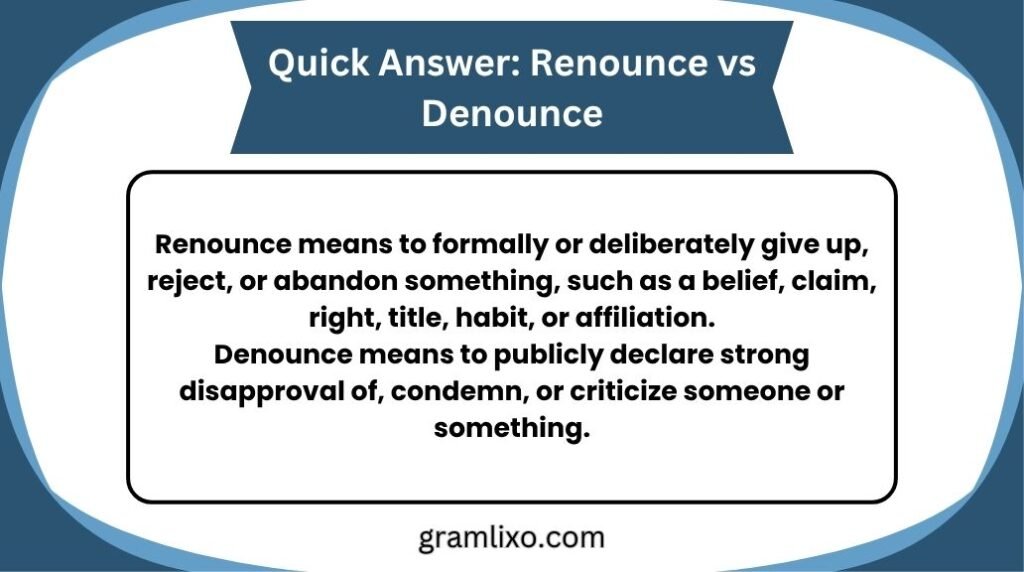
Renounce means to formally or deliberately give up, reject, or abandon something, such as a belief, claim, right, title, habit, or affiliation.
Denounce means to publicly declare strong disapproval of, condemn, or criticize someone or something.
Easy rule:
- Renounce = give up or reject
- Denounce = publicly condemn
Example:
- She renounced her claim to the inheritance. ✅
- The organization denounced the violent attack. ✅
You can remember the distinction with this simple idea:
Renounce what you leave; denounce what you condemn.
Understanding the Basics of Renounce vs Denounce
The words renounce and denounce share similar spelling, but their meanings are different enough that they should not normally be used interchangeably.
What Does “Renounce” Mean?
Renounce is a verb meaning to give up, reject, abandon, or formally refuse something.
The object of renounce is often something that a person previously possessed, supported, claimed, believed in, or was connected with.
For example:
- He renounced his political affiliation.
- She renounced her inheritance.
- The leader renounced violence.
- He renounced his former beliefs.
The focus is on giving something up or turning away from it.
Merriam-Webster’s treatment of renounce includes senses involving formally giving up a position and solemnly or formally rejecting something previously adhered to.
What Does “Denounce” Mean?
Denounce is a verb meaning to condemn, criticize, or publicly declare strong disapproval of something.
For example:
- The mayor denounced the corruption.
- The newspaper denounced the unfair policy.
- She denounced the attack.
- The activist denounced discrimination.
The focus is not primarily on giving something up. Instead, it is on speaking strongly against it.
Merriam-Webster explains that denounce adds the idea of a public declaration to the meaning of condemnation.
Renounce vs Denounce Comparison Table
| Form | Type | Meaning | Example | Correct/Incorrect |
|---|---|---|---|---|
| Renounce | Verb | To give up or reject | She renounced her claim. | ✅ Correct |
| Denounce | Verb | To publicly condemn | He denounced the decision. | ✅ Correct |
| Renounce | Verb | To publicly criticize something | He renounced the unfair policy. | ⚠️ Usually not the intended meaning |
| Denounce | Verb | To give up a personal belief | She denounced her religion. | ⚠️ Usually incorrect if “give up” is intended |
| Renounced | Past-tense verb | Gave up or rejected | He renounced his title. | ✅ Correct |
| Denounced | Past-tense verb | Publicly condemned | She denounced the violence. | ✅ Correct |
The key difference is therefore simple:
Renounce describes withdrawal or abandonment. Denounce describes condemnation or public criticism.
Renounce: Correct Meanings and Uses
1. Renounce Means to Give Up Something
One of the most common uses of renounce is to voluntarily give up something.
This could be:
- a right
- a title
- a claim
- an inheritance
- a position
- an affiliation
- a belief
- a habit
Example:
The prince decided to renounce his claim to the throne.
Sentence Breakdown
- The prince = subject
- decided = main verb
- to renounce = infinitive verb
- his claim = object
- to the throne = phrase explaining the claim
The prince is not publicly criticizing the throne. He is giving up his claim to it.
Therefore, renounce is the appropriate word.
2. Renounce Can Mean to Reject a Belief
You can also use renounce when someone deliberately abandons a belief, philosophy, practice, or ideology.
Examples:
She renounced her former beliefs.
He publicly renounced violence.
The group renounced extremist practices.
In each case, the subject is turning away from something previously accepted or practiced.
This is different from merely criticizing that thing.
For example:
- He renounced violence. → He rejected or abandoned violence.
- He denounced violence. → He publicly condemned violence.
Both sentences can be grammatically correct, but the meaning is different.
3. Renounce Can Refer to a Claim or Right
Formal writing often uses renounce with words such as:
- claim
- right
- title
- ownership
- inheritance
- citizenship
- allegiance
- privilege
Examples:
She renounced her right to the property.
The heir renounced his claim to the estate.
He formally renounced his title.
These examples involve giving something up, not merely criticizing it.
4. Renounce Can Describe Abandoning an Affiliation
A person can also renounce an association, allegiance, or connection.
Example:
The politician renounced his affiliation with the organization.
This means that the politician deliberately separated himself from that organization.
The emphasis is on withdrawal or rejection.
Denounce: Correct Meanings and Uses
1. Denounce Means to Publicly Condemn
The most important meaning of denounce is to openly condemn something.
Example:
The president denounced the attack.
This means the president publicly expressed strong disapproval of the attack.
The person is not necessarily giving anything up.
Instead, the person is speaking against something.
2. Denounce Is Common in Formal or Public Language
You will often see denounce in:
- political speeches
- news reports
- official statements
- legal discussions
- editorials
- public announcements
- human-rights discussions
For example:
The organization denounced the discriminatory policy.
Here, the organization is publicly expressing strong opposition to the policy.
It does not mean that the organization previously owned or possessed the policy.
3. Denounce Can Mean Strongly Criticize
Although criticize can be neutral or relatively mild, denounce generally communicates much stronger disapproval.
Compare:
The editor criticized the article.
with:
The editor denounced the article.
The first sentence could indicate ordinary criticism.
The second suggests forceful condemnation, often made openly or publicly.
Merriam-Webster distinguishes denounce from related verbs by noting that it carries an implication of public declaration.
4. Denounce Can Be Used Against People, Actions, Policies, and Ideas
You can denounce:
- an action
- a policy
- a decision
- an attack
- corruption
- discrimination
- violence
- injustice
- a practice
- a statement
You can also denounce a person when the meaning is to publicly condemn that person.
Examples:
The senator denounced the policy.
The activists denounced the violence.
The organization denounced the company’s actions.
The mayor denounced the officials involved in the scandal.
Renounce vs Denounce: The Core Difference
The easiest way to separate the two words is to ask what the subject is doing.
If the person is giving something up:
Use renounce.
She renounced her inheritance.
She is giving it up.
If the person is speaking strongly against something:
Use denounce.
She denounced the unfair law.
She is publicly condemning it.
Compare These Two Sentences
The athlete renounced his sponsorship.
This means he gave up or rejected the sponsorship.
The athlete denounced the sponsor’s unethical practices.
This means he publicly condemned those practices.
A person could actually do both:
The athlete renounced the sponsorship and denounced the company’s unethical practices.
This sentence demonstrates the distinction perfectly.
Test Tip: How to Choose the Right Word
When you are unsure about renounce vs denounce, use this quick test:
Ask: “Am I giving something up?”
If yes, choose renounce.
I am giving up my claim.
→ I renounce my claim.
Ask: “Am I publicly condemning something?”
If yes, choose denounce.
I am publicly condemning the decision.
→ I denounce the decision.
Memory Trick 🧠
Think:
RE-nounce = REject or give up
DE-nounce = DEclare strong disapproval
This is not a strict etymological rule. It is simply a useful memory device.
Renounce vs Denounce in Real-Life Situations
Consider a workplace situation.
An employee discovers that a company policy is unfair.
The employee could write:
I denounce this policy because it treats employees unfairly.
This means the employee is openly condemning the policy.
Now imagine the employee has a special benefit under that policy and decides to give it up.
I renounce my benefit under this policy.
Now the employee is giving something up.
The same situation can involve both words because the actions are different.
Workplace Email Example
Imagine a manager writes:
Our team strongly denounces the recent harassment reported in the workplace. We also support employees who choose to renounce involvement in activities connected to the situation.
The first use means publicly condemn.
The second means give up or withdraw from involvement.
This distinction is especially important in professional communication because a wrong word can make a statement sound unclear or change its intended meaning.
Grammar Rules for Renounce vs Denounce
Both renounce and denounce are verbs.
They can be used in several grammatical forms.
Renounce
Common forms include:
- renounce
- renounces
- renounced
- renouncing
Examples:
I renounce the claim.
She renounces her former position.
They renounced their allegiance.
He is renouncing his membership.
Denounce
Common forms include:
- denounce
- denounces
- denounced
- denouncing
Examples:
They denounce corruption.
She denounces the policy.
The organization denounced the attack.
He is denouncing the decision.
Neither word is grammatically “more correct” than the other. The correct choice depends on the meaning you intend.
Merriam-Webster’s entries and synonym discussions distinguish renounce as giving up or rejecting something from denounce as strongly condemning something, particularly through public declaration.
Renounce vs Resign: Another Important Distinction
Because renounce can mean giving something up, writers sometimes confuse it with resign.
These words overlap in some contexts, but they are not always interchangeable.
Resign
Resign commonly means to voluntarily leave a job, office, or position.
The manager resigned from her position.
Renounce
Renounce emphasizes formally giving up or rejecting something.
The manager renounced her claim to the position.
Merriam-Webster specifically notes that resign is commonly used for giving up an office or position, while renounce can involve giving up something with an additional sense of rejection or sacrifice.
So, if you are leaving your job, resign is usually the natural word.
If you are formally abandoning a claim, right, belief, or affiliation, renounce may be more appropriate.
Common Mistakes With Renounce vs Denounce
Why do people confuse these words?
There are several reasons.
1. Similar Spelling
Both words end in -nounce.
That visual similarity makes them easy to mix up.
2. Similar General Idea
Both can involve rejection.
However, rejection can happen in different ways.
- Renounce → reject or give up
- Denounce → condemn publicly
3. Fast Typing
When people type quickly, they may choose the first similar-looking word that comes to mind.
This is particularly common in emails and online conversations.
4. Autocorrect
Autocorrect may not recognize that you intended one specific word.
A correctly spelled but incorrect word can easily survive spell-checking.
For example, if you type renounce when you mean denounce, your software may not flag it because renounce is itself a correctly spelled English word.
5. Lack of Familiarity
People who rarely encounter formal vocabulary may know both words but not fully understand the difference.
Reading the surrounding context carefully can help.
Similar Grammar Confusions
The confusion between renounce and denounce is part of a larger pattern in English.
| Confusing Words | Correct Difference |
|---|---|
| Renounce vs. denounce | Give up/reject vs. publicly condemn |
| Its vs. it’s | Possessive vs. “it is” or “it has” |
| Your vs. you’re | Possessive vs. “you are” |
| Affect vs. effect | Usually verb influence vs. noun result |
| Then vs. than | Time/sequence vs. comparison |
| Accept vs. except | Receive/agree vs. exclude |
| Advice vs. advise | Noun vs. verb |
| Compliment vs. complement | Praise vs. completes/matches |
| Principal vs. principle | Person/main item vs. rule or belief |
| Loose vs. lose | Not tight vs. misplace/fail to win |
These pairs demonstrate why spelling alone cannot determine meaning.
Renounce vs Denounce in Different Contexts
Everyday Conversation
In casual conversation, denounce may sound formal.
People are more likely to say:
- criticize
- reject
- disagree with
- condemn
For example:
I strongly disagree with that decision.
However, renounce can appear in everyday speech when someone gives something up.
He renounced his claim to the money.
Professional Writing
Both words can be useful in professional writing.
Renounce works well when discussing:
- rights
- claims
- contracts
- affiliations
- positions
- beliefs
Denounce works well when discussing:
- misconduct
- unethical behavior
- unfair policies
- violence
- discrimination
- controversial actions
Professional writing should use the word that communicates the intended action precisely.
Academic Writing
Academic writing often benefits from the distinction.
For example:
The philosopher renounced his earlier position.
This indicates that the philosopher abandoned his former position.
Compare:
The philosopher denounced the opposing theory.
This indicates strong criticism of another theory.
The difference can be significant in an academic argument.
Creative Writing
Writers can use these verbs to create stronger emotional or dramatic language.
The king renounced his crown.
This suggests sacrifice, abandonment, or withdrawal.
The king denounced his enemies.
This suggests a forceful public attack or condemnation.
The choice changes the emotional direction of the sentence.
Social Media and Texting
Social media users may use denounce when describing a public statement:
The organization denounced the decision on social media.
Renounce may appear when someone publicly abandons a position:
She renounced her previous comments.
However, in casual posts, simpler alternatives such as reject, give up, or condemn may sound more natural.
Why Renounce vs Denounce Matters
Word choice matters because readers depend on context to understand your exact meaning.
1. Clarity in Communication
Compare:
The politician renounced the proposal.
This suggests the politician gave up, rejected, or disclaimed the proposal.
Now compare:
The politician denounced the proposal.
This means the politician publicly condemned the proposal.
Those sentences communicate different actions.
2. Professionalism
Using precise vocabulary makes formal writing more credible.
A legal document, business statement, academic essay, or official announcement should clearly distinguish between abandoning something and condemning it.
3. Accuracy in Digital Communication
Digital communication moves quickly. A single wrong word can change the meaning of a headline, post, email, or statement.
Because both renounce and denounce are valid words, spell-check software may not detect the mistake.
4. Better Search and Content Quality
Precise language also improves content quality.
Search engines and answer systems increasingly rely on context to understand what a page means. Clear distinctions help readers and automated systems identify the exact concept being discussed.
The right word does more than sound correct—it tells the reader exactly what happened.
Special Exception and Edge Cases
There is no major spelling exception that changes the basic distinction between renounce and denounce.
However, some sentences can legitimately use either word because the situation contains both rejection and condemnation.
Consider:
The activist renounced the organization’s policies.
This emphasizes withdrawing support or rejecting association with the policies.
Now:
The activist denounced the organization’s policies.
This emphasizes publicly condemning those policies.
Both can be grammatically correct. The intended meaning determines the correct choice.
Another useful edge case involves beliefs:
He renounced his former beliefs.
This means he abandoned those beliefs.
He denounced his former beliefs.
This means he strongly condemned those beliefs, likely in a public or forceful way.
The difference is subtle but important.
Renounce vs Denounce: Word Patterns to Remember
Learning common word combinations can make the distinction easier.
Common combinations with “Renounce”
- renounce a claim
- renounce a right
- renounce a title
- renounce an inheritance
- renounce citizenship
- renounce violence
- renounce a belief
- renounce an affiliation
- renounce allegiance
- renounce a position
Common combinations with “Denounce”
- denounce violence
- denounce corruption
- denounce discrimination
- denounce an attack
- denounce a policy
- denounce a decision
- denounce injustice
- denounce misconduct
- denounce a practice
- denounce a statement
Notice that violence can appear with both words.
That does not mean the words have become interchangeable.
The group renounced violence.
The group abandoned or rejected violence as a practice.
The group denounced violence.
The group publicly condemned violence.
Both are possible, but the focus changes.
Examples: Correct vs Incorrect
Example 1
❌ She denounced her inheritance.
If the intended meaning is that she gave up her inheritance, this is not the best choice.
✅ She renounced her inheritance.
Example 2
❌ The organization renounced the violent attack.
If the organization publicly condemned the attack, denounced is better.
✅ The organization denounced the violent attack.
Example 3
❌ He denounced his claim to the property.
If he formally gave up his claim, use renounced.
✅ He renounced his claim to the property.
Example 4
❌ The mayor renounced the corrupt officials.
If the mayor publicly condemned them, denounced is the more precise choice.
✅ The mayor denounced the corrupt officials.
Example 5
✅ She renounced her former political affiliation.
She gave up or rejected the affiliation.
Example 6
✅ The senator denounced the proposed legislation.
The senator publicly condemned the legislation.
Quick Recap Checklist
Use this checklist whenever you are unsure about renounce vs denounce.
| Question | If Yes → Use |
|---|---|
| Am I giving up a claim? | Renounce |
| Am I abandoning a belief? | Renounce |
| Am I giving up a right or title? | Renounce |
| Am I withdrawing an affiliation? | Renounce |
| Am I publicly condemning something? | Denounce |
| Am I strongly criticizing a policy? | Denounce |
| Am I openly condemning an action? | Denounce |
| Am I declaring strong disapproval? | Denounce |
Practice Examples
1. The athlete gave up his claim to the award.
→ The athlete renounced his claim to the award.
2. The mayor publicly condemned the discriminatory policy.
→ The mayor denounced the discriminatory policy.
3. The activist abandoned her former affiliation with the group.
→ The activist renounced her former affiliation with the group.
One-Line Rule
If you give it up, renounce it. If you speak strongly against it, denounce it.
FAQs About Renounce vs Denounce
1. What is the difference between renounce and denounce?
Renounce means to give up, reject, or abandon something, often formally. Denounce means to publicly condemn or strongly criticize someone or something.
2. Is it correct to say “renounce violence”?
Yes. Renounce violence means to reject or abandon the use of violence.
For example:
The group renounced violence and adopted peaceful methods.
3. Is it correct to say “denounce violence”?
Yes. Denounce violence means to publicly condemn violence.
For example:
The organization denounced the violence.
The two expressions are grammatical but have different meanings.
4. Can renounce and denounce be used interchangeably?
Usually, no. Renounce focuses on giving up or rejecting something, while denounce focuses on publicly condemning it.
5. Is “renounced” the past tense of “renounce”?
Yes.
She renounced her claim.
The past-tense form is renounced.
6. Is “denounced” the past tense of “denounce”?
Yes.
The organization denounced the policy.
The past-tense form is denounced.
Conclusion
Understanding renounce vs denounce becomes much easier when you focus on the action behind each word. Renounce means to give up, reject, abandon, or formally withdraw from something. Denounce means to publicly condemn, strongly criticize, or declare disapproval of something.
If someone gives up a right, claim, belief, title, or affiliation, use renounce. If someone openly speaks against a policy, action, person, or practice, use denounce.
Remember the simplest rule:
Renounce = give up.
Denounce = condemn.
These verbs may look almost identical, but they describe different kinds of rejection. Choosing the precise word makes your writing clearer, more professional, and easier to understand. When in doubt, ask yourself one question: “Am I abandoning something, or am I publicly condemning it?” If you are abandoning it, renounce is usually the answer. If you are condemning it, choose denounce.
Give something up? Renounce it. Speak strongly against it? Denounce it.

I’m Christopher Garcia, an English writer and grammar enthusiast at Gramlixo. I enjoy making grammar easy to understand through clear explanations and practical examples.



[…] |Renounce vs Denounce: What Is the Difference? […]