Have you ever wondered whether you should solve a problem or resolve it? You are not alone. The confusion between solve vs resolve is common because both words can describe dealing with a problem and finding an answer. In many situations, they can even be used interchangeably. However, they often emphasize different aspects of a situation.
Solve usually focuses on finding an answer, explanation, or solution, especially when the problem has a definite answer. You can solve a math problem, solve a puzzle, solve a mystery, or solve a technical problem.
Resolve, on the other hand, often focuses on settling, clearing up, or bringing an issue to a conclusion. You can resolve a conflict, resolve a dispute, resolve a disagreement, or resolve a customer complaint.
Understanding this small difference can make your writing more precise. Whether you are writing an email, completing an academic assignment, communicating at work, or simply choosing the right word in everyday conversation, knowing when to solve and when to resolve can improve your English.
|Year Old vs Years Old: What’s the Difference?
|In the Street vs On the Street: Which Is Correct?
|Any Problem vs Any Problems: Which One Is Correct?
Quick Answer: Solve vs Resolve
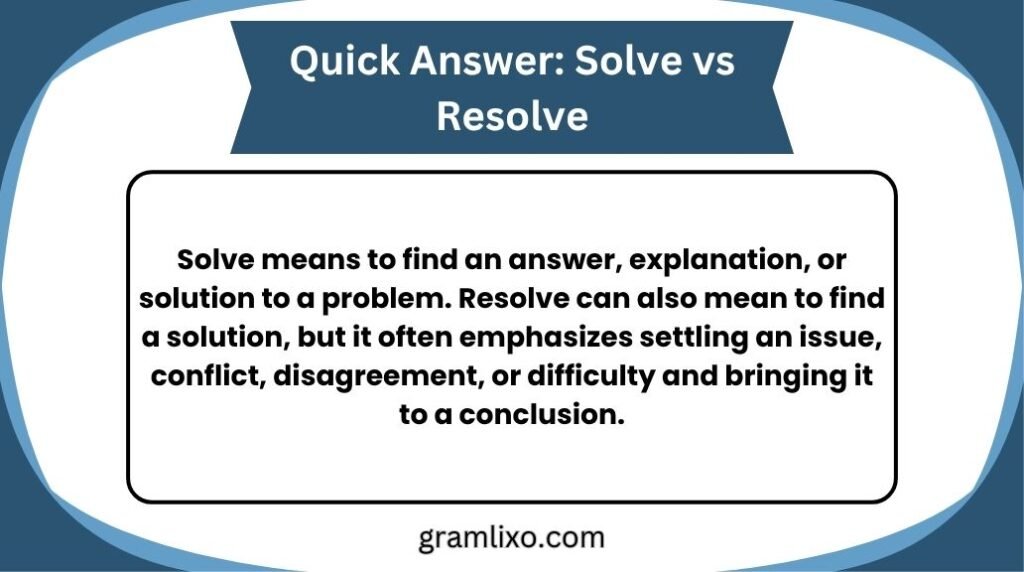
Solve means to find an answer, explanation, or solution to a problem. Resolve can also mean to find a solution, but it often emphasizes settling an issue, conflict, disagreement, or difficulty and bringing it to a conclusion.
For example:
- Solve a puzzle: Find the correct answer.
- Solve a math problem: Work out the answer.
- Resolve a dispute: Settle a disagreement.
- Resolve a conflict: Bring opposing sides to an agreement or conclusion.
A useful shortcut is:
Solve = find the answer.
Resolve = settle the issue.
This is a helpful general rule, although there is some overlap between the two words.
Understanding the Basics of Solve vs Resolve
The easiest way to understand solve vs resolve is to focus on what each verb emphasizes.
Solve commonly suggests figuring something out. It is especially natural when there is a question, puzzle, mystery, calculation, or problem that requires an answer.
Resolve commonly suggests dealing with something successfully and settling it. It is especially common with conflicts, disputes, disagreements, concerns, and difficult situations.
However, the distinction is not absolute. Merriam-Webster recognizes overlapping meanings for the two words. Its thesaurus even lists resolve among synonyms for solve, showing that the words can overlap depending on context.
Comparison Table
| Form | Type | Meaning | Example | Correct/Incorrect |
|---|---|---|---|---|
| solve | Verb | Find an answer or solution | We need to solve this math problem. | Correct |
| resolve | Verb | Settle or deal with an issue successfully | We need to resolve this disagreement. | Correct |
| solved | Past tense/past participle | Found an answer or solution | She solved the puzzle. | Correct |
| resolved | Past tense/past participle | Settled or dealt with an issue | They resolved the dispute. | Correct |
| solve a conflict | Verb phrase | Find an answer to a conflict | Possible, but less natural in many contexts | Sometimes appropriate |
| resolve a conflict | Verb phrase | Settle or bring a conflict to an end | The two teams resolved the conflict. | Natural |
The important point is that neither word is simply “correct” while the other is “incorrect.” The best choice depends on the type of problem and the meaning you want to communicate.
Correct Meanings and Uses of Solve
1. Use “Solve” for Problems With an Answer
One of the most common uses of solve is to find the answer to a problem.
For example:
We need to solve this equation.
Here, solve means to determine the correct mathematical answer.
Other examples include:
- I solved the math problem.
- Can you solve this equation?
- She solved the difficult puzzle.
- The student solved the problem in five minutes.
- The software can solve complex calculations.
In these examples, the focus is on figuring something out.
Sentence Breakdown
Consider:
Marcus solved the puzzle.
- Marcus = subject
- solved = verb
- the puzzle = object
The sentence tells us that Marcus figured out the answer to the puzzle.
2. Use “Solve” for Mysteries
Solve is also extremely common when discussing mysteries or crimes.
Examples:
- The detective solved the mystery.
- Police finally solved the case.
- She solved the riddle.
- Investigators solved the mystery behind the disappearance.
- The scientist solved the mystery of the strange behavior.
Here, the goal is to discover an answer or explanation.
That is why phrases such as solve a mystery, solve a riddle, and solve a case are very natural.
3. Use “Solve” for Technical Problems
In technology, engineering, mathematics, and science, solve is often the natural choice.
Examples:
The technician solved the computer problem.
Engineers are trying to solve the software issue.
We need to solve this network problem before tomorrow.
The emphasis is generally on identifying the cause and finding an effective solution.
4. “Solve” Can Also Describe Broader Problems
Do not assume that solve is limited to puzzles or mathematics.
It can be used with many everyday problems:
- solve a financial problem
- solve a transportation problem
- solve a staffing problem
- solve a communication problem
- solve a health problem
- solve a business problem
For example:
The company needs to solve its staffing problem.
The sentence means that the company needs to find an effective solution.
Correct Meanings and Uses of Resolve
1. Use “Resolve” for Conflicts and Disagreements
One of the strongest uses of resolve is with interpersonal or organizational conflict.
Examples:
- The manager resolved the disagreement.
- The two companies resolved their dispute.
- We need to resolve this conflict.
- The neighbors resolved their argument.
- The mediator helped resolve the disagreement.
In these sentences, resolve suggests bringing the matter to a settled state.
The emphasis is not necessarily on discovering one objectively correct answer. Instead, the focus is on settling the situation.
2. Use “Resolve” for Issues and Concerns
Resolve is especially common in professional communication.
For example:
We are working to resolve the issue.
This sounds natural in a workplace email.
You might also write:
Our support team will resolve your concern as quickly as possible.
Or:
The company has taken steps to resolve the problem.
These sentences emphasize successfully dealing with an issue.
3. Use “Resolve” for Disputes
A dispute is a disagreement or conflict between people or groups.
Therefore, resolve a dispute is a very natural collocation.
Examples:
- The lawyers helped resolve the dispute.
- The two sides reached an agreement and resolved the dispute.
- The company wants to resolve the dispute without going to court.
- Negotiations failed to resolve the dispute.
Here, resolve suggests that the disagreement has been settled.
4. “Resolve” Has Another Important Meaning
There is another meaning of resolve that learners should know.
When you resolve to do something, you make a firm decision or determination to do it.
For example:
She resolved to exercise more regularly.
This does not mean that she “solved exercise.”
It means she firmly decided to exercise more regularly.
Other examples include:
- He resolved to study harder.
- They resolved to improve customer service.
- I resolved to arrive earlier.
- She resolved to stop wasting time.
- We resolved to handle the matter differently.
Merriam-Webster also distinguishes this meaning of resolve as a decision or determination.
Test Tip
Whenever you see resolve to + verb, think:
resolve to do something = firmly decide to do something
For example:
I resolved to save more money.
The meaning is:
I made a firm decision to save more money.
Solve vs Resolve: Where They Overlap
This is where the comparison becomes interesting.
Sometimes both words can work.
For example:
We need to solve the problem.
and:
We need to resolve the problem.
Both sentences can be grammatical.
However, the nuance can be slightly different.
Solve the problem tends to emphasize finding the solution.
Resolve the problem tends to emphasize dealing with the problem successfully and bringing it to a conclusion.
The difference becomes clearer with particular nouns.
Common With “Solve”
- solve a puzzle
- solve a riddle
- solve an equation
- solve a mystery
- solve a mathematical problem
- solve a crime
- solve a technical problem
Common With “Resolve”
- resolve a dispute
- resolve a conflict
- resolve a disagreement
- resolve an argument
- resolve a complaint
- resolve an issue
- resolve a concern
These are tendencies rather than unbreakable grammar rules.
A Simple Mental Test
Ask yourself:
Am I looking for an answer?
If yes, solve is often the better choice.
I need to solve this equation.
Am I trying to settle an issue or disagreement?
If yes, resolve is often the better choice.
We need to resolve this disagreement.
This simple test will help in most everyday situations.
Case Study: Solve vs Resolve in the Workplace
Imagine a customer contacts a company because their order has not arrived.
The customer says:
“My package was supposed to arrive three days ago. Can you help?”
The customer service representative investigates the tracking information.
First, the representative may need to solve the logistical problem.
For example:
We need to solve the shipping error.
But when communicating with the customer, the representative might naturally say:
We will resolve this issue for you.
Why?
Because the customer does not necessarily care about the technical answer alone. The company needs to deal with the issue and bring the situation to a satisfactory conclusion.
Now imagine two employees disagree about how a project should be handled.
A manager might say:
“Let’s meet tomorrow to resolve this disagreement.”
The manager is not looking for a mathematical answer. The goal is to settle the disagreement.
This illustrates the practical difference between the two words.
Grammar Rules for Solve vs Resolve
Both solve and resolve are verbs.
They can take direct objects:
She solved the puzzle.
She resolved the dispute.
Their grammatical structures are similar.
Basic Structure With Solve
Subject + solve + problem/object
Examples:
I solved the problem.
They solved the mystery.
We solved the technical issue.
Basic Structure With Resolve
Subject + resolve + issue/object
Examples:
I resolved the issue.
They resolved the conflict.
We resolved the dispute.
Resolve + To-Infinitive
There is also this important structure:
resolve + to + verb
Examples:
She resolved to work harder.
He resolved to be more patient.
They resolved to improve the process.
This structure expresses a firm decision.
Merriam-Webster describes resolve as capable of meaning to deal with something successfully, find an answer to something, make something clear, or reach a firm decision about something.
So, context is essential.
What Merriam-Webster Says About Solve and Resolve
Standard dictionaries show why this distinction can sometimes feel confusing.
Merriam-Webster’s thesaurus identifies resolve as a synonym associated with solve, particularly in the sense of finding an answer or solution.
That means it would be misleading to say:
“Never use resolve for a problem.”
That is not true.
Likewise, it would be too strict to say:
“You can only use solve with mathematical problems.”
That is also false.
Instead, think of the words as having overlapping meanings with different common associations.
Solve is strongly associated with discovering an answer or solution.
Resolve is strongly associated with settling, clearing up, or concluding an issue, especially a conflict or dispute.
Common Mistakes With Solve vs Resolve
Why do people confuse these words?
There are several reasons.
1. Their Meanings Overlap
Both words can mean “deal with a problem.”
For example:
We solved the problem.
We resolved the problem.
Both can be acceptable depending on context.
Because the meanings overlap, learners may struggle to recognize the preferred word.
2. Fast Typing
When people type quickly, they often choose the first similar word that comes to mind.
This is particularly common in emails and text messages.
A person might type:
“We need to solve this dispute.”
The sentence is understandable, but resolve this dispute is often the more natural collocation.
3. Autocorrect
Autocorrect can also contribute to word-choice mistakes.
Although spelling may be corrected automatically, grammar and vocabulary choices are not always corrected accurately.
A phone may recognize both solve and resolve as correctly spelled words, even when only one is the best choice for a particular context.
4. Lack of Vocabulary Knowledge
English learners may know both words individually but not know their common collocations.
Knowing vocabulary is more than knowing definitions. It also involves learning which words naturally appear together.
For example:
solve a puzzle
is highly natural.
resolve a dispute
is highly natural.
Learning these combinations makes word choice much easier.
Similar Grammar and Word Confusions
The solve vs resolve confusion is part of a larger pattern in English. Many words have similar forms or related meanings but different uses.
| Confusing Words | Correct Difference | Example |
|---|---|---|
| it’s vs its | it’s = it is; its = possessive | It’s cold. / The dog wagged its tail. |
| your vs you’re | your = possessive; you’re = you are | Your car is here. / You’re early. |
| their vs there vs they’re | possession, place, contraction | Their house is there. / They’re home. |
| affect vs effect | usually verb vs noun | The news affected me. / The effect was strong. |
| then vs than | time/order vs comparison | We left then. / She is taller than me. |
| advice vs advise | noun vs verb | I need advice. / I advise caution. |
| accept vs except | receive/agreed to vs excluding | I accept the offer. / Everyone came except John. |
| solve vs resolve | find an answer vs settle/deal with an issue | Solve the puzzle. / Resolve the dispute. |
The lesson is simple: similar meanings do not always mean identical usage.
Solve vs Resolve in Different Contexts
Everyday Conversation
In casual conversation, both words are common.
You might say:
“I need to solve this problem.”
Or:
“We need to resolve this issue.”
For everyday problems, the distinction may not be important if the meaning is clear.
However, native speakers often have strong preferences for certain combinations.
For example:
“Let’s resolve this argument.”
sounds more natural than:
“Let’s solve this argument.”
Professional Writing
Professional writing benefits from precise word choice.
Consider:
We need to solve the disagreement between the departments.
This is understandable.
But:
We need to resolve the disagreement between the departments.
is more natural and professional.
Similarly:
Our team is working to resolve your complaint.
sounds appropriate in customer service communication.
Academic Writing
Academic writing may use both words frequently.
Examples:
Researchers attempted to solve the mathematical problem.
The study examines how communities resolve conflicts.
In technical or mathematical contexts, solve is often the obvious choice.
In social, political, legal, or interpersonal contexts, resolve is frequently more appropriate.
Creative Writing
Creative writers can use either word depending on the desired meaning.
For example:
Detective Morgan finally solved the mystery.
This creates a sense of discovery.
Compare:
The brothers finally resolved their differences.
This creates a sense of reconciliation or settlement.
The choice changes the emphasis of the sentence.
Social Media and Texting
In texting and social media, people often use the words more casually.
You might see:
“How do we solve this?”
or:
“We need to resolve this.”
Both are understandable.
In informal communication, exact distinctions matter less, but choosing the natural collocation still makes your English sound more polished.
Why the Difference Matters
Choosing between solve and resolve may seem like a small detail, but precise vocabulary improves communication.
1. Clarity
The right word helps readers understand what you mean.
Compare:
The team solved the dispute.
with:
The team resolved the dispute.
The second sentence clearly suggests that the disagreement was settled.
Now compare:
The mathematician solved the equation.
This is much more natural because the task requires finding a specific answer.
2. Professionalism
Word choice matters in workplace communication.
Compare:
We will solve your complaint.
with:
We will resolve your complaint.
The second version sounds more natural in customer service because a complaint is something that needs to be handled and settled.
3. Digital Communication
Emails, support tickets, workplace messages, and online documents often require concise language.
A precise verb can communicate your intention quickly.
For example:
“Our team is working to resolve the issue.”
This tells the reader that the team is actively addressing the situation.
4. Natural-Sounding English
Correct grammar is important, but natural word combinations matter too.
English speakers do not choose words only by dictionary definitions. They also rely on common patterns and collocations.
A useful principle is:
Good word choice makes correct English sound natural.
Special Exception: Resolve as a Decision
One special use deserves extra attention.
Resolve can describe a person’s firm decision.
For example:
She resolved to improve her writing.
Here, resolve is followed by to + verb.
The meaning is:
She made a firm decision to improve her writing.
This use is different from:
She resolved the problem.
In the first sentence, resolve means “decided firmly.”
In the second, it means “settled or dealt with.”
There is also the noun resolve, which means determination.
For example:
He showed great resolve during the difficult situation.
So, resolve has a wider range of meanings than solve.
Can You Solve a Conflict?
Yes, solve can sometimes be used with broad problems and conflicts, especially when the speaker is emphasizing finding a solution.
However, resolve a conflict is generally the more natural expression when the focus is on settling the conflict.
Compare:
We need to solve the conflict.
We need to resolve the conflict.
The second sentence is usually preferable when two people or groups are in disagreement.
Similarly:
The mediator helped resolve the dispute.
is a particularly natural expression.
Can You Resolve a Problem?
Yes.
Resolve a problem is completely grammatical and common.
For example:
The technician resolved the problem.
This means the technician successfully dealt with the problem.
In many contexts, solve a problem and resolve a problem can both work.
The nuance is usually:
- solve a problem → find the answer or solution
- resolve a problem → successfully deal with or settle the problem
The context determines which emphasis is more useful.
Can You Solve an Issue?
Yes, but resolve an issue is often more natural in professional communication.
For example:
We are working to resolve this issue.
This is a very common workplace expression.
You might also say:
We need to solve this technical issue.
The second sentence is particularly natural when the issue has a technical cause that must be figured out.
Can You Resolve a Puzzle?
This is possible in some contexts, but solve a puzzle is the standard and more natural choice.
For example:
She solved the crossword puzzle.
This is better than:
She resolved the crossword puzzle.
Why?
Because a puzzle is normally something you figure out.
The same principle applies to:
- solve a riddle
- solve an equation
- solve a mystery
- solve a crossword
- solve a logic problem
Quick Recap Checklist
Use the following checklist when choosing between solve and resolve.
| Question | If Yes → Use |
|---|---|
| Are you finding the answer to a puzzle? | solve |
| Are you working out a math problem? | solve |
| Are you discovering the answer to a mystery? | solve |
| Are you settling a disagreement? | resolve |
| Are you settling a dispute? | resolve |
| Are you dealing with a complaint? | resolve |
| Are you bringing an issue to a conclusion? | resolve |
| Are you making a firm decision to do something? | resolve + to |
Practice Examples
1. The detective finally ___ the mystery.
Answer: solved
The detective finally solved the mystery.
2. The manager helped the employees ___ their disagreement.
Answer: resolve
The manager helped the employees resolve their disagreement.
3. She ___ to become more organized.
Answer: resolved
She resolved to become more organized.
Solve vs Resolve: Easy Memory Trick
If you want one quick trick to remember the difference, use this:
🧩 Solve = Figure It Out
Think about:
- puzzles
- equations
- riddles
- mysteries
- technical problems
You are trying to figure something out.
🤝 Resolve = Settle It
Think about:
- disputes
- conflicts
- disagreements
- complaints
- concerns
- difficult situations
You are trying to settle something.
So remember:
🧩 Solve the puzzle.
🤝 Resolve the conflict.
This is not an absolute rule, but it is an excellent practical guide.
Frequently Asked Questions
1. What is the difference between solve and resolve?
Solve usually means to find an answer, explanation, or solution to a problem. Resolve often means to settle, clear up, or successfully deal with an issue, conflict, or dispute. The two words overlap in some contexts.
2. Is it correct to say “solve a problem”?
Yes. Solve a problem is completely correct and extremely common. It usually emphasizes finding the answer or solution.
Example:
We need to solve this technical problem.
3. Is it correct to say “resolve a problem”?
Yes. Resolve a problem is also correct. It often emphasizes successfully dealing with the problem and bringing it to a conclusion.
Example:
The technician resolved the problem quickly.
4. Should I say “solve a conflict” or “resolve a conflict”?
Resolve a conflict is generally the more natural choice. A conflict involves disagreement between people or groups, so resolve emphasizes settling the disagreement.
Example:
The mediator helped resolve the conflict.
5. Should I say “solve a mystery” or “resolve a mystery”?
Solve a mystery is the standard and more natural expression. A mystery involves discovering an answer or explanation.
Example:
The detective solved the mystery.
6. What does “resolve to do something” mean?
Resolve to do something means to make a firm decision or determination to do it.
Example:
She resolved to study every evening.
This is different from resolve a problem, which means to deal with or settle a problem.
Final Conclusion
Understanding solve vs resolve becomes much easier when you focus on the type of situation and the meaning you want to express. Solve generally emphasizes finding an answer, explanation, or solution. It is especially natural with puzzles, equations, mysteries, riddles, and problems that require figuring something out. Resolve often emphasizes settling, clearing up, or successfully dealing with an issue. It is especially common with conflicts, disputes, disagreements, complaints, and concerns.
The two words can overlap, so there is no rule saying that solve is always correct and resolve is always wrong, or vice versa. In many contexts, both are grammatical. The key is choosing the word that best matches the intended meaning and natural English usage.
Remember the simple rule: solve when you need to figure something out; resolve when you need to settle something. And when you see resolve to + verb, think “make a firm decision.”
Once you learn these patterns, choosing between solve and resolve becomes much more natural.
Solve the mystery. Resolve the conflict. Choose the word that matches the job.

I’m Sarah Martinez, a writer and English language enthusiast at Gramlixo. I love explaining grammar concepts in a clear and practical way that anyone can understand.


[…] |Solve vs Resolve: What’s the Difference and When Should You Use Each? […]