Have you ever looked at a salon menu and wondered whether you need a pedicure vs manicure? You are not alone. The two words look and sound similar, and both describe personal-care services involving nails. That similarity makes them easy to mix up, especially when you are booking an appointment, writing a beauty post, or simply trying to explain what kind of treatment you want.
The good news is that the difference is very simple. A manicure is primarily a beauty and grooming treatment for the hands and fingernails, while a pedicure is primarily a beauty and grooming treatment for the feet and toenails.
Both words are standard English, so neither is grammatically “wrong.” The important point is choosing the word that matches the part of the body being treated.
In this guide, we will break down pedicure vs manicure, explain their meanings, show correct examples, examine common mistakes, and provide an easy way to remember the difference.
Whether you are writing professionally, texting a friend, or booking a salon service, you will know exactly which word to use. 💅🦶
|Renounce vs Denounce: What Is the Difference?
|My Apology vs My Apologies: Which One Is Correct?
Quick Answer: Pedicure vs Manicure
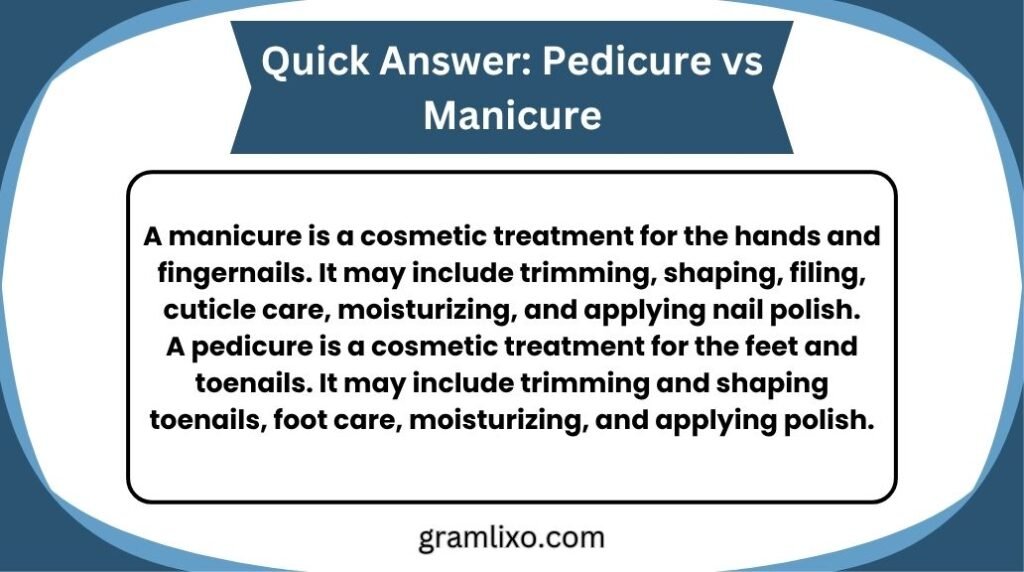
A manicure is a cosmetic treatment for the hands and fingernails. It may include trimming, shaping, filing, cuticle care, moisturizing, and applying nail polish.
A pedicure is a cosmetic treatment for the feet and toenails. It may include trimming and shaping toenails, foot care, moisturizing, and applying polish.
Easy memory trick:
👉 Manicure = hands
👉 Pedicure = feet
Both manicure and pedicure are correct English words. The choice depends on whether you are talking about your hands or your feet.
Understanding the Basics: Pedicure vs Manicure
The biggest difference between pedicure vs manicure is the area of the body involved.
A manicure focuses on the hands, especially the fingernails. A pedicure focuses on the feet, especially the toenails.
The words are both nouns when you are naming the service:
- “I booked a manicure.”
- “She wants a pedicure.”
- “My manicure looks great.”
- “His pedicure included toenail shaping.”
They can also function as verbs:
- “I need to manicure my nails.”
- “The technician pedicured her toenails.”
However, in everyday American English, people are much more likely to use manicure and pedicure as nouns when discussing salon services.
Comparison Table
| Form | Type | Meaning | Example | Correct/Incorrect |
|---|---|---|---|---|
| manicure | Noun | A treatment for the hands and fingernails | “I booked a manicure.” | ✅ Correct |
| pedicure | Noun | A treatment for the feet and toenails | “I booked a pedicure.” | ✅ Correct |
| manicure | Verb | To care for or treat the hands or fingernails | “She manicured her nails.” | ✅ Correct |
| pedicure | Verb | To care for or treat the feet or toenails | “He pedicured his toenails.” | ✅ Correct |
| pedicure for hands | Noun phrase | Uses the wrong service name for the body area | “I want a pedicure for my hands.” | ❌ Usually incorrect |
| manicure for feet | Noun phrase | Uses the wrong service name for the body area | “I need a manicure for my feet.” | ❌ Usually incorrect |
The key distinction is not traditional grammar such as singular versus plural or formal versus informal. It is meaning and usage.
What Does “Manicure” Mean?
A manicure is a treatment involving the hands and fingernails.
A typical manicure may involve:
- Cleaning the fingernails
- Trimming the nails
- Filing and shaping the nails
- Caring for the cuticles
- Moisturizing the hands
- Applying nail polish
- Applying gel, acrylic, or another nail enhancement, depending on the service
For example:
“I am getting a manicure before the wedding.”
The word manicure tells us that the speaker is talking about a hand-and-fingernail treatment.
Example 1: Salon Appointment
“I scheduled a manicure for Saturday.”
Sentence breakdown:
- I = subject
- scheduled = verb
- a manicure = object
- for Saturday = time expression
Here, manicure is a noun because it names the service.
Example 2: Personal Care
“Her manicure looks beautiful.”
Here, manicure refers to the finished nail treatment or the groomed appearance of the fingernails.
Example 3: Professional Setting
“The salon offers classic and gel manicures.”
The plural form is manicures.
Notice that the word does not need an apostrophe. You write:
✅ “manicure”
❌ “manicure’s” when you simply mean more than one manicure
An apostrophe would have a different grammatical function, usually showing possession.
What Does “Pedicure” Mean?
A pedicure is a treatment involving the feet and toenails.
A typical pedicure may include:
- Cleaning the feet
- Trimming toenails
- Filing and shaping toenails
- Foot care
- Moisturizing
- Cuticle care
- Applying toenail polish
- Additional cosmetic foot treatments
For example:
“I need a pedicure before my beach vacation.”
The word pedicure tells the reader that the treatment concerns the feet and toenails.
Example 1: Salon Appointment
“She booked a pedicure for Friday afternoon.”
Here, pedicure is a noun naming the service.
Example 2: Vacation Preparation
“I got a pedicure before our trip.”
The speaker is talking about toenail and foot grooming.
Example 3: Plural Form
“The salon performed several pedicures today.”
The plural form is pedicures.
Again, no apostrophe is needed when simply making the word plural.
Pedicure vs Manicure: The Core Difference
If you remember only one thing from this article, remember this:
A manicure is for your hands, while a pedicure is for your feet.
Think about the first part of each word:
- Mani- → manicure → hands
- Pedi- → pedicure → feet
The terms are related, but they do not mean the same thing.
Manicure
A manicure generally focuses on:
- Hands
- Fingernails
- Cuticles around fingernails
- Hand skin
- Fingernail polish
Pedicure
A pedicure generally focuses on:
- Feet
- Toenails
- Cuticles around toenails
- Foot skin
- Toenail polish
Many salons also offer combined services, such as a manicure and pedicure package.
For example:
“I booked a manicure and pedicure for Saturday.”
This sentence is completely natural because it clearly identifies both services.
Is “Pedicure vs Manicure” a Grammar Question?
Technically, pedicure vs manicure is not a traditional grammar conflict like your vs you’re or its vs it’s.
Both words are correctly spelled English words.
The confusion comes from meaning, not grammatical correctness.
You would not normally ask:
“Which spelling is grammatically correct: pedicure or manicure?”
Instead, the useful question is:
“Which word describes the treatment I mean?”
If you are talking about fingernails, choose manicure.
If you are talking about toenails and feet, choose pedicure.
This is an important distinction for SEO and language learners because search queries often place two related terms together even when both are correct.
Correct Meanings & Uses
When to Use “Manicure”
Use manicure when the context involves the hands or fingernails.
Examples:
- “I need a manicure.”
- “She got a French manicure.”
- “My manicure lasted for two weeks.”
- “The salon offers gel manicures.”
- “I am doing my manicure at home.”
When to Use “Pedicure”
Use pedicure when the context involves the feet or toenails.
Examples:
- “I need a pedicure.”
- “She got a pedicure before vacation.”
- “My pedicure includes a foot massage.”
- “He booked a pedicure for Saturday.”
- “I usually get a pedicure during the summer.”
When to Use Both
Use manicure and pedicure when you mean both treatments.
Examples:
- “I booked a manicure and pedicure.”
- “The salon offers manicure and pedicure packages.”
- “She gets a manicure and pedicure before special events.”
Test Tip: Use the Body-Part Test
Here is a simple test that can help you choose the right word.
Ask yourself:
“Am I talking about my hands or my feet?”
If the answer is hands, use manicure.
If the answer is feet, use pedicure.
Try These
1. “I want my fingernails shaped.”
Answer: Manicure
2. “I want my toenails trimmed.”
Answer: Pedicure
3. “I want both my hands and feet treated.”
Answer: Manicure and pedicure
This simple test works in most everyday situations.
Case Study: A Real-Life Salon Conversation
Imagine that Sarah is preparing for a wedding.
She calls a salon and says:
“Hi, I’d like to make an appointment for a manicure and pedicure.”
The receptionist understands immediately.
Sarah wants her:
- Fingernails treated → manicure
- Toenails and feet treated → pedicure
Now imagine Sarah says:
“I’d like a pedicure for my hands.”
The receptionist might understand what she means from context, but the terminology is incorrect for the usual salon service. The standard term for hand and fingernail care is manicure.
Another Workplace Example
Suppose a coworker asks:
“Why are you leaving early today?”
You might say:
“I have a manicure appointment.”
That means you are going to have your hands and fingernails treated.
If you say:
“I have a pedicure appointment.”
The listener will normally understand that you are having your feet and toenails treated.
The distinction is therefore practical, not merely academic.
Grammar Rules Explanation
Rule 1: Both Words Are Correct
There is no general grammar rule saying that manicure is correct while pedicure is incorrect, or vice versa.
Both are established English words.
The important rule is to use the word according to its meaning.
Rule 2: “Manicure” Can Be a Noun
“She booked a manicure.”
Here, manicure names a service.
Rule 3: “Pedicure” Can Be a Noun
“He booked a pedicure.”
Here, pedicure also names a service.
Rule 4: Both Can Also Function as Verbs
English sometimes uses the same word as both a noun and a verb.
For example:
“She got a manicure.”
“She manicured her nails.”
Likewise:
“He got a pedicure.”
“He pedicured his toenails.”
In everyday speech, however, the noun forms are far more common when discussing salon appointments.
Merriam-Webster’s treatment of English parts of speech illustrates that words can have different grammatical functions depending on how they are used in a sentence.
Standard Usage Matters
The distinction between the two terms is also reflected in professional nail-care guidance. The American Academy of Dermatology discusses manicures and pedicures separately while providing safety recommendations for both types of nail care.
Common Mistakes With Pedicure vs Manicure
Because the words are similar in spelling and sound, people sometimes switch them accidentally.
Mistake 1: Calling a Hand Treatment a Pedicure
❌ “I am getting a pedicure on my fingernails.”
Better:
✅ “I am getting a manicure on my fingernails.”
Mistake 2: Calling a Foot Treatment a Manicure
❌ “I booked a manicure for my toenails.”
Better:
✅ “I booked a pedicure for my toenails.”
Mistake 3: Assuming One Is More Correct
Neither word is inherently more correct.
The correct word depends on the service.
Mistake 4: Using an Apostrophe for a Plural
❌ “I booked two manicure’s.”
Correct:
✅ “I booked two manicures.”
Likewise:
❌ “The salon offers several pedicure’s.”
Correct:
✅ “The salon offers several pedicures.”
The apostrophe is not used simply to make a regular plural.
Why Do People Mix Up These Words?
There are several common reasons.
1. Fast Typing
When people type quickly, they may remember that both words relate to nail care but select the wrong one.
2. Autocorrect
Phones and computers sometimes change unfamiliar or less frequently typed words. A quick message can therefore contain an unintended word.
3. Similar Spelling
Both words end in -icure, which makes them visually similar.
Compare:
- manicure
- pedicure
Only the beginning changes, so it is easy to confuse them.
4. Lack of Familiarity
Someone who rarely visits a salon may know both words but not remember which one refers to hands and which one refers to feet.
5. Contextual Assumption
People sometimes use “nails” as a general term without specifying fingernails or toenails. That can make the intended treatment unclear.
Similar Word Confusions
The pedicure vs manicure confusion is different from common grammar pairs such as these:
| Confusing Pair | Correct Distinction |
|---|---|
| its / it’s | Possession vs. “it is” or “it has” |
| your / you’re | Possession vs. “you are” |
| their / there / they’re | Possession, location, and “they are” |
| then / than | Time/order vs. comparison |
| affect / effect | Usually verb vs. noun, with additional meanings |
| advice / advise | Noun vs. verb |
| lose / loose | Misplace/fail to win vs. not tight |
| manicure / pedicure | Hands/fingernails vs. feet/toenails |
Notice something important: manicure and pedicure are not misspellings of one another.
They describe different services.
Usage in Different Contexts
Everyday Conversation
In casual conversation, both words are common.
“I’m getting a manicure tonight.”
“She needs a pedicure before the vacation.”
You do not need complicated language. The basic terms are enough.
Professional Writing
In professional writing, accuracy matters because readers should immediately understand what service or treatment you mean.
For example:
“Our salon provides professional manicure services.”
or:
“Our spa offers relaxing pedicure treatments.”
If you are writing a salon menu, website, advertisement, or appointment confirmation, using the correct term helps customers choose the appropriate service.
Creative Writing
Creative writers can use these words naturally:
“She admired her freshly polished manicure before slipping her shoes back on.”
Or:
“After a long week, he treated himself to a relaxing pedicure.”
The context makes the meaning clear.
Social Media and Texting
Short forms are common online:
“Fresh manicure! 💅✨”
“Pedicure day! 🦶💖”
“Mani + pedi before vacation! ✈️💅”
In informal texting, abbreviations such as mani-pedi may appear. However, for formal writing, spelling out manicure and pedicure is clearer.
Manicure vs Pedicure: Are They Only About Nail Polish?
No.
This is another common misunderstanding.
A manicure or pedicure does not necessarily mean simply applying nail polish.
The services can involve nail grooming and surrounding skin care as well.
A manicure may include:
- Nail shaping
- Nail trimming
- Cuticle care
- Hand moisturizing
- Polish application
- Gel or artificial nail services
A pedicure may include:
- Toenail trimming
- Toenail shaping
- Foot cleansing
- Foot moisturizing
- Cuticle care
- Polish application
The exact service varies from salon to salon, so customers should check the service description before booking.
Safety and Nail-Care Considerations
Although pedicure vs manicure is primarily a vocabulary question, proper nail care is also important.
The American Academy of Dermatology recommends paying attention to salon cleanliness and tool disinfection. It also advises people not to cut or forcefully push back their cuticles because doing so can increase the risk of inflammation or infection.
For pedicures, the AAD also recommends checking that foot baths and filters are properly disinfected. Improperly cleaned equipment can harbor bacteria and fungi.
The AAD further recommends keeping nails clean and dry, trimming toenails regularly, and avoiding attempts to dig out painful or infected ingrown toenails.
So, while the vocabulary difference is simple, the quality and cleanliness of the service matter too.
Why It Matters
Clarity in Communication
Using the correct word helps people understand exactly what you want.
Compare:
“I want a manicure.”
with:
“I want a pedicure.”
The first indicates hands and fingernails. The second indicates feet and toenails.
Professionalism
Correct terminology is especially useful for:
- Salon employees
- Beauty bloggers
- Website owners
- Content writers
- Product descriptions
- Appointment systems
- Marketing materials
A salon website that clearly distinguishes manicure services from pedicure services makes it easier for customers to select the right appointment.
Digital Communication
Accuracy matters online because readers often scan rather than carefully interpret every sentence.
A small vocabulary mistake can change the meaning of a sentence.
A Useful Reminder
“Clear words make clear communication.”
The goal is not to use complicated English. The goal is to use the right word for the intended meaning.
Special Exception: “Mani-Pedi”
In casual American English, you may encounter mani-pedi, mani/pedi, or similar shortened forms.
For example:
“I’m getting a mani-pedi this weekend.”
This informal expression usually means both a manicure and a pedicure.
It is common in casual conversation, texting, social media, and beauty-related marketing.
However, it is less appropriate for highly formal writing.
For example, a formal salon document might say:
“Manicure and pedicure services are available by appointment.”
A casual Instagram caption might say:
“Time for a mani-pedi! 💅🦶✨”
Both can be appropriate depending on the context.
Manicure vs Pedicure in SEO and Content Writing
If you are writing an article, product description, salon page, or beauty guide, understanding pedicure vs manicure can also improve content clarity.
Instead of using the terms interchangeably, create clear topical relationships.
For example:
Manicure-related keywords:
- manicure
- manicure services
- manicure for fingernails
- gel manicure
- French manicure
- hand and nail care
Pedicure-related keywords:
- pedicure
- pedicure services
- pedicure for toenails
- gel pedicure
- foot care
- toenail care
Combined keywords:
- manicure and pedicure
- manicure vs pedicure
- manicure and pedicure services
- mani-pedi
- nail and foot care
This natural variation helps readers understand the topic without unnecessary keyword repetition.
Quick Recap Checklist
Use this table whenever you are unsure which word to choose.
| Question | If Yes → Use |
|---|---|
| Is the service for your hands? | Manicure |
| Is the service for your fingernails? | Manicure |
| Is the service for your feet? | Pedicure |
| Is the service for your toenails? | Pedicure |
| Do you want both services? | Manicure and pedicure |
| Are you writing casually about both? | Mani-pedi |
Practice Example 1
“I want my fingernails shaped and polished.”
Answer: Manicure
Practice Example 2
“I want my toenails trimmed before my vacation.”
Answer: Pedicure
Practice Example 3
“I want my hands and feet ready for the wedding.”
Answer: Manicure and pedicure
Common Sentence Patterns
Learning common sentence structures can make these words easier to remember.
With “Manicure”
- “I booked a manicure.”
- “She got a manicure yesterday.”
- “My manicure looks great.”
- “The salon offers gel manicures.”
- “I need a manicure before the event.”
With “Pedicure”
- “I booked a pedicure.”
- “She got a pedicure yesterday.”
- “My pedicure looks great.”
- “The salon offers spa pedicures.”
- “I need a pedicure before vacation.”
With Both
- “I booked a manicure and pedicure.”
- “She gets a manicure and pedicure every few weeks.”
- “The salon offers manicure and pedicure packages.”
These patterns show how naturally the two words can appear in everyday American English.
Pedicure vs Manicure: Singular and Plural Forms
Another small detail that sometimes causes confusion is number.
Singular
- one manicure
- one pedicure
Examples:
“I scheduled a manicure.”
“She scheduled a pedicure.”
Plural
- two manicures
- two pedicures
Examples:
“The salon completed three manicures.”
“The spa offers several pedicures.”
The plural forms simply add -s.
Possessive Forms
If you need to show possession, an apostrophe may be appropriate.
For example:
“My manicure’s color is fading.”
However, in most natural sentences, it is easier to say:
“The color of my manicure is fading.”
Do not confuse possession with ordinary pluralization.
Frequently Asked Questions
1. What is the difference between a pedicure and a manicure?
A manicure is a grooming treatment for the hands and fingernails, while a pedicure is a grooming treatment for the feet and toenails. Both may involve trimming, shaping, cuticle care, moisturizing, and nail polish.
2. Is a pedicure for hands or feet?
A pedicure is for the feet, especially the toenails. The standard term for a hand and fingernail treatment is manicure.
3. Is a manicure for toes?
Generally, no. A manicure refers to hand and fingernail care. A treatment for the feet and toenails is called a pedicure.
4. Are manicure and pedicure both correct words?
Yes. Manicure and pedicure are both standard English words. Neither is a misspelling of the other. They describe different types of nail-care services.
5. What does mani-pedi mean?
Mani-pedi is an informal shortened expression for manicure and pedicure. It usually means that someone is getting both their hands and feet treated.
6. Which one should I book before a vacation?
It depends on what you want treated. Choose a manicure for your hands and fingernails, a pedicure for your feet and toenails, or both if you want complete hand-and-foot nail care.
Conclusion
Understanding pedicure vs manicure is much easier once you focus on the body part involved. A manicure is for the hands and fingernails, while a pedicure is for the feet and toenails. Both words are correct, so this is not a case where one spelling is right and the other is wrong.
Use manicure when you are talking about your hands, fingernails, or a hand-and-nail salon service. Use pedicure when you are talking about your feet, toenails, or a foot-and-toenail service. If you want both, simply say manicure and pedicure or, in casual language, mani-pedi.
The easiest memory trick is simple: mani = hands, pedi = feet. 💅🦶
Once you remember that distinction, you will never need to second-guess these two terms again. The right word is the one that clearly matches the service you mean.

I’m Robert Williams, an English grammar writer at Gramlixo. I focus on breaking down confusing grammar rules into simple explanations and useful examples.

[…] |Pedicure vs Manicure: What’s the Difference? […]