Have you ever typed a word that looks perfectly normal, only to wonder whether one letter is out of place? Presence vs presense is a common spelling confusion because both forms look and sound almost identical. However, there is an important difference: one is the correct English word, while the other is a misspelling.
The correct spelling is presence. It is a noun that generally refers to the state of being present, existing, or being in a particular place. It can also describe the noticeable effect or impression someone creates, especially when people talk about confidence or personality.
Presense is not the standard spelling of this word in modern English. The confusion usually happens because the ending can be difficult to remember when writing quickly. The pronunciation may also make the incorrect spelling seem reasonable.
In this guide, we will explain presence vs presense, show the correct spelling and meaning, examine common mistakes, and provide practical examples for everyday, professional, academic, and digital writing. By the end, you will have a simple way to remember which form to use. ✍️
|Sunrise vs Sunset: Meaning, Differences, Grammar, and Correct Usage
|At the House vs In the House: What’s the Difference?
|Brite vs Bright: What’s the Difference and Which One Is Correct?
Quick Answer: Presence vs Presense
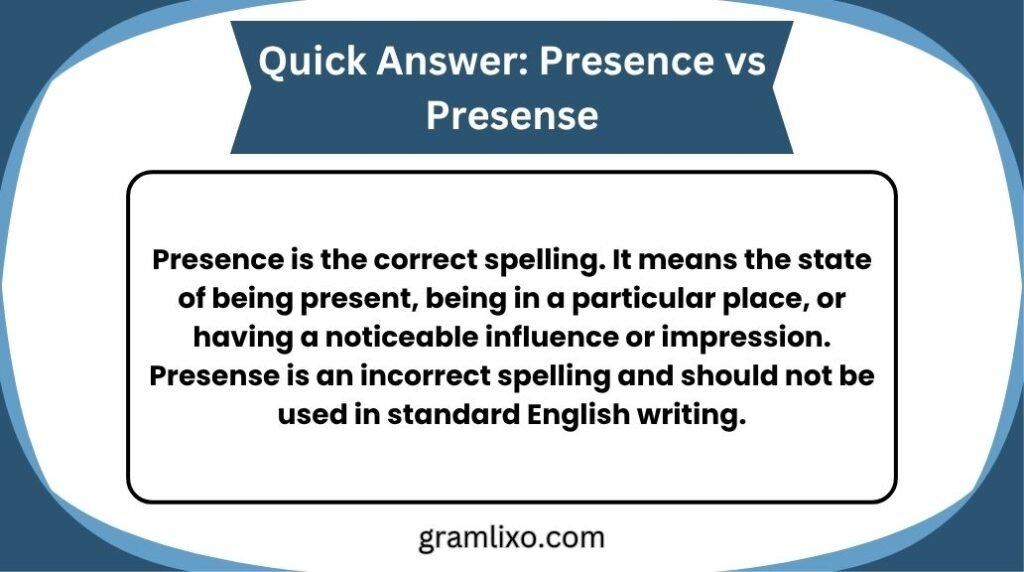
Presence is the correct spelling. It means the state of being present, being in a particular place, or having a noticeable influence or impression.
Presense is an incorrect spelling and should not be used in standard English writing.
Correct: Her presence made the meeting more comfortable.
Incorrect: Her presense made the meeting more comfortable.
Quick rule: If you mean “the state of being present” or “a noticeable influence,” use presence.
Understanding the Basics: Presence vs Presense
The main difference between presence and presense is simple: presence is a correctly spelled English word, while presense is a misspelling.
The word presence comes from the idea of being present. It is commonly used when discussing someone’s physical location, participation, influence, appearance, or personal impact.
For example:
- The teacher noticed his presence in the classroom.
- Her presence helped calm everyone down.
- The company has a strong online presence.
- His stage presence impressed the audience.
By contrast, presense does not function as a standard English noun. If you see it in an email, essay, article, or social media post, it is generally a spelling error.
Comparison Table
| Form | Type | Meaning | Example | Correct/Incorrect |
|---|---|---|---|---|
| presence | Noun | The state of being present or an influential appearance | Her presence was reassuring. | ✅ Correct |
| presense | Misspelling | No standard English meaning | Her presense was reassuring. | ❌ Incorrect |
The easiest way to remember the distinction is to focus on the ending:
presence → -ence
Not:
presense → -ense
What Does Presence Mean?
Presence is a noun with several related meanings. The exact meaning depends on the context.
1. The State of Being Present
The most basic meaning of presence is the condition of being present in a particular place.
For example:
The manager requested everyone’s presence at the meeting.
Here, presence means that the people are expected to be physically or officially present.
Another example:
Your presence is required at the ceremony.
The sentence means that you are expected to attend the ceremony.
2. Being in a Particular Place
Presence can also describe someone’s physical existence in a location.
The police officer’s presence made the crowd more orderly.
Here, presence refers to the officer being there. However, the word can also suggest that simply being there had an effect.
3. Personal Influence or Impression
Presence can describe the strong impression someone makes on other people.
For example:
She has a confident presence.
This does not simply mean that she is physically present. It means that her personality, confidence, appearance, or behavior makes her noticeable.
You may also hear expressions such as:
- strong presence
- powerful presence
- commanding presence
- calming presence
- professional presence
- friendly presence
4. Online or Business Activity
The word presence is also frequently used in digital and business contexts.
For example:
The company has a strong social media presence.
This means the company is active and visible on social media platforms.
Another example:
Small businesses need an online presence.
Here, online presence refers to a business’s visibility on the internet through websites, social media, search results, and other digital channels.
Why Is “Presense” Incorrect?
The spelling presense is incorrect because the standard English spelling is presence.
The mistake is understandable because the pronunciation does not always make the spelling obvious.
When people hear the word, they may mentally connect the ending with other words that contain -ense. This can lead to the incorrect form presense.
However, standard written English uses:
P-R-E-S-E-N-C-E
Correct spelling
presence
Incorrect spelling
presense
Notice the important final letters:
- presence → ence
- presense → ense
That single letter difference matters in formal writing.
Presence: Meaning and Sentence Examples
Let’s examine some common uses of presence more closely.
Physical Presence
When someone is physically somewhere, you can use presence to describe their being there.
His presence in the room was immediately noticed.
Breakdown:
- His = shows possession.
- presence = his being there.
- in the room = identifies the location.
Another example:
The student’s presence was recorded by the teacher.
Here, presence refers to attendance or being present.
Emotional Presence
Presence can also describe someone’s ability to be attentive, supportive, or emotionally available.
Her presence gave me comfort during a difficult time.
The sentence does not necessarily mean she solved the problem. Instead, simply having her there provided emotional support.
Another example:
Sometimes, your presence is more valuable than your advice.
This means that being there for someone can be more helpful than giving them suggestions.
Professional Presence
In professional environments, presence can describe the impression a person makes through communication, confidence, appearance, and behavior.
The speaker had a strong professional presence.
This suggests that the speaker appeared confident, prepared, and capable.
You might also hear:
He needs to develop a stronger executive presence.
In this context, presence refers to how someone communicates and carries themselves in a professional setting.
Online Presence
Digital communication has made online presence an extremely common phrase.
The brand is building its online presence.
This means the brand is increasing its visibility and activity on the internet.
Examples include:
- website activity
- social media accounts
- online publications
- business listings
- digital communities
A person can also have an online presence:
She maintains a professional online presence.
This means her public activity and information on the internet create a particular professional impression.
Test Tip: How to Remember “Presence”
Here is a simple memory trick:
Think of “present.”
Present → presence
The noun presence is closely connected to the adjective present.
You can remember:
Present people have presence.
This connection can help you avoid writing presense.
Another useful technique is to memorize the final four letters:
ENCE
So:
✅ presence
❌ presense
Test Tip
If you are unsure while writing, ask yourself:
“Am I talking about being present?”
If the answer is yes, presence is almost certainly the spelling you need.
Presence vs Presense in Real-Life Writing
Consider a workplace email.
Incorrect version
Thank you for your presense at today’s meeting.
The meaning is understandable, but the spelling is incorrect.
Correct version
Thank you for your presence at today’s meeting.
This version is grammatically and orthographically correct.
The same issue can occur in academic writing:
❌ The presence of bacteria was confirmed.
Wait—that sentence is actually correct.
The mistake would be:
❌ The presense of bacteria was confirmed.
Correct:
✅ The presence of bacteria was confirmed.
This distinction is important because presence appears in many academic and technical contexts.
Case Study: A Workplace Email
Imagine that a manager sends an email after an important team meeting.
Incorrect email
Thank you everyone for your presense at today’s meeting. Your ideas were very helpful.
The word presense is misspelled.
Correct email
Thank you everyone for your presence at today’s meeting. Your ideas were very helpful.
Here, presence refers to the employees’ attendance.
The correct spelling makes the email look more polished and professional.
This small correction may seem insignificant, but spelling accuracy contributes to the overall quality of workplace communication.
Practical Lesson
When writing professional emails, reports, or presentations:
- Use presence.
- Avoid presense.
- Proofread words that contain unfamiliar endings.
- Use a dictionary when you are uncertain.
Grammar Rules for Presence
The word presence is a noun.
It can function as a subject, object, or complement in a sentence.
As a Subject
Her presence changed the atmosphere.
Here, presence is the subject of the sentence.
As an Object
We appreciated his presence.
Here, presence is the object of the verb appreciated.
After a Possessive Determiner
Their presence was important.
Here, their modifies presence.
With Common Adjectives
Presence frequently appears with adjectives such as:
- physical presence
- strong presence
- noticeable presence
- powerful presence
- professional presence
- online presence
- public presence
- calming presence
These combinations are all built around the correctly spelled noun presence.
What Does Merriam-Webster Say?
Standard dictionaries such as Merriam-Webster recognize presence as an English noun. Its meanings include the state or fact of being present and related senses involving appearance, bearing, or influence.
The important point for the spelling question is that the standard word is spelled:
presence
The form presense is not the standard spelling of this noun.
When spelling questions arise, consulting a reputable dictionary such as Merriam-Webster is a useful way to verify the accepted form.
Common Mistakes With Presence
Why do people write presense when presence is correct?
There are several common reasons.
1. Fast Typing
People often make spelling errors when typing quickly.
For example:
I appreciate your presense.
A writer may know the correct word but accidentally type the wrong letter.
Solution
Slow down briefly when writing important documents and proofread before sending.
2. Pronunciation
English spelling does not always perfectly match pronunciation.
Because presence can sound similar to how someone might mentally spell presense, the incorrect form can seem logical.
Solution
Connect the word with present:
present → presence
3. Autocorrect
Autocorrect tools can sometimes fail to identify a misspelled word, especially when the incorrect spelling resembles a real pattern.
Do not rely entirely on automatic correction.
Solution
Use a dictionary or grammar checker when you are uncertain.
4. Lack of Familiarity
Someone who has rarely encountered the written word may not remember whether it ends in -ence or -ense.
Reading more English can help build spelling familiarity.
Similar Spelling Confusions
Presence vs presense is part of a larger group of English spelling and grammar mistakes.
| Confusion | Correct Form | Common Incorrect Form | Main Issue |
|---|---|---|---|
| presence vs presense | presence | presense | Spelling |
| it’s vs its | it’s / its | — | Contraction vs possession |
| your vs you’re | your / you’re | — | Possession vs contraction |
| their vs they’re | their / they’re | — | Possession vs contraction |
| affect vs effect | affect / effect | — | Different grammatical functions |
| separate vs seperate | separate | seperate | Spelling |
| definitely vs definately | definitely | definately | Spelling |
| receive vs recieve | receive | recieve | Spelling |
| occurrence vs occurence | occurrence | occurence | Spelling |
| necessary vs neccessary | necessary | neccessary | Spelling |
These mistakes often happen because English contains many words whose pronunciation does not provide an obvious spelling guide.
Presence vs Presense in Different Contexts
The correct spelling remains presence regardless of the context.
Everyday Conversation
In everyday English, presence is often used to talk about someone’s being somewhere.
Examples:
I enjoyed your presence at dinner.
Her presence made everyone feel welcome.
His presence was not required.
The word sounds natural in both casual and formal communication.
Professional Writing
In business English, presence is especially common.
Examples:
The company has expanded its online presence.
Her professional presence has improved significantly.
Attendance will be recorded to confirm everyone’s presence.
In professional writing, spelling presence correctly is important because errors can make otherwise polished communication look careless.
Academic Writing
The word presence appears frequently in academic and scientific writing.
Examples:
Researchers detected the presence of the chemical.
The study examined the presence of microorganisms.
The presence of several factors affected the results.
Because academic writing values precision, presense should always be corrected to presence.
Creative Writing
Authors can use presence to create atmosphere or describe characters.
For example:
A strange presence seemed to follow them through the dark hallway.
Here, presence can refer to an unexplained person, force, or feeling.
Another example:
The old house had a quiet presence that made visitors uncomfortable.
Creative writing allows many imaginative uses, but the spelling remains presence.
Social Media and Texting
Informal communication often contains typos.
Someone might write:
Thanks for your presense ❤️
The intended meaning is clear, but the spelling is still incorrect.
The correct version is:
Thanks for your presence ❤️
Even when writing casually, presence is the standard spelling.
Presence in Common Expressions
Learning common phrases can make the spelling easier to remember.
Physical Presence
Means being physically present.
Physical presence is required for the examination.
Online Presence
Means visibility or activity on the internet.
The company is improving its online presence.
Stage Presence
Means the ability to command attention while performing.
The singer has impressive stage presence.
Strong Presence
Means someone or something has a noticeable effect.
The speaker has a strong presence.
Human Presence
Means the existence or participation of people.
The museum has increased security because of the importance of human presence.
Presence of Mind
This expression means the ability to remain calm and think clearly in a difficult situation.
She had the presence of mind to call for help.
Notice that all of these expressions use presence, never presense.
Why the Correct Spelling Matters
A single spelling mistake may not always prevent readers from understanding your meaning. However, accurate spelling still matters.
Clarity in Communication
Correct spelling helps readers process information quickly.
When readers see a familiar word spelled incorrectly, they may pause and wonder whether the word has a different meaning.
Using presence removes that distraction.
Professionalism
Spelling mistakes can affect how professional writing appears.
This is especially important in:
- resumes
- cover letters
- business emails
- reports
- proposals
- academic papers
- websites
Writing presence correctly shows attention to detail.
Digital Communication
Online writing moves quickly, but that does not make spelling irrelevant.
Website copy, social media posts, emails, and professional profiles may be seen by thousands of people.
A simple proofreading step can prevent unnecessary errors.
“Clear writing makes your message easier to trust.”
The goal is not perfection for its own sake. The goal is to communicate your meaning clearly and confidently.
Special Exception: Can “Presense” Ever Be Correct?
For standard English writing, presense should be treated as a misspelling of presence.
However, unusual spellings can sometimes appear as:
- usernames
- fictional names
- company or product names
- intentionally stylized brands
- website names
- character names
For example, a fictional company could theoretically choose Presense as a brand name.
That would not make presense the standard English spelling of the noun.
So, unless you are deliberately reproducing a specific name or brand, use:
✅ presence
Quick Recap Checklist
Use this checklist whenever you are unsure about presence vs presense.
| Question | If Yes → Use |
|---|---|
| Do you mean the state of being present? | presence |
| Do you mean someone’s physical attendance? | presence |
| Do you mean someone’s influence or impression? | presence |
| Are you talking about online visibility? | presence |
| Are you describing stage or professional impact? | presence |
| Are you tempted to write “presense”? | Change it to presence |
Practice Example 1
The teacher noticed the student’s ______ in class.
Answer: presence
Practice Example 2
The company has a growing online ______.
Answer: presence
Practice Example 3
Her calm ______ helped everyone relax.
Answer: presence
Easy Ways to Remember Presence
If spelling is difficult to remember, try these techniques.
Method 1: Connect It to “Present”
present → presence
If you know how to spell present, this connection can help you remember presence.
Method 2: Remember “ENCE”
Think:
Presence ends with ENCE.
Not:
Presense ends with ENSE.
Method 3: Use a Phrase
Memorize:
A present person has a presence.
This creates a mental connection between the adjective present and the noun presence.
Method 4: Read the Word
Repeated exposure helps spelling become automatic.
Look at these forms:
presence
presence
presence
The more familiar the correct spelling becomes, the less likely you are to type presense.
Frequently Asked Questions
Is “presense” a correct word?
No. Presense is not the standard spelling of the English noun. The correct spelling is presence.
What is the correct spelling: presence or presense?
The correct spelling is presence. It ends in -ence, not -ense.
What does presence mean?
Presence generally means the state of being present or existing in a particular place. It can also refer to someone’s noticeable influence, appearance, or personal impact.
Is “presence” a noun?
Yes. Presence is a noun. For example: “Her presence made the room feel warmer.”
Why do people spell presence as presense?
The mistake commonly occurs because the two forms look and sound similar. Fast typing, pronunciation, autocorrect, and unfamiliarity with the word can also contribute to the error.
How can I remember the spelling of presence?
Connect it with present: present → presence. You can also remember that the word ends in -ence.
Presence vs Presense: Final Takeaway
The difference between presence vs presense is straightforward once you remember the correct spelling. Presence is the standard English word. It is a noun that can describe someone’s being present, physical attendance, influence, impression, or visibility.
Presense is a spelling mistake and should not be used in standard English writing.
When you need this word, remember the connection:
Present → presence
You can use presence when talking about physical attendance, emotional support, professional influence, stage performance, or online visibility. Whether you are writing a casual message, an academic paper, a business email, or a website, the spelling stays the same.
A simple proofreading habit can prevent this common error. If you ever hesitate between presence and presense, choose presence.
Remember it once, spell it right every time: present → presence.

I’m Christopher Garcia, an English writer and grammar enthusiast at Gramlixo. I enjoy making grammar easy to understand through clear explanations and practical examples.