Have you ever stopped while writing because you were unsure about I vs Me? You are not alone.
Many English learners and even native speakers confuse these two pronouns, especially when another person appears in the same sentence.
The good news is that the difference between I vs Me is simple once you understand their grammatical roles. I is used as a subject, while me is used as an object.
For example, “I finished the project” is correct because I performs the action, while “She called me” is correct because me receives the action.
In this guide, I’ll explain I vs Me with clear rules, practical examples, easy tests, and common mistakes so you can confidently choose the correct pronoun in everyday, academic, and professional English.
|You Are Correct vs You Are Right: What’s the Difference?
|In vs Within: What Is the Difference and How to Use Them Correctly?
|Tear vs Tare: Meaning, Differences, Uses, and Examples
Quick Answer: I vs Me
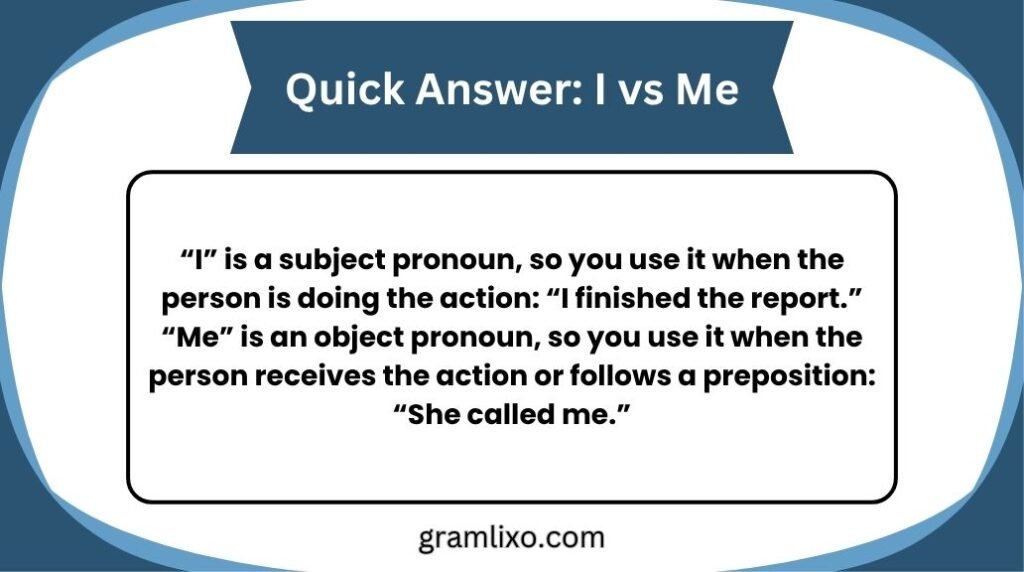
“I” is a subject pronoun, so you use it when the person is doing the action: “I finished the report.” “Me” is an object pronoun, so you use it when the person receives the action or follows a preposition: “She called me.”
A simple rule is:
I = does the action
Me = receives the action
Understanding the Basics: I vs Me
The difference between I and me is mainly about grammatical function.
Both words refer to the speaker, but they do different jobs in a sentence.
What Is “I”?
I is a first-person singular subject pronoun.
Use I when you are the subject of a verb.
In other words, I usually identifies the person performing the action.
Examples:
- I work from home.
- I called my friend.
- I finished the assignment.
- Sarah and I went shopping.
- I understand the question.
Look at this sentence:
I wrote the email.
“Wrote” is the action. Who performed that action? I did.
Therefore, I is correct.
What Is “Me”?
Me is a first-person singular object pronoun.
Use me when the action is directed toward you, or when a preposition requires an object.
Examples:
- She called me.
- He helped me.
- They invited me.
- Give me the book.
- The teacher spoke to me.
Consider:
She called me.
Who performed the action? She.
Who received the action? Me.
Therefore, me is correct.
I vs Me Comparison Table
| Form | Type | Meaning | Example | Correct/Incorrect |
|---|---|---|---|---|
| I | Subject pronoun | The speaker performs an action | I finished the work. | ✅ Correct |
| Me | Object pronoun | The speaker receives an action | She helped me. | ✅ Correct |
| I | Subject pronoun | Used as the subject | John and I arrived early. | ✅ Correct |
| Me | Object pronoun | Used after a verb | John called me. | ✅ Correct |
| Me | Object pronoun | Used after a preposition | She sat beside me. | ✅ Correct |
| I | Subject pronoun | Used as an object | She called I. | ❌ Incorrect |
| Me | Object pronoun | Used as the subject | Me went home. | ❌ Incorrect |
The most important distinction is simple:
I performs the action. Me receives the action.
When Should You Use “I”?
Use I when you are the subject of the sentence or clause.
I as the Subject
The subject is the person or thing doing the action.
For example:
I studied all night.
The verb is studied.
Who studied?
I did.
Therefore:
✅ I studied all night.
Not:
❌ Me studied all night.
Here are more examples:
- I like coffee.
- I need some help.
- I finished my homework.
- I want to learn English.
- I sent the message.
- I visited my cousin.
- I understand what you mean.
In each sentence, I performs the action.
I With Another Person
This is where many people become uncertain.
Consider:
John and I went to the store.
This is correct because “John and I” are the subjects of went.
You can remove “John and” to test the sentence:
I went to the store.
That sounds correct.
Now consider:
John and me went to the store.
Remove “John and”:
Me went to the store.
That is incorrect.
So the correct sentence is:
✅ John and I went to the store.
When Should You Use “Me”?
Use me when you are the object of a verb or preposition.
Me as a Direct Object
A direct object receives the action of the verb.
For example:
She called me.
“She” performs the action.
“Me” receives the action.
Therefore:
✅ She called me.
Not:
❌ She called I.
Other examples include:
- He invited me.
- She thanked me.
- They helped me.
- My friend visited me.
- The manager contacted me.
- The teacher praised me.
Me as an Indirect Object
“Me” can also function as an indirect object.
For example:
She gave me a gift.
Here:
- She = subject
- gave = verb
- me = indirect object
- a gift = direct object
Another example:
My brother sent me a message.
“Me” identifies the person who received the message.
Me After a Preposition
After a preposition, use me, not I.
Common prepositions include:
- to
- for
- with
- from
- by
- about
- between
- beside
- near
- without
- against
Examples:
- Come with me.
- This gift is for me.
- She talked to me.
- He sat beside me.
- They were talking about me.
- The decision was made without me.
- Between you and me, that was surprising.
This rule is especially useful because it gives you a fast way to identify the correct pronoun.
The “Remove the Other Person” Test
One of the easiest ways to solve I vs me problems is to temporarily remove the other person.
Consider:
My sister and I went to the mall.
Remove “my sister”:
I went to the mall.
Correct.
Now:
My sister invited John and me.
Remove “John and”:
My sister invited me.
Correct.
Therefore, “John and me” is correct.
Why This Test Works
When another person is added to a sentence, the basic grammatical role does not change.
If I is correct alone, it remains correct when another subject is added.
If me is correct alone, it remains correct when another object is added.
More Examples
Example 1:
David and I finished the project.
Test:
I finished the project. ✅
Example 2:
The teacher spoke with David and me.
Test:
The teacher spoke with me. ✅
Example 3:
Sarah and I prepared dinner.
Test:
I prepared dinner. ✅
Example 4:
The coach congratulated Sarah and me.
Test:
The coach congratulated me. ✅
I vs Me in Compound Subjects
A compound subject contains two or more subjects.
For example:
Michael and I are friends.
Both Michael and I are doing or experiencing the action represented by the verb.
More examples:
- My brother and I live nearby.
- Emma and I studied together.
- My parents and I traveled to California.
- David and I discussed the issue.
- My friend and I watched the movie.
A common mistake is:
❌ Me and David went to lunch.
In informal conversation, you may hear this frequently. However, in standard formal English, the subject pronoun I is appropriate:
✅ David and I went to lunch.
There is also a style convention in English of placing the other person before yourself:
David and I
rather than:
I and David
The important grammatical point, however, is that I is used because the phrase is the subject.
I vs Me in Compound Objects
Now consider the opposite situation.
The manager thanked David and me.
Here, “David and me” are objects of the verb thanked.
Remove David:
The manager thanked me.
That works.
Therefore:
✅ The manager thanked David and me.
Not:
❌ The manager thanked David and I.
More examples:
- She invited my sister and me.
- The teacher called David and me.
- They asked Sarah and me to stay.
- The company hired James and me.
- He told my brother and me the news.
What About “Between You and I”?
This is one of the most famous I vs me mistakes.
You may hear:
❌ Between you and I
The standard grammatical form is:
✅ Between you and me
Why?
Because between is a preposition, and pronouns following a preposition normally appear in object form.
Compare:
- between you and me
- with you and me
- for you and me
- to you and me
Not:
- ❌ between you and I
- ❌ with you and I
- ❌ for you and I
So remember:
Between you and me is the standard form.
What About “It Is I” vs. “It Is Me”?
This is a more interesting case.
You may encounter:
It is I.
This form follows a traditional grammatical analysis in which I is a subject complement after a linking verb.
However, in modern everyday American English, It’s me is extremely common and natural.
For example:
“Who is at the door?”
“It’s me!”
In ordinary conversation, It’s me is the normal choice for most speakers.
This illustrates an important point: grammar and natural usage sometimes interact in complicated ways. A construction can be traditionally analyzed one way while another form becomes standard in everyday speech.
For practical US English, “It’s me” is natural in ordinary conversation.
Case Study: I vs Me in the Workplace
Imagine you work on a project with a colleague named Daniel.
Your manager sends this email:
“Who will attend the meeting with the client?”
You could answer:
Daniel and I will attend the meeting.
Why?
Because Daniel and I are the people performing the action of attending.
Now imagine your manager writes:
“Who did the client contact?”
You answer:
The client contacted Daniel and me.
Why?
Because Daniel and I are receiving the action of contacted.
Notice how only the grammatical role changes.
Situation 1: Subject
Daniel and I will attend the meeting.
Situation 2: Object
The client contacted Daniel and me.
This is why memorizing “always use I” or “always use me” does not work.
You must look at the sentence structure.
Grammar Rules for I vs Me
The basic grammar rule is based on case.
English pronouns change form depending on their grammatical function.
For first-person singular pronouns:
| Function | Pronoun |
|---|---|
| Subject | I |
| Object | me |
| Possessive determiner | my |
| Possessive pronoun | mine |
| Reflexive | myself |
For example:
I lost my phone, and someone returned it to me. Now the phone is mine, so I will keep it myself.
Each form has a different grammatical job.
Merriam-Webster’s dictionary and usage resources distinguish I as a first-person singular nominative pronoun and me as the corresponding objective form. This reflects the standard English case distinction used in sentences.
The practical rule remains:
Use I for subjects. Use me for objects.
Why Do People Confuse I and Me?
The confusion has several causes.
Trying to Sound More Formal
Some people were taught that I sounds more educated or formal.
As a result, they may say:
❌ She invited my husband and I.
They may think “my husband and I” sounds more polished.
But formality does not determine the pronoun.
The correct version is:
✅ She invited my husband and me.
The phrase is an object of invited, so me is required.
Trying to Avoid “Me”
Other speakers become so worried about using “me” incorrectly that they avoid it altogether.
This can create sentences such as:
❌ The gift was given to Sarah and I.
Correct:
✅ The gift was given to Sarah and me.
The preposition to requires the object form.
Fast Typing
Digital communication makes grammar mistakes easier.
When someone is typing quickly, they may choose the pronoun without analyzing the sentence.
A quick review can catch these errors.
Autocorrect
Autocorrect and predictive text can sometimes encourage a particular word based on previous patterns.
Because I and me are both common words, technology does not always understand the grammatical role you intend.
Lack of Knowledge
Some people simply have not been taught the difference.
That is not unusual. English pronoun case can be confusing because modern English has fewer visible case changes than many other languages.
Common Grammar Confusions Similar to I vs Me
The same kind of confusion appears with many other word pairs.
| Confusion | Correct Distinction | Example |
|---|---|---|
| I / me | Subject vs. object | I called her. She called me. |
| he / him | Subject vs. object | He helped me. I helped him. |
| she / her | Subject vs. object | She called him. He called her. |
| we / us | Subject vs. object | We arrived. They saw us. |
| they / them | Subject vs. object | They left. I called them. |
| who / whom | Subject vs. object in formal usage | Who called? Whom did you call? |
| it’s / its | Contraction vs. possessive | It’s cold. The dog wagged its tail. |
| your / you’re | Possessive vs. contraction | Your car is here. You’re early. |
| their / they’re | Possessive vs. contraction | Their house is large. They’re home. |
| then / than | Time/sequence vs. comparison | First eat, then leave. Taller than me. |
These pairs demonstrate a broader lesson:
Similar-looking or similar-sounding words can perform completely different grammatical functions.
I vs Me in Everyday Conversation
Everyday speech often contains shortened or informal constructions.
You might hear:
“Me and my friends went out.”
This is common in casual speech, but standard edited English generally uses:
“My friends and I went out.”
However, me is perfectly natural when it is an object:
“She invited me.”
There is no reason to replace me with I simply to sound more formal.
Natural Conversation Examples
Question: Who wants pizza?
I do.
Question: Who did she invite?
She invited me.
Question: Who is coming with you?
My brother and I are coming.
Question: Who did you send the email to?
I sent it to him and me?
That last sentence needs care because the intended meaning matters. If you mean you sent the email to yourself and another person, me follows the preposition to:
I sent it to him and me.
I vs Me in Professional Writing
Professional writing benefits from grammatical accuracy.
Use I when you are the subject:
I reviewed the proposal.
Use me when you are the object:
The director asked me to review the proposal.
Use me after a preposition:
The director spoke with me about the proposal.
Professional Examples
- My colleague and I prepared the presentation.
- The supervisor asked my colleague and me to revise it.
- I will send the final version tomorrow.
- Please contact me if you have questions.
- The client spoke with Sarah and me.
- James and I will join the call.
A simple grammatical choice can make professional writing easier to read.
I vs Me in Creative Writing
Creative writing gives authors more flexibility, especially when reproducing dialogue.
A character might naturally say:
“Me and Tom were there.”
If the goal is realistic dialogue, that wording may reflect the character’s natural speech.
Narrative prose, however, generally follows standard edited grammar unless the writer intentionally uses a nonstandard form for characterization or voice.
For example:
Tom and I walked through the empty street.
This is standard narration.
But dialogue could intentionally sound informal:
“Me and Tom were just talking about it.”
The choice depends on the writer’s purpose.
I vs Me in Social Media and Texting
Social media and texting are informal environments.
You may encounter:
- Me and my friends
- Me and him
- I and her
- Between you and I
People often prioritize speed and conversational tone over formal grammar.
That does not change the standard grammatical distinction.
For polished posts, professional messages, schoolwork, applications, and formal communication, use the standard rules:
I = subject
Me = object
For casual texting, people may use nonstandard constructions without intending a formal grammatical statement.
Why I vs Me Matters
Using the correct pronoun improves clarity in communication.
Consider:
“The manager spoke with John and I.”
The intended meaning is understandable, but standard grammar calls for:
“The manager spoke with John and me.”
Accuracy matters more in contexts such as:
- job applications
- academic writing
- business emails
- reports
- formal presentations
- professional websites
- published content
In digital communication, readers often make quick judgments based on writing quality. Correct grammar helps your message appear polished and easier to understand.
A Short Reminder
Good grammar should make your meaning easier to understand, not harder.
You do not need complicated grammar to write clearly. Knowing a few basic rules, such as I vs me, can solve many common mistakes.
Special Exceptions and Edge Cases
There is no major standard-English exception that changes the basic rule that I is the subject form and me is the object form.
However, some expressions deserve special attention.
“It’s Me”
As discussed earlier:
It’s me.
is normal and natural in contemporary American English.
You may also encounter the more traditional:
It is I.
The two forms have different histories and stylistic associations, but It’s me is widely accepted in everyday modern English.
Brand Names and Titles
Sometimes I or me may appear in a product name, song title, book title, business name, or other proper name.
A title does not necessarily follow ordinary sentence grammar.
For example, if a creative work intentionally uses “Me” in its title, you should preserve the official title rather than changing it according to a grammar rule.
A Simple Step-by-Step Method
When you are unsure about I vs me, follow these steps.
Step 1: Find the Verb
Identify the main action.
Example:
Sarah and I finished the project.
The verb is finished.
Step 2: Ask Who Performed the Action?
Who finished the project?
Sarah and I.
So I is correct.
Step 3: Look for Prepositions
If the pronoun follows words such as to, for, with, from, by, between, or about, object form is usually required.
Example:
She talked with me.
Step 4: Remove the Other Person
Try the sentence without the second person.
Sarah and I finished the project.
Becomes:
I finished the project.
Correct.
Now:
She talked with Sarah and me.
Becomes:
She talked with me.
Correct.
Step 5: Read the Sentence Naturally
After applying the grammar rule, read the entire sentence again.
This catches additional errors.
Test Tip: The “Alone” Test
Here is one of the fastest tests you can use.
Remove the other person from the sentence.
If “I” works:
Use I.
Maria and I went home.
→ I went home. ✅
If “me” works:
Use me.
Maria called John and me.
→ Maria called me. ✅
Another Example
The teacher gave the assignment to Kevin and me.
Remove Kevin:
The teacher gave the assignment to me. ✅
So Kevin and me is correct.
Quick Recap Checklist
| Question | If Yes → Use |
|---|---|
| Am I performing the action? | I |
| Am I the subject? | I |
| Does the verb act on me? | me |
| Am I receiving the action? | me |
| Am I after a preposition such as “to” or “with”? | me |
| Can I remove the other person and “I” remains correct? | I |
| Can I remove the other person and “me” remains correct? | me |
Practice Examples
1. ___ went to the store with Alex.
Answer: I
Alex and I went to the store.
2. The teacher called Alex and ___.
Answer: me
The teacher called Alex and me.
3. The manager asked Sarah and ___ to join the meeting.
Answer: me
The manager asked Sarah and me to join the meeting.
Practice: Can You Choose Correctly?
Try these before looking at the answers.
Example 1
___ am responsible for the report.
Answer: I
I am responsible for the report.
Example 2
She sent the email to John and ___.
Answer: me
She sent the email to John and me.
Example 3
David and ___ completed the assignment.
Answer: I
David and I completed the assignment.
Example 4
The coach congratulated Maria and ___.
Answer: me
The coach congratulated Maria and me.
Example 5
Between you and ___, this was unexpected.
Answer: me
Between you and me, this was unexpected.
FAQs About I vs Me
Is “I” or “me” correct?
Both are correct words, but they have different grammatical functions. I is the subject form, while me is the object form.
Should I say “John and I” or “John and me”?
It depends on the sentence. Use John and I when the phrase is the subject: “John and I went home.” Use John and me when the phrase is an object: “She called John and me.”
Is “Me and my friends” grammatically correct?
In standard edited English, use “My friends and I” when the phrase is the subject. For example: “My friends and I went to the park.”
Is “Between you and I” correct?
In standard English, “between you and me” is the conventional form because between is a preposition and takes an object pronoun.
Is “It’s me” grammatically correct?
Yes. “It’s me” is a standard and natural expression in contemporary American English. The more traditional “It is I” also exists but is much more formal or stylistically marked.
How can I quickly tell whether to use I or me?
Remove the other person from the sentence. If I works by itself, use I. If me works by itself, use me.
Final Conclusion
Understanding i vs me becomes much easier when you stop thinking about which word sounds more formal and instead focus on the word’s grammatical job. I is the subject pronoun used when the speaker performs an action: “I wrote the report.” Me is the object pronoun used when the speaker receives an action or follows a preposition: “She called me” and “She spoke with me.” When another person appears in the sentence, use the remove-the-other-person test to check your choice. If “I” works alone, use I; if “me” works alone, use me. Once you understand this simple pattern, common phrases such as “John and I,” “John and me,” and “between you and me” become much easier to handle. ✨
Memorable rule: I does the action; me receives the action.

I’m Michael Williams, an English writer and grammar enthusiast at Gramlixo. I’m passionate about making grammar easier to learn and helping readers write with greater confidence.
[…] |I vs Me: What’s the Difference and When Should You Use Each? […]