Have you ever answered a question correctly and then wondered whether you should say “you are correct” or “you are right”? 🤔 Both expressions are common in American English, and in many situations, they communicate almost the same idea. That is exactly why you are correct vs you are right can be confusing for English learners and even native speakers.
The good news is that neither expression is grammatically wrong. Both “you are correct” and “you are right” are grammatically correct sentences. The main difference is usually tone, context, and meaning, rather than grammar. Correct emphasizes accuracy or agreement with facts, rules, or standards. Right can also mean correct, but it has additional meanings related to suitability, morality, judgment, direction, and more.
In everyday conversation, “you are right” is generally more natural and conversational. “You are correct” can sound more formal, precise, or official.
Understanding this small distinction can make your English sound more natural and help you choose the best expression for different situations.
|Presence vs Presense: Which Spelling Is Correct?
|Renounce vs Denounce: What Is the Difference?
|Limited to vs Limited Too: Which One Is Correct?
Quick Answer: You Are Correct vs You Are Right
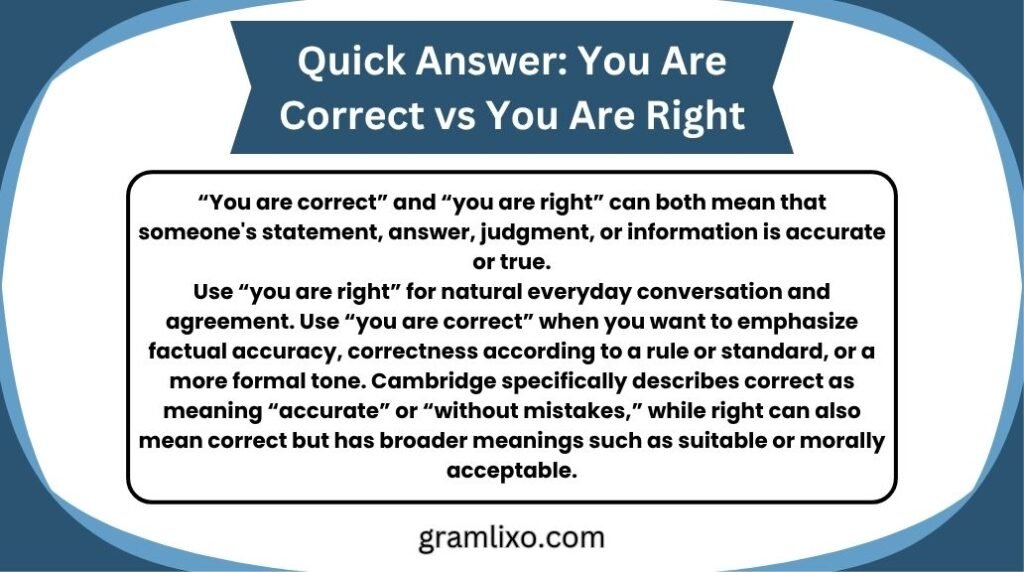
“You are correct” and “you are right” can both mean that someone’s statement, answer, judgment, or information is accurate or true.
Use “you are right” for natural everyday conversation and agreement. Use “you are correct” when you want to emphasize factual accuracy, correctness according to a rule or standard, or a more formal tone. Cambridge specifically describes correct as meaning “accurate” or “without mistakes,” while right can also mean correct but has broader meanings such as suitable or morally acceptable.
Examples:
- “You are right about the meeting.” ✅
- “You are correct about the meeting.” ✅
- “You are right. I made a mistake.” ✅
- “You are correct. The answer is 42.” ✅
So, the important point is:
Both are correct; the best choice depends on context and tone.
Understanding the Basics: You Are Correct vs You Are Right
The easiest way to understand you are correct vs you are right is to look at what each adjective emphasizes.
What Does “You Are Correct” Mean?
“You are correct” means that what someone said, wrote, calculated, identified, or stated agrees with the facts, rules, information, or accepted standard.
For example:
“You are correct. The capital of California is Sacramento.”
Here, correct focuses on factual accuracy.
You might also hear:
- “Your answer is correct.”
- “Your calculation is correct.”
- “That spelling is correct.”
- “You are correct about the date.”
- “That interpretation is correct.”
Cambridge defines correct as being in agreement with true facts or a generally accepted standard.
What Does “You Are Right” Mean?
“You are right” can also mean that someone’s statement, answer, belief, or judgment is correct.
For example:
“You are right. We should leave earlier.”
Here, right does not simply confirm a factual answer. It can also express agreement with someone’s judgment or conclusion.
Other examples include:
- “You are right about the problem.”
- “You are right; I forgot the appointment.”
- “You are right about her decision.”
- “I think you are right.”
- “You were right all along.”
Cambridge lists right as an adjective meaning correct, true, or exact and specifically gives the use of right for someone’s judgment or statement.
Comparison Table
| Form | Type | Meaning | Example | Correct/Incorrect |
|---|---|---|---|---|
| You are correct | Adjective phrase | Your statement or answer is accurate | “You are correct about the date.” | ✅ Correct |
| You are right | Adjective phrase | Your statement, judgment, or answer is correct | “You are right about the date.” | ✅ Correct |
| You are correctly | Adverb | Describes an action done accurately | “You answered correctly.” | ✅ Correct |
| You are rightly | Adverb | Means appropriately or justifiably | “You were rightly concerned.” | ✅ Correct |
| You are correctness | Noun | Incorrect grammatical structure | — | ❌ Incorrect |
| You are righted | Verb form, not the intended expression | Does not mean “you are correct” | — | ❌ Incorrect |
The key takeaway is simple: “You are correct” and “you are right” are both grammatically correct.
The Main Difference Between “Correct” and “Right”
Although the two words overlap, they are not identical in every situation.
“Correct” Focuses on Accuracy
Correct is especially useful when something can be measured against facts, rules, instructions, spelling, calculations, or standards.
Consider:
“Your answer is correct.”
This sounds natural because an answer can be checked against an established answer.
Similarly:
“The spelling is correct.”
“Your calculation is correct.”
“That information is correct.”
In these examples, correct highlights accuracy.
Cambridge’s grammar guidance explains that correct means “accurate” or “without mistakes.”
“Right” Has a Broader Meaning
Right can mean correct, but it can also describe something appropriate, suitable, fair, moral, or wise.
For example:
“You chose the right person.”
Here, right does not necessarily mean that the person was factually “correct.” It means the person was suitable.
Compare:
“Your answer is correct.”
with:
“You made the right decision.”
The first focuses on accuracy.
The second focuses on suitability or judgment.
That broader meaning is one of the biggest differences between correct and right.
When to Use “You Are Correct”
1. When Confirming a Factual Answer
Use “you are correct” when someone gives accurate information.
Example:
“Is Denver the capital of Colorado?”
“Yes, you are correct.”
This sounds precise and slightly formal.
Another example:
“The meeting starts at 9:00 a.m.”
“You are correct.”
The speaker is confirming factual information.
2. When Discussing Rules
Correct works particularly well when discussing established rules.
For example:
“You are correct. The verb should agree with the subject.”
Or:
“You are correct. A sentence should begin with a capital letter.”
The word correct emphasizes conformity with a grammar or writing rule.
3. In Academic Situations
Teachers, instructors, examiners, and educational materials may use correct frequently.
For example:
“Your answer is correct.”
“You are correct about the formula.”
“That is the correct interpretation.”
These expressions have a clear, instructional tone.
4. In Professional or Formal Communication
You are correct can sound more professional or formal than you are right.
For example:
“You are correct regarding the updated deadline.”
This could work in a workplace email.
However, that does not mean you are right is grammatically inappropriate in professional communication. It simply sounds more conversational.
When to Use “You Are Right”
1. In Everyday Conversation
You are right is extremely natural in ordinary conversation.
For example:
“You are right. I left my keys in the car.”
Or:
“You’re right. We should order dinner instead.”
The contraction “you’re right” is especially common in spoken American English.
2. When Agreeing With Someone
Use you are right when you want to acknowledge someone’s opinion, observation, or argument.
For example:
“I think this restaurant will be crowded tonight.”
“You’re right. It’s Friday.”
The second speaker is agreeing with the first person’s judgment.
3. When Someone Corrects You
This is another very common situation.
“The appointment is tomorrow, not today.”
“You’re right. I checked the wrong date.”
Here, you are right sounds natural and friendly.
4. When Discussing a Decision
Right is often better when the issue involves judgment rather than simple factual accuracy.
For example:
“You were right to call the manager.”
This means the person’s decision or action was appropriate or justified.
Cambridge notes that right can refer to something suitable or morally acceptable, in addition to meaning correct.
“You’re Right” vs “You’re Correct”
The contractions are important in everyday English.
“You’re Right”
You’re right is the contracted form of:
You are right.
It is very common in conversation, texting, casual emails, and social media.
Examples:
- “You’re right about that.”
- “You’re right. I forgot.”
- “You’re absolutely right.”
- “You’re right, we need more time.”
“You’re Correct”
You’re correct is also grammatically correct.
Examples:
- “You’re correct about the spelling.”
- “You’re correct. The answer is B.”
- “You’re correct about the deadline.”
However, you’re correct often sounds more formal or deliberate.
A teacher might say:
“You’re correct. The answer is 25.”
A friend might be more likely to say:
“You’re right!”
Neither is grammatically wrong.
Is “You Are Correct” More Formal Than “You Are Right”?
Usually, yes.
There is a difference in register, or the level of formality.
Casual
“You’re right.”
Neutral
“You are right.”
More formal or precise
“You are correct.”
This is not an absolute rule. Native speakers can use correct casually and right formally. Context matters.
For example, a judge, teacher, or customer-service representative might say:
“You are correct.”
But a professor could easily say:
“You’re right.”
So, think of the distinction as a tendency, not a strict grammatical law.
Sentence Breakdown: “You Are Correct”
Let’s examine the structure.
You are correct.
- You = subject pronoun
- are = linking verb
- correct = subject complement/adjective
The adjective correct describes the subject you.
It means that you are accurate in what you have said, answered, identified, or concluded.
For example:
“You are correct about the deadline.”
Here, about the deadline specifies what the person is correct about.
Another example:
“You are correct that the document needs revision.”
The clause that the document needs revision identifies the specific claim being confirmed.
Sentence Breakdown: “You Are Right”
Now consider:
You are right.
The grammatical structure is almost identical.
- You = subject pronoun
- are = linking verb
- right = adjective functioning as a subject complement
Here, right describes the person’s statement, judgment, conclusion, or position.
For example:
“You are right about the budget.”
Or:
“You are right to be concerned.”
The second sentence can carry a meaning beyond factual correctness. It can mean that the person’s concern is justified or reasonable.
Correct Meanings and Uses
Meaning 1: Accurate Information
Both expressions can confirm accurate information.
“You are correct about the address.”
“You are right about the address.”
Both sentences can mean that the person gave accurate information.
Sentence Breakdown
You → the person being addressed
are → linking verb
correct/right → adjective describing the person’s statement or judgment
about the address → identifies the topic
Meaning 2: A Correct Answer
When discussing quizzes, exams, calculations, or factual questions, correct is particularly natural.
“You are correct. The answer is 144.”
However, right is also perfectly acceptable:
“You’re right. The answer is 144.”
Both work.
The choice depends largely on tone.
Meaning 3: Correct Judgment
When someone makes a prediction or judgment, right often sounds more natural.
“You were right about the traffic.”
This means the person’s earlier judgment turned out to be accurate.
You can also say:
“You were correct about the traffic.”
This is grammatically correct, but it sounds somewhat more formal or analytical.
Meaning 4: Appropriate Action
This is where right has an important meaning that correct does not always express naturally.
Consider:
“You did the right thing.”
This means the action was appropriate, wise, fair, or morally acceptable.
You would not normally replace it with:
“You did the correct thing.”
Although correct can sometimes be used in similar contexts, the right thing is the established and natural expression.
Cambridge specifically distinguishes right as meaning suitable or morally acceptable.
Meaning 5: Suitable Choice
Consider:
“She is the right person for the job.”
Here, right means suitable.
You cannot automatically replace it with:
“She is the correct person for the job.”
That sentence may be possible in a specific context, but it changes the natural meaning.
The first sentence emphasizes suitability.
The second emphasizes correct identification or selection.
Meaning 6: Moral Judgment
Consider:
“It isn’t right to lie.”
Here, right means morally acceptable.
Correct does not normally carry this exact meaning by itself.
This is an important reason why right is broader than correct.
Test Tip: How Can You Choose the Right Word?
Try this simple test:
Ask yourself:
Am I talking about accuracy, facts, spelling, answers, or rules?
If yes, correct is a strong choice.
“Your spelling is correct.”
Am I agreeing with someone’s opinion, judgment, or conclusion?
If yes, right often sounds more natural.
“You’re right about that.”
Am I talking about suitability, morality, or an appropriate decision?
Use right.
“You made the right decision.”
This quick test will solve most you are correct vs you are right questions.
Case Study: A Workplace Conversation
Imagine that two coworkers are discussing a project deadline.
Sarah says:
“I think the report is due Friday, not Thursday.”
James checks the company calendar and responds:
“You’re right. I was looking at last month’s schedule.”
This sounds natural because James is agreeing with Sarah’s observation.
Now imagine a formal training session.
The instructor asks:
“What is the deadline listed in the official project guidelines?”
An employee answers:
“Friday.”
The instructor might say:
“You are correct.”
Here, correct sounds appropriate because the situation focuses on a factual answer according to an official document.
What Does This Case Study Teach Us?
Both expressions can communicate the same basic idea:
The other person has accurate information.
But the tone differs.
You’re right feels conversational.
You are correct feels more formal, precise, or instructional.
Grammar Rules Explanation
There is no grammatical rule saying that “you are right” is correct while “you are correct” is incorrect.
Both follow a standard adjective construction:
Subject + linking verb + adjective
Examples:
You are right.
You are correct.
The verb are links the subject you to the adjective that describes it.
Why Both Are Grammatically Correct
Right can mean correct.
Cambridge’s English dictionary explicitly defines one use of right as correct, true, or exact.
Correct means accurate or in agreement with facts or accepted standards.
Therefore:
“You are right.”
and
“You are correct.”
are both standard English constructions.
The real difference is semantic range and register, not grammatical correctness.
What About Merriam-Webster?
Merriam-Webster is another major American English dictionary and standard reference for word meanings and usage. For this comparison, the central dictionary distinction is consistent with the broader standard-English treatment: correct relates to accuracy or freedom from error, while right has a wider range of meanings, including correctness.
The important practical rule is that you should not treat correct and right as completely interchangeable in every sentence.
Common Mistakes With “You Are Correct vs You Are Right”
People often make mistakes because these expressions overlap.
Mistake 1: Thinking One Is Grammatically Wrong
Incorrect assumption:
“You are correct” is wrong because people usually say “You’re right.”
That is false.
Both are correct.
Mistake 2: Using “Correct” Everywhere
For example:
“You did the correct thing.”
This is understandable, but:
“You did the right thing.”
is generally more idiomatic when talking about an appropriate or morally acceptable action.
Mistake 3: Assuming “Right” Always Means “Factually True”
Right can mean correct, but it can also mean:
- suitable
- appropriate
- morally acceptable
- wise
- on the right-hand side
- functioning properly
For example:
“This is the right person for the job.”
Here, right means suitable.
Mistake 4: Confusing “Your” and “You’re”
This is a completely different issue.
Your = possessive determiner.
“Is this your book?”
You’re = you are.
“You’re right.”
Therefore:
“Your right.” ❌
is incorrect when you mean “You are right.”
The correct form is:
“You’re right.” ✅
Similar Grammar Confusions
| Confusion | Correct Form | Meaning |
|---|---|---|
| it’s / its | It’s raining. | It is raining. |
| your / you’re | You’re right. | You are right. |
| their / they’re | They’re correct. | They are correct. |
| then / than | Better than before. | Comparison |
| to / too | Too late. | Excessively or also |
| affect / effect | It affected me. | Influenced |
| there / their | Their house is there. | Possession/location |
| who’s / whose | Who’s right? | Who is right? |
| you’re / your | You’re correct. | You are correct |
| its / it’s | It’s correct. | It is correct |
Why These Mistakes Happen
Fast Typing
When people type quickly, they may leave out apostrophes.
“Your right.”
instead of:
“You’re right.”
Autocorrect
Phones and computers can sometimes replace words or suggest the wrong form.
Lack of Knowledge
English learners may know that your and you’re sound similar but may not know that they perform completely different grammatical functions.
Speech Patterns
In spoken English, you’re and your can sound very similar depending on the sentence. This can make the written distinction harder to remember.
Usage in Different Contexts
Everyday Conversation
For casual conversation, you are right is very natural.
Examples:
“You’re right. I should have called earlier.”
“You’re absolutely right.”
“I think you’re right.”
“You were right about the weather.”
These expressions sound relaxed and natural.
Professional Writing
Both forms work in professional communication.
More conversational:
“You’re right about the revised schedule.”
More formal:
“You are correct regarding the revised schedule.”
If you’re writing a formal report, official response, or technical explanation, correct may provide a more precise tone.
However, don’t assume that right is unprofessional. It is standard English.
Creative Writing
Authors choose between these expressions based on character and voice.
For example:
“You’re right,” Maria whispered.
This sounds natural in dialogue.
Meanwhile:
“You are correct,” the examiner replied.
This may create a more formal or authoritative voice.
Social Media and Texting
In texting and social media, you’re right is much more natural.
Examples:
“You’re right 😂”
“Okay, you’re right!”
“You’re absolutely right!”
Because digital conversation is usually informal, the conversational expression works well.
You are correct is still grammatically correct, but it may sound deliberately formal or humorous in a casual chat.
For example:
“You are correct, my friend. 😂”
The formal wording can even be used jokingly.
Why It Matters
Understanding the difference between you are correct vs you are right matters because good communication involves more than simply avoiding grammatical errors.
Clarity
Choosing the appropriate word helps readers understand whether you’re discussing factual accuracy, personal judgment, suitability, or morality.
Compare:
“That is correct.”
with:
“That is right.”
The first often sounds more focused on factual accuracy. The second can sound broader.
Professionalism
In professional settings, choosing the right level of formality can make your communication feel more appropriate.
For example:
“You are correct regarding the figures.”
can sound precise and professional.
Digital Communication
In emails, messages, comments, and online discussions, small word choices can affect tone.
“You’re right.”
may sound friendly.
“You are correct.”
may sound formal.
Neither is inherently better; the context determines which one fits.
A Simple Reminder
Correct checks accuracy; right can express accuracy, agreement, suitability, or what is appropriate.
That distinction is worth remembering.
Special Exception: “Right” Has Many Other Meanings
One important exception is that right is not simply a synonym for correct.
It can refer to direction:
“Turn right at the corner.”
It can describe suitability:
“She is the right person for the job.”
It can describe morality:
“It isn’t right to treat people that way.”
It can describe something functioning properly:
“Something doesn’t feel right.”
It can also refer to legal or social rights:
“Everyone has the right to speak.”
Cambridge’s American English dictionary lists these different senses, including correctness, suitability, moral acceptability, health or proper functioning, direction, and legal rights.
So, although right and correct overlap, right has a much broader semantic range.
Can You Always Replace “Correct” With “Right”?
No.
Sometimes you can.
Both work:
“Your answer is correct.”
“Your answer is right.”
Both can work:
“You are correct about the date.”
“You are right about the date.”
But some expressions strongly favor right.
“You did the right thing.” ✅
“You did the correct thing.” ⚠️ Less natural in many contexts.
Likewise, some contexts strongly favor correct.
“Please enter the correct password.” ✅
“Please enter the right password.” ✅
Interestingly, both can work here, but correct emphasizes matching the required information, while right can sound more conversational.
“You Are Right” vs “You Are Correct” in Questions
Both can be used in responses.
Question:
“Is this the correct address?”
Response:
“Yes, you are correct.”
This is formal.
Or:
“Yes, you’re right.”
This is conversational.
Question:
“Did I calculate this correctly?”
Response:
“Yes, you are correct.”
Or:
“Yes, you’re right.”
Again, both can work.
Quick Recap Checklist
Use this checklist when you’re unsure.
| Question | If Yes → Use |
|---|---|
| Are you confirming factual accuracy? | You are correct / You are right |
| Are you speaking casually? | You are right |
| Are you agreeing with someone’s opinion or judgment? | You are right |
| Are you discussing an answer or rule? | You are correct |
| Are you discussing suitability? | Right |
| Are you discussing moral acceptability? | Right |
| Do you want a more formal tone? | You are correct |
| Do you want a natural conversational tone? | You are right |
Practice Example 1
Someone says:
“The meeting starts at 10 a.m.”
You checked the schedule and agree.
Answer:
“You are correct.”
Or casually:
“You’re right.”
Practice Example 2
Someone says:
“I think we should leave now because traffic will get worse.”
You agree with their judgment.
Natural choice:
“You’re right.”
Practice Example 3
Someone asks:
“Is this the correct spelling?”
You verify the dictionary.
Natural choice:
“Yes, that spelling is correct.”
FAQs
1. Is “you are correct” grammatically correct?
Yes. “You are correct” is completely grammatical. It means that someone’s statement, answer, judgment, or information is accurate or agrees with an accepted standard.
2. Is “you are right” grammatically correct?
Yes. “You are right” is also grammatically correct. In this expression, right means correct or accurate. Cambridge specifically lists this meaning of right.
3. Which is more natural: “you are correct” or “you are right”?
In ordinary conversation, “you are right” or “you’re right” is generally more natural. “You are correct” often sounds more formal, precise, or instructional.
4. Can I use “you are correct” in casual conversation?
Yes. There is no grammatical problem with using it casually. However, it can sound more formal than “you’re right.”
For example:
“You’re right!” — casual and natural.
“You are correct.” — more formal or deliberate.
5. Is “you’re right” the same as “you are right”?
Yes. You’re is the contraction of you are.
Therefore:
You’re right. = You are right.
Be careful not to confuse you’re with your.
“You’re right.” ✅
“Your right.” ❌ when you mean “you are right”
6. Does “right” have meanings that “correct” does not?
Yes. Right has a much broader range of meanings. It can mean correct, suitable, morally acceptable, appropriate, healthy or functioning properly, or related to the direction opposite left.
Final Conclusion
When comparing you are correct vs you are right, remember that both expressions are grammatically correct. The main difference is their usual tone and range of meaning.
“You are correct” focuses strongly on accuracy, facts, rules, answers, and accepted standards. It can sound formal, precise, or instructional. “You are right” can also mean that someone is correct, but it is generally more conversational and can express agreement with someone’s judgment, opinion, decision, or conclusion.
The difference becomes even clearer when right means suitable or morally acceptable, as in “the right person,” “the right decision,” or “the right thing to do.” Cambridge confirms that correct means accurate or without mistakes, while right has the additional meanings of suitability and moral acceptability.
So, when you’re simply agreeing with someone in everyday conversation, “You’re right” is a natural choice. When you’re confirming accuracy in a more formal or precise context, “You are correct” works very well.
Remember: correct focuses on accuracy, while right can go beyond accuracy.

Hi, I’m Lisa Jones, a grammar enthusiast and writer at Gramlixo. I enjoy making English grammar simple, clear, and easy to apply in everyday writing.
[…] |You Are Correct vs You Are Right: What’s the Difference? […]