Have you ever written a sentence and wondered whether you should use imply vs infer? You are not alone. These two words are often confused because both deal with meaning, communication, and what someone understands from a statement.
The key difference, however, is surprisingly simple: the speaker or writer implies something, while the listener or reader infers it.
In other words, one person puts an indirect meaning into a message, and another person figures that meaning out. Once you understand who is doing the communicating and who is interpreting, choosing between imply and infer becomes much easier.
In this guide, we will explore imply vs infer with clear definitions, examples, grammar rules, practical situations, common mistakes, and easy memory tricks.
Whether you are writing an email, having a conversation, creating a social media post, or polishing an academic sentence, this guide will help you use both words accurately. ✍️
|Fewer vs Less: What Is the Difference and When Should You Use Each?
|Presence vs Presense: Which Spelling Is Correct?
Quick Answer: Imply vs Infer
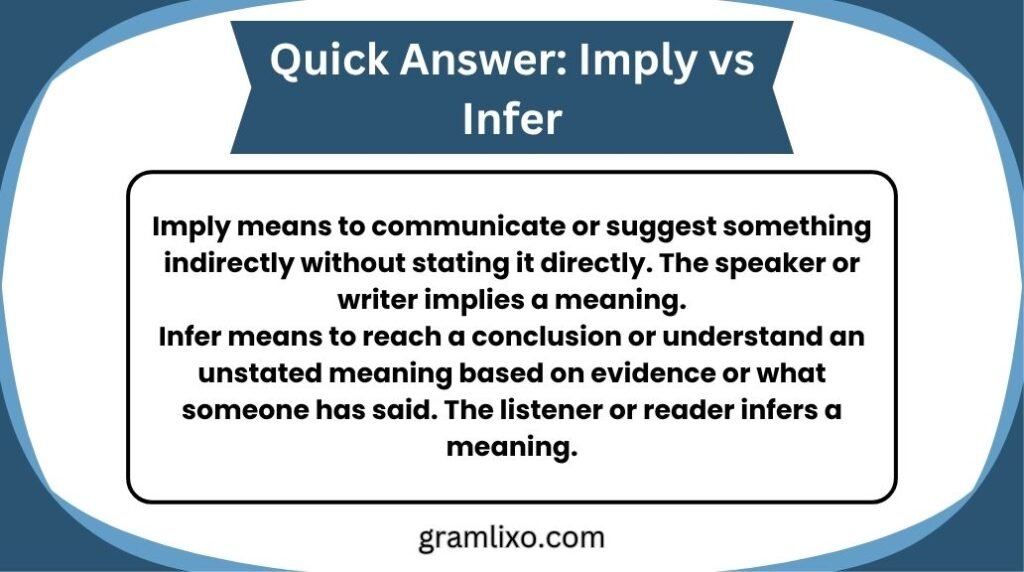
Imply means to communicate or suggest something indirectly without stating it directly. The speaker or writer implies a meaning.
Infer means to reach a conclusion or understand an unstated meaning based on evidence or what someone has said. The listener or reader infers a meaning.
Easy rule:
👉 Speaker/writer → implies
👉 Listener/reader → infers
For example:
“You might want to check the time.”
The speaker implies that you are late.
The listener infers that the speaker thinks you are late.
Understanding the Basics: Imply vs Infer
The most important distinction between these words is direction.
When you imply something, you send a message indirectly. You may not say exactly what you mean, but you give another person enough information to understand your intended message.
When you infer something, you receive information and use it to reach a conclusion. The information may come from words, actions, evidence, tone, or context.
Comparison Table
| Form | Type | Meaning | Example | Correct/Incorrect |
|---|---|---|---|---|
| Imply | Verb | To suggest something indirectly | “Her comment implied that she was disappointed.” | ✅ Correct |
| Infer | Verb | To conclude something from evidence or information | “I inferred that she was disappointed.” | ✅ Correct |
| Imply | Verb | Used by the communicator | “The manager implied that changes were coming.” | ✅ Correct |
| Infer | Verb | Used by the person interpreting | “Employees inferred that changes were coming.” | ✅ Correct |
| Infer | Verb | To suggest something to someone | “He inferred that we should leave.” | ❌ Usually incorrect when intended to mean “suggested” |
| Imply | Verb | To conclude something from evidence | “I implied that he was angry from his expression.” | ❌ Incorrect when intended to mean “concluded” |
The Simplest Way to Remember
Think of communication as a two-way street:
Person A → communicates indirectly → Person B
Person B → interprets the message → conclusion
Therefore:
Person A implies.
Person B infers.
What Does “Imply” Mean?
Imply is a verb meaning to communicate an idea indirectly or suggest something without saying it explicitly.
When you imply something, you do not necessarily state it directly.
Example 1
“The teacher implied that we had not studied enough.”
The teacher did not necessarily say:
“You did not study enough.”
Instead, the teacher may have said:
“Some students might have spent more time reviewing the material.”
The teacher implied that the students were not sufficiently prepared.
Example 2
“His silence implied that he disagreed.”
The person did not directly say, “I disagree.”
However, his silence communicated a possible message. Therefore, his silence implied disagreement.
Example 3
“The advertisement implies that the product will save you money.”
The advertisement may not directly promise a specific amount of savings. Instead, its wording, images, or claims suggest that idea.
Common Structures With “Imply”
You will often see imply used in these patterns:
- imply that something is true
- imply something
- imply a meaning
- imply a connection
- imply a criticism
- imply a possibility
For example:
“Her response implied that she already knew the answer.”
Here, the person responding is the source of the implied message.
What Does “Infer” Mean?
Infer is a verb meaning to reach a conclusion from information, evidence, or clues.
When you infer something, you are interpreting information and deciding what it probably means.
Example 1
“From his expression, I inferred that he was nervous.”
The person’s expression was evidence. You interpreted that evidence and reached a conclusion.
You did not necessarily know for certain that he was nervous. You inferred it.
Example 2
“We can infer from the data that sales increased.”
The data provides evidence. You examine the evidence and reach a conclusion.
Example 3
“She inferred from my message that I was upset.”
You sent the message. She interpreted it and reached a conclusion.
Therefore:
- You implied the message.
- She inferred the meaning.
Imply vs Infer: The Core Difference
The easiest way to understand the distinction is to focus on who is responsible for the meaning.
The Communicator Implies
A speaker or writer can imply something.
“The manager implied that the deadline might change.”
The manager communicated an indirect message.
The Receiver Infers
A listener or reader can infer something.
“The employees inferred that the deadline might change.”
The employees interpreted the manager’s message.
One Situation, Two Verbs
Consider this conversation:
Manager: “It may be difficult to finish everything by Friday.”
The manager implies that the team may need more time.
The employees infer that the Friday deadline could change.
Both words can describe the same communication, but they describe different sides of it.
Imply vs Infer in Everyday Conversation
These words appear in everyday communication more often than you might realize.
Imagine your friend says:
“I thought you were going to clean the kitchen.”
Your friend may imply that the kitchen is still dirty.
You might infer that your friend is annoyed.
Notice the difference:
- Your friend implied something.
- You inferred something.
Another Example
Someone says:
“Wow, you are leaving early today.”
Depending on the tone, the speaker might imply that you usually stay late.
You might infer that the person is surprised.
The speaker sends the indirect message. The listener interprets it.
Imply vs Infer in Professional Writing
The distinction becomes especially important in emails, reports, business communication, and workplace discussions.
Consider this sentence:
“The report implies that customer satisfaction has declined.”
This means the report contains information suggesting a decline.
Now compare:
“The analysts inferred that customer satisfaction had declined.”
Here, the analysts examined information and reached that conclusion.
Workplace Example
Suppose a manager writes:
“Several projects have recently missed their deadlines.”
The manager may imply that the team needs to improve its time management.
An employee may infer that the manager is dissatisfied with the team’s performance.
Why Precision Matters
Professional communication often involves indirect language. Using imply and infer correctly makes it clear whether you are:
- communicating an indirect idea, or
- interpreting information.
That distinction can prevent confusion.
Imply vs Infer in Academic Writing
Academic writing frequently uses both words.
Researchers may present evidence that implies a particular possibility.
Readers may infer a conclusion from that evidence.
For example:
“The results imply that sleep quality affects concentration.”
The results suggest the relationship.
Now:
“From these results, researchers inferred that sleep quality affects concentration.”
The researchers examined the evidence and formed a conclusion.
A Useful Academic Pattern
You can remember these structures:
Evidence → implies → possible meaning
Reader/researcher → infers → conclusion
This distinction is useful in essays, research papers, analytical writing, and reports.
Imply vs Infer in Creative Writing
Creative writers often use implication because indirect meaning can make a story more engaging.
For example:
“She looked at the empty chair and quietly closed the door.”
The sentence does not directly explain what she is thinking.
The scene may imply sadness, loss, disappointment, or another emotion.
A reader may infer what happened from the details.
This creates room for interpretation.
Why Writers Use Implication
Indirect communication can:
- create suspense
- build emotional depth
- encourage readers to think
- make dialogue feel natural
- avoid unnecessary explanation
For example:
“Don’t worry. I won’t make the same mistake twice.”
The sentence might imply that the speaker made a serious mistake before.
The reader can infer the background from the context.
Grammar Rules for Imply and Infer
Both imply and infer are verbs, but their grammatical roles differ because their meanings differ.
Rule 1: Use “Imply” for the Source
Use imply when the subject is suggesting or communicating an indirect meaning.
“The article implies that the policy may change.”
The article is the source of the suggestion.
Rule 2: Use “Infer” for the Interpreter
Use infer when the subject reaches a conclusion based on evidence or information.
“Readers inferred that the policy might change.”
Readers interpret the information.
Rule 3: Avoid Treating Them as Exact Synonyms
Although dictionaries and historical usage show that the two words have been related, modern standard usage generally distinguishes them according to the direction of communication.
A useful rule is:
You imply; I infer.
This distinction is also reflected in standard dictionary explanations, including those provided by Merriam-Webster.
Test Tip: How to Choose the Right Word
When you are unsure whether to use imply or infer, ask yourself:
“Who is doing what?”
If the person is sending, suggesting, or communicating an indirect idea:
👉 Use imply.
If the person is interpreting, concluding, or figuring out an idea:
👉 Use infer.
Quick Test
Ask:
“Is someone putting the meaning into the message?”
If yes → imply
Ask:
“Is someone taking meaning from the message?”
If yes → infer
This simple test works in most everyday situations.
Case Study: An Office Email
Let’s look at a realistic workplace example.
A manager sends this email:
“We have noticed that several reports have been submitted after the deadline. Please make sure future reports are completed on time.”
The manager does not directly say:
“Some members of the team are not managing their time well.”
However, the email may imply that deadline management needs improvement.
An employee reads the email and thinks:
“The manager is concerned about our recent performance.”
The employee has inferred the manager’s concern.
Breaking It Down
Manager → implies:
The team needs to improve its deadlines.
Employee → infers:
The manager is concerned about performance.
This example demonstrates why confusing these words can change the meaning of a sentence.
Common Mistakes With Imply and Infer
People often confuse these words because they are closely connected.
Mistake 1: “The Evidence Inferred…”
Incorrect:
“The evidence inferred that the company made a mistake.”
Better:
“The evidence implied that the company made a mistake.”
Why? Evidence can suggest something. The person examining the evidence infers the conclusion.
However, in some contexts, a person can infer a conclusion from evidence:
“The investigators inferred from the evidence that the company made a mistake.”
Mistake 2: “He Inferred That We Should Leave”
If the intended meaning is that he suggested that you should leave, use implied:
“He implied that we should leave.”
If the intended meaning is that he concluded that you should leave based on information, inferred may be appropriate.
Mistake 3: “I Implied From Her Expression…”
If you mean that you reached a conclusion based on her expression, use inferred:
“I inferred from her expression that she was upset.”
Why Do People Mix Them Up?
Several factors contribute to this confusion.
Fast Typing
When people write quickly, they may remember that both words relate to indirect meaning and choose the wrong one.
Autocorrect
Typing tools may not recognize a semantic mistake. Both imply and infer are correctly spelled words, so autocorrect usually has no reason to replace one with the other.
Lack of Knowledge
Many people learn these words by exposure rather than through a formal explanation of the difference.
Similar Meanings
Both words involve information that is not stated directly. That shared idea makes them easy to confuse.
Similar Grammar Confusions
The English language contains many pairs that are frequently confused.
| Confusing Pair | Correct Difference |
|---|---|
| It’s / Its | It’s = it is; its = possessive |
| Your / You’re | Your = possessive; you’re = you are |
| They’re / Their / There | Different grammatical functions |
| Affect / Effect | Usually affect = influence; effect = result |
| Then / Than | Then = time/order; than = comparison |
| Accept / Except | Accept = receive/agree; except = excluding |
| Compliment / Complement | Compliment = praise; complement = complete or enhance |
| Imply / Infer | Imply = suggest; infer = conclude |
Learning these distinctions helps make your writing more precise.
Usage in Different Contexts
Everyday Conversation
In casual speech, people often use these words correctly without consciously thinking about the grammar rule.
“Are you implying that I broke it?”
This asks whether the speaker is suggesting something indirectly.
“I inferred from your reaction that you didn’t like it.”
This explains the conclusion the listener reached.
Professional Writing
Precision is particularly valuable in professional settings.
“The findings imply that additional training may be necessary.”
“The management team inferred that additional training was necessary.”
Both sentences are grammatical, but the subjects are performing different actions.
Creative Writing
Writers use implication to leave certain ideas unstated.
“He checked the clock for the third time.”
The action may imply impatience.
A reader may infer that he wants someone to leave or is worried about being late.
Social Media and Texting
Digital communication creates even more room for inference because messages often lack facial expressions and vocal tone.
For example:
“Okay.”
A sender might imply annoyance through context or punctuation.
The recipient may infer that the sender is upset.
This is one reason short digital messages can sometimes be misunderstood.
Why Imply vs Infer Matters
Correct use of these words improves clarity, professionalism, and accuracy.
A sentence can be grammatically complete but still communicate the wrong relationship between a message and its interpretation.
For example:
“The reader implied the author’s meaning.”
This can be confusing because the reader is normally the person who infers meaning from the author’s words.
A clearer version is:
“The author implied the meaning, and the reader inferred it.”
Clarity in Communication
The distinction helps readers understand who is communicating and who is interpreting.
Professionalism
Accurate word choice demonstrates careful writing, especially in business, academic, and technical contexts.
Digital Communication
Text messages, emails, and online posts often rely on indirect meaning. Knowing the difference between imply and infer can help you describe these situations accurately.
A Helpful Quote
“You imply; your audience infers.”
Keep that sentence in mind whenever you are uncertain.
Special Exceptions and Edge Cases
There is no major spelling-based exception that changes the basic distinction between imply and infer in standard modern US English.
However, historical usage can be more complicated. Older English sometimes used these words in ways that overlap more than modern style guides recommend.
In contemporary standard writing, the safest approach is to maintain the familiar distinction:
- Imply = suggest indirectly
- Infer = conclude from evidence or context
What About “Infer” Meaning “Suggest”?
You may occasionally encounter older, unusual, or nonstandard uses in which infer is used in a way that overlaps with imply. Such usage can create confusion.
For modern professional and academic writing, use the conventional distinction unless a specific quotation or historical context requires otherwise.
Imply vs Infer: More Examples
Example 1
“The manager implied that the meeting would be postponed.”
The manager suggested the possibility indirectly.
Example 2
“The employees inferred that the meeting would be postponed.”
The employees interpreted the manager’s message.
Example 3
“Her tone implied that she was frustrated.”
Her tone communicated an indirect suggestion.
Example 4
“I inferred from her tone that she was frustrated.”
I interpreted her tone and reached a conclusion.
Example 5
“The evidence implies that the theory may be correct.”
The evidence points toward a possibility.
Example 6
“Scientists inferred from the evidence that the theory was correct.”
Scientists analyzed the evidence and reached a conclusion.
A Simple Memory Trick
Here is one of the easiest ways to remember the difference:
IMPLY = INTO
Think:
The speaker puts a meaning INTO the message.
IMPLY → message going out
INFER = IN
Think:
The listener takes meaning IN from the message.
INFER → meaning coming in
Another useful sentence is:
The speaker implies, and the listener infers.
If you remember only one rule from this article, remember that one. 🧠
Quick Recap Checklist
Use this checklist whenever you need to choose between the two words.
| Question | If Yes → Use |
|---|---|
| Is someone suggesting something indirectly? | Imply |
| Is the subject the speaker or writer? | Imply |
| Is someone communicating an unstated idea? | Imply |
| Is someone reaching a conclusion? | Infer |
| Is the subject a reader or listener? | Infer |
| Is someone interpreting evidence or context? | Infer |
Practice Examples
1. The author’s wording ________ that the character was hiding something.
Answer: implied
The author’s wording implied that the character was hiding something.
2. From the author’s wording, readers ________ that the character was hiding something.
Answer: inferred
Readers inferred that the character was hiding something.
3. Her expression ________ that she was unhappy.
Answer: implied
Her expression implied that she was unhappy.
FAQs About Imply vs Infer
1. What is the difference between imply and infer?
Imply means to suggest something indirectly, while infer means to reach a conclusion from information or evidence. The speaker or writer implies; the listener or reader infers.
2. Is it “imply” or “infer” when someone suggests something?
Use imply when someone suggests something indirectly.
“She implied that she was disappointed.”
3. Is it “imply” or “infer” when someone reaches a conclusion?
Use infer when someone reaches a conclusion based on evidence, context, or information.
“I inferred that she was disappointed.”
4. Can a reader infer an author’s meaning?
Yes. A reader can infer an author’s meaning by interpreting the author’s words, context, evidence, and other clues.
“Readers inferred that the character was afraid.”
5. Can a writer imply something?
Yes. A writer can imply an idea without stating it directly.
“The writer implied that the character had lied.”
6. What is an easy trick for remembering imply vs infer?
Remember:
The speaker or writer implies. The listener or reader infers.
You can also think of imply as putting an idea into a message and infer as taking an idea from a message.
Conclusion
The difference between imply vs infer becomes much easier once you focus on the direction of communication. Imply means to suggest or communicate an idea indirectly, so the speaker, writer, action, evidence, or message can imply something. Infer means to reach a conclusion from information, so the reader, listener, or observer infers something. For example, a manager can imply that a deadline may change, while an employee can infer that the deadline will probably be extended. When you are unsure, ask yourself who is providing the indirect message and who is interpreting it. The source implies; the receiver infers. Keep that simple distinction in mind, and you will avoid one of the most common word-choice mistakes in English. You imply the message; your audience infers the meaning. 🎯

Hi, I’m Lisa Jones, a grammar enthusiast and writer at Gramlixo. I enjoy making English grammar simple, clear, and easy to apply in everyday writing.

[…] |Imply vs Infer: What’s the Difference? […]
[…] |Imply vs Infer: What’s the Difference? […]
[…] |Imply vs Infer: What’s the Difference? […]