
Have you ever typed adapter vs adaptor into a search bar because you were unsure which spelling was correct? You are not alone. These two words look slightly different, but they have the same basic meaning in standard English. The confusion usually comes from differences in regional spelling and usage rather than from a major difference in definition.
Both adapter and adaptor can refer to a device that connects equipment that does not otherwise fit together. They can also describe a person who changes a work, such as a book or play, for another form or purpose. Cambridge lists adaptor as another spelling of adapter, while Oxford also gives adaptor as an alternative form.
For US English writers, however, adapter is generally the more familiar and preferred spelling. British English may use adaptor more frequently, although both forms are recognized. So, if you are writing for an American audience, choosing adapter is usually the simplest option.
Let’s explore adapter vs adaptor in detail so you can use the right spelling confidently in emails, articles, technical documents, and everyday conversations.
|Lay vs Lie: What’s the Difference and How to Use Them Correctly?
|Imbed vs Embed: What’s the Difference and Which One Should You Use?
|Emasculate vs Demasculate: Which Word Is Correct?
Quick Answer: Adapter vs Adaptor
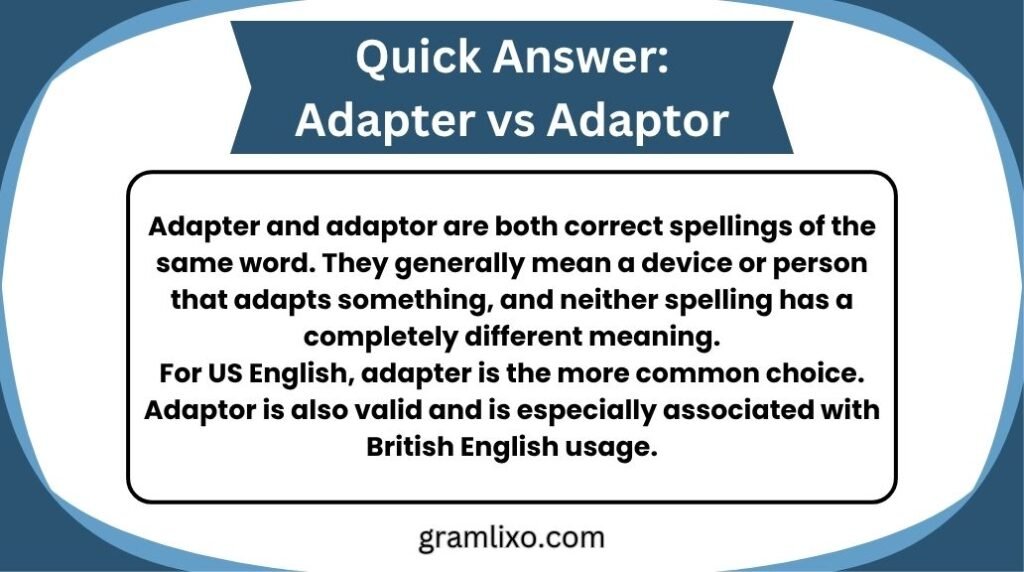
Adapter and adaptor are both correct spellings of the same word. They generally mean a device or person that adapts something, and neither spelling has a completely different meaning.
For US English, adapter is the more common choice. Adaptor is also valid and is especially associated with British English usage.
Quick rule: 🇺🇸 Use adapter in most American English writing.
🇬🇧 Adaptor is also correct, particularly in British English.
Understanding the Basics: Adapter vs Adaptor
The easiest way to understand adapter vs adaptor is to recognize that they are spelling variants, not two completely different words.
Both words come from the verb adapt, which means to change or modify something so that it works in a different situation.
The endings -er and -or sometimes create different spellings for nouns describing people or things that perform an action. In this case, both adapter and adaptor developed as accepted forms.
Cambridge defines an adapter as a device used to connect equipment, and it also recognizes adaptor as another spelling. Oxford likewise lists adaptor as an alternative form of adapter.
Adapter vs Adaptor Comparison Table
| Form | Type | Meaning | Example | Correct/Incorrect |
|---|---|---|---|---|
| adapter | Noun | A device that connects or modifies equipment | I need a USB adapter. | ✅ Correct |
| adaptor | Noun | A device that connects or modifies equipment | I need a USB adaptor. | ✅ Correct |
| adapter | Noun | A person who adapts a creative work | The adapter changed the novel for television. | ✅ Correct |
| adaptor | Noun | A person who adapts a creative work | The adaptor changed the novel for television. | ✅ Correct |
| adapter | Verb | — | — | ❌ Incorrect |
| adaptor | Verb | — | — | ❌ Incorrect |
The key point is simple: both spellings are nouns, and both can be correct.
What Does “Adapter” Mean?
Adapter is a noun with several related meanings.
The most common meaning is a device that allows two pieces of equipment to connect even though they were not originally designed to fit together.
For example:
I bought an adapter for my headphones.
Here, adapter refers to a physical device that makes one connection compatible with another.
Cambridge gives this same general meaning, describing an adapter as a device used to connect pieces of equipment.
Adapter as a Connecting Device
An adapter can connect:
- Different types of cables
- Different plugs and sockets
- Computer accessories
- Audio equipment
- Video equipment
- Cameras and lenses
- Electronic devices
- Network equipment
Examples:
- I need a power adapter for my laptop.
- She bought a USB adapter for her computer.
- The camera requires a special lens adapter.
- We used an audio adapter to connect the headphones.
- He forgot to bring his travel adapter.
In each example, the word describes something that helps equipment work together.
Adapter as a Power Device
In American English, adapter is especially common when talking about electronic power supplies.
For example:
My laptop adapter stopped working.
The adapter supplies or modifies electrical power for the device.
Other common phrases include:
- AC adapter
- power adapter
- laptop adapter
- phone adapter
- USB adapter
- charging adapter
- wall adapter
Dictionary.com also lists meanings involving electrical connections, power supplies, computers, and other equipment.
What Does “Adaptor” Mean?
Adaptor has essentially the same meaning as adapter.
It can describe a device that connects equipment, changes how something works, or makes one component compatible with another.
For example:
I need a travel adaptor for this plug.
This sentence is grammatically correct.
You could also write:
I need a travel adapter for this plug.
That sentence is also correct.
The difference is primarily one of spelling preference and regional usage.
Dictionary.com identifies adaptor as a variation of adapter rather than a completely separate word.
Adaptor in British English
Adaptor can be particularly common in British English.
For example:
I need an adaptor for this electrical socket.
A British writer may naturally choose adaptor, while an American writer may naturally choose adapter.
That does not mean the other spelling is automatically wrong.
Adapter vs Adaptor in American English
If your website, school assignment, business document, or article is intended for readers in the United States, adapter is generally the safer choice.
This is especially true in technical and everyday contexts.
Examples:
- power adapter
- laptop adapter
- network adapter
- HDMI adapter
- USB adapter
- travel adapter
American English commonly uses the -er spelling.
Collins lists adapter in American English and also recognizes adaptor as an alternative spelling.
Why “Adapter” Is Usually Better for US Readers
If you are writing specifically for Americans, consistency matters.
Consider these examples:
Please bring your laptop adapter.
The adapter connects the monitor to the computer.
I ordered a new power adapter.
These forms look natural to most US English readers.
Using adaptor is not necessarily grammatically wrong, but adapter generally fits American usage better.
Adapter vs Adaptor in British English
British English presents a slightly different picture.
Both spellings are accepted, but adaptor has historically been used more frequently in British English.
The Cambridge Guide notes that the two forms are interchangeable in database evidence from both the US and UK, while their frequency differs by variety: adapter is substantially more frequent in American English, whereas adaptor has been more frequent in British English.
This means regional preference can influence what looks most natural.
For example:
American English:
I bought a new phone adapter.
British English:
I bought a new phone adaptor.
Both sentences communicate the same idea.
Adapter vs Adaptor for People
The word is not limited to electronic equipment.
An adapter/adaptor can also be a person who modifies an existing creative work for another format.
For example, someone may adapt:
- A novel into a movie
- A book into a television series
- A play into a musical
- A story into a screenplay
Oxford includes this meaning, defining an adapter as a person who changes a book or play so it can be made into another form, such as a film or television drama.
Examples:
The adapter transformed the novel into a screenplay.
The adaptor made several changes to the original play.
Again, both spellings can work.
Sentence Breakdown
Consider:
The adapter changed the novel for television.
- The adapter = the person performing the adaptation
- changed = the action
- the novel = the original work
- for television = the new format or purpose
The spelling does not change the basic meaning.
Adapter vs Adaptor: Is One Incorrect?
No.
This is one of the most important points about adapter vs adaptor.
It would be inaccurate to say that adaptor is always wrong or that adapter is the only correct spelling.
Major dictionaries recognize both forms. Cambridge explicitly lists adaptor as another form of adapter, and Oxford does the same.
The better question is:
Which spelling is more appropriate for my audience?
For US English, choose adapter in most situations.
For British English, adaptor may be a natural choice, although adapter remains valid.
Correct Meanings & Uses
1. Adapter for Electronics
This is probably the most common modern use.
My phone needs a new adapter.
The word refers to equipment that helps supply power or connect the phone to another system.
More examples:
- The adapter is plugged into the wall.
- I left my laptop adapter at home.
- This adapter works with several devices.
- The camera came with a power adapter.
2. Adapter for Cables
An adapter can allow different cable types to connect.
I used an adapter to connect the old cable to the new monitor.
The adapter bridges a compatibility problem.
3. Travel Adapter
Travel adapters are used when plug shapes differ between countries.
Don’t forget your travel adapter before your international trip.
The word adapter is especially common in American English for this type of product.
4. Adapter in Computing
Computing uses the word frequently.
Examples include:
- network adapter
- wireless adapter
- graphics adapter
- USB adapter
- Bluetooth adapter
Dictionary.com includes computing-related meanings for devices that connect systems or provide necessary circuitry.
5. Adapter in Literature and Film
An adapter can also be a person who transforms an existing work into another format.
The adapter turned the novel into a screenplay.
This meaning has nothing to do with electricity, but the basic idea is similar: something is being adapted for a new purpose.
Test Tip: How Can You Check Your Usage?
Here is an easy test:
Step 1: Ask whether you mean a connecting or modifying device.
If yes, adapter or adaptor can work.
I need an adapter.
Step 2: Ask whether you are writing for a US audience.
If yes, prefer:
adapter
Step 3: Check whether your organization has a style guide.
If your company consistently uses adaptor, maintain that spelling throughout the document.
Step 4: Check the original product name.
If a manufacturer officially calls a product an Adaptor, keep the official product name unchanged.
Simple test: If replacing adapter with adaptor does not change the meaning of the sentence, you are probably dealing with spelling variants rather than different words.
Case Study: Adapter vs Adaptor at Work
Imagine that Sarah is writing an email to her manager.
Her laptop charger has stopped working, and she needs a replacement.
She writes:
I need a new laptop adaptor because the old one stopped working.
Is this sentence wrong?
No. Adaptor is a recognized spelling.
However, if Sarah works for a US company whose documentation consistently uses adapter, the company may prefer:
I need a new laptop adapter because the old one stopped working.
The second version is more aligned with typical US English usage.
Workplace Lesson
The important issue is not whether one spelling is universally correct.
Instead, consider:
- Your audience
- Your regional variety of English
- Your organization’s style guide
- Consistency within the document
- Official product terminology
This approach helps professional writing remain clear and consistent.
Grammar Rules Explanation
Why Are Both Forms Correct?
English has many nouns that can end in -er or -or.
These endings often develop from historical patterns and word formation rather than from one simple grammatical rule.
The verb adapt means to change something so that it becomes suitable for a different situation.
From this verb, English developed the noun forms adapter and adaptor.
Both forms are established in dictionaries.
Merriam-Webster’s dictionary ecosystem recognizes adaptor as a word and points readers to adapter for its definition, while Cambridge explicitly identifies adaptor as another spelling of adapter.
Therefore, you should not treat adaptor as a spelling mistake.
The Main US English Rule
For American English:
Prefer “adapter” unless there is a specific reason to use “adaptor.”
That is a style preference rather than a rule declaring the alternative grammatically impossible.
Is “Adaptor” More British?
It can be.
Regional frequency differs.
The Cambridge Guide reports that adapter is much more frequent in American English, while adaptor has been more frequent in British English.
So you may see:
🇺🇸 US English: adapter
🇬🇧 British English: adaptor
But remember that this is a tendency, not an absolute rule.
Both forms exist in both varieties.
Common Mistakes With Adapter vs Adaptor
People often make mistakes because they assume the two spellings have different meanings.
They generally do not.
Mistake 1: Thinking “Adaptor” Is Always Wrong
Incorrect assumption:
Adaptor is a misspelling.
Why it causes trouble:
Major dictionaries recognize adaptor as a valid word.
Better understanding:
Adaptor is an accepted spelling variant.
Mistake 2: Thinking They Have Different Definitions
Some writers assume:
Adapter = electronic device
Adaptor = person
That distinction is not reliable.
Both spellings can refer to devices and people.
Mistake 3: Mixing Regional Styles
A document might repeatedly use:
adapter
adaptor
adapter
adaptor
This can make the writing look inconsistent.
Choose one style and use it consistently.
Mistake 4: Fast Typing
When people type quickly, they may write whichever spelling comes to mind first.
This is especially common when working under time pressure.
Mistake 5: Autocorrect
Autocorrect systems may recognize one spelling more readily than another depending on the language settings.
For example, a US English keyboard may favor adapter, while a British English setting may behave differently.
Mistake 6: Lack of Knowledge
Many learners simply do not know that both forms are accepted.
Once you understand the regional difference, the choice becomes much easier.
Similar Grammar and Spelling Confusions
| Confusion | Correct Forms | Main Difference |
|---|---|---|
| it’s / its | Both correct | Contraction vs possessive |
| your / you’re | Both correct | Possessive vs contraction |
| their / there / they’re | All correct | Different meanings and functions |
| advice / advise | Both correct | Noun vs verb |
| affect / effect | Both correct | Usually different grammatical roles |
| practice / practise | Both used | US/UK spelling conventions differ |
| adapter / adaptor | Both correct | Regional/style preference |
| color / colour | Both correct | US/UK spelling |
| center / centre | Both correct | US/UK spelling |
Notice something important: not every spelling pair represents the same type of confusion.
With adapter vs adaptor, the primary issue is variation in spelling—not a major difference in meaning.
Usage in Different Contexts
Everyday Conversation
In casual American conversation, adapter is very natural.
Examples:
Do you have a phone adapter?
I forgot my laptop adapter.
Where’s the HDMI adapter?
These sentences sound completely normal in US English.
You may also hear adaptor, particularly from speakers influenced by British English.
Professional Writing
Professional US writing generally benefits from using adapter consistently.
Examples:
Please bring the appropriate power adapter to the meeting.
The device requires a compatible network adapter.
We recommend using the manufacturer’s adapter.
If your company has a terminology guide, follow it.
Technical writing often values consistency more than personal spelling preference.
Creative Writing
Creative writers have more flexibility.
A character’s dialogue could use either spelling depending on the character’s background or the intended variety of English.
For example:
“Don’t forget the travel adaptor,” James said.
There is nothing inherently grammatically wrong with this sentence.
If the story is written in American English, however, adapter may feel more consistent with the surrounding language.
Social Media and Texting
Social media is flexible.
You may encounter:
- adapter
- adaptor
- phone adapter
- travel adaptor
- power adapter
Because both spellings are accepted, neither automatically creates a grammar error.
Still, if you want to write specifically for a US audience, adapter is usually the most straightforward choice.
Why Adapter vs Adaptor Matters
At first glance, this may seem like a tiny spelling issue. In practice, choosing a consistent form can improve the quality of your writing.
Clarity in Communication
Clear writing reduces unnecessary questions.
If you consistently use familiar US English vocabulary, your readers can focus on your message rather than wondering about terminology.
Professionalism
Professional writing benefits from consistency.
A technical manual that switches randomly between adapter and adaptor may look less carefully edited, even though both spellings are valid.
Digital Communication
Search engines, documentation systems, product catalogs, and online stores frequently use standardized terminology.
Using the form most familiar to your target audience can make content easier to understand and maintain.
A Simple Writing Principle
“Choose the form that fits your audience, then use it consistently.”
This principle applies beyond adapter vs adaptor.
It also helps with words such as:
- color/colour
- center/centre
- organize/organise
- theater/theatre
Regional consistency makes writing easier to read.
Special Exceptions and Edge Cases
There is no major grammatical exception that changes the fundamental meaning of adapter and adaptor.
However, there are a few practical situations worth remembering.
Official Brand or Product Names
A manufacturer may officially use one spelling.
For example, if a product is officially named XYZ Adaptor, do not rewrite its brand name as XYZ Adapter merely to match your preferred US spelling.
Proper product names should generally remain unchanged.
Technical Terminology
Some industries, companies, or technical communities may have established terminology.
If a technical standard or internal style guide consistently uses adaptor, follow that terminology within the relevant context.
Historical or Quoted Text
If you are quoting a historical document or reproducing an original title, preserve the original spelling.
For example, if a historical source uses adaptor, changing it to adapter could alter the original wording.
Adapter vs Adaptor: Quick Recap Checklist
Use this checklist whenever you are unsure.
| Question | If Yes → Use |
|---|---|
| Are you writing standard US English? | adapter |
| Are you referring to a connecting device? | adapter/adaptor |
| Are you referring to someone who adapts a work? | adapter/adaptor |
| Does your company style guide specify “adaptor”? | adaptor |
| Is “Adaptor” part of an official product name? | adaptor |
| Are you writing British English and prefer the common regional form? | adaptor |
| Do you simply need the most familiar US spelling? | adapter |
Practice Example 1
I need a new ___ for my laptop.
US English answer: adapter
Practice Example 2
The ___ transformed the novel into a television script.
Answer: adapter or adaptor
Practice Example 3
Please bring your travel ___ to the airport.
US English answer: adapter
Adapter vs Adaptor in Common Phrases
Here are some common expressions you may encounter:
Adapter
- power adapter
- laptop adapter
- phone adapter
- USB adapter
- HDMI adapter
- network adapter
- wireless adapter
- travel adapter
- audio adapter
- camera adapter
Adaptor
The same combinations can appear with adaptor:
- power adaptor
- laptop adaptor
- phone adaptor
- USB adaptor
- travel adaptor
- network adaptor
The meaning generally remains unchanged.
Frequently Asked Questions About Adapter vs Adaptor
Is “adapter” or “adaptor” correct?
Both adapter and adaptor are correct. They are spelling variants of the same noun and can refer to a device that connects equipment or to a person who adapts a creative work.
Is “adapter” preferred in American English?
Yes. Adapter is generally the more common spelling in American English. Adaptor is also recognized, but adapter is the more natural default for most US English writing. The Cambridge Guide reports substantially higher frequency for adapter in American English.
Is “adaptor” British English?
Adaptor is commonly associated with British English, where it has historically been more frequent than adapter. However, adapter is also used in British English, so the distinction is one of preference and frequency rather than correctness.
Do adapter and adaptor have different meanings?
Usually, no. Both can refer to a device that connects incompatible equipment, and both can describe a person who adapts a creative work.
Should I use “adapter” in a US English article?
Yes. If your article is written specifically for a US audience, adapter is generally the best default choice. It is familiar, widely used, and aligns with common American English usage.
Is “adaptor” a spelling mistake?
No. Adaptor is a legitimate English word. Major dictionaries recognize it as an alternative form of adapter.
Conclusion
When comparing adapter vs adaptor, the most important thing to remember is that both spellings are correct. They generally have the same meaning and can describe a device that connects equipment or a person who adapts a work for another purpose. The main difference is regional and stylistic usage. In American English, adapter is usually the preferred and more familiar spelling, while adaptor is particularly common in British English. Major dictionaries recognize both forms, so using adaptor does not automatically mean you have made a spelling mistake.
If you are writing for a US audience, choose adapter as your default. If a style guide, product name, or regional convention calls for adaptor, that form is perfectly acceptable.
Remember: same basic meaning, different spelling preference—US English usually favors “adapter.”

I’m Christopher Garcia, an English writer and grammar enthusiast at Gramlixo. I enjoy making grammar easy to understand through clear explanations and practical examples.

[…] |Adapter vs Adaptor: What’s the Difference? […]
[…] |Adapter vs Adaptor: What’s the Difference? […]