
Have you ever written a sentence like “I’m going to lay down for a while” and then wondered whether it should actually be “lie down”? You are not alone. Lay vs lie is one of the most confusing grammar topics in English because the two words are closely related, and one form of lie is actually lay in the past tense. That small detail creates a surprisingly large amount of confusion.
The good news is that the basic difference is simple once you know what to look for. Lay generally means “to put or place something,” while lie means “to rest, recline, or be in a particular position.” The main trick is to determine whether the verb has a direct object.
For example, you lay a book on a table, but you lie on the sofa. You lay something, but you lie yourself down.
This guide explains lay vs lie in simple US English, including their meanings, verb forms, past tenses, common mistakes, real-life examples, grammar rules, and practical memory tricks. By the end, you should be able to choose the correct word with confidence. 😊
|Imply vs Infer: What’s the Difference?
|Extensible vs Extendible: What’s the Difference?
|Day Off vs Off Day: What’s the Difference?
Quick Answer: Lay vs Lie
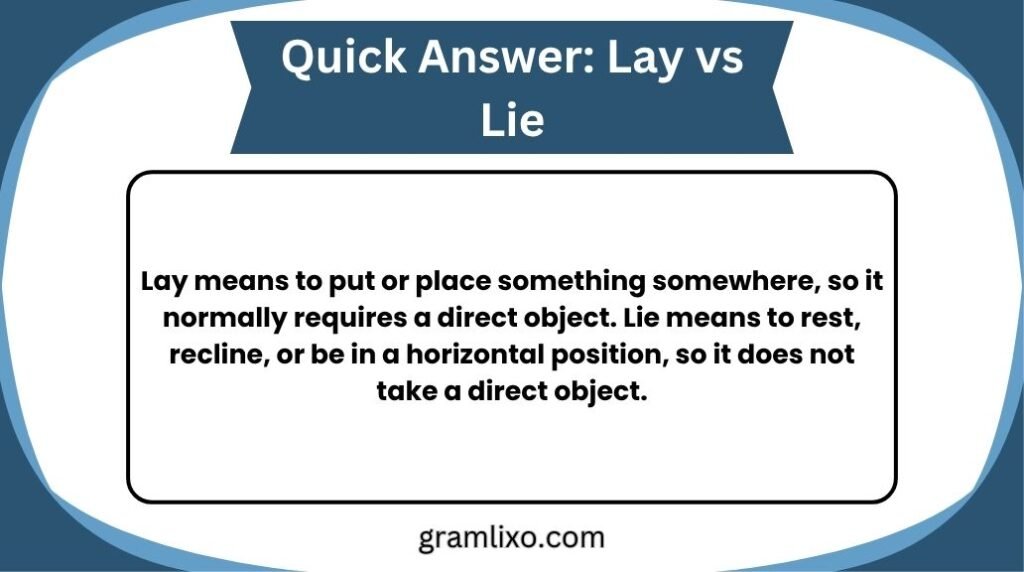
Lay means to put or place something somewhere, so it normally requires a direct object. Lie means to rest, recline, or be in a horizontal position, so it does not take a direct object.
- Lay: I lay the book on the desk.
- Lie: I lie on the couch after work.
The confusing part is that lay is also the past tense of lie:
- Present: I lie on the bed.
- Past: Yesterday, I lay on the bed.
- Past participle: I have lain on the bed before.
Meanwhile, the verb lay has these forms:
- Present: lay
- Past: laid
- Past participle: laid
- -ing form: laying
So remember:
Lay = put something down.
Lie = rest or recline.
Understanding the Basics: Lay vs Lie
The easiest way to understand lay vs lie is to focus on the object of the verb.
A direct object receives the action of a transitive verb. The verb lay normally needs this kind of object.
For example:
I lay the keys on the table.
Here, keys is the object. You are putting the keys somewhere.
With lie, there is no direct object:
I lie on the couch.
You are not putting another thing somewhere. You are simply resting or being in a position.
Comparison Table
| Form | Type | Meaning | Example | Correct/Incorrect |
|---|---|---|---|---|
| lay | Present verb | Put or place something | I lay the book on the desk. | ✅ Correct |
| lie | Present verb | Rest or recline | I lie on the sofa. | ✅ Correct |
| laid | Past of lay | Put or placed something | She laid the keys down. | ✅ Correct |
| lay | Past of lie | Rested or reclined | She lay on the sofa. | ✅ Correct |
| lain | Past participle of lie | Been in a resting position | She has lain there for an hour. | ✅ Correct |
| laying | -ing form of lay | Putting or placing | He is laying the papers down. | ✅ Correct |
| lying | -ing form of lie | Resting or reclining | He is lying on the bed. | ✅ Correct |
| lay | Present used for resting | Rest/recline | I lay down every night. | ❌ Incorrect |
| laid | Used for resting | Rested/reclined | I laid on the couch yesterday. | ❌ Incorrect |
| layed | Past form of lay | Modern standard English form | I layed the book down. | ❌ Incorrect |
The biggest source of confusion is this:
The word “lay” can be either the present tense of one verb or the past tense of another.
That means:
I lay the book on the table.
Here, lay is present tense.
But:
Yesterday, I lay on the couch.
Here, lay is past tense of lie.
Context tells you which meaning is intended.
The Verb “Lay”: Meaning and Uses
The verb lay means to put, place, or set something somewhere. It is normally a transitive verb, which means it takes a direct object.
Present Tense: Lay
Use lay when you are putting something somewhere.
Examples:
- I lay the book on the table.
- Please lay the documents beside the computer.
- She lays the baby in the crib.
- They lay the towels on the beach.
- We lay the cards on the table.
Notice that every example answers the question “Lay what?”
- Lay the book.
- Lay the documents.
- Lay the baby.
- Lay the towels.
- Lay the cards.
That is the key.
Third-Person Singular: Lays
With he, she, or it, the present-tense form becomes lays.
Examples:
She lays the blanket on the bed.
He lays his phone beside his laptop.
The hen lays an egg every morning.
The last example shows another common meaning of lay: producing or depositing an egg.
Past Tense: Laid
The past tense of lay is laid.
Examples:
I laid the book on the desk yesterday.
She laid the baby in the crib.
They laid the foundation for the building.
Never use layed as the standard modern past tense of this verb.
❌ I layed the book on the table.
✅ I laid the book on the table.
Past Participle: Laid
The past participle is also laid.
Examples:
I have laid the documents on your desk.
She had laid the clothes on the bed.
They have laid the carpet.
The pattern is:
lay → laid → laid
Present Participle: Laying
The -ing form of lay is laying.
Examples:
She is laying the plates on the table.
I am laying the papers in alphabetical order.
They were laying bricks all afternoon.
The important point is that laying means putting or placing something.
The Verb “Lie”: Meaning and Uses
The verb lie has several meanings, but when comparing it with lay, we are usually talking about lie meaning to rest, recline, or be in a horizontal position.
Unlike lay, this meaning of lie is normally intransitive. It does not take a direct object.
Present Tense: Lie
Use lie when the subject itself is resting or reclining.
Examples:
I lie on the couch after dinner.
She likes to lie on the beach.
The dog lies beside the fireplace.
The book lies on the desk.
In each sentence, the subject is simply in a position.
Third-Person Singular: Lies
With he, she, or it, the present tense becomes lies.
Examples:
She lies on the sofa every afternoon.
The cat lies under the table.
The answer lies somewhere between these two ideas.
Notice that lies can also mean “is situated” or “exists in a particular place or condition.”
Past Tense: Lay
Here is where the major confusion begins.
The past tense of lie is lay.
That means:
Today, I lie on the couch.
becomes:
Yesterday, I lay on the couch.
The same word lay is therefore:
- The present tense of lay, meaning “put or place.”
- The past tense of lie, meaning “rest or recline.”
Compare these sentences:
I lay the book on the desk.
Here, lay means put.
Yesterday, I lay on the desk.
Here, lay means rested.
The surrounding words and meaning tell you which verb is being used.
Past Participle: Lain
The past participle of lie is lain.
The complete pattern is:
lie → lay → lain
Examples:
I have lain awake all night.
She had lain on the beach for hours.
The papers have lain untouched on the desk.
Lain is grammatically correct, although it can sound formal or unusual in everyday conversation.
Present Participle: Lying
The -ing form of lie is lying.
Examples:
I am lying on the bed.
She was lying on the grass.
The dog is lying beside the door.
This spelling is especially important.
❌ I am lieing on the sofa.
✅ I am lying on the sofa.
The correct spelling is lying, with the e removed before adding -ing.
The Most Important Difference: Object vs. No Object
If you remember only one rule from this article, remember this:
Lay takes an object. Lie does not.
Consider:
Please lay the book on the table.
What is being laid?
The book.
Now consider:
Please lie down.
What is being laid?
Nothing.
You are simply resting yourself.
This gives you a quick test.
Ask: “Am I putting something somewhere?”
If the answer is yes, use a form of lay.
I need to lay the clothes on the bed.
Ask: “Am I resting or reclining?”
If the answer is yes, use a form of lie.
I need to lie on the bed.
This object test is also consistent with standard grammar references. The Chicago Manual of Style explains that lay is transitive and takes an object, while lie in the reclining sense is intransitive.
A Simple Verb Chart to Memorize
One of the easiest ways to master lay vs lie is to memorize the two verb patterns separately.
| Meaning | Present | Past | Past Participle | -ing Form |
|---|---|---|---|---|
| Put/place | lay | laid | laid | laying |
| Rest/recline | lie | lay | lain | lying |
Try saying them aloud:
Lay, laid, laid, laying.
Then:
Lie, lay, lain, lying.
The shared word lay is the reason these verbs cause so much trouble.
Correct Meanings and Uses
Lay Something Down
Use lay when placing an object somewhere.
Please lay the keys on the counter.
Breakdown:
- Subject: you
- Verb: lay
- Object: the keys
- Location: on the counter
Because the keys receive the action, lay is correct.
Lie Down
Use lie when the subject rests or reclines.
I need to lie down for a few minutes.
There is no direct object after lie. The phrase down tells us the direction or position.
Lay the Baby Down
This is another useful example.
The mother laid the baby down.
The mother is putting the baby in a resting position.
Therefore, laid is correct.
Compare:
The baby lay down.
Here, the baby is the one resting. Therefore, lay is the past tense of lie.
Lie on the Bed
I like to lie on my bed and read.
You are resting on the bed, so lie is correct.
Lay the Blanket on the Bed
I lay the blanket on the bed.
You are putting an object somewhere, so lay is correct.
Test Tip: Use “Put” as a Substitute
Here is a useful test when you are unsure.
Try replacing the verb with put.
If put makes sense, you probably need a form of lay.
Example:
Please lay the book on the table.
Replace lay with put:
Please put the book on the table.
It works.
Now try:
I need to lie down.
Replace lie with put:
I need to put down.
That changes the meaning and does not work in the same way.
So:
Put/place something → lay
Rest/recline → lie
This simple substitution can help you make the correct choice quickly.
Case Study: A Workplace Example
Imagine that an employee is preparing documents for a meeting.
She says:
“I’m going to lay down for ten minutes before the meeting.”
Her coworker might understand what she means, but the standard grammatical form is:
“I’m going to lie down for ten minutes before the meeting.”
Why?
Because the employee is describing her own resting position. She is not placing an object somewhere.
Later, she says:
“I need to lay these reports on the manager’s desk.”
This time, lay is correct because the reports are the direct object.
The two sentences look similar but have different grammatical structures:
I’m going to lie down.
→ I am resting.
I’m going to lay the reports down.
→ I am putting something somewhere.
This distinction becomes much easier once you focus on the object.
Grammar Rules Explained
Standard grammar references make a clear distinction between these verbs.
The Chicago Manual of Style describes lie as an intransitive verb and gives its principal forms as lie–lay–lain. It describes lay as a transitive verb with the forms lay–laid–laid.
The Oxford Advanced Learner’s Dictionary similarly explains that lie can describe a person or animal being in a flat position and lists its forms as lie, lay, lain, and lying. It also notes that lay takes an object.
The CDC’s Clear Writing guidance provides the same distinction:
- Lie: be in or assume a horizontal position.
- Lay: put or set something down.
- Lie: lie–lay–lain.
- Lay: lay–laid–laid.
The grammar is therefore not based on a preference or stylistic trick. The verbs have different meanings and grammatical patterns.
Why the Past Tense Is So Confusing
The hardest part of lay vs lie is the past tense.
You might think the pattern should be:
lie → lied
But that is only true when lie means to tell an untruth.
For the meaning “rest or recline,” the pattern is:
lie → lay → lain
For example:
I lie on the couch every evening.
Yesterday, I lay on the couch.
I have lain on that couch many times.
But when lie means “tell something untrue,” the forms are:
lie → lied → lied
For example:
He lies about his age.
He lied about his age yesterday.
He has lied about his age before.
This creates another important distinction:
| Meaning | Present | Past | Past Participle |
|---|---|---|---|
| Rest/recline | lie | lay | lain |
| Tell an untruth | lie | lied | lied |
| Put/place | lay | laid | laid |
Context makes the meaning clear.
Common Mistakes with Lay vs Lie
Mistake 1: “I’m going to lay down.”
In standard written English, when you mean that you are going to rest, the correct form is:
I’m going to lie down.
Why?
Because you are the one reclining.
Mistake 2: “I laid on the bed yesterday.”
The correct sentence is:
I lay on the bed yesterday.
Why?
Because lay is the past tense of lie.
Mistake 3: “I have laid there all morning.”
The standard form is:
I have lain there all morning.
Why?
Because the past participle of lie is lain.
Mistake 4: “She is laying on the sofa.”
If she is resting, the correct form is:
She is lying on the sofa.
Laying means putting or placing something.
Mistake 5: “I layed the book down.”
The standard form is:
I laid the book down.
The verb lay has the past form laid, not layed.
Why Do People Confuse These Words?
There are several reasons.
1. Fast Typing
When people type quickly, they often choose the familiar word without stopping to analyze the sentence.
A message such as:
“I’m going to lay down now.”
is common in informal communication even though standard edited English uses lie in this context.
2. Autocorrect
Autocorrect can sometimes reinforce a mistaken choice because both lay and lie are legitimate English words.
A spelling checker may not understand the intended grammatical meaning.
3. Lack of Knowledge
Many speakers learn these verbs naturally through conversation. Since native speakers frequently hear informal variations, the traditional distinction can be difficult to internalize.
4. The Past Tense of Lie Is Lay
This is the biggest problem.
People naturally expect:
lie → lied
But “lied” has a different meaning.
For resting:
lie → lay → lain
That unusual pattern makes the verbs harder to memorize.
Similar Grammar Confusions
The lay vs lie problem is part of a larger group of commonly confused English forms.
| Confusion | Correct Difference | Example |
|---|---|---|
| lay vs lie | Put something vs. rest | Lay the book down. / Lie down. |
| its vs. it’s | Possessive vs. it is | The dog wagged its tail. / It’s cold. |
| your vs. you’re | Possessive vs. you are | Your phone is ringing. / You’re late. |
| their vs. they’re | Possessive vs. they are | Their car is new. / They’re outside. |
| then vs. than | Time/sequence vs. comparison | First eat, then leave. / Taller than me. |
| affect vs. effect | Usually verb vs. usually noun | It may affect us. / The effect was obvious. |
| to vs. too | Direction/infinitive vs. also/excessively | Go to school. / I want to go too. |
| its vs. it’s | Possession vs. contraction | The company changed its policy. / It’s changing. |
These errors often happen because the words sound similar, look similar, or are used frequently in casual communication.
Lay vs Lie in Everyday Conversation
In everyday conversation, you may hear forms such as:
“I’m going to lay down.”
This usage is common in informal speech, but traditional standard edited English uses:
“I’m going to lie down.”
Similarly, you may hear:
“The dog is laying on the floor.”
Standard edited English uses:
“The dog is lying on the floor.”
The distinction is especially useful when writing emails, school assignments, reports, articles, applications, or other formal material.
Lay vs Lie in Professional Writing
Professional writing benefits from grammatical precision.
Imagine writing:
“The documents are laying on your desk.”
A clearer standard version is:
“The documents are lying on your desk.”
The documents are already resting there. Nobody is actively placing them at the moment.
But:
“I am laying the documents on your desk.”
is correct because I am actively placing them.
This distinction can make workplace communication clearer.
Professional Examples
Correct:
Please lay the forms on my desk before noon.
Correct:
The completed forms are lying on my desk.
Correct:
Yesterday, the forms lay on the conference table.
Correct:
I have laid the forms beside the printer.
Lay vs Lie in Creative Writing
Creative writers often use these verbs to describe physical movement, stillness, and setting.
For example:
She lay beneath the old oak tree and watched the clouds.
Here, lay is the past tense of lie.
Another example:
He laid the letter carefully beside the candle.
Here, laid means that he placed the letter.
The difference can subtly change the action:
- She lay beneath the tree. → She was resting there.
- She laid the blanket beneath the tree. → She placed the blanket there.
Good grammar helps readers visualize exactly what is happening.
Lay vs Lie in Social Media and Texting
Text messages and social media posts are informal, so people often use lay and lie interchangeably.
You might see:
“Finally home. Going to lay down!”
For casual texting, the meaning is usually obvious.
However, if you are writing:
- a professional post,
- a LinkedIn update,
- a business message,
- an academic assignment,
- an article,
- a formal email,
using lie down is the standard choice when you mean rest.
Digital communication may be casual, but correct grammar still improves clarity and credibility.
Why Lay vs Lie Matters
Grammar is not only about following rules. It is also about making your meaning easy to understand.
Clarity in Communication
Compare:
Lay on the sofa.
with:
Lie on the sofa.
The second sentence clearly means “rest on the sofa.”
Likewise:
Lay the phone on the desk.
clearly tells someone to place the phone there.
Professionalism
Correct grammar can make workplace writing look more polished.
A single mistake does not automatically make someone a poor writer, but repeated errors can distract readers from the message.
Accuracy in Digital Communication
Emails, messages, websites, documents, and social media posts are often read quickly. Clear grammatical choices reduce ambiguity.
As a simple rule:
Lay something. Lie down.
That short distinction solves a large percentage of everyday mistakes.
Special Exception: Lie Can Mean “Tell an Untruth”
There is an important exception because lie has another completely different meaning.
When lie means to say something that is not true, its verb forms are:
lie → lied → lied → lying
Examples:
He lied to his parents.
She has lied about the situation.
They are lying about what happened.
This meaning has nothing to do with resting or reclining.
Compare:
I lay on the bed yesterday.
This means I rested on the bed.
I lied to my friend yesterday.
This means I told my friend something untrue.
The words are related in spelling but completely different in meaning and verb forms.
Quick Recap Checklist
Use this checklist whenever you are unsure.
| Question | If Yes → Use |
|---|---|
| Am I putting or placing something somewhere? | Lay |
| Does the verb have a direct object? | Lay |
| Am I resting or reclining? | Lie |
| Is the sentence about my own resting position? | Lie |
| Am I talking about the past of “rest/recline”? | Lay |
| Do I need the past participle of “rest/recline”? | Lain |
| Am I putting something somewhere in the past? | Laid |
| Am I putting something somewhere right now? | Laying |
| Am I resting right now? | Lying |
Practice Example 1
I need to ___ down for a few minutes.
Answer: lie
I need to lie down for a few minutes.
Practice Example 2
Please ___ the folder on my desk.
Answer: lay
Please lay the folder on my desk.
Practice Example 3
Yesterday, I ___ on the couch all afternoon.
Answer: lay
Yesterday, I lay on the couch all afternoon.
Remember that the third example is correct because lay is the past tense of lie.
A Super-Easy Memory Trick
Try this:
Lay = Place.
Lie = Recline.
If you can replace the verb with put, think lay.
If you can replace it with rest, think lie.
For example:
I ___ the phone on the table.
“Put the phone on the table” works.
So:
I lay the phone on the table.
Now:
I ___ on the couch.
“Rest on the couch” works.
So:
I lie on the couch.
For the past tense:
Yesterday, I lay on the couch.
And:
Yesterday, I laid the phone on the table.
The two patterns are:
Rest: lie → lay → lain
Place: lay → laid → laid
FAQs About Lay vs Lie
1. What is the main difference between lay and lie?
Lay means to put or place something somewhere and normally requires a direct object. Lie means to rest, recline, or be in a horizontal position and normally does not take a direct object.
2. Is it “lay down” or “lie down”?
When you mean “recline or rest,” the standard form is lie down.
I am tired, so I’m going to lie down.
The form lay down can be correct when lay has an object:
Please lay the blanket down.
3. Is “I laid down” grammatically correct?
If you mean that you rested or reclined, standard grammar calls for I lay down, not “I laid down.”
Yesterday, I lay down for an hour.
However, laid is correct when you are placing an object:
I laid the book down.
4. What is the past tense of lie?
When lie means “rest or recline,” its past tense is lay.
Present: I lie on the bed.
Past: I lay on the bed.
Its past participle is lain:
I have lain on this bed before.
5. What is the past tense of lay?
The past tense of lay is laid.
Present: I lay the book on the desk.
Past: I laid the book on the desk.
The past participle is also laid.
6. Is “layed” a correct word?
For the standard modern verb lay meaning “put or place,” the past tense and past participle are laid, not layed.
Correct:
She laid the book on the table.
Incorrect in standard modern English:
She layed the book on the table.
Conclusion
The difference between lay vs lie becomes much easier once you focus on one question: Is something being placed, or is someone or something resting?
Use lay when you put or place something somewhere. Its forms are lay, laid, laid, laying. Use lie when someone or something rests, reclines, or is in a horizontal position. Its forms are lie, lay, lain, lying.
The biggest challenge is that lay has two jobs. It is the present tense of lay and the past tense of lie. That is why sentences such as “I lay the book down” and “I lay on the couch yesterday” can both be grammatically correct.
When in doubt, remember the simplest rule:
You lay something down, but you lie down yourself.
Once you learn that distinction and memorize the two verb patterns, lay vs lie no longer needs to be a confusing grammar problem. Keep the object test in mind, check the tense, and your choice will become much more natural. ✨

I’m Michael Williams, an English writer and grammar enthusiast at Gramlixo. I’m passionate about making grammar easier to learn and helping readers write with greater confidence.


[…] |Lay vs Lie: What’s the Difference and How to Use Them Correctly? […]