Have you ever typed a sentence and suddenly wondered whether you should use accept or except? You are not alone. These two words sound similar, especially when spoken quickly, but they have completely different meanings and grammatical jobs. Understanding accept vs except is important because choosing the wrong word can change the meaning of an entire sentence.
The good news is that the difference is actually simple once you connect each word with its main purpose. Accept is usually a verb meaning to receive, agree to, approve, or acknowledge something. Except, on the other hand, usually means excluding someone or something from a group, rule, or statement. It can also function as a preposition, conjunction, or verb in certain contexts.
In this guide, I’ll break down accept vs except with simple explanations, examples, grammar rules, practical situations, common mistakes, and easy memory tricks.
By the end, you should be able to choose the correct word confidently in everyday conversations, professional writing, school assignments, emails, and social media posts. 😊
|Adapt vs Adopt: Meaning, Difference, Grammar Rules, and Examples
|My Apology vs My Apologies: Which One Is Correct?
|Giving vs Given: Understanding the Difference With Clear Examples
Quick Answer: Accept vs Except
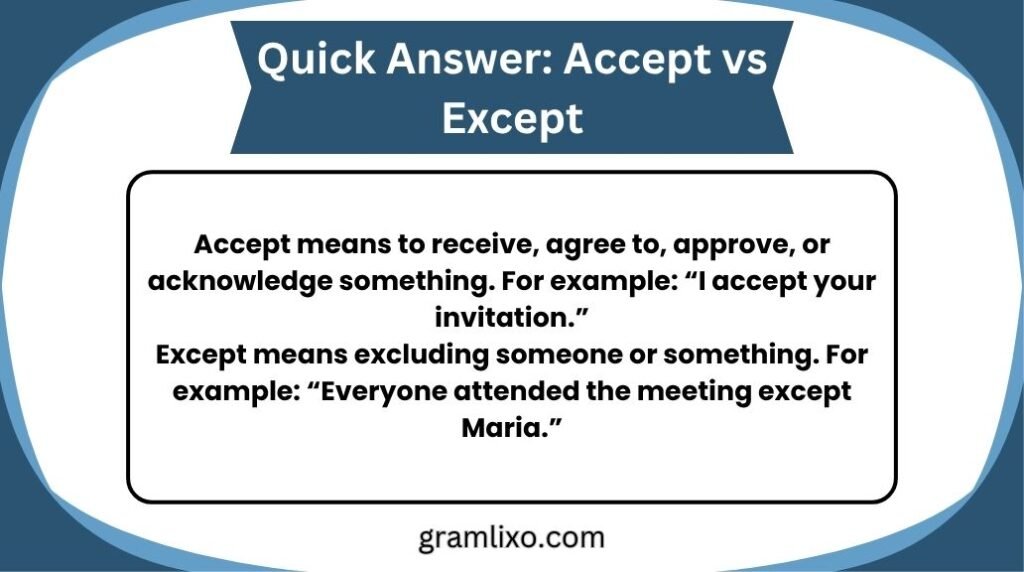
Accept means to receive, agree to, approve, or acknowledge something. For example: “I accept your invitation.”
Except means excluding someone or something. For example: “Everyone attended the meeting except Maria.”
Easy way to remember:
- Accept = receive or agree
- Except = exclude or leave out
If you are talking about taking, receiving, agreeing, or approving, use accept. If you are talking about leaving something or someone out, use except.
Understanding the Basics of Accept vs Except
The most important difference between accept vs except is their meaning and grammatical function.
Accept is primarily a verb. It describes an action involving receiving, agreeing to, approving, or acknowledging something.
Except most commonly works as a preposition or conjunction. It introduces an exception or shows that someone or something is excluded.
Comparison Table
| Form | Type | Meaning | Example | Correct/Incorrect |
|---|---|---|---|---|
| Accept | Verb | To receive or agree to something | I accept your offer. | ✅ Correct |
| Except | Preposition | Excluding someone or something | Everyone came except Tom. | ✅ Correct |
| Except | Conjunction | Other than; excluding a condition | I would go, except I am busy. | ✅ Correct |
| Accept | Verb | To exclude someone | Everyone accept Tom came. | ❌ Incorrect |
| Except | Preposition | To receive something | I except your apology. | ❌ Incorrect |
The Core Difference
Think of the words this way:
Accept = take it in.
Except = leave it out.
For example:
- “She accepted the gift.” → She received the gift.
- “Everyone received a gift except James.” → James was left out.
This simple contrast can help you distinguish the two words quickly.
What Does Accept Mean?
Accept is a verb with several related meanings. The basic idea is receiving, agreeing to, approving, or acknowledging something.
Accept Means to Receive Something
When you willingly receive something that is offered to you, you can use accept.
Example:
I accepted the package from the delivery driver.
Here, accepted means that the person received the package.
Another example:
She accepted the award with a smile.
The person received the award.
Accept Means to Agree to Something
You can also use accept when you agree to an offer, invitation, proposal, request, or arrangement.
Example:
We accepted the invitation to the wedding.
The people agreed to attend.
Another example:
He accepted the job offer.
This means he agreed to take the job.
Accept Means to Approve Something
Accept can also mean agreeing that something is suitable, valid, or satisfactory.
Example:
The company accepted my application.
The company approved the application.
Similarly:
The editor accepted her article for publication.
The editor approved the article.
Accept Means to Acknowledge or Recognize Something
Sometimes accept means recognizing something as true, real, or unavoidable.
Example:
She finally accepted the fact that the project had failed.
Here, accepted means she acknowledged the reality of the situation.
Test Tip for Accept
Ask yourself:
“Am I receiving, agreeing to, approving, or acknowledging something?”
If the answer is yes, accept is probably the correct word.
What Does Except Mean?
Except usually introduces an exception. It tells readers that someone or something is excluded from a group, statement, rule, or situation.
Except Means “Excluding”
This is the most common use.
Example:
Everyone passed the test except John.
The sentence means everyone passed, but John did not.
Another example:
I like all fruits except bananas.
This means bananas are excluded from the fruits the speaker likes.
Except in a Group
You can use except when one person or thing is different from the rest.
Example:
All the students arrived on time except Sarah.
Sarah is the exception.
Another example:
The store is open every day except Sunday.
Sunday is excluded from the schedule.
Except as a Conjunction
Except can also introduce a reason, condition, or exception.
Example:
I would call you, except I don’t have your number.
The speaker would call, but one condition prevents it.
Another example:
We could go for a walk, except it is raining.
The rain is the reason the plan cannot happen.
Test Tip for Except
Ask yourself:
“Am I leaving someone or something out?”
If yes, except is likely the correct choice.
Accept vs Except: Side-by-Side Examples
Seeing the words next to each other makes the difference much easier to understand.
Example 1
I accept your apology.
The speaker agrees to receive or acknowledge the apology.
Everyone except Mark apologized.
Mark is excluded from the group.
Example 2
She accepted the invitation.
She agreed to the invitation.
Everyone was invited except James.
James was not included.
Example 3
The restaurant accepted our reservation.
The restaurant approved or confirmed the reservation.
The restaurant is open every day except Monday.
Monday is excluded.
Example 4
I accept that I made a mistake.
The speaker acknowledges the mistake.
I would agree with you except for one problem.
One problem creates an exception.
Accept vs Except in Real-Life Situations
Understanding grammar rules is useful, but seeing these words in realistic situations makes them easier to remember.
Everyday Conversation
Imagine a friend offers you a cup of coffee.
You could say:
“Thanks! I accept.”
Now imagine a group of friends is going to dinner.
You might say:
“Everyone is coming except David.”
The meanings are completely different.
Another Conversation
Friend: “Would you like to come to the party?”
You: “Yes, I accept the invitation.”
Later:
“Everyone is coming except Sarah.”
Here, accept refers to agreeing to an invitation, while except identifies the person who is not included.
Accept vs Except in Professional Writing
Choosing the correct word becomes especially important in workplace communication.
Consider this email sentence:
“We are pleased to accept your proposal.”
This means the company has approved the proposal.
Now compare it with:
“All team members attended the meeting except David.”
This means David did not attend.
Confusing these words in a business email could make your message unclear or even change its meaning.
Professional Examples
- We are happy to accept your offer.
- The manager accepted the revised proposal.
- The system will accept payments through Friday.
- All employees must attend except those on approved leave.
- Every department responded except the legal team.
- The office is open every weekday except Friday.
Accept vs Except in Creative Writing
Writers use both words frequently because stories often involve choices, relationships, inclusion, exclusion, and emotional acceptance.
Examples with Accept
Maya finally accepted the truth.
He accepted her decision without arguing.
The village accepted the stranger as one of their own.
Examples with Except
Everyone trusted him except his oldest friend.
The forest was silent except for the sound of birds.
Nothing had changed except the weather.
In creative writing, the wrong word can weaken an important sentence. A reader may understand your general idea, but the grammar will still be incorrect.
Accept vs Except in Social Media and Texting
Texting and social media make mistakes more common because people often type quickly.
You might see:
“I except your apology.”
The correct sentence is:
“I accept your apology.”
Another common mistake is:
“Everyone accept me was invited.”
The correct sentence is:
“Everyone except me was invited.”
Although casual communication is forgiving, using the correct word helps your writing look more polished and professional.
Why Do People Confuse Accept and Except?
The confusion happens mainly because accept and except look and sound very similar.
They share several letters and have similar pronunciation patterns. When people speak quickly, the difference between them may be difficult to hear.
There are several common reasons for mistakes.
1. Fast Typing
When people type quickly, they may choose the wrong word without noticing.
2. Autocorrect
Autocorrect can sometimes change a correctly intended word or fail to identify the intended meaning.
3. Lack of Knowledge
Some writers simply have not learned the distinction yet.
4. Similar Sound
Because the words sound alike in many accents, writers may remember the sound rather than the meaning.
5. Context-Based Confusion
Both words frequently appear in everyday sentences, but they perform different grammatical jobs.
The best solution is to focus on meaning, not pronunciation.
Grammar Rules for Accept vs Except
Standard English grammar treats accept and except as different words with different meanings and functions.
Major dictionary references, including Merriam-Webster, distinguish accept as a verb meaning to receive, agree to, or regard as satisfactory, while except is commonly used to introduce an exclusion or exception.
The grammar rule is therefore based on the intended meaning.
Use Accept When:
- You receive something.
- You agree to something.
- You approve something.
- You acknowledge something.
- You recognize something as true or valid.
Examples:
I accept your offer.
The school accepted her application.
He accepted the apology.
Use Except When:
- You exclude someone.
- You exclude something.
- You identify an exception.
- You introduce a condition that prevents something.
Examples:
Everyone came except Lisa.
I like every color except orange.
I would go, except I am tired.
A Simple Grammar Formula
Accept + thing being received/agreed to
She accepted the invitation.
Except + person/thing being excluded
Everyone came except John.
This formula works in many everyday situations.
Common Mistakes With Accept and Except
Here are some of the mistakes you are most likely to see.
Mistake 1
❌ I except your apology.
✅ I accept your apology.
Why? The speaker is receiving or acknowledging the apology.
Mistake 2
❌ Everyone accept Maria came.
✅ Everyone except Maria came.
Why? Maria is excluded from the group.
Mistake 3
❌ The company excepted my proposal.
✅ The company accepted my proposal.
Why? The company approved the proposal.
Mistake 4
❌ I accept everyone but John.
This sentence may be grammatically possible in a different context, but if your intended meaning is that John is excluded from a group, a clearer sentence is:
✅ Everyone came except John.
Similar Grammar Confusions
Accept vs except is part of a larger group of commonly confused English words.
| Confusing Words | Correct Meaning | Example |
|---|---|---|
| Accept / Except | Receive / Exclude | I accept the offer. Everyone came except Tom. |
| Your / You’re | Possessive / You are | Your phone is here. You’re early. |
| Its / It’s | Possessive / It is | The dog wagged its tail. It’s happy. |
| Their / There / They’re | Possession / Place / They are | Their car is there. They’re ready. |
| Then / Than | Time / Comparison | We ate, then left. She is taller than me. |
| To / Too / Two | Direction / Also / Number | Go to school. I want one too. I have two. |
| Principal / Principle | School leader / Rule or belief | The principal spoke. Honesty is a principle. |
Learning these pairs as meaning-based groups is often more effective than memorizing spelling alone.
Accept vs Except: Usage in Different Contexts
Everyday Conversation
In casual speech, both words are common.
Examples:
“I accept your invitation.”
“Everyone is here except Mike.”
“I accept that you’re right.”
“I eat everything except seafood.”
The key is still the same: accept receives or agrees; except excludes.
Professional Writing
Professional writing requires extra precision.
Use accept when discussing:
- applications
- proposals
- invitations
- offers
- payments
- responsibilities
- decisions
Use except when describing:
- exclusions
- exceptions
- schedules
- groups
- rules
- conditions
Example
“We have accepted all applications except those submitted after the deadline.”
This sentence uses both words correctly.
Accepted means the applications were approved.
Except introduces the applications that were excluded.
Creative Writing
Creative writers can use these words to express emotional or narrative ideas.
“She finally accepted what had happened.”
“Everyone believed him except his sister.”
Both sentences are short, but the words perform completely different jobs.
Social Media and Texting
Informal communication may tolerate minor errors, but correct usage still improves clarity.
Instead of:
“I except your apology ❤️”
Write:
“I accept your apology ❤️”
Instead of:
“Everyone accept me is invited.”
Write:
“Everyone except me is invited.”
Case Study: Accept vs Except in a Workplace Email
Imagine a manager sends an email to employees after a company event.
Incorrect Version
“We are happy to except your proposal. Everyone accept Daniel attended the meeting.”
There are two word-choice errors.
Correct Version
“We are happy to accept your proposal. Everyone except Daniel attended the meeting.”
Now the meaning is clear.
- Accept your proposal = approve the proposal.
- Except Daniel = Daniel was not part of the group.
This example shows why the distinction matters in real workplace communication. A single incorrect word can make a sentence confusing or unintentionally humorous.
A Simple Memory Trick for Accept vs Except
If you struggle to remember the difference, use this trick:
Accept = Agree
Both accept and agree are associated with saying yes.
I accept your offer.
I agree to your offer.
Except = Exclude
The beginning of except can remind you of exclude.
Everyone came except Sarah.
Sarah was excluded from the group.
So remember:
Accept = Agree
Except = Exclude
This is one of the easiest ways to keep the words separate.
Can Accept and Except Ever Be Used in the Same Sentence?
Yes! In fact, using both words in one sentence can be a great way to understand their difference.
Example 1
The store accepted every return except damaged items.
Accepted = received or approved.
Except = excluding damaged items.
Example 2
I accept everyone’s opinion except those based on false information.
Accept = acknowledge or tolerate.
Except = exclude.
Example 3
The committee accepted all applications except those submitted late.
Again, both words have distinct functions.
This pattern is useful because it shows that accept and except are not interchangeable.
Special Exception and Edge Cases
There is an interesting grammatical edge case involving except.
Although except is most commonly used as a preposition or conjunction, it can also appear in less common verb-related constructions, particularly in older or formal usage.
For everyday modern American English, however, you generally do not need to worry about these rare uses. In most situations, remember:
Accept = receive, agree, approve, or acknowledge.
Except = exclude or identify an exception.
There are also words derived from these terms, such as acceptable, acceptance, exception, and exceptional. Their meanings follow related patterns.
For example:
- Acceptable = good enough to be accepted.
- Acceptance = the act of accepting.
- Exception = something excluded from a general rule.
- Exceptional = unusually good or different.
Quick Recap Checklist
Use this checklist whenever you are unsure about accept vs except.
| Question | If Yes → Use |
|---|---|
| Am I receiving something? | Accept |
| Am I agreeing to something? | Accept |
| Am I approving something? | Accept |
| Am I acknowledging something? | Accept |
| Am I leaving someone or something out? | Except |
| Am I identifying an exception? | Except |
| Does the sentence mean “excluding”? | Except |
| Could I replace the word with “receive” or “agree”? | Accept |
| Could I replace it with “excluding”? | Except |
Practice Examples
1. I ___ your invitation to dinner.
Answer: accept
I accept your invitation to dinner.
2. Everyone attended the meeting ___ James.
Answer: except
Everyone attended the meeting except James.
3. The company will ___ your application if all requirements are met.
Answer: accept
The company will accept your application if all requirements are met.
FAQs About Accept vs Except
What is the difference between accept and except?
Accept means to receive, agree to, approve, or acknowledge something. Except means excluding someone or something from a group, statement, or situation.
Is it “accept my apology” or “except my apology”?
The correct phrase is “accept my apology.” The verb accept means to receive or acknowledge the apology.
Example:
Please accept my apology.
“Except my apology” is incorrect when you mean receiving an apology.
Is it “everyone accept John” or “everyone except John”?
The correct phrase is “everyone except John” when John is excluded from the group.
Example:
Everyone except John attended the meeting.
What is an easy way to remember accept vs except?
Remember:
Accept = agree or receive.
Except = exclude.
You can also connect except with exclude because both involve leaving something out.
Can accept and except be used together?
Yes. They can appear in the same sentence because they have different meanings.
Example:
We accepted all applications except those submitted late.
Here, accepted means approved or received, while except introduces the applications that were excluded.
Is “except” always a preposition?
No. Except can function as a preposition, conjunction, and, in less common usage, a verb. In everyday American English, however, its most familiar role is introducing an exception or exclusion.
Why Accept vs Except Matters
Knowing the difference between accept vs except may seem like a small grammar detail, but small details often have a big effect on communication.
Using the correct word improves clarity, especially when you are writing emails, applications, reports, school assignments, business documents, or online posts.
It also improves professionalism. A reader may overlook an occasional typo, but repeatedly confusing common words can make your writing appear less polished.
Digital communication makes accuracy even more important because short messages often have little context. When a single word carries a major part of the meaning, choosing the right word helps prevent misunderstandings.
A useful principle is:
Clear writing begins with precise word choice.
When you know whether you are talking about receiving or agreeing versus excluding, the choice becomes much easier.
Final Takeaway: Accept vs Except
The difference between accept vs except is simple once you focus on meaning.
Accept is a verb. It means to receive, agree to, approve, or acknowledge something.
“I accept your offer.”
Except introduces an exclusion or exception.
“Everyone came except Maria.”
The easiest memory trick is:
Accept = agree or receive.
Except = exclude.
When you are unsure, stop and ask yourself what the sentence means. If someone is receiving, approving, agreeing to, or acknowledging something, choose accept. If someone or something is being left out, choose except.
These two words may look and sound similar, but they do very different jobs. Mastering that small distinction can make your everyday writing, professional communication, academic work, and online messages much clearer.
Remember: Accept brings something in; except leaves something out. ✍️

I’m Sarah Martinez, a writer and English language enthusiast at Gramlixo. I love explaining grammar concepts in a clear and practical way that anyone can understand.
[…] |Accept vs Except: What’s the Difference and How to Use Them Correctly? […]
[…] |Accept vs Except: What’s the Difference and How to Use Them Correctly? […]