Have you ever written a sentence like “I want to pose you a question” and wondered whether ask would sound better? You are not alone. The confusion around ask vs pose usually happens because both words can be used when someone wants to introduce a question.
For example, you can say, “I want to ask a question,” or “I want to pose a question.” Both sentences are grammatically correct, but they do not always have exactly the same tone or meaning.
Ask is the everyday, direct choice for requesting information, help, permission, or an answer. Pose is more formal and often emphasizes presenting a question, problem, challenge, or idea for consideration. Understanding this small difference can make your writing sound more natural and precise.
Whether you are writing an email, completing an academic assignment, speaking in a meeting, or posting online, choosing between ask vs pose depends on what you want to communicate and how formal you want to sound.
|Accept vs Except: What’s the Difference and How to Use Them Correctly?
|Freshman vs Freshmen: What’s the Difference and How to Use Them Correctly?
|Better Than vs Better Then: Which One Is Correct?
Quick Answer: Ask vs Pose
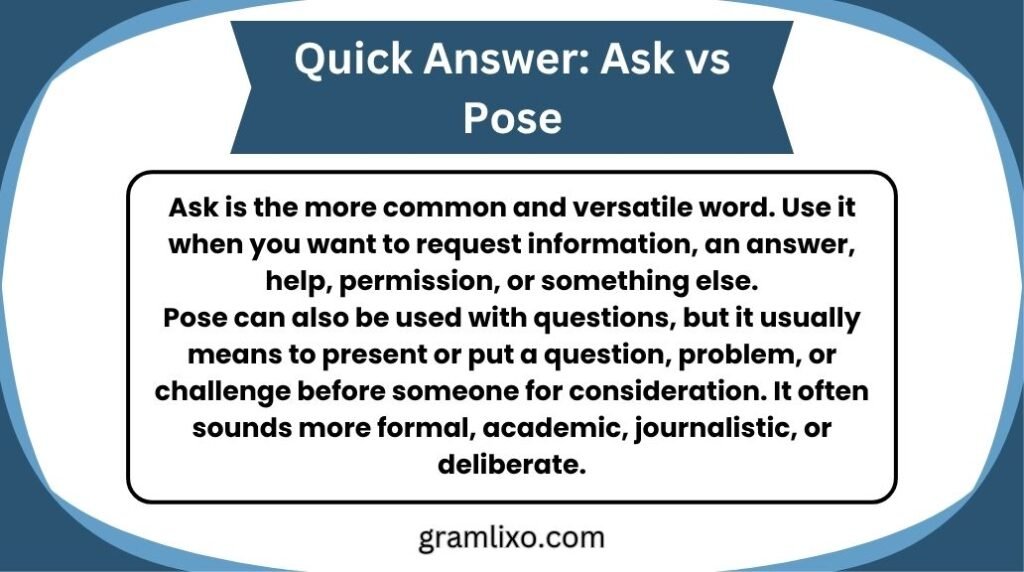
Ask is the more common and versatile word. Use it when you want to request information, an answer, help, permission, or something else.
Pose can also be used with questions, but it usually means to present or put a question, problem, or challenge before someone for consideration. It often sounds more formal, academic, journalistic, or deliberate.
Simple rule: If you simply want an answer, ask is usually the safest choice. If you are presenting a question or problem for thought or discussion, pose may be the better choice.
Understanding the Basics of Ask vs Pose
The easiest way to understand ask vs pose is to look at their central meanings.
What Does “Ask” Mean?
Ask is a common verb that means to request information, an answer, permission, help, an action, or something else.
Examples:
- I asked my teacher a question.
- She asked me for directions.
- Can I ask you something?
- He asked for help.
- They asked whether the store was open.
The word ask is extremely flexible. It works naturally in casual conversation, professional communication, academic writing, and everyday situations.
What Does “Pose” Mean?
Pose has several meanings, but when it is used with a question, it generally means to present or put forward a question for someone to consider or answer.
Examples:
- The professor posed an interesting question.
- The reporter posed a difficult question.
- The study poses several important questions.
- She posed a challenge to the team.
In these examples, pose gives the idea of presenting something for consideration. It can make the sentence sound more formal or thoughtful.
Ask vs Pose Comparison Table
| Form | Type | Meaning | Example | Correct/Incorrect |
|---|---|---|---|---|
| ask | Verb | Request information or an answer | I asked him a question. | ✅ Correct |
| ask for | Verb phrase | Request something | She asked for help. | ✅ Correct |
| ask whether | Verb phrase | Request information about a choice or fact | He asked whether I was ready. | ✅ Correct |
| pose a question | Verb phrase | Present a question for consideration | The professor posed a question. | ✅ Correct |
| pose a problem | Verb phrase | Present or create a problem | The delay poses a problem. | ✅ Correct |
| pose a challenge | Verb phrase | Present a challenge | The project poses a challenge. | ✅ Correct |
| pose someone a question | Verb phrase | Present a question to someone | She posed me a difficult question. | ⚠️ Possible, but less natural |
| ask a question | Verb phrase | Request an answer | She asked me a difficult question. | ✅ Correct |
The key point is that ask focuses more on the act of requesting an answer, while pose focuses more on presenting a question, problem, or challenge.
Correct Meanings and Uses of “Ask”
1. Use “Ask” to Request Information
This is one of the most common uses of ask.
Examples:
- I asked him where he lived.
- She asked what time the meeting started.
- They asked why the flight was delayed.
- I asked the receptionist for directions.
In each sentence, the speaker wants information.
A useful structure is:
ask + person + question
I asked Sarah where she was going.
Another common structure is:
ask + question word
He asked why I was late.
You can also use:
ask + for + noun
She asked for more information.
2. Use “Ask” to Request Help
Ask is also the natural choice when requesting assistance.
Examples:
- I asked my coworker for help.
- She asked her parents for advice.
- He asked the manager for assistance.
- Don’t be afraid to ask for help.
Here, pose would not work naturally.
❌ I posed my coworker for help.
✅ I asked my coworker for help.
This is an important distinction. Although ask and pose can overlap when discussing questions, they are not general substitutes for one another.
3. Use “Ask” to Request Permission
Ask is also used when someone wants permission.
Examples:
- I asked my parents if I could go.
- She asked her boss for permission.
- He asked whether he could leave early.
- Did you ask before using my computer?
You would not normally replace ask with pose in these sentences.
❌ I posed my boss for permission.
✅ I asked my boss for permission.
4. Use “Ask” in Everyday Conversation
In ordinary speech, ask is almost always the natural choice.
For example:
“Can I ask you a quick question?”
This sounds friendly and normal.
By contrast:
“Can I pose you a quick question?”
Although understandable, this sounds more formal and less conversational.
That does not make pose wrong. It simply makes it less natural in casual situations.
Correct Meanings and Uses of “Pose”
1. Use “Pose a Question” to Present a Question
One of the most important expressions is:
pose a question
It means to put a question forward for consideration or discussion.
Examples:
- The teacher posed an interesting question.
- The journalist posed a difficult question.
- The researcher posed several questions about the results.
- The speaker posed a question to the audience.
The phrase is especially common in academic, professional, journalistic, and formal contexts.
2. “Pose” Can Emphasize Thought or Discussion
Compare these sentences:
The student asked a question.
The student posed a question.
The first sentence simply tells us that the student requested an answer.
The second sentence can suggest that the question was deliberately presented for discussion or consideration.
For example:
The professor posed an important question about the future of artificial intelligence.
This sounds more formal and analytical than:
The professor asked an important question about the future of artificial intelligence.
Both are correct. The difference is mainly one of emphasis and register.
3. Use “Pose” With Problems and Challenges
Unlike ask, pose commonly works with nouns such as:
- problem
- challenge
- threat
- risk
- danger
- question
- possibility
Examples:
- The storm poses a serious threat to the region.
- The new policy poses several challenges.
- Rising costs pose a problem for small businesses.
- The discovery poses an interesting question.
- The situation poses a significant risk.
You cannot simply replace pose with ask here.
❌ Rising costs ask a problem for small businesses.
✅ Rising costs pose a problem for small businesses.
This is one reason the two verbs should not be treated as complete synonyms.
4. “Pose” Has Other Meanings
Pose is not limited to questions.
It can also mean to position yourself in a particular way, especially for a photograph.
Example:
She posed for a picture.
It can also mean to pretend to be someone or something.
Example:
The man posed as a doctor.
It can also mean to create or present a problem, danger, or difficulty.
Example:
The broken bridge poses a safety risk.
These meanings are completely different from the question-related use of pose.
Ask vs Pose: The Most Important Difference
The simplest distinction is this:
Ask = request an answer, piece of information, help, permission, or something else.
Pose = present a question, problem, challenge, or issue for consideration.
Consider these examples:
I asked my friend a question.
This is neutral and conversational.
I posed a question to the committee.
This sounds more formal and suggests that the question was deliberately presented for discussion.
Another pair:
She asked me why I was late.
This focuses on her desire to know the reason.
She posed a difficult question about the project.
This focuses on the question itself and its challenge to the people considering it.
A Simple Memory Trick 🧠
Think of ask as requesting.
Think of pose as presenting.
If you are requesting an answer:
Ask.
If you are presenting a question for thought or discussion:
Pose.
Examples of Ask vs Pose
Here are several examples that show how the two words work in real sentences.
Example 1: Casual Conversation
Can I ask you something?
✅ Natural
Can I pose you something?
❌ Incorrect in this meaning
The verb pose does not normally replace ask when “something” means a general request or question.
Example 2: Academic Writing
The researcher asked an important question about climate change.
✅ Correct
The researcher posed an important question about climate change.
✅ Correct and somewhat more formal.
Both work, but posed emphasizes the deliberate presentation of the question.
Example 3: Requesting Help
I asked my coworker for help.
✅ Correct
I posed my coworker for help.
❌ Incorrect
Use ask for when requesting help.
Example 4: Presenting a Problem
The unexpected delay poses a serious problem.
✅ Correct
The unexpected delay asks a serious problem.
❌ Incorrect
Here, pose means “present” or “create” a problem.
Example 5: Journalism
The reporter posed several challenging questions to the politician.
✅ Correct
The reporter asked several challenging questions to the politician.
✅ Correct
Both are natural. Posed can sound slightly more formal or deliberate.
Test Tip: How to Choose Between Ask and Pose
When you are unsure, try this quick test:
Ask Yourself: “Am I Requesting Something?”
If yes, use ask.
- ask a question
- ask for help
- ask for permission
- ask for information
- ask someone to wait
- ask whether something is true
Ask Yourself: “Am I Presenting Something for Consideration?”
If yes, pose may be appropriate.
- pose a question
- pose a problem
- pose a challenge
- pose a threat
- pose a risk
- pose an interesting possibility
This test will solve most ask vs pose questions.
Case Study: Ask vs Pose in the Workplace
Imagine that Emma works as a project manager. During a team meeting, she needs information from a coworker.
She says:
“Can I ask you a question about the sales report?”
This is natural because Emma wants specific information.
Later, Emma presents a major issue to the entire team:
“This situation poses an important question: Are we using our marketing budget effectively?”
Here, pose works well because Emma is presenting an issue for the team to consider.
Now imagine an email:
Hi Daniel,
Could I ask you for the updated sales figures when you have a moment?
Thanks,
Emma
This is professional and natural.
A more formal report might say:
The findings pose several important questions about the effectiveness of the current strategy.
Again, both contexts demonstrate the difference.
Ask is especially useful for direct communication between people.
Pose is especially useful when presenting questions, problems, risks, or challenges for analysis.
Grammar Rules for Ask vs Pose
Both ask and pose are verbs, but their grammatical patterns are different.
Common Structures With “Ask”
Ask + Someone + Something
I asked him a question.
Ask + Someone + For + Something
She asked me for advice.
Ask + Someone + To + Verb
He asked me to call later.
Ask + Whether/If
She asked whether I was available.
Ask + Question Word
They asked where we were going.
These structures are extremely common in English.
Common Structures With “Pose”
Pose + A Question
The teacher posed a question.
Pose + A Question + To + Someone
The teacher posed a question to the students.
Pose + A Problem
The delay poses a problem.
Pose + A Challenge
The new project poses a challenge.
Pose + A Threat
The storm poses a serious threat.
Pose + A Risk
The mistake poses a financial risk.
One important point is that pose a question to someone is generally more natural than pose someone a question.
Compare:
The professor posed a question to the class. ✅
The professor posed the class a question. ⚠️ Less common and less natural for many speakers.
For maximum clarity, especially in formal writing, pose a question to someone is a strong choice.
What Does Merriam-Webster Say?
Merriam-Webster treats ask and pose as distinct verbs with overlapping but different meanings. Its dictionary and thesaurus resources show ask in the sense of making a request or seeking information, while pose has uses involving presenting or putting something forward, including questions and problems.
This supports an important grammar principle: two words can be related in meaning without being interchangeable in every sentence.
For example, ask can be used for requests:
I asked for assistance.
But pose is appropriate for presenting a problem:
The situation poses a serious problem.
That difference is based on meaning and sentence structure, not simply on formality.
Common Mistakes With Ask vs Pose
Why do people confuse these verbs?
There are several common reasons.
1. Fast Typing
When people type quickly, they often choose a word that feels similar without checking its exact meaning.
For example:
❌ “I posed my manager for help.”
The writer probably means:
✅ “I asked my manager for help.”
2. Autocorrect
Autocorrect can also cause unexpected substitutions. A person may type quickly and accept a suggested word without noticing that the meaning has changed.
This is particularly common in texts, emails, and social media posts.
3. Lack of Vocabulary Knowledge
English contains many near-synonyms. Words such as ask, request, inquire, and pose may overlap in certain situations, but they do not have identical grammatical patterns.
Learning the core meaning of each word makes the choice easier.
4. Assuming Synonyms Are Interchangeable
This is perhaps the biggest mistake.
A thesaurus may list related words, but related words do not always fit the same sentence.
For example:
I asked for help. ✅
You cannot automatically change this to:
I posed for help. ❌
The words have different meanings and grammatical uses.
Similar Grammar Confusions
| Confusing Pair | Correct Difference | Example |
|---|---|---|
| ask vs pose | Request vs present for consideration | Ask for help / pose a question |
| it’s vs its | Contraction vs possessive | It’s cold / its color |
| your vs you’re | Possessive vs you are | Your book / you’re ready |
| their vs there vs they’re | Possession, location, contraction | Their car / over there / they’re here |
| affect vs effect | Usually verb vs usually noun | It affected me / the effect was strong |
| advice vs advise | Noun vs verb | Give advice / advise someone |
| then vs than | Time/order vs comparison | Then we left / taller than me |
| accept vs except | Receive/agree vs exclude | Accept the offer / everyone except Sam |
These pairs create problems because the words can sound similar, appear in similar contexts, or have related meanings. The solution is to learn what each word actually does in a sentence.
Ask vs Pose in Different Contexts
Everyday Conversation
In everyday speech, ask is overwhelmingly the natural choice.
Examples:
- Can I ask you something?
- Ask your brother.
- I need to ask a question.
- She asked me where I lived.
- Did you ask for help?
Using pose in casual conversation is not necessarily wrong when referring to a question, but it may sound formal.
“I want to pose a question.”
This could sound appropriate in a serious discussion, but:
“Can I ask you something?”
sounds much more natural in ordinary conversation.
Professional Writing
Both words can work in professional writing.
Use ask when describing a direct request:
The client asked for additional information.
Use pose when describing an issue or question:
The new findings pose several questions for the research team.
The second sentence has a more analytical tone.
Academic Writing
Pose is common in academic contexts because academic writing often discusses questions, problems, and issues.
Examples:
- The study poses an important question.
- This theory poses several challenges.
- The findings pose new questions for researchers.
However, ask is still perfectly acceptable:
The researcher asked whether the results could be replicated.
Do not assume that formal writing always requires pose. Accuracy and natural usage matter more than choosing the more sophisticated-looking word.
Creative Writing
Creative writers can use either word depending on tone.
She asked the stranger a simple question.
This feels direct and conversational.
The old man posed a question that changed everything.
This sounds more dramatic and deliberate.
In fiction, pose can help create a thoughtful, serious, or dramatic atmosphere.
Social Media and Texting
For texting and social media, ask is usually the better choice.
Examples:
- Can I ask you something?
- Quick question: can I ask you something?
- I need to ask everyone a favor.
Pose may feel overly formal in a casual post unless you intentionally want a formal or humorous tone.
Why Ask vs Pose Matters
Choosing the right verb is not just about passing a grammar test. It affects how clearly your message communicates your intention.
1. Clarity in Communication
Using the correct verb helps readers understand exactly what you mean.
Compare:
I asked for information.
The meaning is immediately clear.
I posed for information.
This is incorrect because pose does not mean “request information.”
2. Professionalism
Small word-choice errors can affect how polished your writing appears.
In a workplace email, saying:
“I posed my supervisor for assistance”
can make the sentence sound incorrect.
A better version is:
“I asked my supervisor for assistance.”
3. Accuracy in Digital Communication
Digital communication is often short and fast. Because there is less context, word choice matters even more.
An incorrect word can make a message confusing or unintentionally humorous.
4. Better Academic Writing
Academic writers often need to distinguish between requesting information and presenting questions or problems.
For example:
The researcher asked participants about their experiences.
versus:
The findings pose an important question about future research.
These sentences communicate different ideas.
A Useful Reminder
“Clear words make clear thoughts.”
The goal is not to use the most complicated word. The goal is to use the word that expresses your meaning most accurately.
Special Exception and Edge Cases
There is no major grammatical exception that makes ask and pose interchangeable in every situation. However, pose has several meanings that can create confusion.
“Pose” as a Photography Verb
She posed for the photographer.
Here, pose means to arrange or hold one’s body in a particular position.
You cannot use ask here.
❌ She asked for the photographer.
The meaning is completely different.
“Pose” Meaning Pretend
He posed as a police officer.
Here, pose as means to pretend to be someone else.
Again, ask cannot replace it.
“Pose” Meaning Create a Risk or Threat
The damaged building poses a danger.
This means the building creates or presents a danger.
You would not say:
The damaged building asks a danger.
So, when you see pose, always look at the surrounding words. The meaning depends heavily on context.
Ask vs Pose: Common Sentence Corrections
Here are some quick corrections to reinforce the difference.
Incorrect:
I posed my teacher for help.
Correct:
I asked my teacher for help.
Incorrect:
Can I pose you something?
Better:
Can I ask you something?
Or, if you specifically mean a formal question:
Can I pose a question to you?
Correct:
The researcher posed an interesting question.
This is appropriate because the researcher is presenting the question for consideration.
Correct:
I asked the researcher an interesting question.
This is appropriate because the speaker is requesting information.
Correct:
The problem poses a serious challenge.
Here, pose means present or create a challenge.
Correct:
She asked whether the problem could be solved.
Here, ask expresses a request for information.
Quick Recap Checklist
Use this checklist whenever you are deciding between ask vs pose.
| Question | If Yes → Use |
|---|---|
| Am I requesting information? | Ask |
| Am I requesting help? | Ask |
| Am I requesting permission? | Ask |
| Am I asking someone to do something? | Ask |
| Am I presenting a question for consideration? | Pose |
| Am I presenting a problem? | Pose |
| Am I presenting a challenge? | Pose |
| Am I describing a threat or risk? | Pose |
| Am I talking casually to someone? | Usually Ask |
| Am I writing formal or academic prose? | Ask or Pose, depending on meaning |
Practice Examples
1. I need to ___ my manager for permission.
Answer: ask
I need to ask my manager for permission.
2. The discovery ___ an important question about the future.
Answer: poses
The discovery poses an important question about the future.
3. The new regulation ___ several challenges for small businesses.
Answer: poses
The new regulation poses several challenges for small businesses.
Frequently Asked Questions About Ask vs Pose
1. Is it correct to say “pose a question”?
Yes. “Pose a question” is completely correct. It means to present or put forward a question for consideration, discussion, or response.
The professor posed an important question to the class.
2. Is “ask a question” or “pose a question” more common?
Ask a question is more common in everyday English. Pose a question is also correct but often sounds more formal, deliberate, or academic.
For casual conversation, ask is usually the natural choice.
3. Can I use “pose” instead of “ask”?
Not always. The two words overlap when referring to questions, but they are not complete synonyms.
You can say:
She asked a question.
or:
She posed a question.
But you cannot say:
She posed for help.
Instead, say:
She asked for help.
4. Is “pose someone a question” grammatically correct?
It can occur, but “pose a question to someone” is generally the clearer and more natural construction.
For example:
The interviewer posed a difficult question to the candidate.
This is an especially good structure for formal writing.
5. Should I use “ask” or “pose” in academic writing?
Either can be correct. Use ask when the sentence focuses on requesting information. Use pose when the sentence focuses on presenting a question, issue, challenge, or problem for consideration.
For example:
The researcher asked participants about their experiences.
But:
The findings pose several questions for future researchers.
6. Does “pose” always sound more formal than “ask”?
Not necessarily, but pose a question often has a more formal or deliberate tone than ask a question. The exact tone depends on context.
The important point is not to choose a word simply because it sounds more sophisticated. Choose the word that matches your intended meaning.
Final Conclusion
Understanding ask vs pose becomes much easier when you focus on the main difference between the two verbs. Ask is the everyday word for requesting information, an answer, help, permission, or an action. Pose is commonly used when someone presents a question, problem, challenge, risk, or threat for consideration.
Both can correctly describe the introduction of a question, but they create slightly different tones. For normal conversation, emails, requests, and direct questions, ask is usually the best choice.
For academic, professional, analytical, or formal contexts where a question is deliberately presented for discussion, pose can be an excellent choice. \
Remember the simple rule: ask when you are requesting; pose when you are presenting. Once you understand that distinction, choosing between these two words becomes quick, natural, and accurate. ✨

I’m Christopher Garcia, an English writer and grammar enthusiast at Gramlixo. I enjoy making grammar easy to understand through clear explanations and practical examples.
[…] |Ask vs Pose: What Is the Difference? […]