Have you ever typed “appreciate it” or “appreciated it” and then stopped to wonder which one actually sounds right? 🤔 You are not alone. The difference between appreciate it vs appreciated it is small, but the verb tense changes the meaning and the time being discussed. Both expressions can be grammatically correct, but they are not always interchangeable.
In everyday American English, “I appreciate it” is usually used to express gratitude for something happening now or something that has just happened. For example, if someone helps you with a project, you might say, “Thanks, I appreciate it.” On the other hand, “I appreciated it” refers to gratitude or recognition connected to something in the past. You might say, “I appreciated it when you checked on me yesterday.”
The key is simple: “appreciate” is present tense, while “appreciated” is past tense. Once you understand the time relationship, choosing between the two becomes much easier.
Whether you are writing an email, replying to a text, thanking a coworker, or speaking with a friend, knowing the difference can make your English sound more natural and precise.
|Copy That vs Roger That: Meaning, Difference, and Correct Usage
|You Are Correct vs You Are Right: What’s the Difference?
|Better Than vs Better Then: Which One Is Correct?
Quick Answer: Appreciate It vs Appreciated It
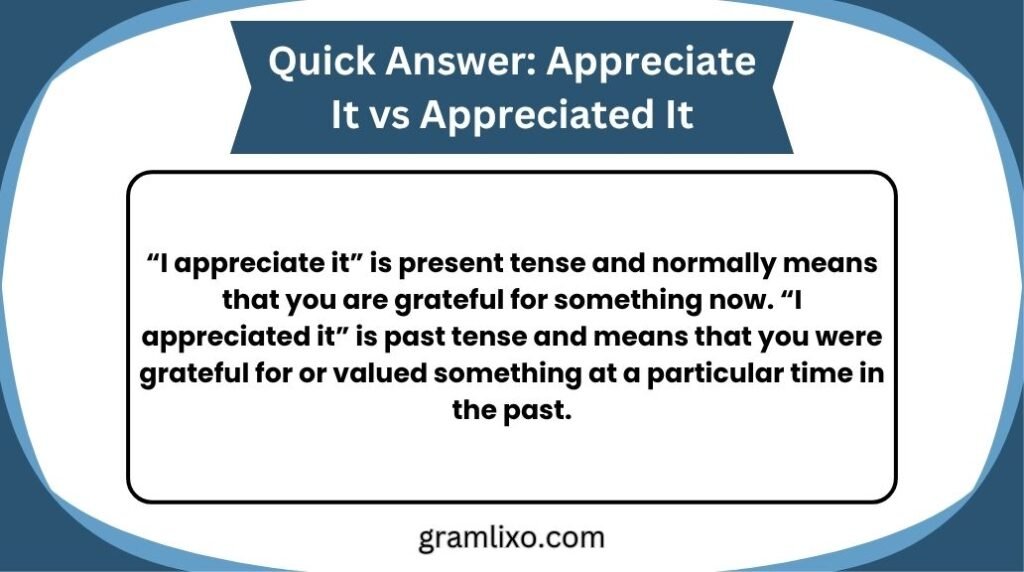
“I appreciate it” is present tense and normally means that you are grateful for something now. “I appreciated it” is past tense and means that you were grateful for or valued something at a particular time in the past.
- I appreciate it. → I am grateful for it now.
- I appreciated it. → I was grateful for it in the past.
For example:
“Thanks for helping me. I appreciate it.”
But:
“You helped me yesterday, and I appreciated it.”
Both are correct. The difference is when the appreciation is being expressed or experienced.
Understanding the Basics of Appreciate It vs Appreciated It
The easiest way to understand appreciate it vs appreciated it is to focus on verb tense.
The verb appreciate describes recognizing the value, usefulness, kindness, or importance of something. When you use appreciate, you are using the present tense.
The verb appreciated is the past-tense form of appreciate. It places the appreciation in the past.
Comparison Table
| Form | Type | Meaning | Example | Correct/Incorrect |
|---|---|---|---|---|
| I appreciate it | Present tense | I am grateful for it now | “Thanks for your help. I appreciate it.” | ✅ Correct |
| I appreciated it | Past tense | I was grateful for it in the past | “I appreciated it when you helped me yesterday.” | ✅ Correct |
| I appreciate it yesterday | Present + past time | Tense does not match | “I appreciate it yesterday.” | ❌ Incorrect |
| I appreciated it now | Past + present time | Tense usually does not match | “I appreciated it now.” | ❌ Usually incorrect |
| I really appreciate it | Present tense | Strong current gratitude | “I really appreciate it.” | ✅ Correct |
| I really appreciated it | Past tense | Strong past gratitude | “I really appreciated your help last week.” | ✅ Correct |
The important point is that neither expression is automatically wrong. The correct choice depends on the time and context.
What Does “I Appreciate It” Mean?
“I appreciate it” is a common expression of gratitude.
It tells another person that you recognize and value something they have done, offered, or said.
For example:
“Thanks for picking me up. I appreciate it.”
Here, the speaker is expressing gratitude now.
The phrase is especially common in American English because it is polite, natural, and flexible.
Examples of “I Appreciate It”
- “Thanks for covering my shift. I appreciate it.”
- “I appreciate it when you give me honest feedback.”
- “Thanks for sending the files. I appreciate it.”
- “I really appreciate it.”
- “I appreciate your patience.”
- “I appreciate everything you’ve done for me.”
Notice that the expression can work in casual and professional situations.
Sentence Breakdown
Consider:
“Thanks for helping me with the report. I appreciate it.”
- Thanks = expression of gratitude.
- for helping me = identifies the helpful action.
- I = subject.
- appreciate = present-tense verb.
- it = pronoun referring to the help.
Because the speaker is expressing gratitude at the current moment, appreciate is appropriate.
What Does “I Appreciated It” Mean?
“I appreciated it” uses the simple past tense.
It indicates that the speaker valued or was grateful for something at a past time.
For example:
“I appreciated it when you called me after the meeting.”
The phone call happened in the past, and the speaker is describing how they felt about it.
Examples of “I Appreciated It”
- “I appreciated your advice yesterday.”
- “I appreciated it when you stayed late.”
- “I really appreciated your help last week.”
- “I appreciated everything you did for the team.”
- “I appreciated the opportunity to speak with you.”
- “I appreciated your kindness during that difficult time.”
In these examples, the past tense is connected to a completed event or period.
Sentence Breakdown
Consider:
“I appreciated it when you helped me.”
- I = subject.
- appreciated = simple past verb.
- it = object pronoun.
- when you helped me = identifies the past event.
The use of appreciated tells us that the appreciation is being discussed as something associated with the past.
The Core Difference Between Appreciate It and Appreciated It
The central difference is tense.
Appreciate = Present
Use appreciate when your gratitude or recognition is current.
“I appreciate your help.”
Meaning:
“I am grateful for your help.”
Appreciated = Past
Use appreciated when you are talking about gratitude or recognition connected to a past situation.
“I appreciated your help yesterday.”
Meaning:
“I was grateful for your help yesterday.”
Simple Memory Trick 🧠
Think of it this way:
Appreciate = now
Appreciated = before
If the appreciation belongs to the present, choose appreciate.
If the appreciation belongs to a completed past situation, choose appreciated.
When Should You Use “I Appreciate It”?
There are several common situations where “I appreciate it” is the natural choice.
1. When Someone Helps You Right Now
Imagine your coworker helps you finish a report.
You might say:
“Thanks for helping me. I appreciate it.”
The help has just occurred, but your gratitude is being expressed now.
2. When Someone Offers You Something
Someone might offer to drive you home.
You can say:
“That would be great. I appreciate it.”
Your gratitude exists in the current situation.
3. When Someone Gives You Advice
For example:
“Thanks for the advice. I appreciate it.”
Again, you are expressing your current reaction.
4. In Professional Communication
The phrase works well in workplace emails.
For example:
“I appreciate it if you could send the updated document by Friday.”
However, in formal writing, it is often more natural to say:
“I would appreciate it if you could send the updated document by Friday.”
That version makes the request more polished and courteous.
When Should You Use “I Appreciated It”?
Use “I appreciated it” when describing a past situation.
1. When Referring to Yesterday
“I appreciated it when you checked on me yesterday.”
The word yesterday strongly supports the past tense.
2. When Discussing a Previous Event
“I really appreciated it when everyone came to my graduation.”
The graduation happened in the past.
3. When Looking Back on an Experience
“I appreciated the opportunity to work with such a talented team.”
This can describe a completed experience.
4. When Recalling Someone’s Kindness
“I appreciated it when you stood by me during that difficult period.”
The speaker is looking back on something that happened before.
Can “I Appreciate It” and “I Appreciated It” Both Be Correct?
Yes. Absolutely. ✅
This is one of the most important points about appreciate it vs appreciated it.
The two expressions are not competing versions where one is correct and the other is always wrong.
They communicate different time relationships.
Compare these sentences:
“Thank you for your help. I appreciate it.”
and:
“You helped me last year, and I appreciated it.”
Both are grammatically correct.
The first expresses present gratitude.
The second describes past gratitude.
Why Context Matters
Consider this sentence:
“I appreciate what you did for me.”
This can mean:
“I am grateful for what you did.”
Now compare:
“I appreciated what you did for me.”
This can mean:
“I was grateful for what you did.”
The difference is subtle but meaningful.
Is “Appreciated It” Correct as a Standalone Reply?
This is where many English learners become confused.
Suppose someone says:
“I sent you the document.”
You could reply:
“Appreciate it!”
This is an informal shortened form of:
“I appreciate it!”
But saying:
“Appreciated it!”
is much less common as a normal response.
Why?
Because “Appreciated it!” sounds like a reference to an action that has already been evaluated from a past perspective. In everyday conversation, native speakers generally use “Appreciate it!” when immediately thanking someone.
For example:
Person A: “I sent the files.”
Person B: “Appreciate it!”
That sounds natural and casual.
But:
Person B: “Appreciated it!”
may sound unusual or incomplete without additional context.
This does not mean “appreciated it” is grammatically wrong. It simply means that the phrase has different conversational uses.
“Appreciate It” Without “I”
You may also see:
“Appreciate it!”
This is extremely common in casual American English.
Technically, the complete sentence is:
“I appreciate it!”
The subject I is omitted in the informal version.
Similar examples include:
- “Appreciate the help!”
- “Really appreciate it!”
- “Appreciate you!”
- “Appreciate your time!”
These expressions are common in texts, chats, workplace messages, and casual conversations.
In highly formal writing, however, complete sentences are usually preferable.
“I Appreciate It” vs “I Appreciate That”
Both can be correct, but they are used somewhat differently.
I Appreciate It
“Thanks for helping me. I appreciate it.”
Here, it refers to the help.
I Appreciate That
“I appreciate that you took the time to explain everything.”
Here, that introduces a clause explaining what the speaker appreciates.
Both forms are useful.
Compare:
“I appreciate it.”
and:
“I appreciate that you came.”
The second sentence gives more specific information about the action being appreciated.
“I Appreciated It” vs “I Really Appreciated It”
Adding really strengthens the statement.
Compare:
“I appreciated it.”
with:
“I really appreciated it.”
The second sentence expresses stronger gratitude.
Examples:
- “I really appreciated your support.”
- “I really appreciated it when you stayed late.”
- “I really appreciated your honesty.”
- “I really appreciated the opportunity.”
This form is particularly natural when reflecting on a meaningful past event.
Grammar Rules Behind Appreciate and Appreciated
The verb appreciate follows a regular tense pattern.
Present Tense
appreciate
Example:
“I appreciate your help.”
Simple Past
appreciated
Example:
“I appreciated your help.”
The -ed ending marks the simple past form because appreciate is a regular verb.
Standard dictionaries such as Merriam-Webster list appreciate as a verb and explain meanings related to recognizing the value or quality of something, understanding something, or being grateful for something.
The grammatical distinction therefore comes from the verb’s tense rather than from a difference in the basic meaning of gratitude.
Present vs Past
| Time | Verb | Example |
|---|---|---|
| Present | appreciate | “I appreciate your help.” |
| Past | appreciated | “I appreciated your help yesterday.” |
| Present | appreciate | “We appreciate your patience.” |
| Past | appreciated | “We appreciated your patience during the project.” |
The key is to match the verb with the time being discussed.
How Time Words Help You Choose
Time expressions can make the choice much easier.
Words That Often Support “Appreciate”
- now
- today
- currently
- always
- every time
- generally
Examples:
“I appreciate your help today.”
“I always appreciate your honesty.”
Words That Often Support “Appreciated”
- yesterday
- last week
- last year
- earlier
- before
- during the meeting
- at the time
- when I was younger
Examples:
“I appreciated your help yesterday.”
“I appreciated what you said during the meeting.”
Remember that these words do not mechanically determine the tense. Context still matters. They simply provide useful clues.
A Useful Test Tip 📝
When you are unsure between appreciate it vs appreciated it, ask yourself:
“Am I talking about my gratitude now, or am I looking back at gratitude in the past?”
If the answer is now, use:
I appreciate it.
If the answer is past, use:
I appreciated it.
Test Example
Sentence:
“Thank you for helping me today. I ___ it.”
The natural answer is:
appreciate
So:
“Thank you for helping me today. I appreciate it.”
Now:
“You helped me during my first week at the company, and I ___ it.”
The natural answer is:
appreciated
So:
“You helped me during my first week at the company, and I appreciated it.”
Case Study: Workplace Email
Imagine an employee receives help from a manager.
Situation 1: Current Gratitude
The manager sends the employee a useful document.
The employee replies:
“Thank you for sending this. I appreciate it.”
This is natural because the employee is expressing gratitude at the time of receiving the document.
Situation 2: Looking Back
Several weeks later, the employee discusses the manager’s help during a performance conversation.
The employee says:
“I really appreciated it when you helped me prepare for that presentation.”
This is also correct.
The employee is now looking back on a previous event.
The Lesson
The action may be similar, but the speaker’s perspective changes.
Immediate gratitude:
“I appreciate it.”
Reflection on a past event:
“I appreciated it.”
Usage in Everyday Conversation
In everyday speech, “I appreciate it” is much more common as an immediate thank-you.
Examples
“Can you give me a ride?”
“Sure.”
“Thanks. I appreciate it.”
Another example:
“I saved you a seat.”
“Thanks! I appreciate it.”
For past situations, you might say:
“I appreciated it when you helped me move last month.”
The distinction is easy once you pay attention to the timeline.
Usage in Professional Writing
Both forms are useful at work.
Present Gratitude
“Thank you for your quick response. I appreciate it.”
This is appropriate in an email or message.
Past Gratitude
“I appreciated your assistance during last week’s meeting.”
This describes a previous event.
A More Formal Request
When making a polite request, use:
“I would appreciate it if you could review the document.”
This is different from simply saying:
“I appreciate it.”
The phrase “I would appreciate it if…” is a conventional polite structure for requests.
For example:
“I would appreciate it if you could send the final version by Friday.”
This sounds professional and courteous.
Usage in Creative Writing
Creative writing gives you more freedom because the tense depends on the story.
Present Narrative
“I appreciate everything you have done for me.”
This works when the character is expressing current feelings.
Past Narrative
“She told him that she appreciated everything he had done.”
Here, the story is narrated in the past.
The writer may use appreciated because the entire scene is being presented as a past event.
Usage in Social Media and Texting
Informal digital communication often shortens expressions.
Common examples include:
- “Appreciate it!”
- “Really appreciate it!”
- “Appreciate you!”
- “Thanks, appreciate it!”
- “I appreciate you!”
These are common in texts, group chats, direct messages, and social media.
What About “Appreciated It”?
You may see:
“Appreciated it.”
But this is less common as an immediate casual thank-you.
A more natural expression is usually:
“Appreciate it.”
If you are describing a past experience, then:
“I appreciated it.”
is perfectly appropriate.
Common Mistakes With Appreciate It vs Appreciated It
Why do people confuse these forms?
Several factors contribute to the problem.
1. Fast Typing
When people type quickly, they may choose a familiar word without thinking about tense.
For example:
“Thanks, appreciated it!”
The writer may intend to say:
“Thanks, appreciate it!”
2. Autocorrect
Autocorrect can sometimes change a word or suggest a different form.
A quick message may therefore contain an unintended tense.
3. Lack of Grammar Knowledge
English learners may know that both appreciate and appreciated mean gratitude but may not yet understand how tense changes the context.
4. Informal Speech
People frequently shorten sentences when speaking.
For example:
“Appreciate it!”
This is an informal version of:
“I appreciate it!”
Because conversational English drops words, learners may become uncertain about the complete grammatical structure.
Similar Grammar Confusions
The confusion between appreciate it vs appreciated it is part of a larger pattern in English.
| Confusion | Correct Difference |
|---|---|
| it’s vs its | “It’s” = it is; “its” = possessive |
| your vs you’re | “Your” = possession; “you’re” = you are |
| their vs there vs they’re | Possession, place, and “they are” |
| then vs than | “Then” = time/order; “than” = comparison |
| to vs too vs two | Direction/infinitive, excessive/also, number |
| affect vs effect | Usually verb vs noun, depending on context |
| accept vs except | Receive/agree vs exclude |
| appreciate vs appreciated | Present vs past tense |
These pairs are easy to confuse because the words can look or sound familiar.
The best strategy is not to memorize isolated words. Instead, learn what grammatical job each form performs.
Why “I Appreciated It” Can Sometimes Sound Different
There is a subtle difference in conversational feeling between the two expressions.
“I Appreciate It”
This sounds immediate.
“Thanks for helping. I appreciate it.”
The speaker is actively expressing gratitude.
“I Appreciated It”
This sounds reflective.
“I appreciated it when you checked on me.”
The speaker is looking back on an event.
Because of this, using “appreciated it” as an immediate response can sound slightly unnatural even though the words themselves are grammatical.
Compare:
“Thanks for the ride. Appreciate it!”
Natural and casual. ✅
“Thanks for the ride. Appreciated it!”
Possible to understand, but unusual as a standard immediate response. ⚠️
Better:
“Thanks for the ride. I appreciated it.”
if you are specifically referring to a past event.
Why This Difference Matters
Grammar is not only about avoiding mistakes. It is also about making your meaning easy to understand.
Clarity in Communication
Choosing the correct tense tells your reader when your appreciation applies.
Compare:
“I appreciate your support.”
with:
“I appreciated your support.”
The first sounds like your gratitude is current.
The second suggests you are referring to a past period or event.
Professionalism
In workplace communication, small grammatical choices can affect how polished your writing sounds.
“Thank you for your help. I appreciate it.”
sounds clear and professional.
When discussing previous assistance:
“I really appreciated your support during the project.”
sounds natural and precise.
Accuracy in Digital Communication
Texts and emails are often short. Because there is less surrounding context, the exact verb form can carry more meaning.
A small tense change can help readers understand whether you are responding now or describing something that happened before.
A Simple Principle
Good grammar makes your intended meaning easier to see.
That is especially important in short digital messages.
Special Exceptions and Edge Cases
There is no major grammatical exception that makes “appreciate it” or “appreciated it” universally correct or incorrect.
However, there are a few special cases worth understanding.
“Appreciate It!” as an Elliptical Expression
In informal English:
“Appreciate it!”
is understood as:
“I appreciate it!”
The subject I is omitted because the meaning is obvious from context.
This is common in spoken English and casual writing.
“Much Appreciated”
You may also see:
“Much appreciated!”
This is another common expression of thanks.
For example:
“If you could send the report today, much appreciated.”
In professional communication, a complete sentence may be clearer:
“I would really appreciate it if you could send the report today.”
“Your Help Is Appreciated”
This is a passive construction.
“Your cooperation is appreciated.”
It does not mean exactly the same thing as:
“I appreciate your cooperation.”
Both express gratitude, but they use different grammatical structures.
Quick Recap Checklist
Use this checklist whenever you are unsure.
| Question | If Yes → Use |
|---|---|
| Am I expressing gratitude right now? | I appreciate it. |
| Did someone just help me? | I appreciate it. |
| Am I describing a past situation? | I appreciated it. |
| Am I looking back on someone’s help? | I appreciated it. |
| Am I making a polite request? | I would appreciate it if… |
| Am I writing a casual text? | Appreciate it! |
Practice Examples
1. Someone sends you a file right now:
“Thanks for sending that. I appreciate it.”
2. Someone helped you last week:
“I really appreciated your help last week.”
3. You are politely asking someone to review a document:
“I would appreciate it if you could review this document.”
Practice: Choose the Correct Form
Try these examples before checking the answers.
Example 1
“Thanks for staying late. I ______ it.”
Answer: appreciate
“Thanks for staying late. I appreciate it.”
The speaker is expressing gratitude now.
Example 2
“When I was having a difficult week, I really ______ your support.”
Answer: appreciated
“When I was having a difficult week, I really appreciated your support.”
The situation belongs to the past.
Example 3
“Thanks for picking me up. Really ______ it!”
Answer: appreciate
“Thanks for picking me up. Really appreciate it!”
This is an informal present-tense expression.
Example 4
“I ______ it when you called me after the interview.”
Answer: appreciated
“I appreciated it when you called me after the interview.”
The speaker is describing a past event.
FAQs About Appreciate It vs Appreciated It
1. Is “I appreciate it” grammatically correct?
Yes. “I appreciate it” is grammatically correct and commonly used to express current gratitude. For example, “Thanks for your help. I appreciate it.”
2. Is “I appreciated it” grammatically correct?
Yes. “I appreciated it” is also grammatically correct. It uses the simple past tense and normally refers to something the speaker valued or felt grateful for in the past.
3. Which is better: “appreciate it” or “appreciated it”?
Neither is always better. Use “appreciate it” for present or immediate gratitude and “appreciated it” when discussing past gratitude.
4. Can I say “Appreciate it!” instead of “I appreciate it!”?
Yes. “Appreciate it!” is a common informal shortening of “I appreciate it!” It is especially natural in conversations, texts, and casual workplace messages.
5. Is “Appreciated it!” correct?
It can be understood, but it is not usually the most natural immediate response to someone who has just helped you. In that situation, “Appreciate it!” or “I appreciate it!” is more natural. “I appreciated it” works well when you are describing a past situation.
6. Should I say “I appreciate it” in a professional email?
Yes. “I appreciate it” is polite and professional when expressing current gratitude. For a formal request, “I would appreciate it if…” is often more appropriate.
Conclusion
Understanding appreciate it vs appreciated it becomes much easier when you focus on tense and timing. “I appreciate it” uses the present tense and normally expresses gratitude that you feel or communicate now. “I appreciated it” uses the past tense and describes gratitude connected to something that happened before.
Neither form is automatically wrong. The context determines which one is appropriate. If someone has just helped you, you can naturally say, “Thanks, I appreciate it.” If you are talking about help you received yesterday, last week, or during an earlier experience, you can say, “I appreciated it.”
For quick decisions, remember this simple rule:
Appreciate = present. Appreciated = past.
And when you are thanking someone immediately, “Appreciate it!” is one of the most natural casual expressions in American English.
Once you connect the verb to the timeline, this confusing pair becomes simple: use “appreciate” for gratitude now and “appreciated” for gratitude in the past.

I’m Michael Williams, an English writer and grammar enthusiast at Gramlixo. I’m passionate about making grammar easier to learn and helping readers write with greater confidence.

[…] |Appreciate It vs Appreciated It: Meaning, Difference, and Correct Usage […]