Have you ever wondered about the difference between copy that vs roger that when you hear these phrases in radio conversations, movies, workplaces, or everyday texting? Both expressions are commonly used to acknowledge that a message has been received and understood, so it is easy to assume they mean exactly the same thing.
While their basic purpose is similar, they have different historical backgrounds and can create slightly different impressions depending on the situation. “Copy that” generally sounds modern, direct, and conversational, while “roger that” has a stronger connection to traditional radio, military, aviation, and command-style communication.
In this guide, I’ll explain copy that vs roger that in simple US English, including their meanings, differences, correct usage, grammar, tone, and real-life examples.
You’ll also learn which expression works best in casual conversations, professional communication, creative writing, texting, and radio-style dialogue.
|Disloyal vs Unloyal: Which Word Is Correct?
|Braggart vs Bragger: Meaning, Difference & Correct Usage
|Marquee vs Marquis: Meaning, Difference, and Correct Usage
Quick Answer: Copy That vs Roger That
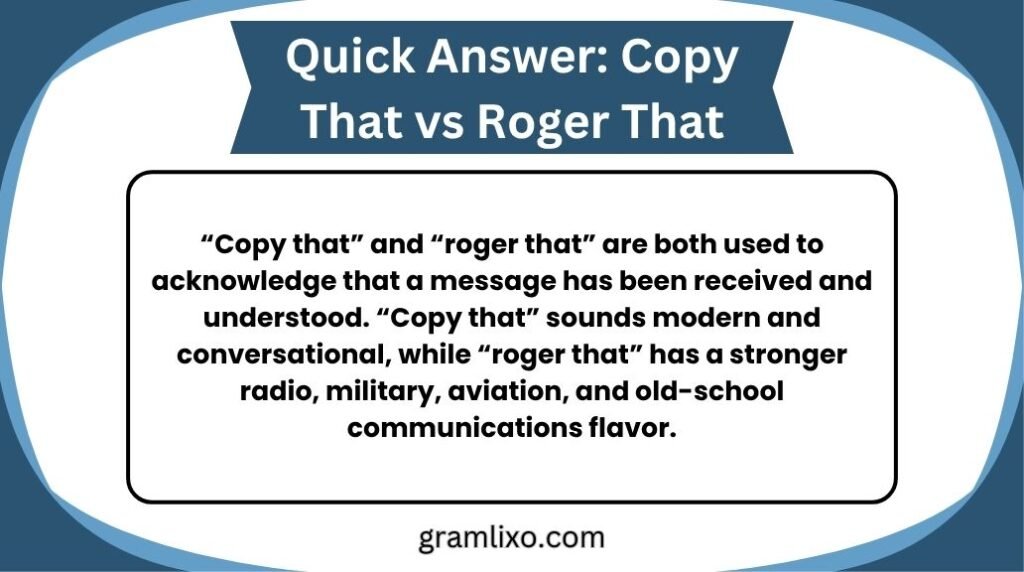
“Copy that” and “roger that” are both used to acknowledge that a message has been received and understood. “Copy that” sounds modern and conversational, while “roger that” has a stronger radio, military, aviation, and old-school communications flavor.
For example:
- “Please send the updated report by noon.” — “Copy that.”
- “Proceed to the next checkpoint.” — “Roger that.”
Neither phrase is inherently grammatically incorrect. The best choice depends mainly on context, tone, and the style of communication.
Understanding the Basics of Copy That vs Roger That
The easiest way to understand copy that vs roger that is to think of both phrases as acknowledgments.
When someone gives you information or an instruction, you may want to communicate:
“I received your message, and I understand what you said.”
That is the basic purpose of both expressions.
However, they do not have exactly the same feel.
“Copy that” emphasizes receiving or understanding the information. It is common in modern radio-style communication and has also entered everyday informal English.
“Roger that” also communicates acknowledgment, but it has a distinctive radio-communication history. It often sounds more formal, disciplined, military, aviation-oriented, or intentionally playful.
Copy That vs Roger That Comparison Table
| Form | Type | Meaning | Example | Correct/Incorrect |
|---|---|---|---|---|
| Copy that | Informal acknowledgment phrase | I received and understand your message | “Meet me at the front entrance.” “Copy that.” | ✅ Correct |
| Roger that | Radio-style acknowledgment phrase | I received and understand your message | “Proceed to the next location.” “Roger that.” | ✅ Correct |
| Copy | Short acknowledgment | Message received/understood | “The meeting moved to 3 p.m.” “Copy.” | ✅ Correct in informal communication |
| Roger | Short radio-style acknowledgment | Message received/understood | “Roger.” | ✅ Correct in appropriate contexts |
| I copy that | Less natural in ordinary modern English | Intended as an acknowledgment | “I copy that.” | ⚠️ Understandable, but less idiomatic |
| I roger that | Nonstandard construction | Attempts to use “roger” as a normal verb | “I roger that.” | ❌ Avoid |
The important point is that copy and roger are not ordinary interchangeable verbs in standard English.
They are part of specialized communication language.
What Does “Copy That” Mean?
Meaning of Copy That
“Copy that” means “I received your message and understand it.”
It is especially associated with radio communication, where people need short, clear acknowledgments.
For example:
“The delivery truck should arrive at Gate 4.”
A response could be:
“Copy that.”
The speaker is essentially saying:
“I received that information and understand it.”
Why Is It Called “Copy”?
The word copy has a long association with receiving or recording transmitted information.
In communication settings, “copy” can indicate that the listener successfully received the message. The phrase is especially useful when communication needs to be brief.
You may hear it in:
- police-style radio conversations
- emergency communication
- trucking
- security work
- military-inspired dialogue
- construction sites
- aviation-related conversations
- movies and television
- casual texting
However, “copy that” is not limited to literal radio communication anymore.
Examples of Copy That
Example 1: Workplace
“Please upload the final document before 5 p.m.”
“Copy that.”
Meaning: “I understand.”
Example 2: Texting
“I’ll pick you up at 7.”
“Copy that.”
Meaning: “Got it.”
Example 3: Team communication
“Take the left entrance and wait there.”
“Copy that.”
Meaning: “I received and understood your instruction.”
Tone of Copy That
“Copy that” usually sounds:
- casual
- direct
- concise
- practical
- modern
- radio-inspired
It can sound perfectly natural in informal conversations, but it may feel slightly unusual in highly formal writing.
For example, in a formal business email, this is usually better:
“Understood. I’ll take care of it.”
rather than:
“Copy that.”
What Does “Roger That” Mean?
Meaning of Roger That
“Roger that” means “I received and understood your message.”
The expression comes from older radio communication practices. Historically, “Roger” represented the letter R, which was used to indicate that a transmission had been received.
Over time, “roger” developed into a familiar radio acknowledgment meaning that a message had been received.
Today, people commonly recognize “roger that” as a phrase meaning:
“Understood.”
or:
“Message received.”
The FCC recognizes “roger” among commonly used radio operating words and phrases that do not constitute secret or hidden codes in its personal radio-service rules.
Examples of Roger That
Example 1: Radio-style communication
“Move to the second checkpoint.”
“Roger that.”
Meaning: “Understood.”
Example 2: Casual conversation
“Don’t forget to bring your ID.”
“Roger that.”
Meaning: “Got it.”
Example 3: Playful texting
“You better be ready by 8.”
“Roger that! 😂”
Here, the phrase is deliberately used to create a radio or military-style tone.
Tone of Roger That
“Roger that” can sound:
- military-style
- aviation-related
- radio-oriented
- authoritative
- old-fashioned
- playful
- humorous
Its tone depends heavily on context.
If a friend texts:
“Pizza is on the way.”
and you respond:
“Roger that.”
you are probably being playful rather than communicating through a radio.
Copy That vs Roger That: The Main Difference
The two phrases overlap heavily in meaning.
The biggest difference is tone and communication style, rather than basic meaning.
Copy That
“Copy that” tends to emphasize:
“I received and understood the information.”
It feels more modern and straightforward.
Roger That
“Roger that” tends to communicate:
“Message received and understood.”
It carries a stronger association with radio communication, military language, aviation, and command-style conversations.
A Simple Way to Remember
Think of it this way:
Copy = I received it. 📻
Roger = I received it and acknowledge it. 📡
In many everyday situations, either phrase can work.
Are Copy That and Roger That Exactly the Same?
Not completely, but they are close enough that they are often interchangeable.
Suppose someone says:
“Meet me at the north entrance.”
You could answer:
“Copy that.”
or:
“Roger that.”
Both responses tell the speaker that you received and understood the message.
The difference is primarily the style and tone.
“Copy that” sounds more natural in many modern informal situations.
“Roger that” sounds more deliberately radio-like.
This is why someone might choose “roger that” in a joking conversation even when “copy that” would communicate the same basic idea.
Correct Meanings and Uses
When to Use “Copy That”
Use “copy that” when you want to acknowledge information or an instruction quickly.
For example:
“The meeting has been moved to Room 204.”
“Copy that.”
The response means:
“I understand the information.”
You can use it when:
- receiving instructions
- acknowledging information
- responding on a radio
- texting casually
- communicating with a team
- using a deliberately concise style
When to Use “Roger That”
Use “roger that” when you want a similar acknowledgment but with a stronger radio-style tone.
For example:
“Wait here until the supervisor arrives.”
“Roger that.”
This is especially natural in:
- radio communication
- military-themed dialogue
- aviation-themed dialogue
- emergency-style conversations
- trucking communication
- fictional action scenes
- humorous conversations
When Neither Is the Best Choice
There are situations where neither expression is ideal.
For example, imagine your manager sends you a formal email:
“Please review the attached contract and provide your comments by Friday.”
A response such as:
“Roger that.”
may sound too casual or theatrical.
A more professional response would be:
“Understood. I’ll review the contract and send my comments by Friday.”
This is an important distinction: being grammatically acceptable does not automatically make an expression appropriate for every situation.
Test Tip: How to Choose Between Them
Try this simple test:
Ask yourself: “Am I acknowledging a message?”
If yes, either “copy that” or “roger that” may work.
Then ask: “Do I want a modern, casual acknowledgment?”
If yes, choose:
Copy that.
Ask: “Do I want a radio, military, aviation, or playful tone?”
If yes, choose:
Roger that.
Ask: “Am I writing a formal business document?”
If yes, choose something clearer, such as:
“Understood.”
or:
“I received your message.”
This three-step test makes the choice much easier. ✅
Copy That vs Roger That in Real-Life Communication
The difference becomes easier to understand when we look at actual situations.
Workplace Example
Imagine a project manager tells an employee:
“Please update the spreadsheet before the client meeting.”
The employee could say:
“Copy that.”
This is acceptable in casual spoken workplace communication.
However, if the conversation is highly formal, this may be better:
“Understood. I’ll update it before the meeting.”
“Roger that” would also be understandable, but it may sound more playful or radio-like:
“Roger that.”
So the meaning works, but the tone changes.
Text Message Example
Imagine your friend says:
“I’ll meet you outside the restaurant at 8.”
You might reply:
“Copy that 👍”
This feels casual and efficient.
Or:
“Roger that 😂”
This adds a humorous radio-style personality.
Both work, but the second response has more character.
Radio Communication Example
Imagine a team member says:
“Move to the second location and wait for further instructions.”
A response could be:
“Roger that.”
This fits the communication style because the phrase is traditionally associated with radio acknowledgment.
“Copy that” can also work:
“Copy that.”
Again, the basic meaning is similar.
Grammar Rules: Is “Copy That” Grammatically Correct?
Yes, “copy that” is an established informal expression, especially in communication jargon.
However, it is not functioning like an ordinary sentence such as:
“I copied the document.”
In “copy that,” the phrase operates as a shortened acknowledgment.
The implied meaning is something like:
“I copy that message.”
But in normal communication, speakers generally use the fixed expression:
“Copy that.”
rather than expanding it into an ordinary sentence.
This is an example of how language used in specialized communication can develop its own conventional forms.
Grammar Rules: Is “Roger That” Grammatically Correct?
Yes, “roger that” is a conventional communication phrase.
But “roger” should not normally be treated as a regular verb in standard modern English.
For example:
“Roger that.”
is a recognized expression.
But:
“I rogered the message.”
is not standard everyday English.
Likewise:
“I roger that.”
is not a natural standard-English construction.
The word roger has a specialized history in radio communication. It is therefore better understood as part of an established phrase rather than as a normal verb that can be freely conjugated.
The FCC’s rules also identify “roger” as a commonly used radio operating word or phrase in the context of personal radio services.
Why “Copy That” and “Roger That” Sound Different
Language carries cultural associations.
When people hear:
“Copy that.”
they may imagine:
- a radio
- a police officer
- a security team
- a modern communications system
- a workplace team
When people hear:
“Roger that.”
they may imagine:
- an aircraft cockpit
- a military radio
- an action movie
- an old-fashioned radio operator
- a command center
These associations are not strict grammar rules. They are matters of usage and tone.
That is why both expressions can communicate the same basic idea while producing different impressions.
Common Mistakes With Copy That vs Roger That
People often make mistakes with these phrases because they hear them in movies, social media, or fast conversations rather than learning their meanings directly.
Here are some of the most common problems.
Mistake 1: Treating Them as Formal Business Language
A person may write:
“Roger that”
in every professional situation.
Although understandable, it may sound too casual or theatrical.
For a formal email, use:
“Understood.”
or:
“Thank you. I’ve received your instructions.”
Mistake 2: Thinking “Roger” Means a Person Named Roger
In ordinary English, Roger can certainly be a male given name.
But in:
“Roger that.”
the word is not referring to a person named Roger.
It is part of a communication expression.
Context determines the meaning.
Mistake 3: Writing “I Roger That”
This is a common misunderstanding.
Avoid:
“I roger that.”
Use:
“Roger that.”
instead.
Mistake 4: Assuming “Copy That” Means Making a Duplicate
The word copy normally has many meanings.
For example:
“Please copy this document.”
means to duplicate it.
But:
“Copy that.”
in communication jargon means:
“I received and understood that message.”
Context changes the meaning.
Mistake 5: Using Them When You Actually Disagree
An acknowledgment does not necessarily mean agreement.
If someone says:
“You need to cancel the appointment.”
and you respond:
“Copy that.”
you are generally saying you received and understood the instruction.
You are not necessarily saying:
“I agree with the decision.”
This distinction is important.
Similar Grammar and Usage Confusions
The confusion around copy that vs roger that is different from classic grammar pairs, but the same general problem occurs when words or expressions have similar meanings.
| Confusion | Correct Distinction |
|---|---|
| It’s vs. its | “It’s” = it is; “its” = possessive |
| Your vs. you’re | “Your” = possessive; “you’re” = you are |
| Their vs. there vs. they’re | Possession, location, and “they are” |
| Then vs. than | Time/sequence vs. comparison |
| Accept vs. except | Receive/agree vs. exclude |
| Copy that vs. roger that | Similar acknowledgment phrases with different stylistic associations |
These mistakes can happen because of:
- fast typing
- autocorrect
- unfamiliar expressions
- lack of knowledge
- confusing context
- copying language heard in movies
- assuming similar phrases are identical
Digital communication makes this even more common because people often type quickly and send messages without proofreading.
Usage in Different Contexts
Everyday Conversation
In everyday conversation, both expressions can work.
For example:
“Don’t forget your keys.”
“Copy that.”
This sounds casual.
You could also say:
“Roger that.”
This sounds more playful or radio-inspired.
In ordinary face-to-face conversation, however, many people would simply say:
“Got it.”
or:
“Okay.”
That is usually more natural.
Professional Writing
In professional writing, context matters.
For a casual workplace chat:
“Copy that. I’ll handle it.”
may be acceptable.
For a formal email:
“Understood. I’ll handle it.”
is usually better.
“Roger that” can be appropriate in a workplace if the team culture is informal or if the phrase is being used humorously.
But it should not replace clear professional language when precision matters.
Creative Writing
Creative writers can use both expressions to establish personality.
For example:
“Stay behind the vehicle until I give you the signal.”
“Roger that.”
This immediately creates a radio-style atmosphere.
A character who says:
“Copy that.”
may sound modern and practical.
A character who says:
“Roger that.”
may sound more military, disciplined, old-school, or intentionally humorous.
Writers can therefore use these phrases as tools for characterization.
Social Media and Texting
Both expressions are popular in informal digital communication.
Examples:
“I’ll send you the file tonight.”
“Copy that.”
Or:
“Be ready at 7.”
“Roger that 😂”
Texting gives people freedom to play with tone.
Because of that, “roger that” is sometimes used even when there is no radio or military context at all.
Why It Matters
Knowing the difference between copy that vs roger that matters because good communication is not only about grammar. It is also about clarity, tone, audience, and context.
An expression can be understandable but still sound unusual in a particular situation.
For example:
“Roger that.”
may be funny among friends.
But in a formal client email, it may seem too casual.
Similarly:
“Copy that.”
may be perfectly clear in a team chat but unnecessary in a formal report.
The goal is to choose language that communicates your meaning without creating confusion.
“Clear communication is not just about what you say; it is also about how your words fit the situation.”
That principle applies far beyond these two expressions.
Is “Copy That” More Modern Than “Roger That”?
Generally, “copy that” often feels more modern and neutral, while “roger that” has a stronger traditional radio flavor.
However, this does not mean that “roger that” is outdated or incorrect.
Both remain recognizable expressions.
The difference is primarily stylistic.
Compare:
“Copy that. I’ll send the file.”
with:
“Roger that. I’ll send the file.”
The first feels straightforward.
The second feels more like a radio acknowledgment.
Neither is automatically wrong.
Is “Roger That” More Formal Than “Copy That”?
Not necessarily.
This is an important distinction.
“Roger that” can sound authoritative, but that does not make it formal business English.
For example:
“Roger that, sir.”
may sound disciplined or official in a movie.
But it is still an informal communication expression compared with:
“Understood. I will follow those instructions.”
So do not confuse authoritative tone with formal writing style.
Can “Copy That” Mean Agreement?
Usually, “copy that” means acknowledgment rather than agreement.
Suppose someone says:
“The meeting starts at 9.”
You say:
“Copy that.”
You are acknowledging the information.
Now suppose someone says:
“We should cancel the project.”
If you say:
“Copy that.”
you may be indicating that you heard the statement, but you have not necessarily expressed agreement.
If you want to show agreement, say:
“I agree.”
or:
“That makes sense.”
This distinction can prevent misunderstandings.
Can “Roger That” Mean Agreement?
The same principle applies to “roger that.”
It primarily acknowledges a message.
For example:
“Please wait outside.”
“Roger that.”
The response means:
“Understood.”
It does not necessarily mean:
“I personally agree with this decision.”
The exact interpretation can depend on the conversation and tone.
Special Exception: “Copy” Has Other Meanings
One important edge case is that copy is a normal English word with many meanings.
For example:
“Make a copy of this receipt.”
Here, copy means a duplicate.
In:
“Copy that.”
the meaning is completely different because the phrase is being used as communication jargon.
So you should never interpret the word copy in isolation.
What About “Roger”?
Similarly, Roger can be a person’s name.
For example:
“Roger is waiting outside.”
That has nothing to do with radio communication.
But:
“Roger that.”
is a fixed acknowledgment phrase.
Context is essential.
Copy That vs Roger That in Movies and TV
You will often hear these expressions in movies involving:
- police departments
- military operations
- aircraft
- spacecraft
- emergency responders
- security teams
- tactical teams
- truck drivers
Writers use these phrases because they instantly communicate the idea of coordinated communication.
For example:
“Team One, move to the west entrance.”
“Roger that.”
The audience immediately understands that the speaker has received the instruction.
This is one reason these phrases have become familiar even to people who have never used a radio professionally.
Copy That vs Roger That: Which One Should You Use?
There is no single answer for every situation.
Choose “Copy that” when:
- you want a concise acknowledgment
- the situation is informal
- you are using radio-style language
- you are texting casually
- you want a modern communication feel
Choose “Roger that” when:
- you want a traditional radio tone
- you are writing military-style dialogue
- you are writing aviation-style dialogue
- you want a playful or humorous tone
- you want to sound deliberately radio-like
Choose “Understood” when:
- the situation is formal
- you are writing a business email
- clarity is more important than personality
- the audience may not understand radio jargon
Choose “Got it” when:
- you are speaking casually
- you want natural everyday English
- there is no need for specialized communication language
Quick Recap Checklist
Use this checklist whenever you are deciding between copy that vs roger that.
| Question | If Yes → Use |
|---|---|
| Do you want to acknowledge that you received a message? | Copy that / Roger that |
| Do you want a modern, casual communication style? | Copy that |
| Do you want a traditional radio or military-style tone? | Roger that |
| Are you writing a formal business email? | Understood |
| Are you texting a friend casually? | Copy that / Roger that / Got it |
| Are you writing radio-style dialogue? | Roger that or Copy that |
| Are you talking about duplicating a document? | Copy in its ordinary meaning |
Practice Example 1
“Please send me the final presentation tonight.”
Best casual response:
“Copy that.”
Practice Example 2
“Proceed to the next checkpoint.”
Best radio-style response:
“Roger that.”
Practice Example 3
“Please review the attached contract and respond by Friday.”
Best formal response:
“Understood. I’ll review it and respond by Friday.”
FAQs About Copy That vs Roger That
1. What is the difference between “copy that” and “roger that”?
Both expressions acknowledge that a message has been received and understood. “Copy that” generally sounds more modern and conversational, while “roger that” has stronger associations with traditional radio, military, and aviation communication.
2. Is “copy that” grammatically correct?
Yes. “Copy that” is an established informal communication expression. It is not normally used as a formal sentence in business writing, but it is acceptable in appropriate conversational or radio-style contexts.
3. Is “roger that” grammatically correct?
Yes. “Roger that” is a conventional radio-style acknowledgment. It should be treated as a fixed expression rather than as an ordinary sentence in which “roger” functions like a regular verb.
4. Does “roger that” mean “I agree”?
Not necessarily. “Roger that” primarily means that the speaker received and understood the message. Agreement may be implied by context, but the phrase itself is mainly an acknowledgment.
5. Can I use “copy that” in a professional email?
You can use it in an informal workplace environment, especially in internal chats. However, “Understood,” “Got it,” or “I’ll take care of it” is usually more natural and professional in a formal email.
6. Which is better: “copy that” or “roger that”?
Neither is universally better. Use “copy that” for a more modern and casual acknowledgment, and “roger that” when you want a traditional radio-style or playful tone. For formal communication, use “understood” instead.
Conclusion
The difference between copy that vs roger that is mostly about communication style rather than basic meaning. Both phrases can acknowledge that a message has been received and understood. “Copy that” generally feels more modern, direct, and conversational, while “roger that” carries a stronger radio, military, aviation, or playful tone. Neither expression is inherently grammatically wrong when used appropriately. The key is to consider your audience and situation.
In a casual conversation, either phrase can work. In a formal business email, however, “understood” is usually the clearer choice. Remember the simplest rule: use “copy that” for a straightforward acknowledgment, “roger that” for a radio-style acknowledgment, and “understood” when professionalism and clarity matter most. 📻✅
When in doubt, choose the phrase that makes your meaning clear—and let the context do the rest.

Hi, I’m Lisa Jones, a grammar enthusiast and writer at Gramlixo. I enjoy making English grammar simple, clear, and easy to apply in everyday writing.

[…] |Copy That vs Roger That: Meaning, Difference, and Correct Usage […]
[…] |Copy That vs Roger That: Meaning, Difference, and Correct Usage […]