When you are writing in English, choosing between any problem vs any problems can be surprisingly confusing. Both forms are grammatically possible, but they are used in different contexts and can create slightly different meanings.
If you are asking whether someone is experiencing one or more difficulties, “any problems” is usually the more natural choice in everyday American English. On the other hand, “any problem” can be appropriate when referring to an individual possible issue or a problem of any kind.
Understanding this small distinction can make your writing sound clearer, more natural, and more professional.
In this guide, we will explain any problem vs any problems with simple rules, practical examples, common mistakes, and easy tips so you can confidently choose the correct form in conversations, emails, workplace writing, and everyday communication.
|Reorder vs Re-Order: Which Spelling Is Correct?
|Alright vs All-Right: Which One Is Correct?
|Thus Far vs So Far: What’s the Difference?
Quick Answer: Any Problem vs Any Problems
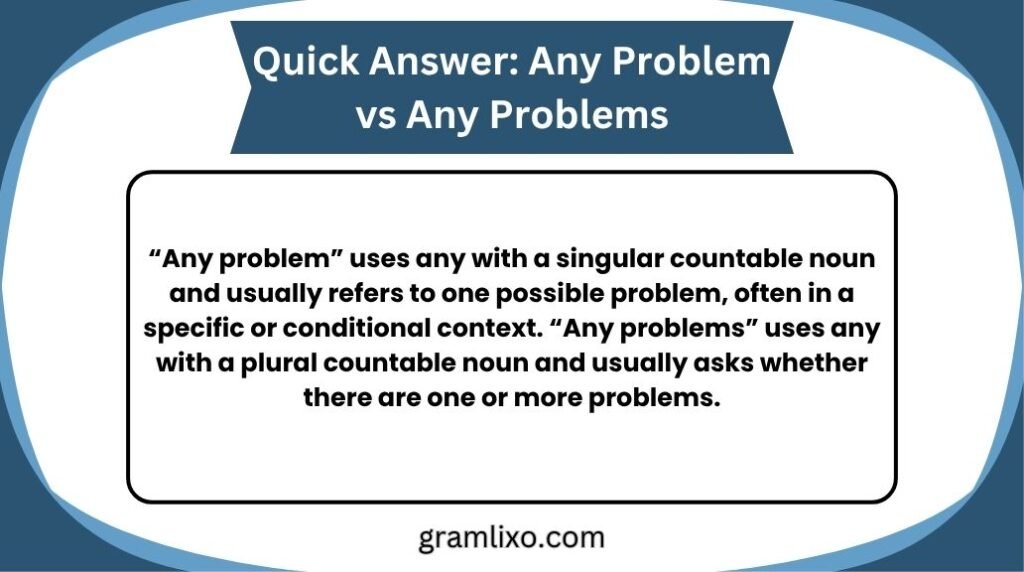
“Any problem” uses any with a singular countable noun and usually refers to one possible problem, often in a specific or conditional context. “Any problems” uses any with a plural countable noun and usually asks whether there are one or more problems.
In everyday American English:
- Do you have any problems? ✅ Natural when asking about possible difficulties.
- Is there any problem? ✅ Possible when referring to a particular issue or obstacle.
- Do you have any problem? ⚠️ Grammatically possible in some contexts, but often less natural in ordinary conversation.
The best choice depends on what you mean.
Understanding the Basics of Any Problem vs Any Problems
The word any is a determiner that can be used with singular countable nouns, plural countable nouns, and uncountable nouns.
That means English allows:
- any problem
- any problems
- any information
- any questions
- any reason
- any reasons
However, grammatical possibility does not always mean that every construction is equally natural.
Basic Difference
Any problem generally presents problem as a singular possibility.
Is there any problem with the plan?
Here, the speaker is asking whether there is a problem with the plan.
Any problems presents problems as multiple possible issues.
Are there any problems with the plan?
Here, the speaker is asking whether there are one or more problems.
Comparison Table
| Form | Type | Meaning | Example | Correct/Incorrect |
|---|---|---|---|---|
| any problem | Singular countable noun | One possible problem or issue | Is there any problem with this method? | ✅ Correct |
| any problems | Plural countable noun | One or more possible problems | Are there any problems with this method? | ✅ Correct |
| any problem | Singular after certain verbs | Any individual problem whatsoever | You can report any problem you notice. | ✅ Correct |
| any problems | Plural after certain verbs | Any number of problems | Report any problems you notice. | ✅ Correct |
| any problem | Singular in ordinary questions | Can sound unnatural in some contexts | Do you have any problem? | ⚠️ Usually less natural |
| any problems | Plural in ordinary questions | One or more difficulties | Do you have any problems? | ✅ Natural |
The important point is that both forms can be grammatically correct. The difference is not simply “one is correct and the other is wrong.”
What Does “Any Problem” Mean?
1. Any Problem Can Mean Any Individual Problem
When any modifies a singular countable noun, it can mean any one of a group or category.
For example:
You can report any problem you find.
This means that regardless of which individual problem you find, you can report it.
The sentence is not asking about several problems. Instead, it gives permission to report any individual problem.
Another example:
If you have any problem with the software, contact support.
This means:
If you have a problem of any kind with the software, contact support.
This structure is common in instructions.
2. “Any Problem” in Conditional Sentences
Any problem is especially natural in sentences beginning with if.
If you have any problem, let me know.
This means that if you experience any kind of problem, you should tell me.
However, American English speakers often use the plural version as well:
If you have any problems, let me know.
Both can work. The plural often sounds more conversational because the speaker is allowing for the possibility of multiple issues.
3. “Any Problem” With “Is There?”
One of the most useful structures is:
Is there any problem?
This asks whether a problem exists.
For example:
Is there any problem with the new schedule?
The speaker is focusing on whether the proposed schedule has an issue.
You can also say:
Are there any problems with the new schedule?
This version focuses more naturally on possible problems, plural.
Both can be correct, but the plural version may sound more natural when you are checking a situation for multiple possible issues.
What Does “Any Problems” Mean?
1. “Any Problems” Usually Means One or More Problems
The plural noun problems allows the speaker to ask about an unspecified number of difficulties.
For example:
Are you having any problems with your computer?
This does not mean the speaker expects several problems. It simply leaves the number open.
There could be:
- one problem,
- two problems,
- several problems,
- or no problems at all.
That is one reason plural nouns work so naturally with any in questions.
2. “Any Problems” in Everyday Conversation
You will frequently hear:
Do you have any problems?
Are you having any problems?
Did you have any problems?
Are there any problems?
These are all natural ways to ask about possible difficulties.
For example:
Are you having any problems with the new software?
This is more natural in many everyday situations than:
Are you having any problem with the new software?
The plural form sounds more open-ended.
3. “Any Problems” Can Include a Single Problem
This is important.
When someone asks:
Are there any problems?
They are not necessarily asking whether there are two or more problems.
The question can be answered:
Yes, there is one problem.
So any problems can refer to the possibility of one or more problems.
When Should You Use “Any Problem”?
Use any problem when you are referring to an individual possible problem, a problem of any kind, or a particular issue viewed as a singular possibility.
Example 1
If you notice any problem, tell your supervisor.
Here, any problem means any individual problem that you might notice.
Example 2
You can contact us if you experience any problem with your order.
The company is referring to any possible issue with the order.
Example 3
Is there any problem with my application?
The speaker is asking whether there is an issue with the application.
Example 4
I don’t anticipate any problem with the project.
Here, any problem means any possible problem.
This is a particularly useful pattern:
I don’t have any problem with that.
This can mean that the speaker has no objection.
For example:
I don’t have any problem with your decision.
This is grammatically correct.
However, in some contexts, I don’t have any problems with your decision may also be natural, depending on the intended meaning.
When Should You Use “Any Problems”?
Use any problems when asking whether someone has difficulties or whether a situation contains one or more issues.
Example 1
Do you have any problems with the new policy?
This is a natural conversational question.
Example 2
Are there any problems with the document?
The speaker is checking for possible errors or issues.
Example 3
Did you have any problems finding the office?
This is a common conversational pattern.
Example 4
Please let me know if you have any problems.
This is extremely common in professional and everyday English.
It means:
Tell me if you experience any difficulties.
“Any Problem” vs “Any Problems” in Questions
Questions are where learners most often notice this difference.
Compare:
Is there any problem?
and
Are there any problems?
The first uses singular problem.
The second uses plural problems.
Is There Any Problem?
This structure often treats the issue as a single possible obstacle.
Is there any problem with the payment?
It can sound like the speaker wants to know whether there is an issue with the payment process.
Are There Any Problems?
This structure asks whether one or more issues exist.
Are there any problems with the payment?
This is often the more natural choice when reviewing something for potential difficulties.
Do You Have Any Problem?
This sentence is grammatically possible in certain contexts, but it may sound unnatural in ordinary American conversation.
For example:
Do you have any problem with me sitting here?
This can sound confrontational or formal depending on context.
A more natural alternative might be:
Do you have a problem with me sitting here?
Or:
Do you have any problems with me sitting here?
The exact choice depends on the intended meaning.
“Any Problem” vs “Any Problems” After “If”
Both forms can work after if, but the meaning and style can differ.
Singular
If you have any problem, contact me.
This treats a problem as any individual possible issue.
Plural
If you have any problems, contact me.
This means if you experience one or more difficulties.
The plural version is extremely common in customer service, workplace communication, and everyday speech.
Which Sounds More Natural?
In many ordinary situations:
If you have any problems, let me know.
sounds more natural than:
If you have any problem, let me know.
However, singular any problem remains completely legitimate when the sentence emphasizes an individual problem or a problem of any kind.
“Any Problem” vs “Any Problems” With Negatives
The word any is particularly common in negative sentences.
Singular
I don’t see any problem with the proposal.
This often means:
I see no problem with the proposal.
It can also communicate agreement or lack of objection.
Plural
I don’t see any problems with the proposal.
This means:
I don’t see any issues with the proposal.
Both are natural.
The difference is subtle.
Any problem can focus on the existence of a problem as a concept or obstacle.
Any problems can focus on possible individual issues.
More Examples
We don’t expect any problem.
We don’t expect any problems.
Both may occur, although the plural form is often more natural when discussing possible difficulties.
A Simple Test Tip
When you are unsure whether to use any problem or any problems, ask yourself:
“Am I talking about one possible issue or checking for one or more issues?”
If you mean one possible issue, singular may work:
Is there any problem with this approach?
If you mean one or more possible difficulties, plural is usually the safer choice:
Are there any problems with this approach?
Easy Memory Trick 🧠
Think:
ANY + SINGULAR = any individual possibility
ANY + PLURAL = any number of possibilities
For example:
any problem = any individual problem
any problems = one or more problems
Case Study: Workplace Email
Imagine a manager sends this email:
Hi everyone,
Please review the updated schedule. If you have any problems with the new timing, let me know before Friday.
This sounds natural and professional.
Why?
The manager is inviting employees to report one or more difficulties.
Now imagine:
Please contact me if you notice any problem in the schedule.
This is also grammatically correct, but it places slightly more emphasis on an individual issue.
Another Example
Suppose an employee writes:
I don’t see any problem with the proposal.
The employee means there is no objection or difficulty.
Another employee might write:
I don’t see any problems with the proposal.
This sounds like the employee has examined the proposal and found no issues.
Both forms are useful.
Grammar Rules Behind “Any Problem” and “Any Problems”
The key grammatical fact is that any can modify both singular countable nouns and plural countable nouns.
Merriam-Webster’s treatment of any recognizes its use as a determiner with singular and plural nouns, with meaning changing according to context. In practical English, this means the choice depends on what the speaker intends to express.
Consider:
any problem
Here, problem is a singular countable noun.
Now consider:
any problems
Here, problems is a plural countable noun.
Neither construction is automatically wrong.
The grammar becomes more natural when you consider the sentence’s purpose.
Singular “Any”
Singular any often has the sense of:
any one of a group
For example:
Choose any book.
This means one book of your choice.
Similarly:
If you have any problem, contact us.
This can mean any individual problem you experience.
Plural “Any”
Plural any often refers to an unspecified number.
Do you have any books?
There may be zero, one, or many.
Similarly:
Do you have any problems?
There may be zero, one, or several.
Common Mistakes With Any Problem vs Any Problems
Many mistakes happen because learners assume that any must always be followed by a plural noun.
That is not true.
Mistake 1: Thinking “Any Problem” Is Always Wrong
❌ Incorrect assumption:
Any problem is wrong because “any” needs a plural noun.
That is false.
Examples such as these are perfectly acceptable:
If you have any problem, call us.
You may report any problem you find.
Is there any problem with the system?
Mistake 2: Thinking “Any Problems” Always Means Multiple Problems
The plural form does not necessarily mean that there must be several problems.
Are there any problems?
The answer could be:
Yes, there is one problem.
So plural problems can cover an unspecified number, including one.
Mistake 3: Translating Directly From Another Language
Learners may choose the noun form based on patterns in their first language.
English requires attention to the grammatical structure of the entire sentence.
Mistake 4: Fast Typing
In texting and online communication, people often type quickly and choose the first form that comes to mind.
Mistake 5: Autocorrect
Autocorrect can sometimes change wording or encourage a familiar phrase without considering the intended meaning.
Mistake 6: Lack of Context
Choosing between any problem and any problems without considering the sentence’s meaning can lead to awkward wording.
Similar Grammar Confusions
| Confusion | Correct Forms | Basic Difference |
|---|---|---|
| it’s / its | it’s / its | contraction vs. possessive |
| your / you’re | your / you’re | possessive vs. “you are” |
| there / their / they’re | all three | location vs. possession vs. contraction |
| advice / advise | both | noun vs. verb |
| affect / effect | both | usually verb vs. noun |
| fewer / less | both | countable vs. uncountable |
| much / many | both | uncountable vs. countable |
| problem / problems | both | singular vs. plural |
| any problem / any problems | both | depends on meaning and context |
The important lesson is that English grammar is often context-sensitive.
Any Problem vs Any Problems in Different Contexts
Everyday Conversation
In casual speech, plural problems is often more natural when asking about difficulties.
Are you having any problems?
Did you have any problems?
Let me know if you have any problems.
These phrases are common and natural.
Singular forms can also work:
Is there any problem?
If there’s any problem, call me.
The best choice depends on the sentence.
Professional Writing
Professional communication frequently uses both forms.
Example
Please contact the IT department if you experience any problems with the system.
This is natural and clear.
Another example:
Please report any problem that prevents you from completing the form.
Here, singular problem works because the sentence refers to any individual problem that could prevent completion.
Professional Tip
When writing instructions for a broad audience, any problems often sounds more conversational and user-friendly:
If you experience any problems, please contact support.
Creative Writing
Writers can choose either form to create a particular nuance.
She had no problem following the instructions.
This presents the task as a single general challenge.
She had no problems following the instructions.
This suggests that the task presented no difficulties.
Both are common.
Social Media and Texting
In informal messages, the plural form is very common:
Any problems?
Let me know if you have any problems.
Did you have any problems getting there?
However, texting is flexible, and speakers may use shorter forms based on context.
Why It Matters
Choosing between any problem and any problems may seem like a tiny grammar issue, but small wording choices can affect clarity.
1. Clarity
The correct form helps readers understand whether you are discussing an individual possible issue or possible difficulties generally.
2. Professionalism
Clear grammar makes workplace emails, instructions, reports, and customer messages sound more polished.
3. Digital Communication
Online writing moves quickly. A grammatically clear sentence reduces confusion, especially when instructions need to be followed correctly.
4. Natural English
Native-like English is not only about grammatical correctness. It is also about choosing the expression that sounds natural in the specific context.
“Good grammar makes meaning easier to follow.”
That is why understanding the difference is more useful than memorizing a single “correct” answer.
Special Exceptions and Edge Cases
There is no major brand-name exception that changes the standard grammar rule for any problem versus any problems.
However, certain fixed or idiomatic expressions can affect what sounds natural.
“No Problem”
The expression:
No problem.
is extremely common in American English.
It means:
That is not an issue.
You would not normally replace it with:
No problems.
although no problems can be appropriate when literally referring to multiple issues.
“Any Problem?” as a Short Question
In some situations, someone might simply ask:
Any problem?
This is a shortened conversational question.
For example, after an unusual event:
Any problem?
It may mean:
Was there any problem?
This is informal and context-dependent.
“Any Problems?”
Similarly:
Any problems?
is extremely natural as a short conversational question.
For example, a supervisor might ask an employee:
Any problems with the new software?
This means:
Are you experiencing any problems with the new software?
Quick Recap Checklist
Use this checklist whenever you are unsure.
| Question | If Yes → Use |
|---|---|
| Am I referring to one individual possible issue? | any problem |
| Am I asking about one or more difficulties? | any problems |
| Am I saying “any individual problem”? | any problem |
| Am I asking whether difficulties exist generally? | any problems |
| Am I writing “If you have…” and referring to possible difficulties? | Usually any problems |
| Am I using “any” to mean “any one of a group”? | any problem |
Practice Examples
1. ___ you have difficulty logging in, contact support.
Answer:
If you have any problem, contact support.
2. Are there ___ with the new software?
Answer:
Are there any problems with the new software?
3. You can report ___ you discover during testing.
Answer:
You can report any problem you discover during testing.
Notice how the context determines the best choice.
Frequently Asked Questions
Is “any problem” grammatically correct?
Yes. Any problem is grammatically correct when any modifies the singular countable noun problem. It can mean any individual problem or any problem of a particular type.
Is “any problems” grammatically correct?
Yes. Any problems is also grammatically correct. It commonly refers to one or more possible problems and is especially natural in questions and negative sentences.
Which is more natural: “any problem” or “any problems”?
It depends on the sentence. In everyday questions about difficulties, any problems is often more natural. For example, “Are you having any problems?” sounds very natural in American English.
Should I say “Do you have any problem?” or “Do you have any problems?”
In ordinary conversation, “Do you have any problems?” is usually the more natural choice when asking whether someone is experiencing difficulties. “Do you have any problem?” can work in specific contexts, but it may sound unusual or may imply a particular objection.
Is “If you have any problem, let me know” correct?
Yes. “If you have any problem, let me know” is grammatically correct. However, “If you have any problems, let me know” is often more natural in everyday American English because it covers one or more possible difficulties.
Can “any problems” refer to only one problem?
Yes. Any problems does not necessarily mean that several problems exist. In a question such as “Are there any problems?”, the answer could be “Yes, there is one problem.” The plural form allows for an unspecified number.
Conclusion
The difference between any problem vs any problems is mainly a matter of number, meaning, and context. Any problem uses the singular countable noun and often refers to any individual problem or any possible issue. Any problems uses the plural noun and commonly refers to one or more difficulties.
In everyday American English, any problems is often the more natural choice when asking whether someone is experiencing difficulties:
Are you having any problems?
But that does not make any problem incorrect. Expressions such as:
If you have any problem, let me know.
and
Is there any problem with the plan?
can be perfectly grammatical depending on the intended meaning and context.
The easiest rule to remember is simple: use any problem when you are thinking about an individual possible issue, and use any problems when you are asking broadly about possible difficulties. When in doubt, focus on the meaning rather than the word any alone.
Choose the form that matches your meaning, and your English will sound clearer, more natural, and more precise.

I’m Sarah Martinez, a writer and English language enthusiast at Gramlixo. I love explaining grammar concepts in a clear and practical way that anyone can understand.

[…] |Any Problem vs Any Problems: Which One Is Correct? […]