Have you ever written a sentence like “This is a full proof plan” and then stopped to wonder whether full proof vs. foolproof is the correct choice? You are not alone.
These expressions sound remarkably similar when spoken, so it is easy to confuse them in emails, school assignments, workplace documents, social media posts, and everyday conversations.
However, there is an important difference: foolproof is the standard English word when you mean something that is extremely reliable, easy to use, or designed to prevent mistakes. Merriam-Webster defines foolproof as something so simple, plain, or reliable that it leaves little or no opportunity for error, misuse, or failure.
The confusion usually comes from hearing “foolproof” and mentally replacing fool with full. But full proof and foolproof are not interchangeable. In most situations where you want to describe a reliable plan, method, system, recipe, or solution, foolproof is the word you need.
|Input vs Imput: Which Is Correct? Meaning, Usage, and Examples
|In the Street vs On the Street: Which Is Correct?
|At the House vs In the House: What’s the Difference?
Quick Answer: Full Proof vs. Foolproof
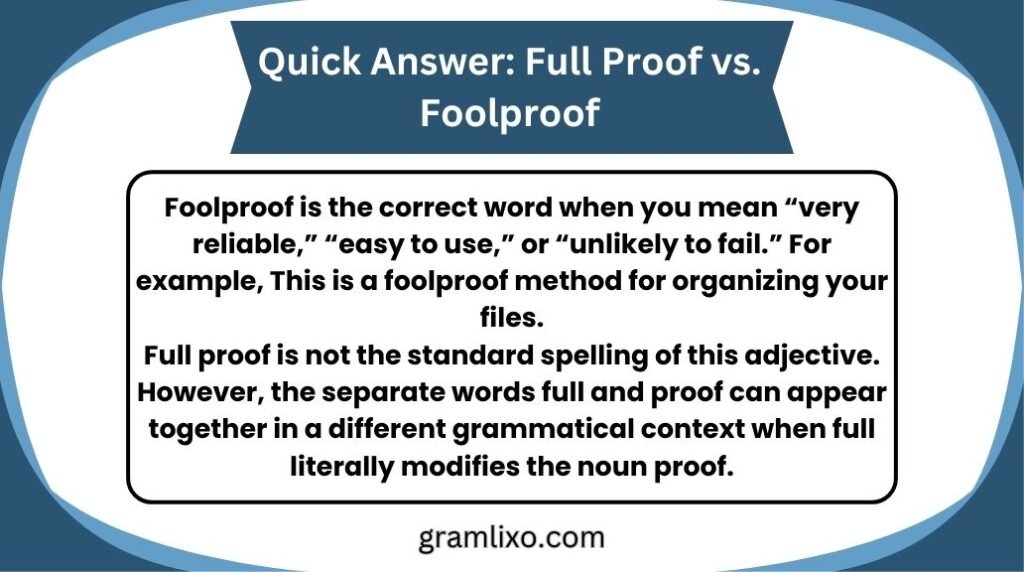
Foolproof is the correct word when you mean “very reliable,” “easy to use,” or “unlikely to fail.” For example, This is a foolproof method for organizing your files.
Full proof is not the standard spelling of this adjective. However, the separate words full and proof can appear together in a different grammatical context when full literally modifies the noun proof.
Quick rule:
👉 If you mean “almost impossible to get wrong,” use foolproof.
Understanding the Basics of Full Proof vs. Foolproof
The easiest way to understand full proof vs. foolproof is to look at their grammatical roles.
Foolproof is a single compound adjective. It describes something designed to prevent mistakes, misuse, or failure.
For example:
This is a foolproof way to remember new vocabulary.
Here, foolproof describes the method.
By contrast, full proof consists of two separate words. In a literal context, full can modify the noun proof. For example, someone might ask for “full proof” in the sense of complete evidence or complete proof. That is a different construction from the adjective foolproof.
Full Proof vs. Foolproof Comparison Table
| Form | Type | Meaning | Example | Correct/Incorrect |
|---|---|---|---|---|
| foolproof | Compound adjective | Very reliable; designed to prevent mistakes | This is a foolproof plan. | ✅ Correct |
| full proof | Two-word phrase | Complete or entire proof, in a literal context | The court required full proof of the claim. | ⚠️ Context-dependent |
| fullproof | Incorrect spelling for foolproof | Intended to mean highly reliable | This is a fullproof method. | ❌ Incorrect |
| fool proof | Incorrect spacing when used as the adjective | Intended to mean reliable | This is a fool proof system. | ❌ Incorrect |
The key distinction is that foolproof is a recognized adjective. Merriam-Webster, Oxford, Cambridge, and Collins all recognize foolproof as an English word.
What Does Foolproof Mean?
Foolproof means something is designed to be so simple, reliable, or dependable that it is unlikely to be used incorrectly or fail.
Merriam-Webster defines it as something “so simple, plain, or reliable” that there is little opportunity for error, misuse, or failure.
Cambridge gives a similar explanation, describing foolproof as something designed to be easily done or operated without the possibility of mistake or failure.
Simple Definition
You can think of foolproof as:
- Almost impossible to do incorrectly
- Very easy to understand
- Highly reliable
- Designed to prevent mistakes
- Unlikely to fail under normal circumstances
Examples
- This recipe is foolproof.
- She created a foolproof system for organizing invoices.
- We need a foolproof way to back up these files.
- The instructions are simple and foolproof.
- He developed a foolproof method for remembering passwords.
Sentence Breakdown
Consider:
The manager created a foolproof procedure.
- The manager = subject
- created = verb
- a foolproof procedure = object
- foolproof = adjective describing procedure
The word does not mean “full of proof.” It describes the reliability or usability of something.
Why Do People Write “Full Proof”?
The full proof vs. foolproof confusion is largely caused by pronunciation.
When people hear foolproof, the first part sounds like “fool.” Because full is a familiar English word and sounds similar to fool in some speech patterns, writers may incorrectly substitute full.
This creates forms such as:
❌ fullproof
❌ full proof method
❌ full-proof method
when the intended meaning is:
✅ foolproof method
Another Reason: Logical Guessing
English learners sometimes assume that full proof means “completely proven.”
That interpretation may sound logical:
full + proof = complete proof
But that is not what foolproof means.
The word is formed from fool + proof, not full + proof. Collins identifies its origin as American English from around 1900–1905, formed from fool plus -proof.
Foolproof as an Adjective
One of the most important grammar rules is that foolproof is an adjective.
It normally comes before a noun or after a linking verb.
Before a Noun
We need a foolproof system.
She found a foolproof method.
This recipe is foolproof.
After a Linking Verb
The process seems foolproof.
Her plan is foolproof.
The instructions are designed to be foolproof.
The word can describe:
- Plans
- Methods
- Systems
- Machines
- Recipes
- Instructions
- Procedures
- Strategies
- Designs
- Processes
- Solutions
Oxford gives examples involving recipes, systems, and methods and notes that something described as foolproof is designed so it cannot easily fail or be used incorrectly.
Is “Full Proof” Ever Correct?
This is where the distinction becomes more interesting.
Although fullproof is not the correct spelling of foolproof, the words full and proof can independently appear together when their literal meanings apply.
For example:
The investigator demanded full proof of the allegation.
Here, full is an adjective meaning complete, and proof is a noun meaning evidence or demonstration.
The phrase is therefore structurally different from foolproof.
Another possible construction is:
The scientist wanted full proof before publishing the conclusion.
However, in modern standard English, writers often choose more natural alternatives such as:
- complete proof
- conclusive proof
- sufficient proof
- convincing evidence
- definitive evidence
So if you are trying to say something is easy, reliable, and difficult to get wrong, do not use full proof.
Use foolproof.
Correct Meanings and Uses of Foolproof
Foolproof Method
A foolproof method is a method designed to make mistakes unlikely.
She developed a foolproof method for sorting customer records.
The method itself is not “proof.” Rather, foolproof describes how reliable the method is.
Foolproof Plan
A foolproof plan is a plan that seems extremely reliable.
We need a foolproof plan before launching the project.
This expression is especially common in workplace and everyday English.
Foolproof System
A foolproof system is designed to minimize user errors.
The company introduced a foolproof system for processing orders.
This can describe technology, workplace procedures, software workflows, or organizational systems.
Foolproof Recipe
A foolproof recipe is a recipe that is easy to follow and likely to produce good results.
This is a foolproof recipe for homemade bread.
Cambridge and Oxford both use recipe-related examples to illustrate the meaning of foolproof.
Foolproof Instructions
Foolproof instructions are instructions that are clear enough to minimize mistakes.
The manual provides foolproof instructions for assembling the device.
This usage is particularly useful when talking about products, training, education, and workplace procedures.
Test Tip: How to Know Whether to Use Foolproof
Here is an easy test.
Ask yourself:
Am I trying to say “very reliable,” “easy to follow,” or “unlikely to fail”?
If the answer is yes, use:
✅ foolproof
For example:
This is a ___ way to solve the problem.
If you mean “a very reliable way,” the answer is:
This is a foolproof way to solve the problem.
Memory Trick 🧠
Think:
FOOL + PROOF = protected against mistakes
You do not need to remember a complicated grammar rule.
Just remember:
Foolproof = difficult to get wrong.
Full Proof vs. Foolproof in Real-Life Communication
Imagine a manager sends this email:
“We need a full proof process for handling customer complaints.”
The reader may understand the intended meaning, but the phrase is incorrect if the manager means “a process that is almost impossible to mess up.”
A better version would be:
“We need a foolproof process for handling customer complaints.”
That small spelling difference makes the sentence more accurate and professional.
Workplace Example
Incorrect:
Let’s create a fullproof system for tracking orders.
Correct:
Let’s create a foolproof system for tracking orders.
Why?
The manager is not asking for “complete proof.” The manager wants a system that prevents errors.
Therefore, foolproof is the appropriate word.
Case Study: A Workplace Email
Consider a fictional workplace situation.
Maria works for a company that processes hundreds of customer orders every day. Employees occasionally enter incorrect product numbers into the system.
Her supervisor writes:
“We need a foolproof process that prevents employees from entering invalid product codes.”
This is correct because the process is intended to minimize human error.
Now imagine someone writes:
“We need a fullproof process.”
The intended meaning is understandable, but fullproof is not the standard adjective for this idea.
A Better Email
We should create a foolproof process for entering product codes. The system should automatically flag invalid numbers before an order is submitted.
This sounds clearer, more professional, and more precise.
Grammar Rules Behind Foolproof
The grammar is relatively simple.
Foolproof functions as an adjective.
It belongs to the same general pattern as compound words ending in -proof, such as:
- waterproof
- fireproof
- soundproof
- bulletproof
- childproof
- tamper-proof
- foolproof
The suffix -proof commonly contributes the idea of being protected against or resistant to something.
For example:
waterproof = resistant to water
fireproof = resistant to fire
foolproof = designed to resist mistakes, misuse, or failure
Merriam-Webster specifically defines foolproof in terms of preventing error, misuse, or failure.
Is “Fool-Proof” Correct?
You may occasionally see fool-proof with a hyphen.
However, foolproof is the standard dictionary form and the best choice for ordinary modern writing. Merriam-Webster lists it as one word.
So prefer:
✅ foolproof plan
rather than:
⚠️ fool-proof plan
And definitely avoid:
❌ fullproof plan
For polished professional, academic, and SEO writing, foolproof is the safest standard form.
Common Mistakes With Full Proof vs. Foolproof
Why does this mistake happen so often?
Several factors contribute to it.
1. Fast Typing ⌨️
When people type quickly, they often write what they hear rather than what they know.
Because fool and full sound similar, the wrong spelling can slip through.
2. Autocorrect
Autocorrect does not always understand the intended meaning of a sentence.
If you type an unusual phrase, your software may fail to identify the intended word.
3. Lack of Familiarity
People who rarely encounter the written word foolproof may reasonably assume it is spelled fullproof.
4. Pronunciation
The two forms are close enough in sound to create confusion.
5. False Logic
“Full proof” sounds as though it could mean “complete proof,” so writers sometimes create the phrase independently.
Similar Grammar Confusions
The full proof vs. foolproof problem belongs to a larger family of commonly confused English forms.
| Confusion | Correct Form | Meaning |
|---|---|---|
| it’s / its | Depends on context | It’s = it is; its = possessive |
| your / you’re | Depends on context | Your = possession; you’re = you are |
| their / they’re | Depends on context | Their = possession; they’re = they are |
| affect / effect | Depends on context | Usually verb vs. noun |
| then / than | Depends on context | Then = time; than = comparison |
| accept / except | Depends on context | Accept = receive; except = excluding |
| advice / advise | Depends on context | Noun vs. verb |
| lose / loose | Depends on context | Lose = misplace/fail to win; loose = not tight |
| foolproof / fullproof | foolproof | Reliable and difficult to misuse |
The lesson is simple: similar sounds do not necessarily mean similar spelling or meaning.
Foolproof in Everyday Conversation
In casual conversation, foolproof is extremely natural.
You might say:
“Do you have a foolproof way to remember names?”
Or:
“I need a foolproof recipe for dinner tonight.”
Or:
“Is there a foolproof way to fix this?”
These sentences sound normal because foolproof is widely used to describe reliable solutions.
Everyday Examples
- I need a foolproof way to wake up early.
- She has a foolproof recipe for chocolate cake.
- Is there a foolproof method for learning vocabulary?
- We need a foolproof plan for the trip.
- He thinks he has a foolproof strategy.
Foolproof in Professional Writing
Professional writing requires precision.
Using foolproof correctly can make a sentence concise and clear.
Examples
The team designed a foolproof onboarding process.
We need a foolproof backup strategy.
The new software provides a foolproof workflow for submitting reports.
Please create foolproof instructions for new employees.
However, be careful with the word in formal contexts. Calling something “foolproof” can sometimes sound informal or imply that users may be foolish.
In highly formal documents, alternatives such as these may be preferable:
- reliable
- robust
- error-resistant
- fail-safe
- dependable
- straightforward
- user-friendly
Foolproof in Creative Writing
Creative writers can use foolproof for humor, personality, or emphasis.
For example:
He claimed to have a foolproof plan, which was exactly what worried everyone.
This creates irony because the narrator suggests that the supposedly perfect plan may not actually be perfect.
Another example:
Her foolproof recipe had one tiny problem: nobody could find the missing ingredient.
Here, foolproof helps create a playful contrast.
Foolproof in Social Media and Texting
Social media often favors short, conversational language.
Examples include:
“My foolproof morning routine ☕”
“Here’s my foolproof study trick 📚”
“Need a foolproof dinner idea? Try this!”
The word works well in captions because it communicates reliability in a single word.
Still, if you are writing professionally, proofread carefully. Social media speed can increase spelling mistakes.
Foolproof Does Not Literally Mean Impossible
One subtle point matters here.
Calling something foolproof does not necessarily mean it can never fail under any imaginable circumstances.
Merriam-Webster’s definition uses language about leaving no opportunity for error, misuse, or failure, while Oxford and Cambridge similarly describe it as highly resistant to failure or misuse.
In real-world writing, people frequently modify foolproof with words such as:
- virtually
- almost
- nearly
- completely
- not entirely
For example:
The system is virtually foolproof.
This acknowledges that even highly reliable systems can have limitations.
In fact, dictionary examples commonly use expressions such as “virtually foolproof” and “not foolproof.”
Foolproof vs. Fail-Safe
These words are related, but they are not always identical.
Foolproof
Focuses on preventing mistakes, misuse, or failure.
We need a foolproof method for entering the data.
Fail-safe
Usually refers to a system designed to remain safe or minimize harm when something goes wrong.
The machine has a fail-safe mechanism.
So:
foolproof → difficult to use incorrectly
fail-safe → designed to remain safe when failure occurs
This distinction is especially useful in technical and professional writing.
Foolproof vs. Infallible
These words also overlap.
Foolproof often describes a method, plan, system, device, or procedure that is designed to prevent mistakes.
Infallible means incapable of being wrong or failing.
For example:
This is a foolproof method for organizing the files.
But:
No human system is completely infallible.
Oxford lists infallible as a synonym for foolproof, but the words can carry slightly different shades of meaning depending on context.
Foolproof vs. Reliable
Reliable is broader.
A reliable car works consistently.
A foolproof procedure is specifically designed to minimize mistakes or misuse.
Compare:
This is a reliable computer.
with:
This is a foolproof computer setup for beginners.
The second sentence emphasizes ease and resistance to user error.
Why the Difference Matters
Choosing foolproof instead of fullproof may seem like a tiny detail, but accurate word choice matters.
1. Clarity
Correct spelling prevents readers from wondering what you mean.
2. Professionalism
A spelling mistake in a proposal, report, resume, or business email can make your writing appear less polished.
3. Credibility
Accurate vocabulary shows that you understand the language you are using.
4. Digital Communication
Online content spreads quickly. A mistaken spelling can be copied, reposted, or repeated by others.
5. Search Accuracy
For online publishing, using the standard dictionary form helps align your content with the term readers actually search for.
As a general principle:
Precise words make precise communication.
Special Exception: When Full and Proof Appear Together
There is an important edge case.
The phrase full proof can exist when full and proof retain their independent meanings.
For example:
The lawyer requested full proof of the transaction.
Here, full means complete, while proof means evidence.
That is grammatically different from:
We need a foolproof process.
The first sentence contains two separate words. The second contains one compound adjective.
So you should not claim that the sequence full proof can never occur in English. The important point is that it is not the standard spelling of the adjective foolproof.
This distinction is especially useful for writers who want to avoid oversimplifying the rule.
Quick Recap Checklist
Use this checklist whenever you are unsure about full proof vs. foolproof.
| Question | If Yes → Use |
|---|---|
| Do you mean “very reliable”? | foolproof |
| Do you mean “difficult to use incorrectly”? | foolproof |
| Do you mean “designed to prevent mistakes”? | foolproof |
| Are you describing a plan, system, method, or recipe? | Usually foolproof |
| Do you literally mean complete proof or evidence? | full proof may work, depending on context |
| Are you spelling the adjective as “fullproof”? | ❌ Use foolproof instead |
Practice Examples
1. This is a ___ method for backing up your files.
✅ foolproof
2. We need a ___ process that new employees can follow easily.
✅ foolproof
3. The investigator requested ___ proof of the claim.
⚠️ full proof may be grammatically possible if full literally means complete, although complete proof or conclusive evidence may sound more natural.
FAQs About Full Proof vs. Foolproof
1. Is “full proof” or “foolproof” correct?
Foolproof is correct when you mean something reliable, easy to use, or difficult to get wrong. Full proof is not the correct spelling of this adjective. Merriam-Webster lists foolproof as the standard word.
2. Is “fullproof” a word?
No, fullproof is not the standard spelling of foolproof. If you mean “designed to prevent mistakes or failure,” write foolproof as one word.
3. What does foolproof mean?
Foolproof means so simple, reliable, or well designed that it is unlikely to be used incorrectly or fail. For example, This is a foolproof way to organize your files.
4. Is “fool-proof” correct?
Foolproof is the standard dictionary spelling. Although hyphenated forms may occasionally appear in writing, the one-word form is the preferred standard form.
5. Can “full proof” ever be grammatically correct?
Yes, in a literal context where full modifies the noun proof and means complete or entire. However, it should not be used as a replacement for the adjective foolproof.
6. What is an easy way to remember foolproof?
Remember:
Foolproof = difficult to mess up.
If you are describing a reliable plan, system, method, recipe, or procedure, foolproof is almost certainly the word you want.
Conclusion
The full proof vs. foolproof confusion is easy to understand once you separate the meanings. Foolproof is the standard English adjective for something that is highly reliable, easy to use, and designed to prevent mistakes, misuse, or failure. Merriam-Webster, Oxford, Cambridge, and Collins all recognize foolproof as the standard word.
Full proof, on the other hand, can appear as two separate words when full literally modifies proof, but it should not be used as the spelling of foolproof. And fullproof should be avoided when you mean “reliable” or “unlikely to fail.”
So, when in doubt, remember the simplest rule:
A reliable plan is foolproof—not fullproof. ✅
Once you remember that one distinction, you can confidently use foolproof in emails, essays, professional documents, conversations, and online writing.

I’m Sarah Martinez, a writer and English language enthusiast at Gramlixo. I love explaining grammar concepts in a clear and practical way that anyone can understand.


[…] |Full Proof vs Foolproof: Which Is Correct? […]